Central America · 8°59′N 79°31′W · Kitchen testing pending
Panama
Two oceans, an isthmus, and culantro in almost everything
The ten
Ranked by what people actually name first
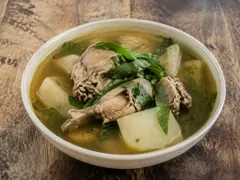 Sancocho de Gallina PanameñoStripped down where its neighbours pile on: one bird, one starch, one herb. The ñame baboso sloughs its mucilaginous outer layer into the broth and binds free water and chicken fat into a silky emulsion — and the culantro goes in twice, once for the background and once, off the heat, for the top notes.
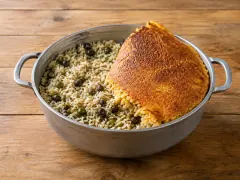 Arroz con Guandú y CocoNo holiday table in Panama functions without it. Coconut milk is an oil-in-water emulsion, and its melting triglycerides film each grain so nothing fuses — while at the bottom of the caldero the coconut sugars pyrolyse into el cocolón, the brittle golden crust everyone actually wants.
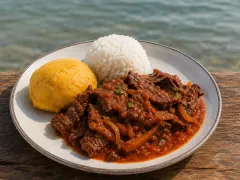
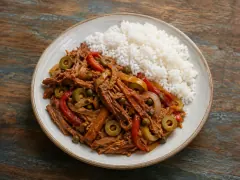 Ropa Vieja Panameña"Old clothes", for the tangle of shredded fibres that looks like torn rags. The cut is everything: flank has coarse fibres running one way, so it goes into the pot in long slabs and is pulled along the grain — and the capillary gaps between those shreds are what drink up the tomato-culantro sofrito.
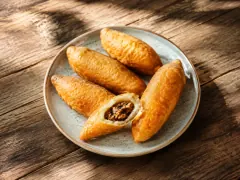 Carimañolas PanameñasTorpedoes of cassava dough with a spiced beef centre, fried before sunrise by every street vendor in the country. There is no flour and no egg in the dough — it holds together purely on gelatinised yuca starch, which means the mash has to happen while the root is still steaming hot.
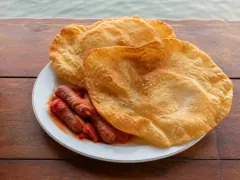 Hojaldras PanameñasBreakfast from Bocas del Toro to Darién. Double-acting baking powder gasses twice — once in the bowl, once in the oil — and thirty minutes of rest relaxes the gluten enough to pull each ball paper-thin by hand. A rolling pin knocks the gas out and gives you a cracker.
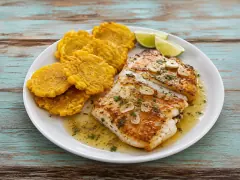 Corvina al AjilloTwo temperature windows decide this plate. Corvina past 62 °C shrinks and wrings out its own water, and garlic past 150 °C turns acrid — so the fish comes off at 57–60 °C and the chips leave the pan the instant they hit hazelnut gold, with cold butter swirled in off the heat.
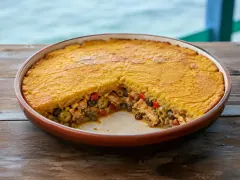 Tamal de Olla PanameñoEverything a banana-leaf tamal contains, built as a casserole instead. The corn dough is cooked on the stove first so the starch granules swell in hot broth between 70 and 80 °C, then the oven sets that gel into something sliceable around a chicken stew of raisins, olives and capers.
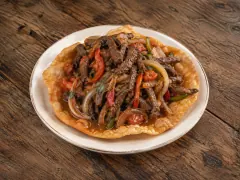 Bistec PicadoThe fonda breakfast rush in one pan. Thin strips cut across the grain hit a smoking skillet in two batches — crowd it and the beef greys in its own juices instead of browning — then return to the tomato-culantro gravy for strictly two minutes, spooned over a hojaldra so the juices soak straight in.
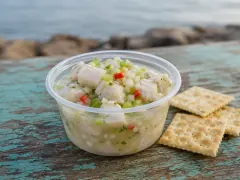 Ceviche Panameño de CorvinaNot the flash cure of Peru — Panama cures cold for four to eight hours, often overnight, until the cubes are firm and springy all the way through and the marinade has gone milky. The heat is ají chombo, apricot-scented and genuinely fierce, minced to specks.
 Tasajo Entomatado PanameñoBeef salted and smoke-dried over hardwood embers in the Azuero cattle country. The boil does two jobs at once — rehydrating shrunken muscle fibres and leaching out the salt by osmosis — while the phenols stay bound to the fat, so the smoke survives into the tomato gravy.
Panama is a land bridge, and its food reads like one. The Afro-Antillean communities of Colón and Panama City brought coconut milk, which is why the Sunday rice is pressed from grated coconut rather than boiled in water. The Spanish and Canary Islands brought ropa vieja and the olive-and-caper habit that turns up in the Christmas casserole. The cattle country of Azuero smoke-dries its beef into tasajo. And two oceans supply the corvina that shows up twice on this list, once seared in garlic butter and once cured raw in lime.
The herb that holds it together is culantro — Eryngium foetidum, not the lacy cilantro it is usually confused with. It has leathery serrated leaves and roughly ten times the essential oils, and crucially it survives an hour in a pot where cilantro turns muddy in five minutes. Seven of these ten dishes use it. In sancocho it goes in twice on purpose: six bruised leaves early for the savoury background, six chopped in off the heat so the volatile 2-dodecenal is still there when the bowl reaches the table.
Three dishes are built on starch behaving in a particular way. Sancocho gets its silky body from ñame baboso, whose mucilaginous glycoproteins slough into the broth and bind the water and chicken fat into an emulsion — which is also why the pot must never boil hard. Carimañolas hold together on gelatinised cassava starch alone, no flour and no egg, which means the yuca has to be mashed while still steaming or the starches crystallise into unworkable grit. And the cocolón at the bottom of the coconut rice is pure pyrolysis: once the water is gone the pot floor passes 140 °C and the coconut sugars fuse into a brittle golden sheet.
The breakfast table deserves its own note. Hojaldras are stretched paper-thin by hand — never rolled, which knocks the gas out — and dropped into 185 °C oil, where the water inside flashes to steam and inflates them in under a minute. They arrive under bistec picado or salchichas guisadas, and the pan juices soak straight through. It is the best argument this country makes, and it is made before eight in the morning.