Carimañolas Panameñas
Torpedoes of cassava dough with a spiced beef centre, fried before sunrise by every street vendor in the country. There is no flour and no egg in the dough — it holds together purely on gelatinised yuca starch, which means the mash has to happen while the root is still steaming hot.
- Prep
- 40 min
- Cook
- 20 min
- Serves
- 12 large carimañolas, about 10 cm long
- Difficulty
- Medium
Researched · Kitchen testing pending
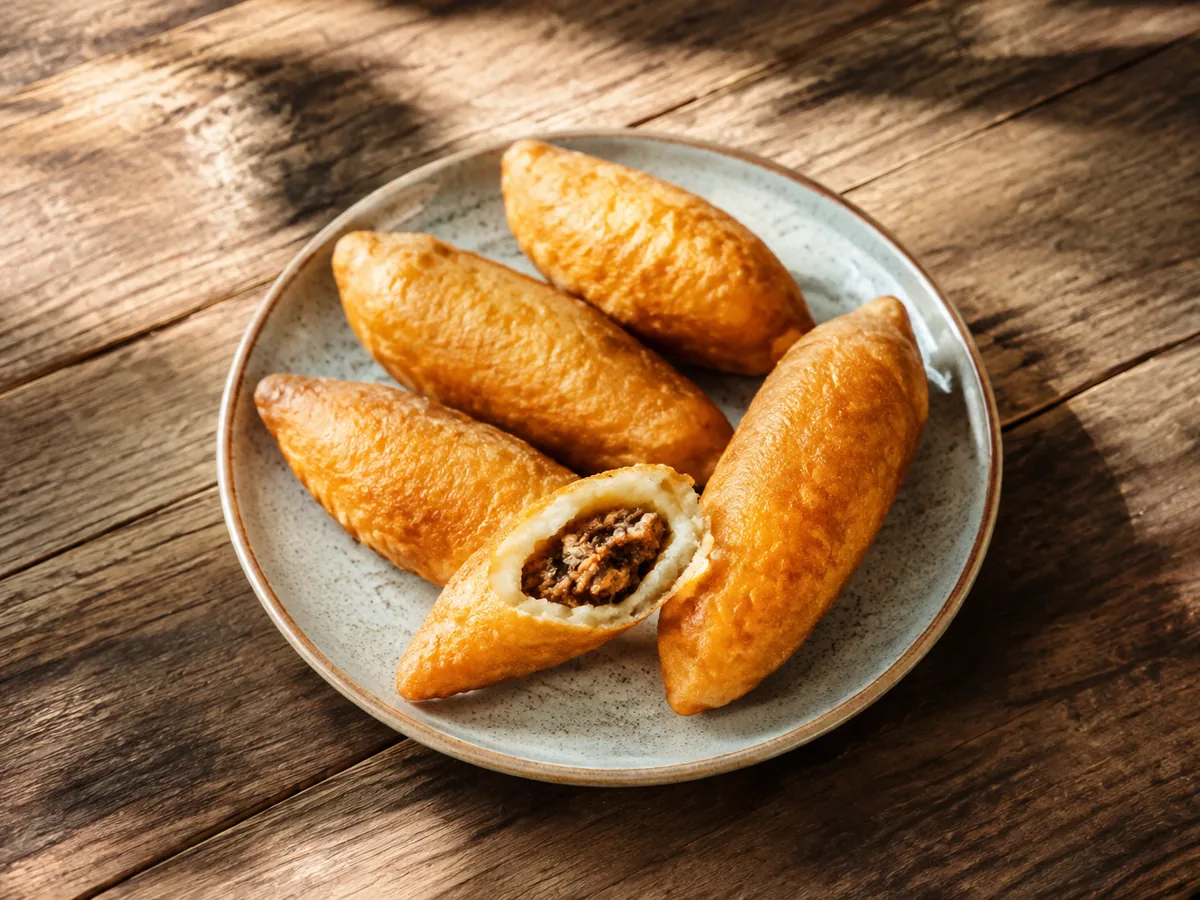
Crisp outside, soft within. Street vendors across Panama fry carimañolas fresh before sunrise.
Shaped into tapered torpedo cylinders, these golden croquettes are made entirely from boiled yuca — mashed hot into a smooth elastic dough with no flour and no egg anywhere in it. Inside sits a pocket of picadillo: ground beef browned with onion, garlic, ají dulce, culantro and tomato.
Dropped into hot oil, the outside crisps into a delicate blistered shell that gives way to a soft steaming yuca interior and a spiced meat centre.
The yuca dough
- 1.2 kg2.6 lbFresh yuca root, peeled, woody central core removed, cut into 5 cm chunks
- 15 g1 TbspFine sea salt, for the boiling water
- 30 g2 TbspUnsalted butter, softened
The picadillo
- 500 g1.1 lbLean ground beef chuck (85/15)
- 30 ml2 TbspAchiote oil, or vegetable oil
- 1 medium1 mediumYellow onion, peeled and cut into fine 3 mm brunoise
- 4 cloves4 clovesFresh garlic, minced fine
- 4 pieces4 piecesAjí trompito or ají dulce, seeded and minced fine
- 2 large2 largeRipe plum tomatoes, peeled, seeded and chopped fine
- 15 g1 TbspTomato paste
- 4 leaves4 leavesFresh culantro, chopped fine
- 4 g1 tspCumin seeds, toasted and ground
- 2 g½ tspDried wild oregano, crushed
- 8 g1.5 tspFine sea salt
- 2 g½ tspFreshly ground black pepper
To fry
- 1 L4.2 cupsHigh-smoke-point corn or peanut oil
Mash it steaming hot
Heat keeps the pectin cell walls soft so the gelatinised starches knit into a smooth pliable paste. Left to cool first, the starches crystallise and you get grainy lumps that will not hold a shape and crack in the oil.
No flour, no egg
Yuca is pure amylose and amylopectin with no gluten at all. Boiling hydrates and gelatinises the granules, and three minutes of kneading with butter is the entire binding mechanism.
The filling must be dry
Wet meat inside the dough turns to steam pockets that rupture the shell in hot oil. Reduce the picadillo until it is moist but has no free liquid at all, then cool it completely.
180 °C, not below
At temperature, surface moisture flashes to steam and fries the outer starch into a rigid shell that keeps oil out. Below 175 °C the yuca simply drinks the oil and goes heavy.
Seal and smooth every seam
Cracking comes from trapped air and thin seams. Pinch tightly and roll smooth between oiled palms before anything goes near the pan.
Passive time, counted separately
The dough cools to warm room temperature, the filling cools completely, and the fried carimañolas rest 3 minutes. None of that is active work.
The five tastes on this plate
Salt is in the boiled yuca dough and the seasoned picadillo. Fat is butter in the dough and the frying oil building the blistered crust. Acid is ripe plum tomato and tomato paste against the starch. Heat is garlic, black pepper, toasted cumin and culantro. Umami is browned beef, tomato paste and deep-fried root starch.
Equipment
- 4 qt pot
- Potato ricer or hand masher
- Skillet, for the picadillo
- 5 qt heavy Dutch oven with a deep-fry thermometer
- Slotted spoon and tongs
- Parchment-lined tray
Traditionally a heavy cast-iron caldero of lard or oil over a high flame. A 5-quart Dutch oven with a deep-fry thermometer works in a modern kitchen — holding 180 °C is the whole game, since the difference between a crisp shell and an oil-logged one is about ten degrees.
Method
Boil and mash the yuca30 min
Cover the yuca chunks with cold water, add 1 Tbsp salt, and boil 20 to 25 minutes until fork-tender. Drain at once and pull out any remaining woody strings.
While steaming hot, rice or mash it thoroughly, then knead in the butter and ½ tsp salt 3 minutes until smooth and pliable with no lumps. Cool to warm room temperature.
Cover yuca with cold water and 1 Tbsp salt; boil 20–25 minutes until fork-tender. Drain immediately and remove woody strings. Mash while steaming hot, then knead with butter and ½ tsp salt 3 minutes until smooth. Cool to warm room temperature.
Cook the picadillo20 min
Heat the achiote oil in a skillet over medium and cook the onion, garlic and ají dulce 4 minutes until soft. Add the beef, breaking it small, and brown 6 minutes.
Stir in the tomatoes, tomato paste, cumin, oregano, pepper and salt and simmer on low 8 to 10 minutes until there is no runny liquid left. Stir in the culantro and cool completely.
Soften onion, garlic and ají dulce in achiote oil over medium 4 minutes. Add beef, crumble finely and brown 6 minutes. Add tomatoes, paste, cumin, oregano, pepper and salt; simmer low 8–10 minutes until no free liquid remains. Stir in culantro and cool completely.
Shape and stuff20 min
Divide the warm dough into 12 balls of about 90 g. Oil your hands lightly and flatten one into an oval disc 8 mm thick.
Spoon 1.5 tablespoons of cold filling into the centre, bring the edges up and over, and pinch tightly shut. Roll gently between your palms to smooth every seam, tapering both ends into a torpedo. Onto a parchment-lined tray.
Divide warm dough into 12 balls, about 90 g each. With lightly oiled hands, flatten into 8 mm ovals; add 1.5 Tbsp cold filling. Pinch closed, expel trapped air and roll all seams smooth, tapering both ends. Place on parchment.
Heat the oil5 min
Pour the litre of oil into the Dutch oven — at least 6 cm deep — and bring it to 180–185 °C on a thermometer.
Pour 1 litre oil into a heavy pot, at least 6 cm deep. Heat to 180–185 °C and check with a thermometer before adding the carimañolas.
Fry20 min
Lower 3 or 4 in at a time with a slotted spoon and fry 4 to 5 minutes, rolling them gently with tongs so they colour evenly, until deep golden-amber and crisp.
Drain on paper towel and repeat.
Lower 3 or 4 carimañolas into the hot oil with a slotted spoon. Fry 4–5 minutes, rolling gently with tongs until evenly deep golden and crisp. Drain on paper and repeat.
Rest and serve
Rest 3 minutes, then serve hot with lime wedges and ají chombo.
Let the fried carimañolas rest for 3 minutes before serving them hot. Offer lime wedges and ají chombo alongside the crisp, filled yuca shells.
Sensory cues of doneness
- Visual: uniform golden-amber torpedoes with blistered crunchy skins and nothing leaking from the seams.
- Auditory: a loud bubbling sizzle that quietens to a hum as each one floats to the surface.
- Olfactory: fried yuca, browned butter, cumin beef and fresh culantro.
Look for evenly golden torpedoes with blistered, crunchy shells and sealed seams that do not leak. Bubbling should quiet as they float, with aromas of fried yuca, butter, cumin beef and culantro.
Storing it
Shape them raw, freeze solid on a tray, then bag. Fry straight from frozen at 170 °C for 6 to 7 minutes.
Troubleshooting
- Grainy dough that will not hold together.
The yuca was mashed cold. It has to be mashed while steaming.
- The shell ruptures in the oil.
The filling was wet, or a seam was thin. Reduce the meat dry and roll the seams smooth.
- Greasy, heavy croquettes.
The oil was below 175 °C. Hold 180 °C.
Substitutions
One-to-one global substitutions, with the technique adjustment each one requires.
Ingredient substitutions
| Ingredient | Replace with | Culinary impact and technique adjustment |
|---|---|---|
| Fresh yuca | Frozen peeled cassava | One-to-one. Boil straight from frozen until tender, and mash hot |
| Ground beef | Shredded chicken, braised pork, or firm white cheese | One-to-one — all are traditional fillings in their own right |
| Culantro | Fresh cilantro leaves | One-to-one |
Scaling
Half, for 6 carimañolas
Halve everything. The fry stays 4 to 5 minutes at 180 °C.
Double, for 24 carimañolas
Double everything and fry in batches of four so the oil temperature holds.
What to serve it with
- Ají chombo casero — habanero, vinegar, mustard and culantro
- Café con leche, the classic Panamanian breakfast pairing
- Slices of salty queso blanco
- Chicha de avena, chilled and spiced
Questions
Can I freeze them?
Yes. Shape them uncooked, freeze solid on a baking sheet, bag them, and fry from frozen at 170 °C for 6 to 7 minutes.
Can they be stuffed with cheese?
Yes — carimañolas de queso, with firm salty queso blanco that melts into a gooey centre.
Why did mine crack?
Trapped air or a thin seam. Pinch tightly and roll smooth between oiled palms first.