Ropa Vieja Panameña
"Old clothes", for the tangle of shredded fibres that looks like torn rags. The cut is everything: flank has coarse fibres running one way, so it goes into the pot in long slabs and is pulled along the grain — and the capillary gaps between those shreds are what drink up the tomato-culantro sofrito.
- Prep
- 35 min
- Cook
- 1 hr 45 min
- Serves
- 6 portions
- Difficulty
- Medium
Researched · Kitchen testing pending
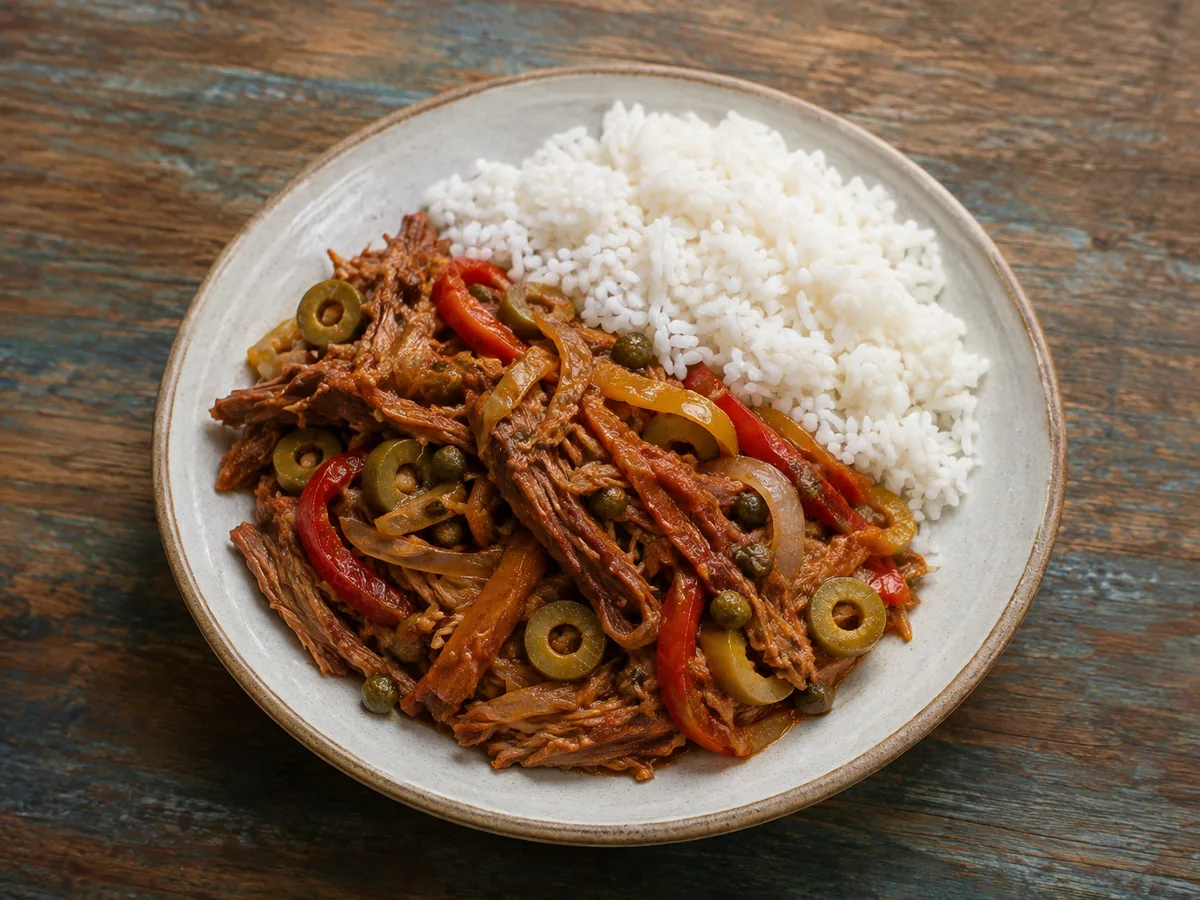
Ropa vieja means “old clothes”, named for the tangle of shredded beef fibres that looks like a pile of tattered rags. It came from the Canary Islands and Spain, and the Panamanian version has taken on its own identity.
Flank steak is simmered with garlic, onion and oregano until the muscle fibres soften, then pulled apart by hand into long juicy strands. Those shreds go back into a wide skillet to cook down in a sofrito of ají dulce, yellow onion, ripe plum tomato, cumin and fresh culantro.
Briny Spanish green olives and capers go in at the end, sharp salty pops against the savoury reduction.
The beef
- 1 kg2.2 lbBeef flank steak (falda) or brisket flat, trimmed, cut with the grain into 8 cm slabs
- 1.5 L6.3 cupsCold filtered water
The sofrito
- 45 ml3 TbspAchiote oil, or extra-virgin olive oil
- 2 large2 largeYellow onions, peeled and cut into fine 6 mm dicehalf to the braise, half to the sofrito
- 6 cloves6 clovesFresh garlic, minced finedivided the same way
- 1 large1 largeRed bell pepper, cored and sliced into thin strips
- 1 large1 largeGreen bell pepper, cored and sliced into thin strips
- 6 pieces6 piecesAjí trompito or ají dulce, seeded and sliced thin
- 400 g3 largeRipe plum tomatoes, peeled, seeded and chopped fine
- 30 g2 TbspDouble-concentrated tomato paste
The seasoning
- 6 leaves6 leavesFresh culantro, washed and chopped fine
- 6 g1.5 tspCumin seeds, freshly toasted and ground
- 3 g1 TbspDried wild oregano, hand-crushed
- 15 ml1 TbspWhite wine vinegar, or fresh lime juice
- 15 ml1 TbspWorcestershire sauce (salsa inglesa)
- 15 g1 TbspFine sea saltdivided between braise and sauce
- 3 g1 tspFreshly ground black pepper
To finish
- 60 g½ cupPitted Spanish Manzanilla olives, sliced into rings
- 30 g2 TbspSpanish capers, drained
Cut with the grain, shred along it
Flank is coarse fibre running in a single direction inside a collagen sheath. Dicing it beforehand makes long authentic strands impossible — cut long slabs, braise, then pull the fibres apart by hand.
Ninety minutes at 90–93 °C
Rapid boiling tightens the fibres and wrings the water out. A gentle braise hydrolyses the connective collagen into gelatin, which is what lets the slabs pull into juicy strands.
The shreds drink the sauce
Capillary action between the separated muscle fibres pulls the acidic aromatic pan sauce into every strand, which is how the dish stays succulent without being greasy.
Keep it moist
Ropa vieja should be coated in thick sauce, never dry. Reduce until it glazes, then stop.
Olives and capers at the end
Three minutes only. Their brine is a sharp punctuation against the meat, and long cooking flattens it.
Passive time, counted separately
The beef cools enough to handle before shredding, and the finished pan rests 5 minutes. Neither is active work.
The five tastes on this plate
Salt is sea salt, briny olives and capers. Fat is achiote oil and beef tallow carrying the fat-soluble cumin and oregano. Acid is plum tomato, wine vinegar and caper liquor cutting the rich beef. Heat is garlic, black pepper, toasted cumin and sweet ají dulce. Umami is braised collagen, reduced beef broth and concentrated tomato paste.
Equipment
- 6 qt pot or Dutch oven, for the braise
- 12 in heavy skillet, for the sofrito
- Two forks, for shredding
- Fine strainer
Traditionally a heavy cast-aluminium caldero or iron skillet. A 6-quart Dutch oven for the braise and a wide 12-inch skillet for the reduction works in a modern kitchen — the width matters at the end, because the sauce has to reduce onto the meat rather than pool under it.
Method
Simmer the beef1 hr 30 min
Put the slabs in the pot with 1.5 L cold water, half the onion, 3 crushed garlic cloves, 1 tsp salt and 1 tsp cumin.
Bring to a gentle boil, skim, then cover and simmer on low 1 hour 30 minutes until fork-tender — 35 minutes in a pressure cooker. Lift the beef out to cool and strain off 300 ml of the broth.
Keep beef in long slabs. Add 1.5 L cold water, half the onion, 3 crushed garlic cloves, 1 tsp salt and 1 tsp cumin. Bring to gentle boiling, skim and simmer covered at 90–93 °C for 1 hour 30 minutes until fork-tender, or pressure-cook 35 minutes. Remove beef and strain 300 ml broth.
Shred along the grain15 min
Once it can be handled, pull the beef along the natural grain into long thin strands with your fingers or two forks, discarding any tough gristle.
Once cool enough to handle, pull the beef along its natural grain into long, thin strands using fingers or two forks. Discard any tough gristle.
Build the sofrito14 min
Heat the achiote oil in the wide skillet over medium and sweat the remaining onion, garlic, both bell peppers and the ají dulce 8 minutes until soft and glistening.
Add the tomatoes, tomato paste, cumin, oregano, black pepper and 1 tsp salt and cook down 6 minutes into a glossy fragrant sauce.
Heat achiote oil over medium. Soften remaining onion and garlic, both bell peppers and ají dulce 8 minutes. Add tomatoes, paste, cumin, oregano, pepper and 1 tsp salt; reduce 6 minutes until glossy and fragrant.
Simmer the meat in the sauce20 min
Add the shredded beef and toss to coat, then pour in the 300 ml reserved broth, the Worcestershire and the vinegar.
Boil, drop to medium-low, and simmer uncovered 15 to 20 minutes, stirring now and then, until the sauce thickens and glazes the shreds.
Toss shredded beef in the sauce, then add 300 ml reserved broth, Worcestershire and vinegar. Bring to boiling, reduce to medium-low and simmer uncovered 15–20 minutes, stirring occasionally, until glazed but still moist.
Olives, capers, culantro3 min
Stir in the olive rings, capers and chopped culantro for the final 3 minutes.
Taste for salt and vinegar, then pull it off the heat and rest 5 minutes.
Add olive rings, capers and chopped culantro for the final 3 minutes only. Adjust salt and vinegar, remove from heat and let the finished pan rest 5 minutes.
Sensory cues of doneness
- Visual: a glistening tangle of mahogany shreds in thick orange-red sauce, studded with green olive rings and red pepper strips.
- Auditory: a steady moist simmer as the sauce reduces around the meat.
- Olfactory: braised beef, toasted cumin, pungent garlic, sweet pepper and fresh culantro.
Check for glossy mahogany shreds coated in thick orange-red sauce with green olives and red peppers. Maintain a moist simmer and stop reducing before the meat dries; expect beef, cumin, garlic and culantro aromas.
Storing it
Better the next day — the shredded fibres keep absorbing the cumin, culantro and tomato as it sits. Leftovers fill empanadas, carimañolas or patacones rellenos.
Troubleshooting
- Short, crumbly meat instead of strands.
It was cut across the grain before cooking. Long slabs with the grain, then shred along the fibres.
- Dry meat with no sauce.
The broth boiled away. It should stay moist and glazed.
- Tough shreds.
The braise was cut short. Flank or brisket needs a full 90 gentle minutes.
Substitutions
One-to-one global substitutions, with the technique adjustment each one requires.
Ingredient substitutions
| Ingredient | Replace with | Culinary impact and technique adjustment |
|---|---|---|
| Flank steak | Brisket flat, skirt steak, or chuck roast | One-to-one. Brisket gives identical long tender shreds |
| Ají trompito | Sweet mini peppers, or cubanelle | One-to-one. The same sweet pepper aroma |
| Culantro | Fresh cilantro leaves and tender stems | One-to-one where culantro cannot be found |
Scaling
Half, for 3 portions
Halve everything. The braise stays 90 minutes for the collagen.
Double, for 12 portions
Double everything and finish in a wide roasting pan or two skillets, so the sauce coats the meat evenly.
What to serve it with
- Arroz con guandú y coco
- Patacones, twice-fried green plantain rounds smashed flat and salted
- Tajadas of fried ripe plantain
- A cold Balboa, or tart chicha de nance
Questions
Slow cooker or pressure cooker?
Yes. Pressure-cook the flank 35 minutes on high with natural release, then shred and finish in the skillet with the sofrito.
Does it keep?
It is better the next day. The fibres go on absorbing the sauce in the fridge.
What do I do with leftovers?
Fill hot empanadas, carimañolas or patacones rellenos with them.