Arroz con Guandú y Coco
No holiday table in Panama functions without it. Coconut milk is an oil-in-water emulsion, and its melting triglycerides film each grain so nothing fuses — while at the bottom of the caldero the coconut sugars pyrolyse into el cocolón, the brittle golden crust everyone actually wants.
- Prep
- 25 min
- Cook
- 40 min
- Serves
- 8 portions
- Difficulty
- Medium
Researched · Kitchen testing pending
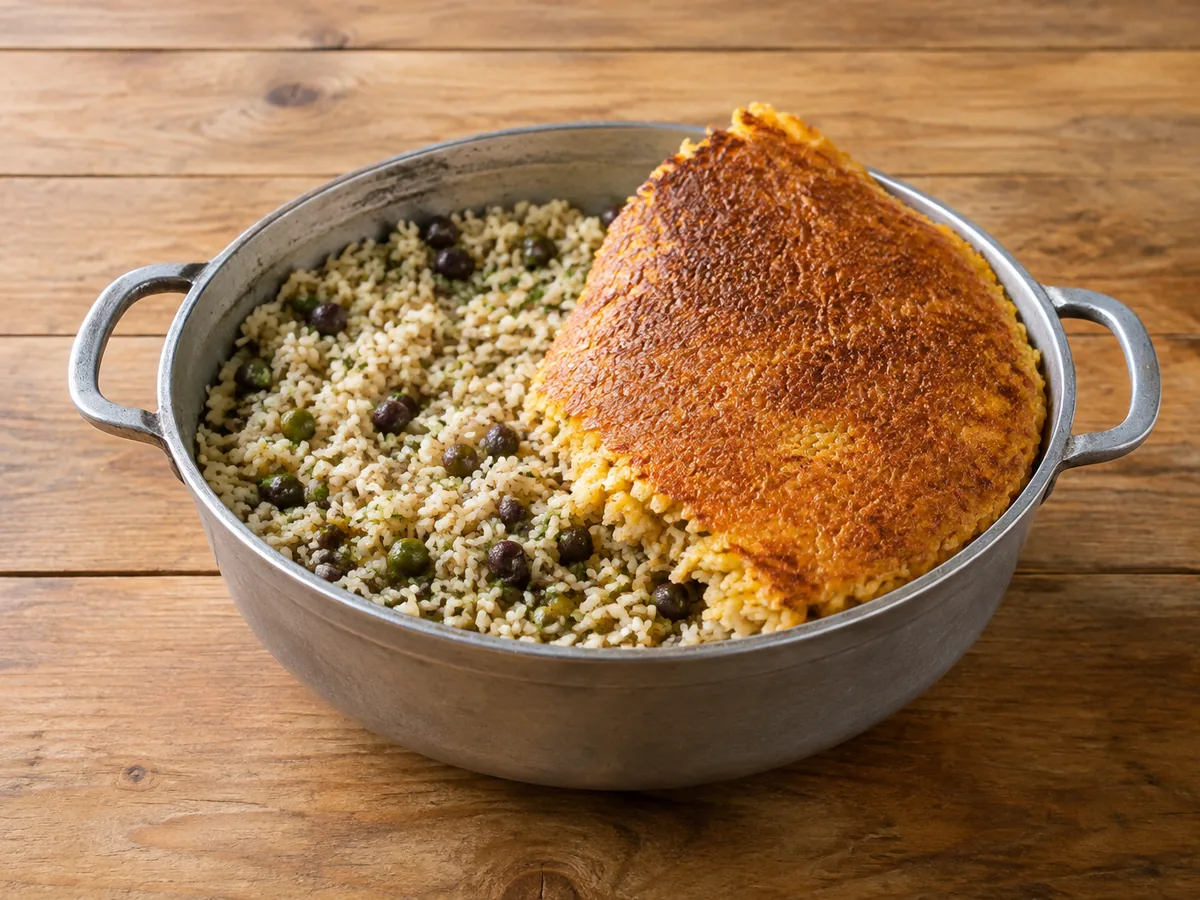
Sundays mean coconut rice. Arroz con guandú y coco comes from the Afro-Antillean communities of Colón and Panama City, and it unites fresh green or purple pigeon peas with raw coconut milk pressed from freshly grated coconut.
The peas are simmered with ají dulce, onion, garlic and culantro before the rice goes in. As the liquid boils away the grains absorb the coconut oils and cook into something separate and fluffy.
And at the bottom of the aluminium caldero, the heat caramelises coconut sugars and rice starches into a crunchy dark-golden crust known across Panama as el cocolón — the part people fight over.
The rice and peas
- 600 g3 cupsLong-grain white rice, rinsed until the water runs clear and drained
- 400 g2.5 cupsFresh green or purple pigeon peas (guandú fresco), sorted and rinsed
The liquid
- 750 ml3.2 cupsFresh coconut milk, from one grated mature coconut pressed with hot water, or two 13.5 oz tins full-fat
- 350 ml1.5 cupsCold filtered water, or light chicken stock
The aromatics
- 30 ml2 TbspUnrefined coconut oil, or vegetable oil
- 1 medium1 mediumYellow onion, peeled and cut into fine 6 mm dice
- 4 cloves4 clovesFresh garlic, minced to a paste
- 4 pieces4 piecesAjí trompito or ají dulce, seeded and minced fine
- 4 leaves4 leavesFresh culantro, chopped fine
The seasoning
- 15 g1 TbspFine sea salt
- 10 g2 tspGranulated cane sugarit lifts the coconut and helps the cocolón form
- 2 g½ tspFreshly ground black pepper
Rinse until the water is clear
That washes off the loose surface amylose responsible for gummy clumping. Coconut fat then does the rest, coating each grain in a hydrophobic film so the grains stay separate.
How the cocolón forms
Once the water has evaporated the pot floor passes 140 °C, and the concentrated coconut sugars and rice starches undergo pyrolysis and Maillard browning into a brittle savoury-sweet sheet.
Unsweetened coconut milk only
Sweetened cream of coconut ruins the pot. It has to be culinary unsweetened milk, tinned or freshly pressed.
Stir once, then leave it
Stirring during the boil-down releases starch into the coconut milk and turns the pot into gummy risotto. One stir when the rice goes in, and no more.
Listen for the crackle
The crust is made by ear. Wet bubbling gives way to a dry crackle as the coconut oil renders and fries the base layer — and high heat past that point turns the sugars to bitter charcoal.
Passive time, counted separately
The pot rests covered 5 minutes after the crust forms. That sits outside the times quoted above.
The five tastes on this plate
Salt dissolves into the coconut milk and seasons each grain to the core. Fat is lauric-rich coconut cream and coconut oil. Acid is absent by design — it arrives in the vinegary gravies and pickled salads served over the top. Heat is garlic, black pepper and culantro terpenes. Umami is earthy pigeon pea and caramelised coconut solids.
Equipment
- Heavy 5 to 6 qt cast-aluminium caldero or enamelled Dutch oven with a tight lid
- Sheet of aluminium foil, for an airtight seal
- Wooden spoon and a large fork
- Flat metal spatula, for lifting the cocolón
Traditionally a heavy cast-aluminium caldero with a close lid. A 5-to-6 quart enamelled Dutch oven works in a modern kitchen — cast iron holds bottom heat evenly, which forms a uniform cocolón instead of a burnt hot spot at the centre.
Method
Build the guandú base8 min
Heat the coconut oil in the caldero over medium and cook the onion, garlic, ají dulce and culantro 5 minutes until soft and translucent.
Add the pigeon peas, the 15 g salt, 10 g sugar and black pepper and sauté 3 minutes to coat.
Heat coconut oil over medium. Soften onion, garlic, ají dulce and culantro 5 minutes. Add pigeon peas, 15 g salt, 10 g sugar and black pepper; sauté 3 minutes to coat.
Coconut milk and water15 min
Pour in the 750 ml coconut milk and 350 ml water — 1,100 ml of liquid in total.
Bring to a rolling boil and simmer the guandú 12 to 15 minutes until tender to the bite. Tinned peas need only 3 minutes.
Add 750 ml unsweetened coconut milk and 350 ml water, 1,100 ml total. Bring to boiling and simmer pigeon peas 12–15 minutes until tender; canned peas need only 3 minutes.
Rice in, boil down10 min
Stir in the drained rice and stir once to distribute the peas.
Bring back to a boil and let it boil uncovered 8 to 10 minutes without stirring, until the liquid drops below the rice line and small steam craters open across the surface.
Rinse rice until water runs clear and drain. Add to the pot, stirring once to distribute peas. Boil uncovered 8–10 minutes without further stirring until liquid falls below rice level and steam craters appear.
Steam on the lowest heat20 min
Turn the burner to its lowest setting and pile the rice gently from the edges towards the centre into a slight dome.
Cover with a sheet of foil under the lid for an airtight seal and steam undisturbed 20 minutes. Do not open it.
Reduce to the lowest heat. Gently mound rice from edges toward the centre, seal with foil beneath the lid and steam undisturbed 20 minutes without opening.
Form the cocolón4 min
Raise to medium-low for 3 to 4 minutes and listen: a distinct dry crackle means the coconut oil is rendering and frying the bottom layer crisp.
Off the heat, rest covered 5 minutes.
Increase to medium-low for 3–4 minutes, listening for a dry crackle as the bottom crisps. Avoid high heat that burns the coconut sugars. Remove from heat and rest covered 5 minutes.
Fluff and unmould
Uncover and fluff the top gently with a large fork, lifting from the edges, then spoon the rice onto a platter.
Scrape the golden sheets of cocolón up with a flat metal spatula and lay them across the top. Serve hot.
Uncover and gently fluff rice from the edges with a large fork; transfer to a platter. Scrape up golden cocolón sheets with a flat metal spatula and arrange on top. Serve hot.
Sensory cues of doneness
- Visual: separate glossy pale-ivory grains speckled with purple-green peas, and a dark amber-gold sheet of crust underneath.
- Auditory: wet bubbling subsiding into dry crackling and popping at the bottom of the pot.
- Olfactory: toasted coconut, nutty pigeon pea, sweet alliums and fresh culantro.
Look for separate glossy ivory grains and tender pigeon peas over an amber-gold crust. Wet bubbling should give way to dry crackling, with aromas of toasted coconut, nutty peas, sweet onion and fresh culantro.
Troubleshooting
- Gummy, risotto-like rice.
It was stirred during the boil-down. Stir once when the rice goes in, then leave it alone.
- Cloying, dessert-sweet rice.
Sweetened cream of coconut was used. It must be unsweetened culinary coconut milk.
- A black, bitter crust.
The final heat was too high for too long. Keep it moderate and stop when you hear the crackle.
Substitutions
One-to-one global substitutions, with the technique adjustment each one requires.
Ingredient substitutions
| Ingredient | Replace with | Culinary impact and technique adjustment |
|---|---|---|
| Fresh guandú | Frozen or tinned green pigeon peas | One-to-one. Tinned peas need only 3 minutes of pre-cooking |
| Fresh coconut milk | Tinned unsweetened full-fat coconut milk | One-to-one — two tins plus a cup of water |
| Ají trompito | Sweet mini peppers, or cubanelle | One-to-one. Sweet pepper aroma with no heat |
Scaling
Half, for 4 portions
Halve everything in a 3.5-quart pot. Boiling and steaming times are unchanged.
Double, for 16 portions
Double everything in a 10-to-12 quart caldero over a wide burner, so the heat reaches the edges and the cocolón forms evenly.
What to serve it with
- Pernil al horno, slow-roasted garlic and cumin pork shoulder
- Ropa vieja panameña, in its sweet pepper and tomato gravy
- Plátanos en tentación, baked in caramelised butter, sugar and cinnamon
- Chicha de saril con jengibre, cold hibiscus with ginger and clove
Questions
What makes guandú oloroso special?
It is a prized purple-and-green pigeon pea harvested in December, and it releases an intense sweet floral perfume when heated that dried or tinned peas cannot match.
Can I use tinned pigeon peas?
Yes. Drain and rinse them and cut the initial simmer to 3 minutes.
How do I make fresh coconut milk?
Grate the meat of one brown coconut, pour 3 cups of boiling water over the shreds, steep 10 minutes, and squeeze hard through cheesecloth.