Sancocho de Gallina Panameño
Stripped down where its neighbours pile on: one bird, one starch, one herb. The ñame baboso sloughs its mucilaginous outer layer into the broth and binds free water and chicken fat into a silky emulsion — and the culantro goes in twice, once for the background and once, off the heat, for the top notes.
- Prep
- 30 min
- Cook
- 2 hr
- Serves
- 6 hearty bowls
- Difficulty
- Medium
Researched · Kitchen testing pending
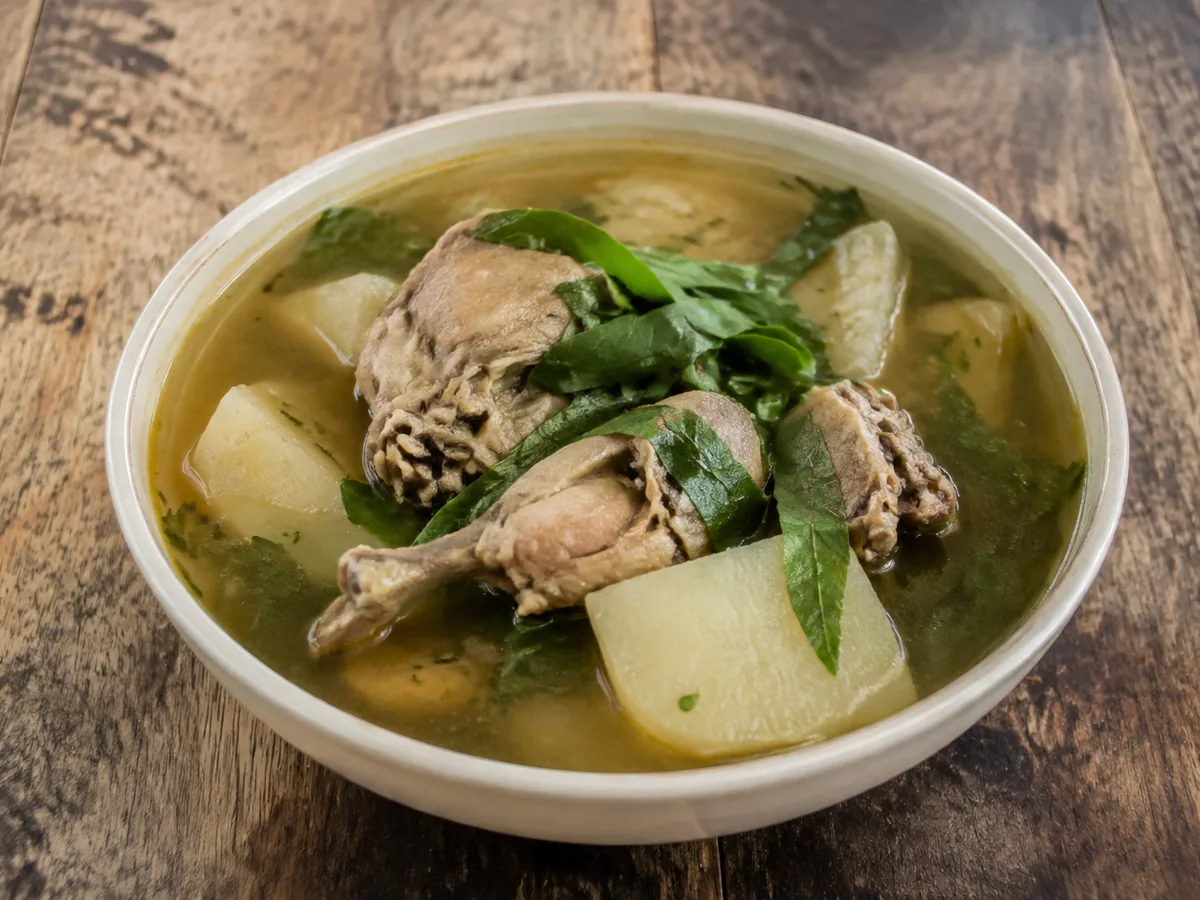
Sancocho is life. Along the rural roads of Penonomé and Los Santos, steam rises from country hearths at dawn.
Unlike the multi-meat, vegetable-heavy boiled dinners of neighbouring Colombia or the Dominican Republic, authentic sancocho panameño is stripped down and herb-driven. The backbone is gallina dura — a mature free-range hen with yellow fat, dense muscle and rich bones. There is one essential starch, ñame baboso, the slimy white yam that melts into the broth.
The defining aroma is culantro, added in stages, its long jagged leaves infusing the golden chicken fat with an earthy, citrus-edged perfume.
The hen
- 1.8 kg4 lbWhole stewing hen (gallina dura), chopped through the bone into 10 pieces, skin on
- 30 ml2 TbspAchiote oil, or rendered chicken fat
- 18 g1 Tbsp + 1 tspFine sea saltseasoned in stages
- 3 g1 tspCoarsely cracked black pepper
The aromatics
- 1 large1 largeYellow onion, peeled and finely diced
- 8 cloves8 clovesFresh garlic, peeled and smashed to a paste
- 12 leaves12 large leavesFresh culantro — 6 bruised whole for the simmer, 6 chopped fine to finish
- 4 g1.5 TbspDried wild oregano, hand-crushed
- 6 pieces6 piecesAjí trompito or ají dulce, seeded and minced fine
The pot
- 2.5 L10.5 cupsCold filtered water
- 1 kg2.2 lbÑame baboso, peeled and cut into irregular 4 cm chunks
- 300 g1 largeGreen plantain, peeled and sliced into 2.5 cm roundsoptional, the rustic country addition
- 2 ears2 earsFresh sweet corn, cut crosswise into 6 roundsoptional, country style
The yam is the thickener
Unlike a waxy potato, ñame baboso carries highly soluble amylose and mucilaginous glycoproteins. Its outer layer sloughs into the broth as it simmers and acts as a natural hydrocolloid, binding free water and rendered chicken lipids into a silky opaque emulsion.
Culantro twice, and not cilantro
The aliphatic aldehydes that define this soup — mostly 2-dodecenal — are volatile. Six leaves early build the savoury background; six chopped in off the heat keep the fresh herbaceous top. Ordinary cilantro goes muddy after five minutes of boiling.
A mature hen, not a broiler
Young supermarket chicken falls into stringy mush in half an hour and has no bone depth. Gallina dura carries cross-linked type-I collagen that needs at least 90 minutes at 88–92 °C to become gelatin.
Never boil hard
A rolling boil shatters the melting yam into a murky purée. A low, lazy simmer is what keeps the chunks whole with velvet edges.
One starch only
This is not the multi-vegetable sancocho of Colombia or the Dominican Republic. Plantain and corn are optional country additions; the ñame is the point.
Passive time, counted separately
The finished pot steeps 10 minutes off the heat with the lid on. That sits outside the times quoted above.
The five tastes on this plate
Salt dissolves into cold water and penetrates the dense hen muscle to the bone. Fat is golden rendered hen fat in shimmering rings. Acid is gentle, punctuated with lime at the table. Heat is raw garlic, cracked pepper and the volatile terpenes of wild culantro. Umami is the nucleotide and collagen load of mature hen bones and melted marrow.
Equipment
- 8 qt enamelled cast-iron Dutch oven or heavy stockpot
- Wide skimming spoon
- Instant-read thermometer
- Wide ceramic or clay bowls
Traditionally a heavy cast-aluminium caldero or an iron paila over wood embers. An 8-quart enamelled Dutch oven works in a modern kitchen — the thick base is what stops the melting yam starch scorching on the bottom.
Method
Brown the hen and aromatics13 min
Heat the achiote oil in the Dutch oven over medium. Season the hen with salt, pepper and the oregano and sear 8 minutes, turning, until the skin releases its yellow fat and colours lightly.
Add the onion, minced ají dulce and garlic paste and cook 5 minutes until soft and fragrant.
Heat achiote oil over medium. Season mature hen with salt, pepper and oregano; sear 8 minutes, turning until fat renders and skin colours lightly. Add onion, minced ají dulce and garlic paste; soften 5 minutes.
Water in, and skim1 hr 15 min
Pour the 2.5 L cold water over everything and add the 6 bruised whole culantro leaves.
Bring to a boil and skim the foam over the first 15 minutes. Drop to low, cover partially, and simmer gently 1 hour until the hen begins to tenderise.
Add 2.5 L cold water and 6 bruised whole culantro leaves. Bring to boiling and skim during the first 15 minutes. Reduce to low, partially cover and simmer gently at 88–92 °C for 1 hour until hen begins softening.
Plantain and corn10 min
Drop in the green plantain rounds and the corn, if using, and simmer 10 minutes.
If using the optional green plantain and corn, add their rounds now and simmer gently for 10 minutes before adding the ñame in the next step.
The yam35 min
Add the ñame chunks and 1 tsp salt, cover partially, and hold a gentle simmer 30 to 35 minutes.
You want the outer layer of each chunk dissolving into the broth while the inner core stays intact — hard boiling here ruins both.
Add ñame chunks and 1 tsp salt. Partially cover and simmer gently 30–35 minutes until edges soften into the broth but centres remain intact. Avoid a rolling boil.
Herbal finish and steep
Check the hen: 85–88 °C and yielding easily to a fork, with the broth velvety and golden.
Off the heat, stir in the remaining 6 chopped culantro leaves, cover tightly, and steep 10 minutes before serving.
Check that hen reaches 85–88 °C and yields easily to a fork, with velvety golden broth. Remove from heat, add the remaining 6 chopped culantro leaves, cover tightly and steep 10 minutes.
Ladle
Into wide ceramic bowls: hot broth, melting ñame and hen pieces. Scatter more fresh culantro over and serve with a mound of white rice and lime wedges.
Ladle hot broth, tender ñame and hen pieces into wide bowls. Scatter fresh culantro over each serving and accompany with white rice and lime wedges.
Sensory cues of doneness
- Visual: an opaque pale yellow-green broth with glistening fat droplets, yam with rounded velvety edges, and hen that yields to a carving fork.
- Auditory: a quiet bubbling murmur — never a churning boil.
- Olfactory: pungent wild culantro, simmered chicken marrow, crushed garlic and sweet stewed yam.
Look for opaque pale yellow-green broth with fat droplets, ñame with velvety edges and fork-tender hen. Keep bubbling quiet throughout; expect pungent culantro, chicken marrow, garlic and sweet yam aromas.
Troubleshooting
- Stringy, flavourless meat.
A young broiler was used. This needs a mature stewing hen.
- Murky, muddy broth.
The pot boiled hard and broke the yam apart. Keep it at a lazy simmer.
- No herbal aroma.
Ordinary cilantro was used, or all the culantro went in at the start. Use culantro, and hold half of it back for the finish.
Substitutions
One-to-one global substitutions, with the technique adjustment each one requires.
Ingredient substitutions
| Ingredient | Replace with | Culinary impact and technique adjustment |
|---|---|---|
| Gallina dura | Boiling fowl, rooster, or bone-in thighs with wings | With young thighs, simmer only 45 minutes before the yam goes in |
| Ñame baboso | White yam, taro, or yuca with a russet potato | Blend a small piece of potato into the broth to mimic the starch body |
| Culantro | Cilantro stems with a pinch of dried oregano | Not a true match, but stems hold up to heat where leaves do not |
Scaling
Half, for 3 portions
Halve everything in a 4-quart pot. Simmer times are unchanged — collagen breakdown depends on temperature, not volume.
Double, for 12 portions
Double everything in a 14-quart stockpot, wide enough that the yam submerges without stacking.
What to serve it with
- Hot steamed white rice, spooned straight into the broth
- Tajadas of fried ripe plantain
- Fresh lime halves, squeezed in at the table to cut the hen fat
- Chicha de piña con arroz, cold and spiced with cinnamon
Questions
What is the difference between culantro and cilantro?
Culantro has long serrated leathery leaves and roughly ten times the essential oils, and it survives heat. Cilantro is lacy and fragile, suited to raw garnish.
Can I use yuca instead of ñame?
You can, but yuca stays firm and will not thicken the broth. Mash a few pieces into the soup with a fork to imitate the body.
Why a stewing hen?
Free-range mature birds build collagen and intramuscular fat through exercise and age, and that is where the bone broth flavour comes from.