Hojaldras Panameñas
Breakfast from Bocas del Toro to Darién. Double-acting baking powder gasses twice — once in the bowl, once in the oil — and thirty minutes of rest relaxes the gluten enough to pull each ball paper-thin by hand. A rolling pin knocks the gas out and gives you a cracker.
- Prep
- 20 min
- Cook
- 10 min
- Serves
- 8 large hojaldras, about 18 cm wide
- Difficulty
- Easy
Researched · Kitchen testing pending
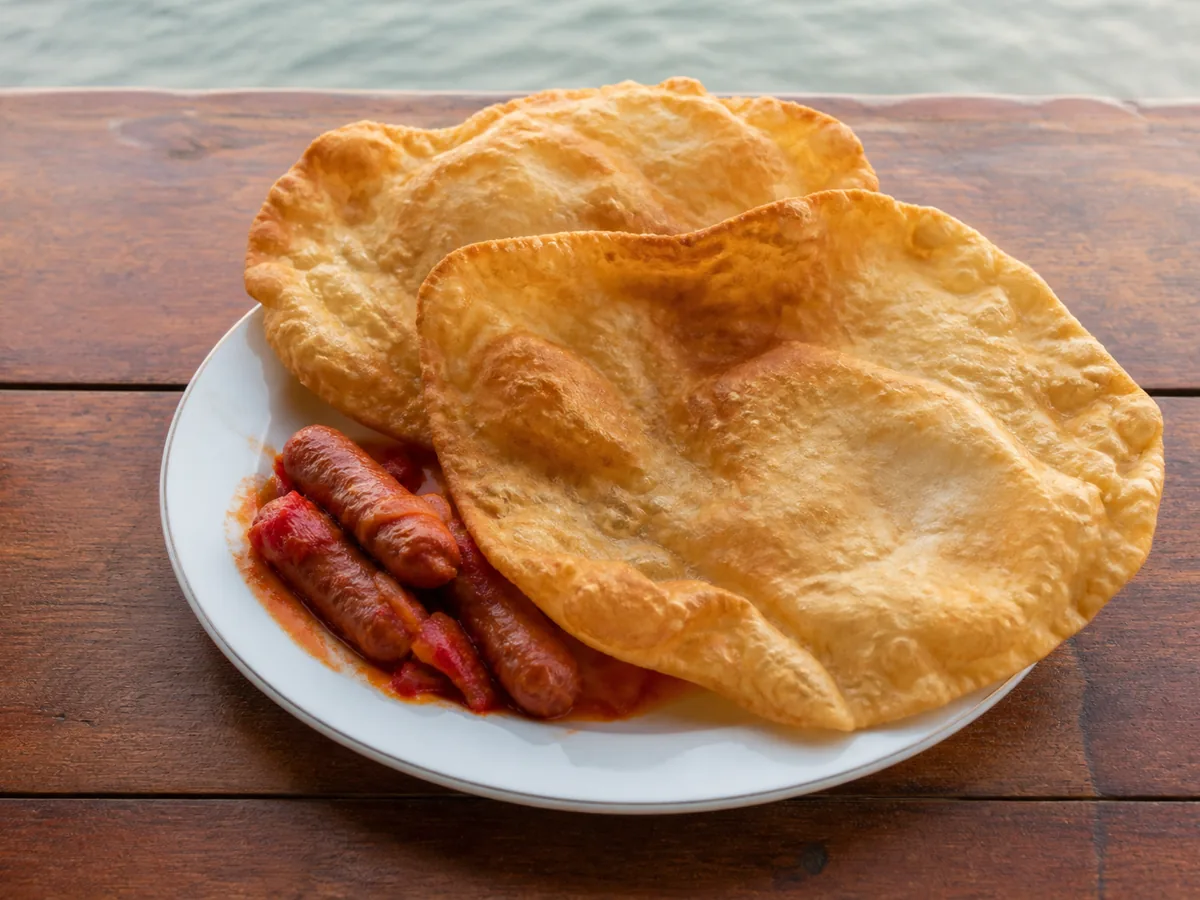
Puff and crunch. Hojaldras rule the Panamanian breakfast table from dawn, in fondas, diners and home kitchens from Bocas del Toro to Darién.
They are deep-fried wheat flatbreads, and nothing like Mexican buñuelos or Spanish pastries. The dough is plain — flour, baking powder, salt, a little sugar, milk — kneaded until silky and rested, then small rounds are stretched paper-thin by hand like pizza dough and slipped into smoking oil.
They puff instantly into giant uneven golden bubbles with crunchy blistered rims and soft airy centres, torn by hand and dragged through salchichas guisadas.
The dough
- 500 g4 cupsAll-purpose wheat flour, about 11% protein, sifted
- 12 g1 TbspDouble-acting baking powder
- 10 g2 tspGranulated cane sugar
- 8 g1.5 tspFine sea salt
- 30 g2 TbspUnsalted butter or vegetable shortening, melted and warm
- 1 large1 largeEgg, at room temperature
- 220 mlscant 1 cupLukewarm whole milk or water, at 38 °C
To fry
- 1 L4.2 cupsHigh-smoke-point vegetable oil
Rest exactly thirty minutes
Un-rested dough snaps back like elastic and tears the moment you try to pull it. Half an hour lets the gluten network relax enough to stretch to 2 mm without fighting you.
Hands, never a pin
Rolling knocks out the carbon dioxide the baking powder has already released and gives a flat, tough cracker. Press, lift, and pull the edges outward with oiled fingertips, rotating as you go.
Where the puff comes from
Double-acting powder gasses once during mixing and again on contact with heat, and at 185 °C the water inside the sheet flashes to steam and inflates it into paper-thin blisters in under a minute.
185 °C, and no cooler
Below 175 °C the oil soaks in before the dough can puff, and the bread comes out heavy and greasy instead of hollow.
Thin centre, thicker rim
The middle should be almost translucent. That contrast is what gives the crunchy blistered edge and the soft pillowy centre in the same bite.
Passive time, counted separately
The dough rests 30 minutes at room temperature. That sits outside the times quoted above.
The five tastes on this plate
Salt is in the dough, balancing the sausage or cheese it carries. Fat is melted butter in the crumb and the frying oil making the blisters. Acid is mellow — it comes from the stewed tomato sausages alongside. Heat is none in the bread itself; it arrives as ají chombo. Umami is toasted fried wheat and browned crust proteins.
Equipment
- Large mixing bowl
- Oiled tray and a clean kitchen towel
- Wide 12 in cast-iron skillet or Dutch oven
- Deep-fry thermometer
- Tongs
Traditionally a broad cast-iron or aluminium paila over a roaring burner. A wide 12-inch skillet with 4 cm of oil works in a modern kitchen — width is the requirement, so the sheet can float flat instead of folding over on itself.
Method
Mix and knead10 min
Whisk the flour, baking powder, sugar and salt and make a well. Add the melted butter, the egg and the lukewarm milk and stir to a shaggy dough.
Turn out and knead vigorously 6 to 8 minutes until smooth, elastic and supple.
Whisk flour, baking powder, sugar and salt; make a well. Add melted butter, egg and lukewarm milk, stirring into shaggy dough. Knead vigorously 6–8 minutes until smooth, elastic and supple.
Portion and rest30 min
Divide into 8 balls of about 100 g and roll each tight and smooth between your palms.
Set them on an oiled tray, brush the tops with oil, cover with a towel, and rest strictly 30 minutes.
Divide dough into 8 balls of about 100 g and roll smooth. Place on an oiled tray, brush tops with oil, cover with a towel and rest exactly 30 minutes at room temperature.
Heat the oil5 min
Bring the litre of oil, about 4 cm deep in a wide skillet, to 185–190 °C on a thermometer.
Heat 1 litre oil, about 4 cm deep in a wide skillet, to 185–190 °C. Check with a thermometer; cool oil makes the dough absorb oil instead of puffing.
Stretch by hand5 min
Oil your hands and the work surface. Press a ball flat with your fingers, then lift and pull the edges outward, rotating continuously, into an uneven circle about 18 cm across.
The centre should be nearly translucent, the edges a little thicker.
Oil hands and work surface. Flatten each ball with fingers, then lift, pull and rotate into an approximately 18 cm circle. Stretch by hand, not rolling pin, to about 2 mm with a nearly translucent centre and thicker rim.
Flash fry10 min
Slip the sheet away from you into the oil. It submerges, then balloons straight back to the surface.
Fry 45 to 60 seconds, flip with tongs, and give the second side 30 to 45 seconds until golden-amber and crisp. Shake off the oil and drain upright on paper towel.
Slide dough into oil away from you. Fry 45–60 seconds as it puffs, turn with tongs and fry the second side 30–45 seconds until golden and crisp. Shake off oil and drain upright on paper.
Serve at once
Serve piping hot, while the crust is still brittle and the centre steamy.
Serve immediately, piping hot, while the crust is still brittle and the centre steamy.
Sensory cues of doneness
- Visual: puffy golden-amber flatbread with giant paper-thin blisters and pale hollow pockets.
- Auditory: a roaring sizzle the instant the stretched dough hits the oil.
- Olfactory: fried pastry dough, toasted butter and sweet cooked wheat.
Look for puffed golden flatbreads with large, paper-thin blisters and pale hollow pockets. They should sizzle strongly on entering the oil and smell of fried pastry, toasted butter and sweet wheat.
Storing it
The dough can be made the night before: shape into balls on an oiled tray, wrap tightly and refrigerate. Bring back to room temperature for 30 minutes before stretching.
Troubleshooting
- The dough tears or springs back.
It was not rested. Thirty minutes, so the gluten relaxes.
- Heavy, greasy bread.
The oil was under 175 °C. Hold 185 °C.
- It stays flat.
Stale baking powder, or cool oil. Check both.
Substitutions
One-to-one global substitutions, with the technique adjustment each one requires.
Ingredient substitutions
| Ingredient | Replace with | Culinary impact and technique adjustment |
|---|---|---|
| Whole milk | Warm filtered water | One-to-one. Water gives a crisper lighter crust, milk a softer crumb |
| Melted butter | Vegetable shortening, or lard | One-to-one. Lard gives a notably traditional flakiness |
| Double-acting baking powder | No substitute | Baking soda alone will not work — the double gas release is the point |
Scaling
Half, for 4 hojaldras
Halve everything. Frying stays about a minute a flatbread.
Double, for 16 hojaldras
Double everything and fry one at a time so the oil holds 185 °C.
What to serve it with
- Salchichas guisadas — sausages stewed in tomato, onion and culantro
- Sunny-side-up fried eggs with soft yolks
- Salty queso blanco del país
- Hot café con leche
Questions
Can they be sweet?
Yes. Traditionally savoury with sausages or eggs, but dusted hot with icing or cinnamon sugar they are a much-loved snack.
Can I make the dough the night before?
Yes — shape the balls, wrap the tray tightly and refrigerate. Bring back to room temperature for 30 minutes before stretching.
Why did mine stay flat?
Either the baking powder was stale or the oil was not at 185 °C.