Corvina al Ajillo
Two temperature windows decide this plate. Corvina past 62 °C shrinks and wrings out its own water, and garlic past 150 °C turns acrid — so the fish comes off at 57–60 °C and the chips leave the pan the instant they hit hazelnut gold, with cold butter swirled in off the heat.
- Prep
- 20 min
- Cook
- 15 min
- Serves
- 4 portions
- Difficulty
- Medium
Researched · Kitchen testing pending
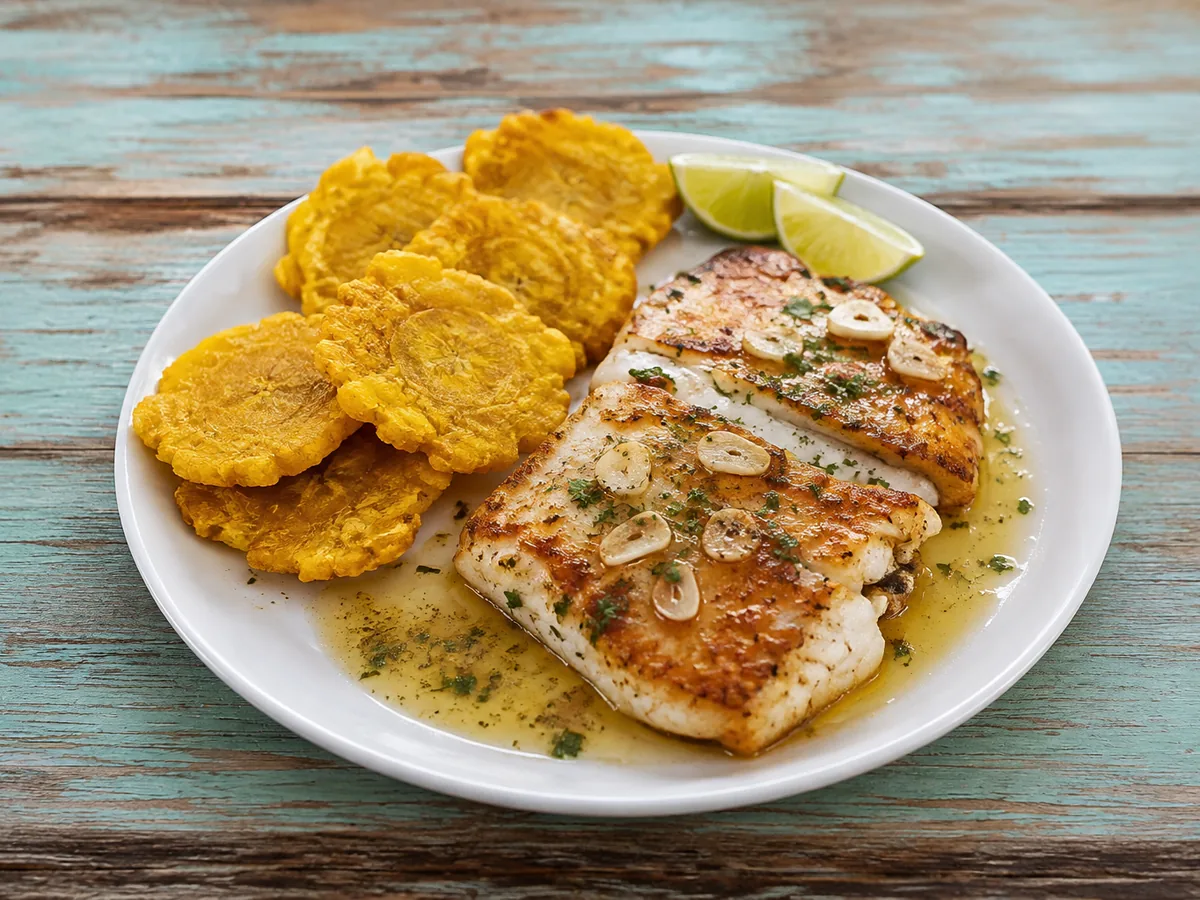
Pacific corvina, garlic and hot butter. Along the Amador Causeway, corvina al ajillo is ordered daily.
Corvina del Pacífico is Panama’s most celebrated fish, prized for firm snowy flakes and a clean sweet flavour. The fillets are seasoned with salt and lime and seared in hot butter and oil until golden, and then the pan is loaded with paper-thin garlic chips cooked gently to hazelnut brown.
Deglazed with dry white wine and lime, the juices are swirled with cold butter into a glossy emulsion, showered with parsley and poured bubbling over the fish beside a mountain of patacones.
The fish
- 800 g1.76 lbFresh corvina fillets, skinned and pin-boned, in 4 equal 200 g portions
- 8 g1.5 tspFine sea saltdivided between the fish and the sauce
- 2 g½ tspFreshly ground white pepper
- 30 g¼ cupAll-purpose flour, for the lightest dusting on the presentation sideoptional
The pan
- 30 ml2 TbspExtra-virgin olive oil
- 60 g4 TbspUnsalted European butter, 82% butterfat — 30 g to sear, 30 g chilled for the sauce
- 12 cloves12 clovesFresh garlic, peeled and sliced into uniform paper-thin chips
The sauce
- 120 ml½ cupDry white wine — Sauvignon Blanc or a crisp Chardonnay
- 30 ml2 TbspFreshly squeezed lime juice1 Tbsp onto the fish, 1 Tbsp into the sauce
- 30 g½ cupFresh flat-leaf parsley, washed, dried and chopped fine
63 °C / 145 °F, then off
Corvina has short muscle fibres separated by thin collagen sheets. Cook to an internal temperature of 63 °C / 145 °F, then remove promptly to avoid overcooking.
Garlic has a ceiling
Allicin and fructans turn bitter and acrid above about 150 °C. Cooked gently on medium-low until pale straw then hazelnut gold, those harsh sulphur compounds break down into sweet nutty pyrazines instead.
Uniform chips
Slice every clove to the same thinness. Mixed thicknesses mean some chips are burnt while others are still raw, and the burnt ones poison the pan.
Monter au beurre, off the heat
Swirling cold cubed butter into the wine reduction away from the burner emulsifies the milk fat into a glossy velvety sauce. Do it over heat and it breaks into greasy oil.
Dust the presentation side only
A whisper of flour, well shaken off, gives an ultra-thin crisp crust without any of the weight of a coating.
Passive time, counted separately
The seared fillets wait on a warm platter while the sauce is built. That sits outside the times quoted above.
The five tastes on this plate
Salt seasons the delicate flesh and the butter sauce. Fat is European butter and olive oil carrying the garlic aromatics. Acid is the wine reduction and fresh lime cutting the butter. Heat is sweet toasted garlic and clean white pepper. Umami is the seared fish fond, reduced wine and butter solids.
Equipment
- 12 in multi-clad stainless or well-seasoned cast-iron skillet
- Fish spatula
- Instant-read thermometer
- Warm serving platter
Traditionally a broad aluminium or cast-iron paila over gas. A 12-inch multi-clad stainless skillet works in a modern kitchen — stainless builds proper fond, and the fond is exactly what the white wine later dissolves into the sauce.
Method
Season the fish5 min
Pat the fillets completely dry and season both sides with 1 tsp salt, the white pepper and 1 Tbsp lime juice.
Dust the presentation side very lightly with flour and shake off all the excess.
Pat fillets completely dry. Season both sides with 1 tsp salt, white pepper and 1 Tbsp lime juice. If using flour, dust only the presentation side very lightly and shake off excess.
Sear7 min
Heat the olive oil and 30 g butter over medium-high until the foam subsides, and lay the fillets in away from you.
Sear undisturbed 3 to 4 minutes until golden, flip with a fish spatula, and give the second side 2 to 3 minutes to 63 °C / 145 °F; continue cooking if needed to reach that temperature. Onto a warm platter.
Heat olive oil and 30 g butter over medium-high until foaming subsides. Lay fillets away from you; sear untouched 3–4 minutes until golden, flip and cook 2–3 minutes, continuing as needed to reach 63 °C / 145 °F internally. Transfer to a warm platter.
Toast the garlic chips2 min
Drop the heat to medium-low and add the garlic chips to the drippings.
Sauté strictly 2 minutes, stirring constantly, watching them go from white to pale straw to hazelnut gold — and move on the instant they turn.
Reduce to medium-low and add uniformly thin garlic chips to the drippings. Stir constantly for 2 minutes, stopping as soon as they turn hazelnut gold; avoid heat above about 150 °C or burning.
Deglaze2 min
Pour in the wine and the remaining lime juice, scraping every browned speck off the pan floor.
Raise to medium and simmer 2 minutes until the wine has halved and the alcohol has cooked off.
Pour in wine and the remaining 1 Tbsp lime juice, scraping up browned bits. Raise to medium and simmer 2 minutes until the wine reduces by half.
Mount with butter2 min
Pull the skillet off the heat and add the chilled butter in small cubes.
Swirl continuously until it melts into a glossy velvety emulsion, then stir in the parsley and check the salt.
Remove the skillet from heat. Add chilled butter in small cubes and swirl continuously until it forms a glossy, velvety sauce. Stir in parsley and adjust salt.
Sauce and serve
Ladle the bubbling garlic butter and all the golden chips over the fillets, and serve immediately with hot patacones and lime wedges.
Spoon the warm garlic-butter sauce and all the golden garlic chips over the fillets. Serve immediately with hot patacones and lime wedges alongside the fish.
Sensory cues of doneness
- Visual: a golden-brown sear over snow-white juicy flakes, under a pale gold glossy sauce speckled with green parsley and gold garlic.
- Auditory: a lively sizzle as the fish lands, then quiet simmering as the wine deglazes.
- Olfactory: sweet toasted garlic, browned butter, clean sea fish, crisp wine and parsley.
Look for a golden sear over juicy white flakes, coated in glossy pale-gold sauce with green parsley and golden garlic. The aroma should be sweet toasted garlic, butter, fish, wine and parsley.
Troubleshooting
- Bitter, acrid sauce.
The garlic burned. Keep the heat moderate and deglaze the second it turns golden.
- Dry, chalky fish.
It cooked too long. Three minutes on the first side, two on the second, and pull it at 60 °C.
- A greasy, split sauce.
The butter went in over heat. Always swirl it in off the burner.
Substitutions
One-to-one global substitutions, with the technique adjustment each one requires.
Ingredient substitutions
| Ingredient | Replace with | Culinary impact and technique adjustment |
|---|---|---|
| Corvina | Black sea bass, halibut, striped bass, or red snapper | One-to-one. Firm white fillets, skin removed |
| White wine | Fish fumet or clam juice with extra lime | One-to-one — 100 ml stock plus a further tablespoon of lime |
| Flat-leaf parsley | Fresh cilantro | One-to-one, for a more herbal Panamanian note |
Scaling
Half, for 2 fillets
Halve everything in a 10-inch pan. Searing and sauce times are identical.
Double, for 8 fillets
Double everything, searing in two batches onto a platter, then build one double batch of the sauce in the skillet.
What to serve it with
- Patacones, hot and salted — the essential companion
- Arroz con coco, white rice cooked in coconut milk
- A green salad of lettuce, cucumber and avocado with lime
- A cold Cerveza Panamá, or a high-acid Sauvignon Blanc
Questions
What can I use instead of corvina?
Sea bass, striped bass, red snapper or grouper — corvina's firm sweet white flake is closest to black sea bass.
Why white pepper?
Clean sharp heat without leaving black specks in a pale gold butter sauce.
Can I make it without alcohol?
Yes. Use 100 ml of rich seafood stock or clam juice plus an extra tablespoon of lime.