Ceviche Panameño de Corvina
Not the flash cure of Peru — Panama cures cold for four to eight hours, often overnight, until the cubes are firm and springy all the way through and the marinade has gone milky. The heat is ají chombo, apricot-scented and genuinely fierce, minced to specks.
- Prep
- 25 min
- Serves
- 6 appetiser portions
- Difficulty
- Easy
Researched · Kitchen testing pending
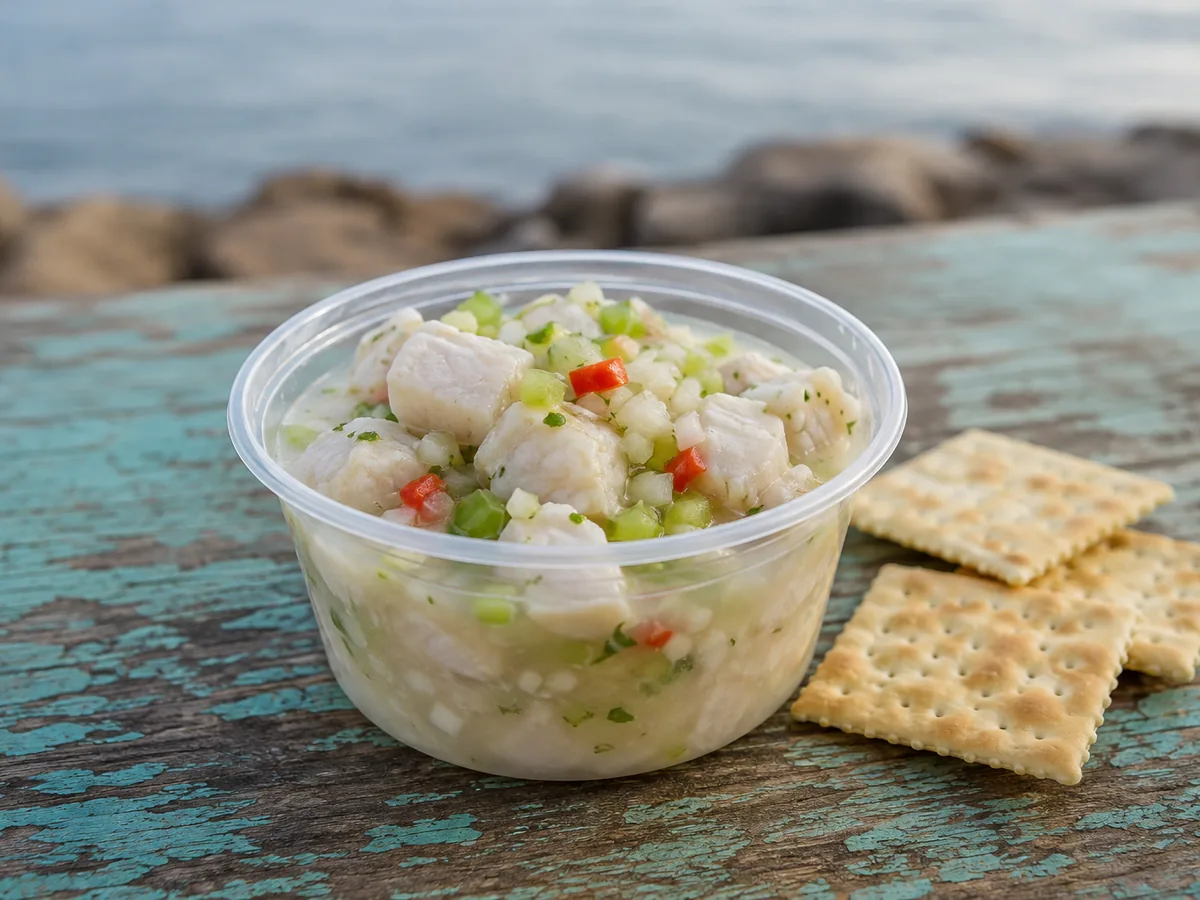
Cold lime juice and sea breeze. Follow the smell of salt down to the Mercado de Mariscos in Panama City, where dozens of open-air stalls sell ceviche spooned into small plastic cups with soda crackers.
Unlike the quick flash-cured Peruvian style, authentic ceviche panameño is cured cold for hours. The fish is Pacific corvina, diced into neat 1 cm cubes and left in pure hand-squeezed lime with finely minced white onion, tender celery, sea salt, pepper and the fiery apricot-scented heat of ají chombo.
The acid cures the flesh right through to opaque white and firm, and what is left behind is the tart cloudy marinade — the leche de tigre.
The fish
- 800 g1.76 lbFresh corvina fillets, boneless and skinless, bloodline trimmed, cut into uniform 1 cm cubes
The cure
- 240 ml1 cupFreshly squeezed lime juice, 10 to 12 Persian limes, gently hand-squeezed
- 12 g2 tspFine sea salt
- 2 g½ tspFreshly ground white or black pepper
The aromatics
- 2 medium2 mediumWhite onions, peeled and cut into very fine 3 mm brunoise
- 2 stalks2 stalksCelery, washed and minced into fine 2 mm dicethe essential Panamanian market touch
- 1 piece1 pieceFresh ají chombo (Scotch bonnet or habanero), seeded and minced to specksa quarter for mild, the whole pepper for market heat
To serve
- 15 g¼ cupFresh culantro or cilantro, minced very fineoptional garnish
A long cold cure, not a flash one
At pH 2.2 to 2.4 the lime alters the charges on the protein chains, unfolding myosin and collagen so they re-aggregate into a dense opaque network. Four to eight hours at 4 °C sets that all the way through into firm springy morsels, which is the Panamanian texture.
Squeeze gently
Hard pressure wrings bitter limonene out of the skin and the whole bowl turns harsh. Light pressure by hand, and stop before the pith.
Strictly 1 cm cubes
Larger pieces stay raw and jelly-like at the centre; smaller ones go sour and tough. Uniformity is what makes everything finish together.
Never at room temperature
The cure happens in the coldest part of the fridge, 2–4 °C, for safety and for the firm crisp texture both.
Non-reactive bowls only
Aluminium, copper and cast iron all leach metallic off-flavours under this much acid. Glass, ceramic or food-grade plastic.
Passive time, counted separately
The fish cures 4 to 8 hours refrigerated, ideally overnight. That is why no cook time is listed above.
The five tastes on this plate
Salt draws water from the fish cells and seasons the marinade. Fat is almost absent — this is lean ocean fish. Acid is electric fresh lime, curing and setting the proteins. Heat is raw white onion, crisp celery and the fruity fire of ají chombo. Umami is sea bass glutamate drawn out into the cloudy leche de tigre.
Equipment
- Non-reactive glass, ceramic or food-grade plastic bowl
- Sharp knife
- Fine strainer and a measuring cup
- Non-metallic spoon
- Chilled small bowls or cups
Traditionally large glass jars or stainless bins packed in shaved ice. A clean non-reactive bowl works in a modern kitchen — what matters is that nothing touching this is aluminium, copper or cast iron.
Method
Cube the fish12 min
Check the fillets for pin bones and trim off any dark bloodline.
Cut into uniform 1 cm cubes — uniformity is critical, since every piece has to cure at the same rate — and put them in a non-reactive bowl.
Remove pin bones and trim dark bloodline from the fillets. Cut into uniform 1 cm cubes and place in a glass, ceramic or food-grade plastic bowl for even curing.
Squeeze the limes6 min
Halve the limes and squeeze by hand with light pressure, stopping short of the white pith.
Strain into a measuring cup to give 240 ml and discard the seeds.
Halve limes and squeeze gently by hand, stopping before the white pith to avoid bitterness. Strain into a measuring cup, discarding seeds, until you have 240 ml juice.
Season and submerge6 min
Add the minced onion, celery, ají chombo, the 12 g salt and the pepper straight to the fish, then pour the lime juice over.
It must completely submerge the fish and onions.
Add minced onion, finely diced celery, seeded minced ají chombo, 12 g salt and pepper to fish. Use a quarter pepper for mild heat or the whole for hot. Pour over lime juice; fish and onion must be completely submerged.
Stir and seal1 min
Stir gently with a non-metallic spoon for a minute so the salt dissolves and the citrus coats every piece.
Cover tightly, pressing the film directly onto the surface of the liquid so no air touches it.
Stir gently with a non-metallic spoon for 1 minute to dissolve salt and coat each piece. Cover tightly, pressing film directly against the liquid surface.
Cold cure4 to 8 hr
Into the coldest part of the fridge, 2–4 °C, undisturbed for a minimum of 4 hours and ideally 8 overnight, with one gentle stir halfway.
The cubes turn firm, springy and opaque white.
Refrigerate in the coldest part of the fridge at 2–4 °C for at least 4 hours, ideally 8 hours overnight. Stir gently once halfway; cubes should become firm, springy and opaque. Never cure at room temperature.
Serve cold
Taste and adjust the salt. Spoon the ceviche and its milky juice into chilled cups, garnish with culantro, and serve with stacks of salted soda crackers or hot patacones.
Taste and adjust salt, then spoon ceviche with its cloudy juice into chilled cups. Add optional finely minced culantro and serve cold with salted soda crackers or hot patacones.
Sensory cues of doneness
- Visual: cubes gone from translucent pinkish-grey to completely opaque milky white, in a cloudy marinade.
- Auditory: the crisp snap of a soda cracker breaking under a spoonful.
- Olfactory: intense fresh lime, clean sea air, sharp onion, celery and fruity habanero.
Check the cured texture: cubes should be firm and milky white in cloudy marinade. Expect bright lime, onion, celery and fruity ají chombo aromas, with crisp crackers alongside.
Storing it
Thoroughly cured and kept cold, it stays firm and good for 3 to 4 days.
Troubleshooting
- Harsh, acrid marinade.
The limes were over-squeezed and the rind oils went in. Light pressure only.
- Some pieces raw, some tough.
The dice was uneven. Strictly 1 cm.
- Soft, unsafe-feeling fish.
It cured too warm. It belongs at 4 °C or colder the whole time.
Substitutions
One-to-one global substitutions, with the technique adjustment each one requires.
Ingredient substitutions
| Ingredient | Replace with | Culinary impact and technique adjustment |
|---|---|---|
| Corvina | Halibut, sea bass, grouper, or red snapper | One-to-one, provided it is pristine lean white ocean fish |
| Ají chombo | Habanero, or Scotch bonnet | One-to-one. The same fruity heat |
| White onion | Sweet yellow onion, or shallots | One-to-one, though white onion gives the traditional crisp sharpness |
Scaling
Half, for 3 portions
Halve everything. The cure stays 4 to 8 hours.
Double, for 12 portions
Double everything in a large glass bowl, making sure the lime juice still covers the fish completely.
What to serve it with
- Galletas de soda, the standard at the Mercado de Mariscos
- Hot crisp patacones
- An ice-cold Balboa or Panamá
- Seco Herrerano with chilled coconut water
Questions
How long does it keep?
Three to four days refrigerated — the long lime cure and the cold are what hold it.
What can I substitute for corvina?
Halibut, sea bass, red snapper or flounder. Avoid oily fish like salmon or mackerel.
How hot is ají chombo?
Very. It is a Scotch bonnet or habanero variety at 100,000 to 350,000 Scoville. Seed it, mince it fine, and use a quarter for mild heat.