South America · 0°13′S 78°30′W · Kitchen testing pending
Ecuador
Coast, mountain, and jungle in one small country
The ten
Ranked by what people actually name first
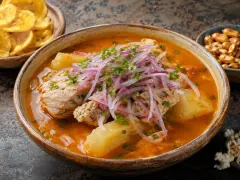 Encebollado de PescadoGuayaquil's morning broth — albacore poached gently in aromatics, yuca boiled soft and half of it blended back in to thicken the pot, crowned with a towering mound of lime-pickled red onion that cuts the tuna oil the instant you stir it through.
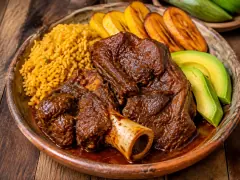 Seco de ChivoGoat shoulder braised for the best part of two hours in tart naranjilla pulp, dark beer and grated panela, reduced until the achiote oil splits back out along the surface — the Latin American marker that says the sauce is finished.
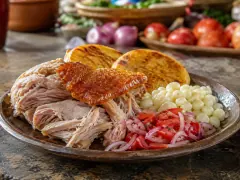 Hornado Serrano con Llapingachos y AgrioThe highland market plate — pork shoulder marinated a full day in garlic, cumin and chicha, roasted low until the collagen melts, then blasted at 230 °C so the dried skin puffs into brittle crackling. Served with potato patties, hominy and a sharp chicha agrio.
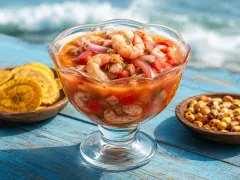 Ceviche de Camarón EcuatorianoNot the dry cured ceviche of Peru — this one is a cold soup. Shrimp poached for barely two minutes and ice-shocked, their shells boiled down into a concentrated broth, then whisked with lime, orange, grated tomato and a spoon of mustard into a glossy coral liquid.
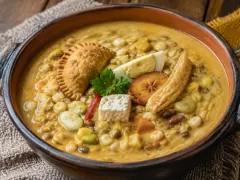 Fanesca TradicionalEcuador's Holy Week soup, and its most complex dish — twelve grains and legumes each cooked separately to its own texture, folded into a golden base of pumpkin, milk and ground roasted peanuts, with desalted cod, hard-boiled egg, fried plantain and tiny empanadas on top.
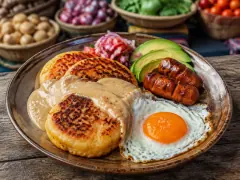 Llapingachos con Salsa de ManíGriddled potato patties from the Ambato market planchas — boiled in their skins, mashed dry, kneaded with achiote and scallions, wrapped around melting quesillo and chilled an hour so the starches set. Ladled with velvety peanut sauce and crowned with a fried egg.
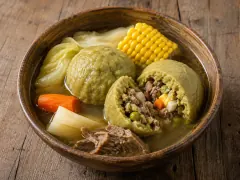 Caldo de Bolas de VerdeSoftball-sized green plantain dumplings poached in clear beef bone broth, each one stuffed with braised beef, hard-boiled egg, raisins and crushed peanuts. The dough is half boiled plantain and half raw grated, which is the only reason it holds together.
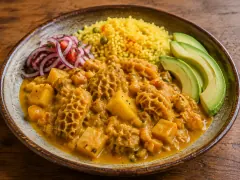 Guatita con Salsa de ManíNational comfort food — honeycomb tripe scoured with lime and coarse salt, simmered ninety minutes until tender, then finished in an achiote refrito with diced potatoes and ground roasted peanuts that thicken into a golden, clinging sauce.
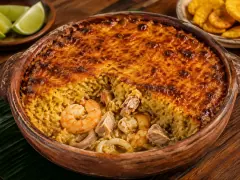 Cazuela de Mariscos ManabitaRaw green plantain grated to a wet pulp, whisked into hot seafood fumet with ground peanuts until the starches seize into a thick glossy batter, then loaded with raw tuna, shrimp and squid and baked in clay pailas until the top blisters brown.
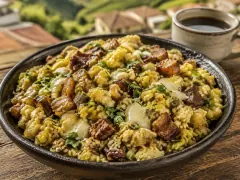 Tigrillo de Plátano VerdeBreakfast in the gold-mining mountains of Zaruma — green plantain boiled then flash-fried in lard, crushed coarse with a wooden pestle, and tossed in a hot skillet with garlic, warm milk, crispy chicharrón, melting farm cheese and beaten eggs.
Ecuador is small and absurdly varied. Four landscapes sit within a few hours of each other: the mist-shrouded Pacific coast, the volcanic spine of the Andes, the Amazon basin, and the Galápagos. Quito sits almost exactly on the equator, at 2,850 metres. That density is why this list splits so cleanly down the middle, coast against sierra, with the same three ingredients showing up on both sides in completely different roles.
Green plantain is the first of them, and it is treated as structural starch rather than as fruit. Grated raw, its ungelatinised granules seize into a thick batter when they hit hot stock — that is the whole mechanism behind cazuela manabita. Kneaded half raw and half boiled, those same granules gelatinise in place during poaching and form a leak-proof skin, which is the only reason the softball-sized dumplings in caldo de bolas survive the pot. Boiled, fried and then crushed coarse with a wooden pestle, it becomes tigrillo. Three dishes, one ingredient, three entirely different states of its starch.
The second is peanut. Roasted, ground and dissolved into milk or broth, pasta de maní turns up in guatita, in the salsa ladled over llapingachos, in fanesca, and in the coastal cazuela. Its vegetable proteins and emulsified lipids bind with milk caseins into sauces that stay velvety instead of splitting. The third is achiote — annatto steeped in warm oil — which carries fat-soluble colour into almost everything here and accounts for the shared orange cast across half these plates.
Restraint with heat runs through the seafood. Albacore for encebollado is poached at 85 °C so the muscle fibres stay supple; shrimp for ceviche get 90 to 120 seconds and an ice bath, because past 65 °C they turn to rubber. Ecuadorian ceviche is worth flagging for anyone expecting the Peruvian version: it is cold, soupy and eaten with a spoon, built on a broth boiled down from the shrimp shells rather than served dry.
Two dishes stand slightly apart. Fanesca is cooked once a year in Holy Week and demands twelve grains and legumes each simmered separately to its own texture, folded into a base of squash, milk and peanut alongside cod that has soaked a full day. And hornado runs two opposing thermodynamics through one oven: hours at 150 °C to melt the shoulder collagen, then a blast at 230 °C that flashes the water trapped under the dried skin into steam and puffs it into brittle crackling.