Cazuela de Mariscos Manabita
Raw green plantain grated to a wet pulp, whisked into hot seafood fumet with ground peanuts until the starches seize into a thick glossy batter, then loaded with raw tuna, shrimp and squid and baked in clay pailas until the top blisters brown.
- Prep
- 40 min
- Cook
- 25 min
- Serves
- 6 individual clay pailas (20 cm / 8 in), or one 23×33 cm / 9×13 in dish
- Difficulty
- Hard
Researched · Kitchen testing pending
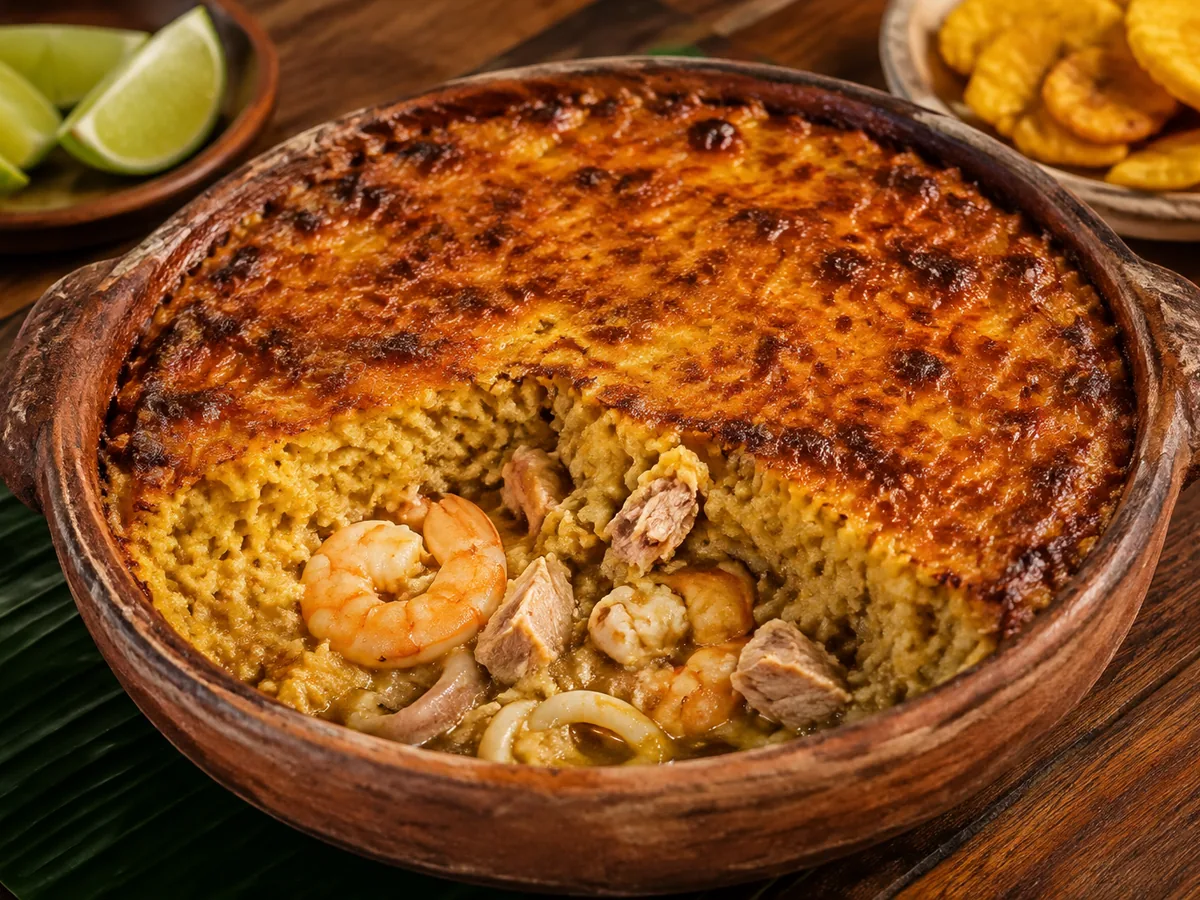
In the coastal province of Manabí, culinary tradition revolves around the clay oven and the plantain grove, and cazuela de mariscos honours both.
Raw green plantains are grated on the finest teeth of a box grater into a wet pulp, then whisked with rich fish fumet, an achiote-scented refrito and freshly ground roasted peanut paste. Cooked in a pot until glossy and thick, the batter is loaded with fresh albacore tuna, plump shrimp and tender squid.
Poured into preheated clay pailas de barro and baked at high heat, it emerges bubbling violently, with a dark, toasted crust on top and molten, savoury seafood beneath.
Batter base
- 4 large4 largeGreen plantains (plátanos verdes), peeled and kept rawabout 600 g of grated pulp
- 1 L4.2 cupsRich seafood fumetfrom fish bones, shrimp shells, white wine and aromatics
- 150 g1 cupRoasted unsalted peanuts, ground with 150 ml warm water into a smooth paste
Refrito
- 60 ml4 TbspAchiote oil (annatto-infused oil)
- 2 large2 largeRed onions, peeled and cut into fine 6 mm / ¼ in brunoise dice
- 6 cloves6 clovesFresh garlic, minced to a paste
- 2 large2 largeRipe plum tomatoes, peeled, seeded and finely chopped
- 1 large1 largeGreen bell pepper, cored and diced fine
- 8 g2 tspGround cumin seeds, freshly toasted
- 4 g1½ TbspDried wild oregano, hand-crushed
- 15 g1 TbspFine sea saltdivided
- 3 g1 tspFreshly ground black peppercorn
Seafood
- 400 g14 ozFresh albacore tuna or sea bass loin, cut into 3 cm / 1.2 in cubes
- 400 g14 ozFresh raw shrimp, peeled and deveined
- 200 g7 ozFresh squid tubes, cleaned, scored and cut into rings
- 30 g½ cupFresh cilantro, finely chopped
To serve
- For serviceFor serviceSteamed white rice, lime wedges and crisp plantain chifles
Raw plantain, not mashed
Unlike cooked plantain mash, finely grated raw green plantain is loaded with unhydrated native starch granules. Whisked into hot seafood stock with ground peanut paste and cooked over medium heat, those starches absorb water and swell between 70 °C and 78 °C / 158–172 °F, seizing suddenly into a thick, glossy, gelatinous batter.
Always dissolve in cold stock first
Tipping grated raw plantain straight into boiling liquid gives you lumps. Whisk the pulp smooth into cold fumet before any of it touches the hot pot.
The seafood goes in raw
Pre-cooking the fish and shrimp is the fastest route to a rubbery casserole. They are folded raw into the warm batter, and the 20-minute bake brings them to tender, juicy doneness at 60–63 °C / 140–145 °F while the core of the dish reaches 74 °C / 165 °F.
What the clay contributes
Baked in preheated unglazed earthenware at 200 °C / 400 °F, the porous clay radiates slow, even heat from the sides, cooking the delicate seafood gently while the exposed surface browns and dehydrates into a fragrant, toasted crust.
Passive time, counted separately
The baked pailas rest 5 minutes before service. That is not active work and sits outside the times quoted above.
The five tastes on this plate
Salt comes through the concentrated fumet and the seasoned plantain batter. Fat is achiote oil, peanut paste lipids and rich seafood oils. Acid is naturally low in a dish this dense, brightened at the table with lime squeezed over the hot crust. Heat is toasted cumin, garlic, cracked black pepper and optional ají de árbol. Umami is the fumet reduction, the tuna, squid and shrimp, and the roasted peanut paste.
Equipment
- Heavy 6 qt Dutch oven
- Box grater
- Whisk
- Silicone spatula
- Six clay pailas 20 cm / 8 in, or 10–12 oz gratin dishes
- Sturdy baking sheet
- Offset spatula
- Probe thermometer
Traditionally unglazed coastal clay bowls, pailas de barro manabitas, preheated in a wood-fired oven. Individual 10-to-12 oz ceramic or enamelled cast-iron baking dishes work in a modern kitchen — both insulate the batter, keeping the interior moist while the top forms a crisp, baked crust.
Method
Cook the achiote refrito14–16 min
Heat 60 ml achiote oil in a heavy 6-quart Dutch oven over medium heat. Add the diced red onions, garlic and green bell pepper and sweat 8 to 10 minutes until soft and translucent.
Add the chopped tomatoes, cumin, oregano, black pepper and 1 tsp salt, and cook down 6 minutes into a glossy, fragrant sofrito paste.
Heat 60 ml achiote oil over medium heat. Sweat onion, garlic and green pepper for 8–10 minutes until soft and translucent. Add tomatoes, cumin, oregano, black pepper and 1 tsp salt; cook 6 minutes into a glossy paste.
Grate the raw green plantains12 min
Peel the raw green plantains.
Using the finest star-shaped teeth of a box grater, grate them into a bowl until you have a fine, wet pulp — about 600 g.
Peel the raw green plantains and grate on the finest star-shaped teeth of a box grater, collecting about 600 g fine, wet pulp.
Build and thicken the plantain-peanut batter8–10 min
In a large bowl, whisk the grated plantain pulp with 500 ml cold seafood fumet until completely smooth, with no lumps.
Pour the slurry into the Dutch oven with the hot refrito. Add the remaining 500 ml fumet and the peanut paste, and whisk constantly over medium heat.
As the mixture approaches 75 °C / 167 °F, the plantain starches gelatinise suddenly, turning the watery liquid into a thick, glossy, bubbling batter. Season with salt and pepper and pull it off the heat.
Blend peanuts with 150 ml warm water into paste. Whisk plantain with 500 ml cold fumet until smooth before adding to hot refrito. Add remaining 500 ml fumet and peanut paste; whisk constantly over medium heat until thick and bubbling near 75 °C / 167 °F. Season; remove from heat.
Fold in the fresh seafood5 min
Season the tuna cubes, raw shrimp and squid rings with salt and a pinch of cumin.
Fold the raw seafood and the chopped cilantro directly into the warm batter with a silicone spatula. The residual heat begins warming the proteins.
Season tuna cubes, raw shrimp and squid rings with salt and a pinch of cumin. Fold them, still raw, into the warm batter with chopped cilantro using a silicone spatula.
Fill and bake the clay pailas23–24 min
Preheat the oven to 200 °C / 400 °F and brush six clay pailas with a little oil.
Divide the batter and seafood evenly among the dishes, smoothing the tops with an offset spatula, and set them on a sturdy baking sheet.
Bake on the middle rack 20 minutes, until bubbling vigorously, then switch to high broil for 3 to 4 minutes until the surface blisters with toasted golden-brown patches. The core must reach 74 °C / 165 °F.
Preheat oven to 200 °C / 400 °F. Oil six clay pailas; divide batter and seafood evenly, smooth tops and place on a sturdy tray. Bake on middle rack 20 minutes; broil high 3–4 minutes until blistered golden. Core must reach 74 °C / 165 °F.
Rest and serve
Take them out and rest 5 minutes — warn guests that the clay holds intense heat.
Serve directly in the baking dishes with steamed white rice, chifles and fresh lime wedges.
Remove the pailas and rest 5 minutes. Warn diners that the clay remains intensely hot; serve in the dishes with steamed white rice, chifles and fresh lime wedges.
Sensory cues of doneness
- Visual: a deep golden-brown toasted crust across the top, vigorous bubbling along the clay rim, and succulent pink shrimp and white fish beneath.
- Auditory: excited, persistent bubbling and hissing from the edge of the dish as steam escapes.
- Olfactory: toasted green plantain, roasted peanuts, sweet shrimp, sea fish, cumin and hot clay.
Look for a deeply golden, toasted crust, vigorous bubbling around the rim, and juicy pink shrimp and white fish underneath, with aromas of toasted plantain, peanuts and seafood.
Troubleshooting
- Lumpy plantain batter.
Grated raw plantain was tipped into boiling liquid. Always whisk it smooth into cold stock before it goes anywhere near heat.
- Overcooked seafood.
The fish and shrimp were cooked before baking. They go into the batter completely raw — the 20-minute bake brings them to tender doneness.
- A scorched batter.
The batter was not stirred while heating. Raw plantain starches stick to hot metal fast; whisk continuously over medium heat.
Substitutions
One-to-one global substitutions, with the technique adjustment each one requires.
Ingredient substitutions
| Ingredient | Replace with | Culinary impact and technique adjustment |
|---|---|---|
| Albacora (albacore) | Mahi-mahi, sea bass or halibut | One-to-one. Cut into sturdy 3 cm chunks |
| Green plantains | No substitute — they must be completely green and unripened | Only green plantains carry the high starch content needed to thicken the batter |
| Roasted peanuts | Pure natural unsalted peanut butter | One-to-one. Whisk it into warm stock |
Scaling
Half, for 3 pailas
Halve the ingredients. The bake stays at 20 minutes at 200 °C.
Double, for 12 portions
Double the ingredients, and thicken the batter in two separate pots so it heats evenly.
What to serve it with
- Arroz blanco caliente — steamed white rice, to balance the rich plantain-peanut casserole
- Chifles — crisp, thin salted green plantain chips
- Fresh lime wedges, squeezed over the hot crust at the table
- Ají manaba — the Manabí-style spicy pickled chilli condiment
- A chilled Pilsener or fresh coconut water
Questions
Can I use a single large casserole dish instead of individual clay pailas?
Yes. Pour the batter into a 23×33 cm / 9×13 in ceramic dish and bake at 200 °C / 400 °F for 25 to 30 minutes, then broil 3 minutes.
How do I grate raw green plantains without tiring my hands?
Cut the peeled raw plantain into 2.5 cm chunks and process them with 250 ml of cold stock until completely smooth and puréed.
Can I use other seafood?
Yes. Mussels, clams, crab meat, or firm white fish fillets like mahi-mahi or sea bass all work wonderfully.