Tigrillo de Plátano Verde
Breakfast in the gold-mining mountains of Zaruma — green plantain boiled then flash-fried in lard, crushed coarse with a wooden pestle, and tossed in a hot skillet with garlic, warm milk, crispy chicharrón, melting farm cheese and beaten eggs.
- Prep
- 20 min
- Cook
- 25 min
- Serves
- 4 breakfast portions
- Difficulty
- Easy
Researched · Kitchen testing pending
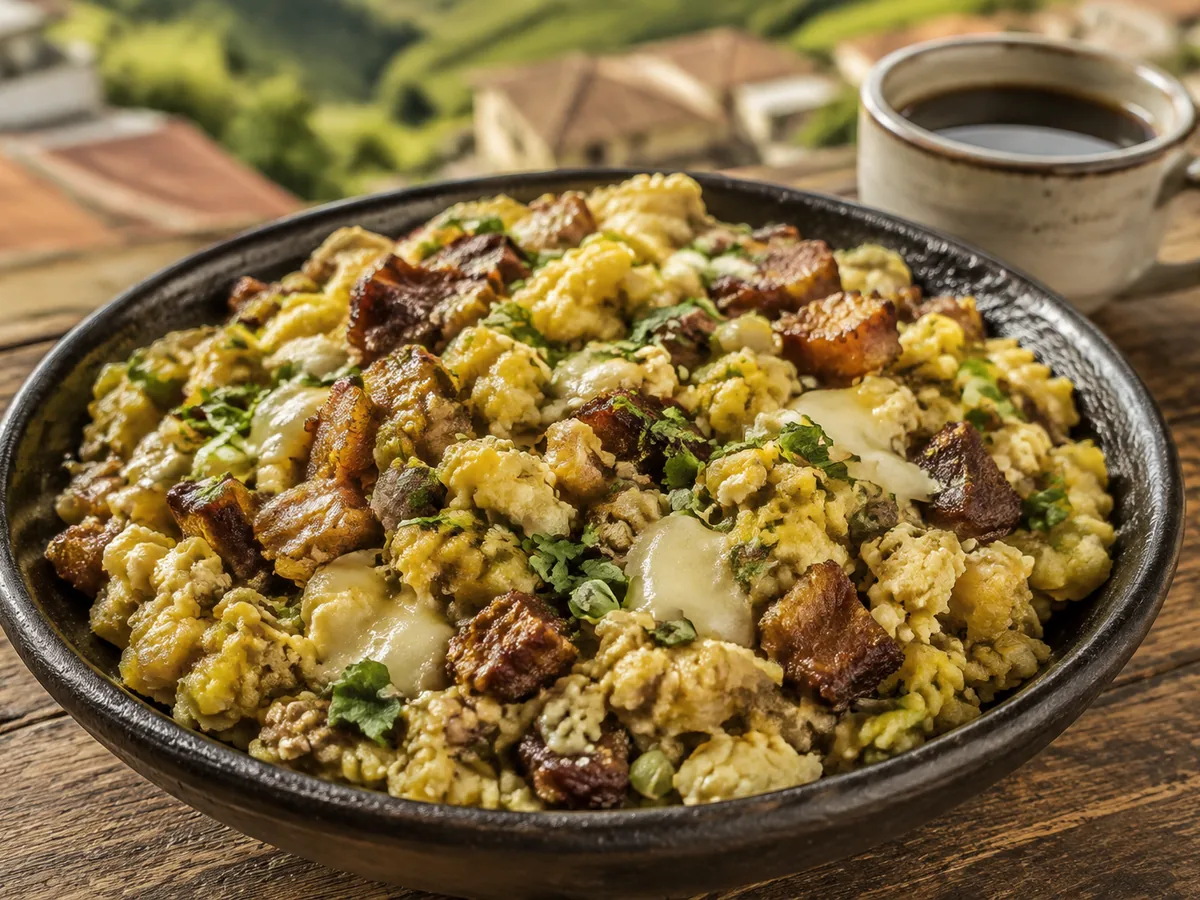
High in the misty gold-mining mountains of Zaruma, in southern Ecuador, the morning starts with tigrillo. The name comes from the tiger-striped look of golden plantain flecked with dark brown pork cracklings.
Unripened green plantains are cut into thick rounds, boiled in salted water until tender, then fried briefly in rendered pork lard until golden outside and still soft within. The hot plantains go into a wooden trough and are crushed with a heavy pestle into a chunky mash.
Tossed in a screaming-hot skillet with minced garlic, warm milk and crispy fried pork belly, then folded with generous handfuls of fresh melting farm cheese and beaten eggs over gentle heat, it is legendary comfort food — served beside a cup of freshly brewed Zaruma mountain coffee.
Plantains
- 4 large4 largeGreen plantains (plátanos verdes), peeled and sliced crosswise into 3 cm / 1.2 in rounds
- 60 ml4 TbspRendered pork lard (manteca de cerdo), or extra-virgin olive oildivided between the fry and the skillet
- 8 g1½ tspFine sea saltplus extra to taste
- 2 g½ tspFreshly ground black peppercorn
The skillet
- 300 g10.5 ozCrispy pork belly cracklings (chicharrón de cerdo), chopped into bite-sized nuggets
- 4 cloves4 clovesFresh garlic, peeled and minced fine
- 2 bunches (40 g)½ cupScallions (cebolla blanca), finely sliced
- 15 ml1 TbspAchiote oilfor the warm sunset-orange colour
- 120 ml½ cupWhole milk, warmed
Cheese and eggs
- 250 g2 cupsFresh artisanal highland cheese (queso de comida or quesillo), crumbled or coarsely shredded
- 4 large4 largeFarm-fresh eggs, at room temperature, lightly beaten with a fork
- 15 g¼ cupFresh cilantro leaves, finely choppedfor garnish
Boiled first, then fried
Green plantains are packed with resistant starch granules that are unpalatable raw. Boiling the thick rounds hydrates and gelatinises the interior starches so the core turns tender and mashable. Frying them afterwards in hot lard at about 180 °C / 356 °F for barely three minutes drives off surface moisture and triggers the Maillard reaction, adding nutty, caramelised crust notes.
Crush, never purée
Mashing with a wooden pestle while the plantain is hot breaks it into coarse, jagged boulders. A food processor turns the same plantain into gummy, gluey paste — the texture is the whole point of the dish.
Why the milk goes in warm
Crushed plantain absorbs liquid rapidly. Warm milk added in the skillet is drawn into the broken starches, creating a moist, creamy base instead of a dry, choking mash.
Low heat for the eggs
Folding the beaten eggs and cheese in over low heat, around 65 °C / 149 °F, lets the egg proteins coagulate into delicate soft curds while the fresh cheese melts into stretchy strands. High heat scrambles them dry and rubbery.
The five tastes on this plate
Salt comes through the boiling water, the cured chicharrón and the salty fresh cheese. Fat is rendered pork lard, crisp pork belly, whole milk and buttery egg yolks. Acid is naturally low, refreshed at the table with lime or pickled chillies. Heat is minced garlic, scallions and cracked black pepper. Umami is the fried cracklings, aged lard and farm eggs.
Equipment
- 4 qt pot
- 12 in well-seasoned cast-iron skillet
- Slotted spatula
- Wooden pestle, meat mallet or potato masher
- Large wooden board or sturdy mixing bowl
- Wooden spatula
Traditionally a wooden trough (batea de madera) with a heavy wooden pestle, cooked in a cast-iron skillet. A large wooden cutting board or sturdy mixing bowl with a heavy flat-bottomed meat mallet or potato masher does the same job, paired with a 12-inch well-seasoned cast-iron skillet — cast iron holds high heat, which warms the pork and melts the cheese rapidly.
Method
Boil the plantain rounds15–18 min
Bring 2 litres of water and 1 Tbsp salt to a rolling boil in a 4-quart pot.
Drop in the peeled 3 cm plantain rounds and boil over medium-high heat 15 to 18 minutes, until a knife pierces the centre with zero resistance. Drain immediately.
Bring 2 L water and 1 Tbsp salt to a rolling boil. Add peeled 3 cm plantain rounds; boil over medium-high heat 15–18 minutes until a knife enters without resistance. Drain immediately.
Flash-fry in lard5–6 min
Melt 30 ml pork lard in a 12-inch cast-iron skillet over medium-high heat until shimmering.
Add the boiled rounds and fry 2 to 3 minutes per side, until a light golden crust forms outside while the inside stays soft.
Lift them out with a slotted spatula onto a board or wooden bowl.
Heat 30 ml lard in a cast-iron skillet over medium-high heat, around 180 °C / 356 °F. Fry boiled plantain rounds 2–3 minutes per side until lightly golden outside and soft inside; lift onto a board or wooden bowl.
Pound the rustic mash4 min
Using a wooden pestle, meat mallet or potato masher, crush the plantains firmly while they are still steaming hot.
You want a coarse, textured mash with bite-sized chunks and tender flakes. Do not purée it into baby food.
Crush the plantains while steaming hot with a wooden pestle, mallet or potato masher. Leave coarse, bite-sized chunks and tender flakes; do not purée or use a food processor.
Sauté the aromatics and chicharrón4 min
In the same skillet over medium heat, add the remaining 30 ml lard and the 15 ml achiote oil.
Add the minced garlic and sliced scallions and cook 2 minutes until fragrant and soft, then add the chopped chicharrón, tossing 2 minutes until hot and sizzling.
In the same skillet over medium heat, add remaining 30 ml lard and 15 ml achiote oil. Cook garlic and scallions 2 minutes until soft and fragrant; toss in chopped chicharrón for 2 minutes until hot and sizzling.
Toss the mash with warm milk3 min
Tip the crushed plantain into the skillet with the chicharrón and scallions.
Pour the 120 ml warm milk over it and fold continuously with a wooden spatula over medium heat for 3 minutes, as the starches drink in the milk and pork fat and turn creamy and moist. Season with salt and pepper.
Add crushed plantain to the chicharrón and scallions. Pour in 120 ml warm milk; fold continuously over medium heat for 3 minutes until moist and creamy. Season with salt and pepper.
Fold in the cheese and eggs2–3 min
Turn the heat to low. Pour the beaten eggs and crumbled cheese over the plantains.
Fold everything together gently for 2 to 3 minutes: the eggs set into soft, creamy curds and the cheese melts into gooey, stretchy pockets.
Pull it off the heat immediately, while it is still moist and glossy.
Reduce heat to low, around 65 °C / 149 °F. Add beaten eggs and crumbled cheese; fold gently 2–3 minutes until eggs form soft curds and cheese melts into stretchy pockets. Remove immediately while moist and glossy.
Garnish and serve
Scoop towering portions onto warm plates and scatter chopped cilantro over the top.
Serve immediately alongside a fried egg or avocado slices, with a steaming mug of black coffee.
Spoon generous portions onto warm plates and scatter with chopped cilantro. Serve immediately with a fried egg or avocado slices alongside and a steaming mug of black coffee.
Sensory cues of doneness
- Visual: a vibrant golden-orange plantain mash flecked with crispy dark-brown cracklings, soft scrambled egg curds and stretchy white cheese.
- Auditory: the rhythmic thumping of the wooden pestle against the bowl, then a gentle sizzle as the eggs fold into the hot skillet.
- Olfactory: rendered pork cracklings, fried green plantain, toasted garlic, warm melted cheese and sweet milk.
Look for golden-orange, chunky plantain with crisp dark-brown chicharrón, soft egg curds and stretchy white cheese. Keep the final sizzle gentle and check for aromas of fried plantain, toasted garlic, pork and warm cheese.
Troubleshooting
- A sticky, gluey paste.
A food processor was used. Always crush with a wooden masher or mallet to preserve the coarse texture.
- A dry, choking texture.
The warm milk step was skipped. Crushed plantains absorb moisture rapidly, and warm milk keeps the dish creamy and tender.
- Dry, rubbery eggs.
The skillet was still on high heat when the eggs went in. Turn it to low and fold gently until just set.
Substitutions
One-to-one global substitutions, with the technique adjustment each one requires.
Ingredient substitutions
| Ingredient | Replace with | Culinary impact and technique adjustment |
|---|---|---|
| Chicharrón de cerdo | Crispy thick-cut pork belly lardons, or smoked bacon | One-to-one. Fry until properly crisp |
| Queso de comida / quesillo | Queso fresco, or equal parts fresh mozzarella and feta | One-to-one. Provides both the salt and the melt |
| Pork lard | Unsalted butter or olive oil | One-to-one. Butter brings its own richness |
Scaling
Half, for 2 portions
Halve the ingredients. The cooking times stay the same.
Double, for 8 portions
Double the ingredients across two 12-inch skillets, so the plantains toss and heat through evenly.
What to serve it with
- Café de Zaruma pasado — strong, freshly dripped black coffee from Zaruma Arabica beans
- Huevo frito extra — an extra crispy-edged fried egg on top, for anyone wanting a runny yolk
- Tajadas de aguacate — fresh ripe avocado slices
- Ají de tomate de árbol — Ecuadorian tree-tomato hot sauce
- Fresh orange juice, or rich spiced hot chocolate
Questions
What is the difference between tigrillo, majado and bolón?
Bolón is mashed plantain shaped into a dense round ball and deep-fried. Majado is boiled green plantain mashed with refrito. Tigrillo is boiled and fried plantain, mashed, then cooked in a skillet with milk, eggs, chicharrón and cheese.
Can I make tigrillo with smoked bacon instead of chicharrón?
Yes. Thick-cut smoked slab bacon cut into small lardons and crisped in a skillet makes a fantastic, smoky alternative.
What cheese should I use outside Ecuador?
Fresh queso fresco, queso costeño, or a 50/50 mix of fresh mozzarella for melting stretch and salted feta for brine.