Ceviche de Camarón Ecuatoriano
Not the dry cured ceviche of Peru — this one is a cold soup. Shrimp poached for barely two minutes and ice-shocked, their shells boiled down into a concentrated broth, then whisked with lime, orange, grated tomato and a spoon of mustard into a glossy coral liquid.
- Prep
- 25 min
- Cook
- 2 min
- Serves
- 6 portions
- Difficulty
- Easy
Researched · Kitchen testing pending
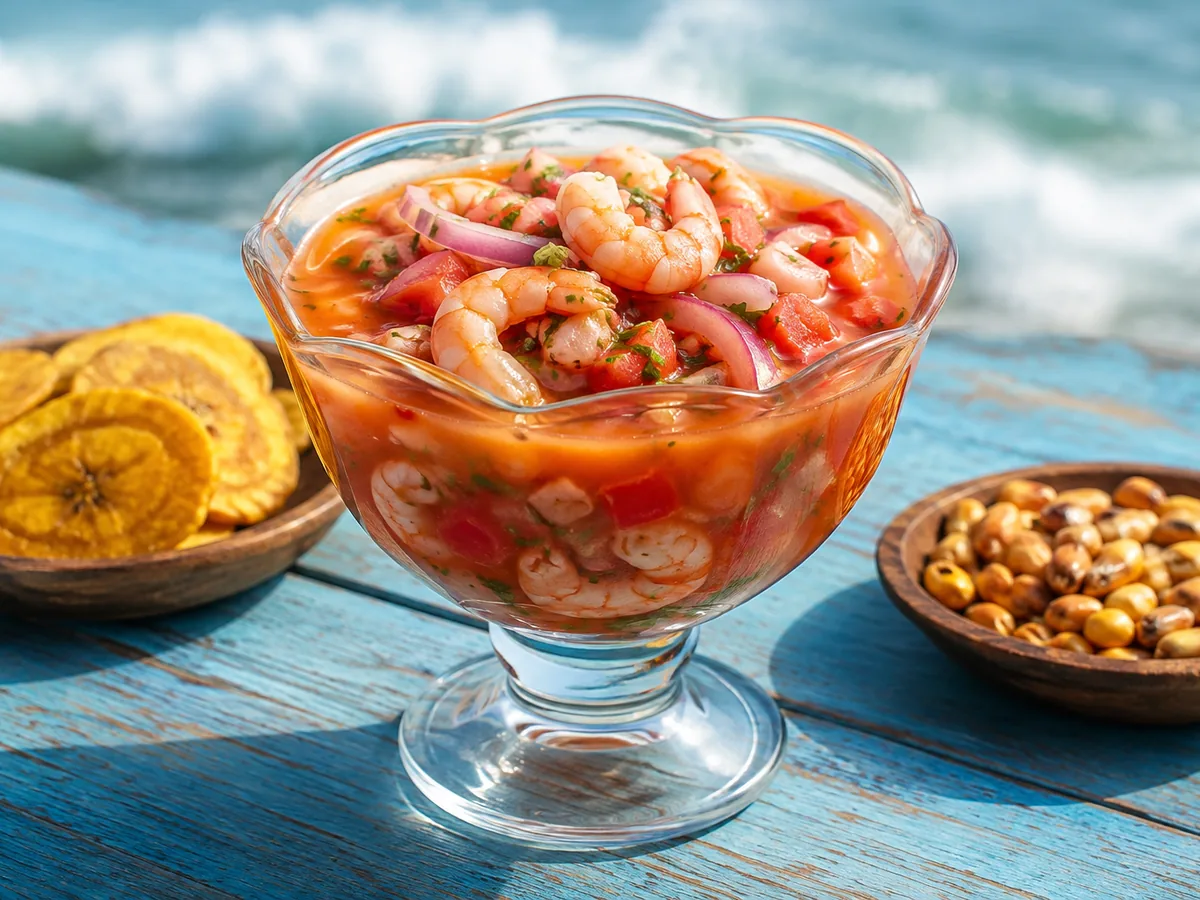
Unlike the dry, raw-cured fish ceviches of neighbouring Peru, Ecuadorian shrimp ceviche is cold, soupy and refreshing — spooned from wide bowls along with its broth. It comes from the mangrove coasts of Esmeraldas, Manabí and El Oro.
The shrimp are poached in salted water for barely two minutes, then shocked in ice. The cooking liquid is boiled down into a savoury shrimp broth that forms the foundation of the soup. Mixed with fresh bitter orange and lime juice, grated raw tomatoes, paper-thin red onions and cilantro, it becomes a bright coral broth dotted with sweet, plump shrimp.
A splash of unrefined oil gives it a glossy sheen. It is served with mountains of green plantain chips and toasted corn.
Shrimp and broth
- 1 kg2.2 lbLarge raw Pacific shrimp, about 21/25 count, shell-on and head-on, deveinedthe shells are the broth — do not discard them
- 1 L4.2 cupsCold filtered waterfor boiling the shells down into concentrated broth
- 15 g1 TbspFine sea salt10 g for poaching, 5 g for curing the onions
The cold broth
- 4 large4 largeRipe plum tomatoes, peeledtwo grated on a box grater into fresh pulp, two finely diced
- 60 ml¼ cupFreshly squeezed orange juicesweet, or bitter Seville orange
- 15 ml1 TbspSmooth prepared yellow mustarda classic coastal touch, and the emulsifier
- 45 ml3 TbspExtra-virgin olive oil, or neutral sunflower oil
- 2 g½ tspFreshly ground white pepper
Curtido and finish
- 2 large2 largeRed onions, peeled and sliced into paper-thin half-moons
- 120 ml½ cupFreshly squeezed lime juiceabout 6 limes
- 30 g½ cupFresh cilantro leaves, finely chopped
- A few dropsA few dropsAjí de árbol hot pepper sauceoptional, to taste
Ninety seconds, then ice
Shrimp muscle proteins contract rapidly past 65 °C / 149 °F, expelling moisture and turning rubbery. Poaching for just 90 to 120 seconds until they turn opaque pink — 60–63 °C / 140–145 °F — then plunging them straight into an ice bath halts the cooking instantly.
The shells are half the flavour
Boiling the reserved shells extracts water-soluble glutamic acid and astaxanthin into the liquid. Reduced and chilled, that broth is the foundation of the soup; cooking the shrimp in plain water and binning the shells throws the seafood flavour away.
What the mustard is doing
It acts as a surfactant. Its natural mucilage and phospholipids stabilise a light, temporary emulsion when the chilled shrimp broth is whisked with lime juice, raw tomato pulp and oil, giving the liquid a velvety mouthfeel instead of a thin, watery one.
Passive time, counted separately
The broth chills before mixing, and the assembled ceviche rests 20 to 30 minutes in the refrigerator so the shrimp absorb the citrus. Neither is active work, and both sit outside the times quoted above.
The five tastes on this plate
Salt comes through the poaching water and the sea salt macerating the shaved onions. Fat is the whisked finishing oil, forming a light emulsion that coats the cold shrimp. Acid is the electric tang of lime and Seville orange. Heat is mustard sharpness, raw red onion and clean white pepper. Umami is the concentrated shell reduction married to raw tomato pulp.
Equipment
- 3 qt saucepan
- Potato masher
- Fine sieve
- Slotted spoon
- Large stainless steel or glass mixing bowl
- Ice bath
Traditionally wide glass or ceramic bowls chilled over ice. In a modern kitchen use stainless steel mixing bowls set over an ice water bath — and avoid reactive aluminium or copper, since the high citrus acidity will leach metallic off-flavours straight into the ceviche.
Method
Peel the shrimp and extract the fumet20 min
Peel the raw shrimp, keeping the tails on if you like, and reserve every shell and head.
Put the shells into a 3-quart saucepan with 1 litre of cold water and 10 g sea salt. Bring to a boil over medium-high heat and simmer 12 minutes, mashing the shells with a potato masher to extract everything they have.
Strain through a fine sieve, pressing hard on the shells, then boil the strained liquid down to 400 ml. Chill in the refrigerator until cold.
Peel shrimp, reserving shells and heads. Simmer shells in 1 L cold water with 10 g salt for 12 minutes, crushing them. Strain through a fine sieve, pressing shells; reduce liquid to 400 ml and refrigerate until cold.
Flash-poach and ice-shock the shrimp2 min
Bring a pot of salted water to a rolling boil and drop in the peeled shrimp.
Cook for strictly 90 to 120 seconds. They will curl into loose C shapes and turn coral-pink.
Lift them straight into a bowl of ice water with a slotted spoon, chill 3 minutes, then drain thoroughly and pat dry. Keep refrigerated.
Drop peeled shrimp into boiling salted water for 90–120 seconds, until opaque coral-pink and loosely C-shaped (60–63 °C / 140–145 °F). Immediately transfer to ice water for 3 minutes; drain, pat dry and refrigerate.
Cure the red onions12 min
Put the paper-thin red onions in a bowl, sprinkle with 5 g salt, and rub it in with your fingers for 30 seconds. Rinse in a sieve under cold water and drain well.
Toss with the 120 ml lime juice and leave 10 minutes, until vibrant pink and crisp.
Rub thinly sliced onions with 5 g salt for 30 seconds. Rinse under cold water and drain thoroughly; toss with 120 ml lime juice and leave 10 minutes until bright pink and crisp.
Mix the ceviche broth3 min
In a large chilled bowl, combine the cold shrimp reduction, grated tomato pulp, diced tomatoes, orange juice, mustard, white pepper and 45 ml oil.
Whisk vigorously for 30 seconds until the oil emulsifies into a smooth, coral-orange broth, then stir in the cured onions along with all their lime juice.
In a chilled bowl, combine cold shrimp reduction, grated and diced tomatoes, orange juice, mustard, white pepper and 45 ml oil. Whisk vigorously 30 seconds until smooth; stir in cured onions and all their lime juice.
Fold and marinate
Add the chilled shrimp and chopped cilantro and stir gently.
Taste the liquid and adjust the salt, the lime, or add a few drops of hot pepper sauce.
Chill 20 to 30 minutes before serving, so the shrimp drink in the citrus broth.
Gently stir chilled shrimp and chopped cilantro into the broth. Taste and adjust salt and lime, adding a few drops of hot sauce if desired; refrigerate 20–30 minutes before serving.
Serve
Ladle generous portions of cold shrimp and broth into chilled wide bowls, making sure every serving gets plenty of liquid, shrimp and pink onion.
Serve immediately with chifles, tostado and canguil alongside.
Ladle the cold ceviche into chilled wide bowls, distributing plenty of broth, shrimp and pink onions in every serving. Serve immediately with chifles, tostado and canguil alongside.
Sensory cues of doneness
- Visual: a glistening, translucent coral-orange broth filled with plump pink-and-white shrimp, crimson onions and green cilantro.
- Auditory: the crisp, audible crunch of plantain chifles dipping into the cold soup.
- Olfactory: fresh lime, sweet ocean shrimp, bruised cilantro and raw summer tomato pulp.
Look for glossy coral-orange broth, plump pink-and-white shrimp, crimson onions and green cilantro. Serve with crisp chifles and check for fresh aromas of lime, shrimp, cilantro and tomato.
Storing it
Ecuadorian ceviche keeps exceptionally well for up to 24 hours in the refrigerator. The shrimp stay tender in the chilled citrus-tomato broth without turning mushy.
Troubleshooting
- Rubbery shrimp.
Five minutes in boiling water ruins them. Poach for strictly 90 to 120 seconds and plunge into ice water immediately.
- Throwing away the shells.
Cooking the shrimp in plain water and discarding the shells loses all the seafood flavour. Always boil the shells down into a concentrated broth.
- A thin, watery broth.
The mustard and oil were skipped. Together they emulsify the citrus into a rich, lip-coating liquid.
Substitutions
One-to-one global substitutions, with the technique adjustment each one requires.
Ingredient substitutions
| Ingredient | Replace with | Culinary impact and technique adjustment |
|---|---|---|
| Pacific shrimp | Wild Gulf shrimp or black tiger prawns | One-to-one. Keep the shells for the stock |
| Seville orange juice | Three parts sweet orange juice to one part fresh lime juice | One-to-one. Replicates bitter orange acidity |
| Red onion | Shallots or sweet Vidalia onions | One-to-one, though red onion gives the traditional colour |
Scaling
Half, for 3 portions
Halve the ingredients. Reduce the shell water to 600 ml and boil it down to 200 ml. The shrimp still poach for 90 to 120 seconds.
Double, for 12 portions
Double the ingredients, and poach the shrimp in two batches so the water temperature does not drop.
What to serve it with
- Chifles — thinly sliced green plantains fried crisp and salted
- Maíz tostado — crisp roasted Andean corn kernels, crunchy and nutty
- Canguil — light salted popcorn, for tipping straight into the bowl
- A cold Pilsener or fresh passion fruit juice, to cleanse the palate against the lime acid
Questions
Why is Ecuadorian ceviche served in broth while Peruvian ceviche is dry?
Ecuadorian coastal cooking prioritises the rich broth extracted from shellfish shells and citrus, producing a cold soup meant to be eaten with a spoon alongside crunchy plantains.
Can I use pre-cooked shrimp?
Pre-cooked commercial shrimp are almost always overcooked, and they lack the raw shells needed for the concentrated stock. Always start with raw, shell-on shrimp.
How long does this keep in the fridge?
Up to 24 hours. The shrimp stay tender in the chilled citrus-tomato broth without turning mushy.