Hornado Serrano con Llapingachos y Agrio
The highland market plate — pork shoulder marinated a full day in garlic, cumin and chicha, roasted low until the collagen melts, then blasted at 230 °C so the dried skin puffs into brittle crackling. Served with potato patties, hominy and a sharp chicha agrio.
- Prep
- 45 min
- Cook
- 4 hr
- Serves
- 8 generous feast portions
- Difficulty
- Hard
Researched · Kitchen testing pending
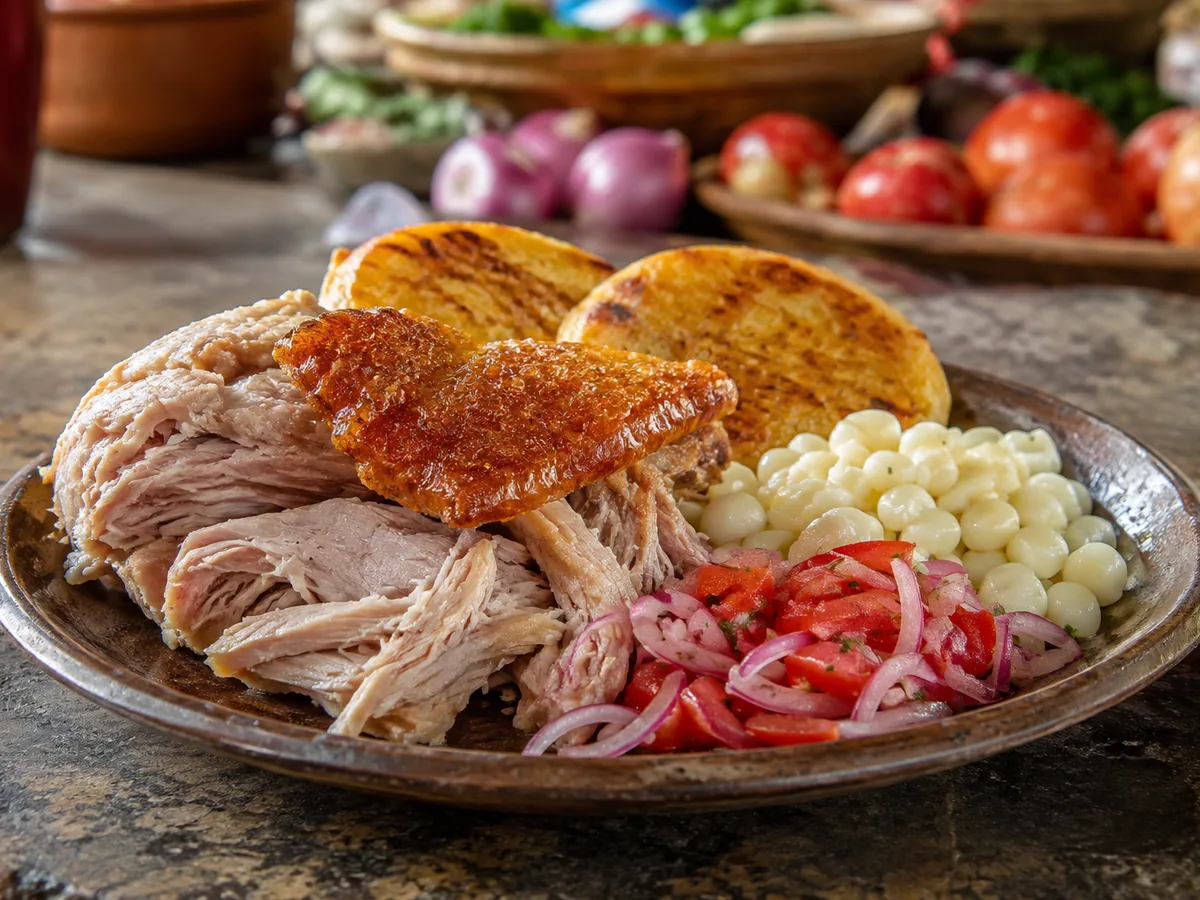
In the highland market halls of Riobamba, Latacunga and Cuenca, hornado vendors rule long rows of tiled stalls. Whole slow-roasted pigs lie on wooden trestles, their skin puffed into brittle, blistered glass, and vendors shear off shards of crackling and tender chunks of juice-soaked shoulder with heavy carving knives.
The meat marinates for a full day in an aliño of crushed garlic, toasted cumin, beer and chicha de jora. Plated alongside golden griddled potato patties and steaming hominy corn, the whole thing is drenched in agrio: a sharp, vinegary relish of chicha, lime, panela, raw red onion and tomato that cuts straight through the pork fat.
Pork and marinade
- 3 kg6.6 lbBone-in pork shoulder or fresh ham, skin on, scored with shallow diagonal slits across the skin
- 10 cloves10 clovesFresh garlic, peeled and smashed to a paste
- 15 g1 Tbsp + 1 tspGround cumin seeds, freshly toasted in a skillet
- 15 g1 TbspDried wild oregano, crushed
- 355 ml1 bottle (1.5 cups)Chicha de jora, or a crisp lager beer
- 60 ml4 TbspAchiote oil (annatto-infused oil)
- 30 g2 TbspFine sea salt20 g into the meat marinade, 10 g rubbed dry into the skin
- 5 g1½ tspFreshly ground black pepper
Agrio (the tart relish)
- 1 large1 largeRed onion, peeled and cut into fine 6 mm / ¼ in dice
- 2 large2 largeRipe plum tomatoes, seeded and finely diced
- 120 ml½ cupChicha de jora, or light beer
- 60 ml¼ cupFresh lime juice
- 30 ml2 TbspWhite wine vinegar
- 15 g1 TbspGrated panela cane sugar
- 20 g½ cupFresh cilantro, finely chopped
To serve
- 500 g3 cupsCooked hominy corn (mote cocido), warm
- 8 whole8 wholeLlapingachos (stuffed potato patties)the full formula is recipe 6 in this collection
Two opposing techniques in one roast
The meat needs long roasting at 150 °C / 300 °F to dissolve thick intramuscular connective tissue into gelatin. The skin needs the opposite: it must never steam, or it turns rubbery. Both happen in the same oven, in sequence.
Why the skin dries for 24 hours
Scoring the skin and rubbing it with salt draws moisture out by osmosis, and leaving it uncovered in the refrigerator overnight dehydrates the epidermis completely. In the final half hour, 230 °C / 450 °F radiant heat flashes the water trapped in the subcutaneous fat into steam, puffing the dried skin into bubbly, brittle crackling.
Passive time, counted separately
The pork marinates uncovered in the refrigerator for a full 24 hours, and the finished roast rests 20 minutes before carving. Neither is active work, and both sit outside the times quoted above.
A note on the roast timing
The source's summary table gives a total roast time of 4 hours 30 minutes, while its own steps specify 3 hours 30 minutes slow, then 25 to 30 minutes to blister. The figure quoted above follows the steps, since that is what you actually cook to.
The five tastes on this plate
Salt penetrates the meat overnight, and coarse salt dehydrates the skin for crackling. Fat is crisp rendered pork skin and melting shoulder fat. Acid is pungent fermented chicha, white vinegar and lime in the cold agrio. Heat is abundant garlic paste, toasted cumin, black pepper and raw red onion. Umami is caramelised roast drippings, the fermented marinade and sweet roasted onion.
Equipment
- Blender, for the marinade
- Heavy roasting pan
- Elevated metal V-rack
- Probe thermometer
- Heavy serrated bread knife
- Mixing bowl, for the agrio
Traditionally wood-fired adobe brick ovens, holding clay trays at around 160 °C for six hours. In a modern kitchen, use a heavy roasting pan fitted with an elevated metal V-rack — the rack lifts the pork above the rendering fat so the bottom does not stew, and lets air circulate around the skin.
Method
Marinate the pork — 24 hours ahead20 min
In a blender, combine the garlic paste, toasted cumin, oregano, chicha or beer, achiote oil, black pepper and 20 g sea salt. Blend into a thick marinade.
Pat the pork dry and cut shallow incisions into the flesh side, avoiding the skin. Rub the marinade thoroughly into the meat side.
Flip the roast skin-side up, wipe the skin completely dry with paper towels, and rub the remaining 10 g salt directly into the scored skin.
Set the roast on a rack in a pan, uncovered, in the refrigerator for 24 hours — this marinates the meat and dehydrates the skin at the same time.
Blend garlic, cumin, oregano, chicha or beer, achiote oil, pepper and 20 g salt. Dry pork; make shallow flesh-side incisions and rub marinade into meat only. Dry scored skin, rub with remaining 10 g salt; refrigerate skin-up on a rack, uncovered, 24 hours.
Slow-roast the meat3 hr 30 min
Preheat the oven to 150 °C / 300 °F. Pour 250 ml water into the bottom of the roasting pan, beneath the rack, keeping the skin completely dry.
Roast on the middle rack for 3 hours 30 minutes, basting the meat underneath occasionally with pan juices while keeping the top skin dry.
The pork core must reach 85 °C / 185 °F.
Preheat oven to 150 °C / 300 °F. Add 250 ml water beneath the roasting rack, keeping skin dry. Roast on the middle rack 3 hours 30 minutes, occasionally basting only the meat underneath. Pork core must reach 85 °C / 185 °F.
Blister the crackling25–30 min
Crank the oven to 230 °C / 450 °F, or switch to high convection. Wipe any oil droplets off the skin with a paper towel.
Roast 25 to 30 minutes, watching closely through the door: the dry skin will bubble, blister and puff into crisp golden-brown crackling.
Pull the roast out onto a cutting board and rest 20 minutes so the juices redistribute.
Raise oven to 230 °C / 450 °F or high convection. Wipe oil droplets from skin; roast 25–30 minutes, watching closely, until blistered, puffed and golden-crisp. Transfer to a board and rest 20 minutes before carving.
Whisk the agrio dressing5 min
Stir together the diced red onion, diced tomatoes, chicha or beer, lime juice, white vinegar, grated panela, 1 tsp salt and chopped cilantro.
Whisk until the panela dissolves. Taste — it should be sharp, tart and sweet.
Combine diced onion and tomatoes, chicha or beer, lime juice, white vinegar, grated panela, 1 tsp salt and chopped cilantro. Whisk until panela dissolves; taste for a sharp, tart-sweet balance.
Carve and plate the feast
Use a heavy serrated bread knife to slice off the sheet of crackling, then break it into large shards.
Carve the pork into thick slices, or pull it into rustic chunks with two forks.
On each plate set a portion of hot mote and two warm llapingachos, arrange the pork alongside, and crown with a shard of brittle crackling. Spoon the cold agrio generously over the meat and hominy. Serve immediately.
Remove crackling with a heavy serrated knife and break into shards. Slice or pull pork. Serve each plate with hot mote, two warm llapingachos, pork and crackling; spoon cold agrio generously over meat and hominy. Serve immediately.
Sensory cues of doneness
- Visual: the skin is a shattered mosaic of golden-amber blistered bubbles; the meat pulls apart into juicy, pale-pink shreds; the agrio is bright magenta and red.
- Auditory: a loud, glass-like shattering snap when a knife taps the crackling, and the steady drip of fat into the roasting pan.
- Olfactory: roasted pork fat, toasted cumin, pungent garlic paste and tart vinegar agrio.
Check for golden-amber blistered skin that snaps sharply when tapped, and juicy meat that pulls into pale-pink shreds. The agrio should be bright red and magenta, with tart vinegar and roasted garlic aromas.
Troubleshooting
- Chewy, leathery skin.
The skin stayed wet, or it was basted with marinade. Liquid prevents crackling — keep the skin completely dry and blast it with high heat only at the end.
- Dry pork meat.
The oven ran too hot from the start, drying the meat before the collagen melted. Roast slow at 150 °C / 300 °F and raise the heat only at the finish.
- Flat, bland agrio.
The chicha or panela was left out. Agrio needs the fermented depth of chicha and the molasses sweetness of panela to balance its sharp vinegar bite.
Substitutions
One-to-one global substitutions, with the technique adjustment each one requires.
Ingredient substitutions
| Ingredient | Replace with | Culinary impact and technique adjustment |
|---|---|---|
| Chicha de jora | Light German wheat beer, or hard apple cider with a splash of lemon | One-to-one. Provides the same yeast and lactic acid tang |
| Fresh pork leg | Skin-on pork shoulder (picnic roast) | One-to-one. Excellent collagen and fat balance |
| Panela | Dark brown sugar | One-to-one. Matches the molasses sweetness in the agrio |
Scaling
Half, for 4 portions
Use a 1.5 kg bone-in roast. Cut the slow roast to 2 hours 15 minutes, then blister at 230 °C for 20 minutes.
Double, for 16 portions
Use a 6 kg whole pork ham. Roast slow for 5 to 6 hours at 140 °C, then blister at 230 °C for 35 minutes.
What to serve it with
- Llapingachos — griddled potato patties stuffed with fresh melting cheese
- Mote cocido — steamed large-kernel Andean hominy, tender and chewy
- Salsa agrio — the tart chicha and lime relish spooned over the rich pork
- Tostado — crunchy roasted Andean corn kernels
- Canelazo caliente or cold chicha de jora — hot spiced aguardiente with cinnamon and naranjilla, or fermented corn chicha
Questions
Can I make this with pork shoulder instead of whole leg?
Yes. Bone-in, skin-on pork shoulder — picnic ham, or Boston butt with the skin intact — yields spectacular hornado with great fat marbling.
What if the skin does not blister in the oven?
If your oven lacks top radiant heat, use a clean kitchen blowtorch held about 10 cm from the skin, moving it constantly until the skin puffs into crisp crackling.
How do I store leftover crackling?
Eat crackling fresh. Refrigerating softens it with moisture. If you must reheat it, toast it skin-down in a hot dry skillet for 2 minutes to restore the crunch.