Seco de Chivo
Goat shoulder braised for the best part of two hours in tart naranjilla pulp, dark beer and grated panela, reduced until the achiote oil splits back out along the surface — the Latin American marker that says the sauce is finished.
- Prep
- 35 min
- Cook
- 2 hr 15 min
- Serves
- 6 portions
- Difficulty
- Hard
Researched · Kitchen testing pending
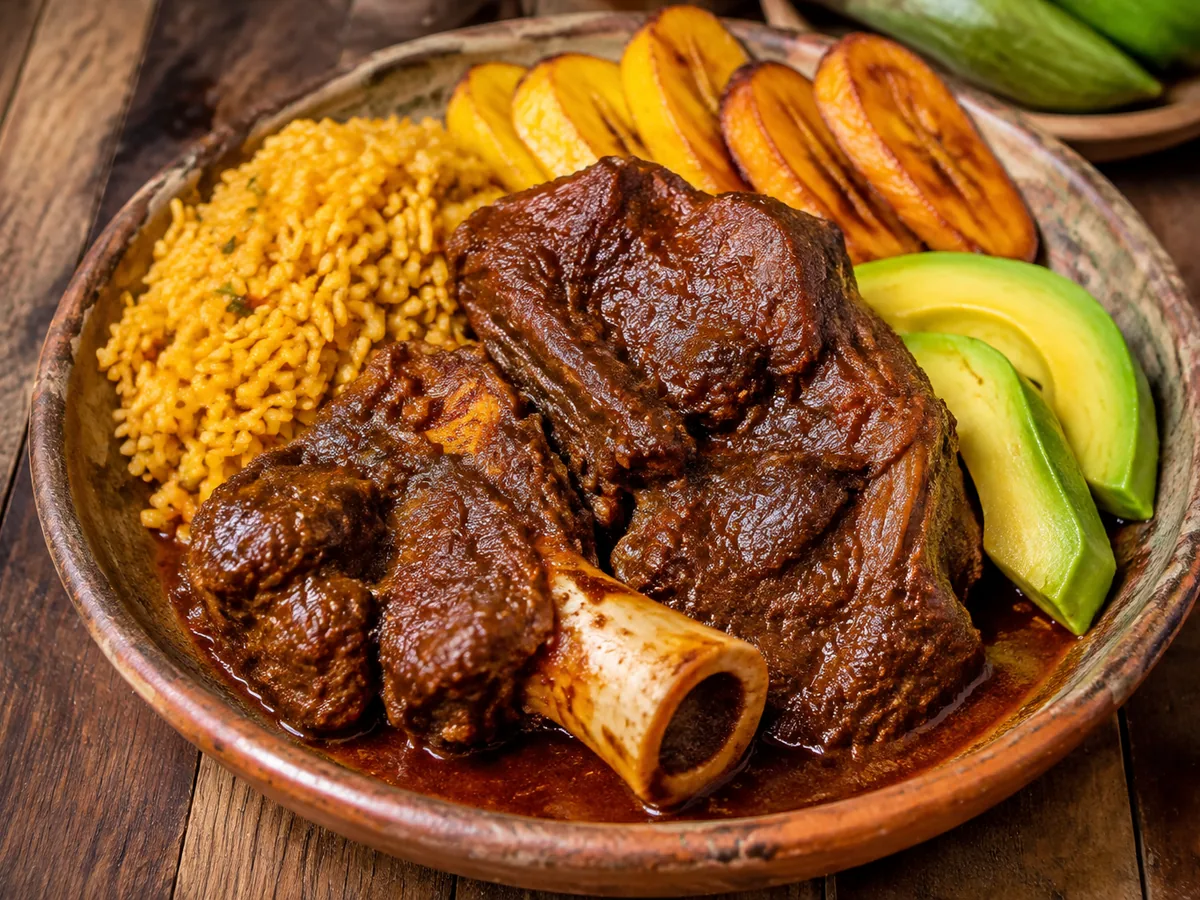
Across the dry coastal valleys of Santa Elena and the rugged ravines of Loja, seco de chivo is an institution. Despite the name, it is not a dry dish — in Ecuador a seco is a slow braise reduced until the fat separates back out.
The meat is goat shoulder or mature lamb, dense with flavour and collagen. What gives the dish its coastal identity is the cooking liquid: acidic green-fleshed naranjilla, dark malt beer or fermented corn chicha, and unrefined panela.
Simmered for hours in an achiote-stained refrito, the meat turns spoon-tender under a thick mahogany sauce balancing tart fruit, caramelised sugar and earthy goat fat.
Meat
- 1.5 kg3.3 lbBone-in goat shoulder or lamb shoulder, heavy exterior fat caps trimmed, cut into 6 large 250 g pieces
- 60 ml4 TbspAchiote oil (neutral oil infused with annatto seeds)divided between the sear and the refrito
Refrito
- 2 large2 largeRed onions, peeled and cut into fine 6 mm / ¼ in brunoise dice
- 6 cloves6 clovesFresh garlic, peeled and finely minced
- 2 large2 largeRipe plum tomatoes, peeled, seeded and chopped fine
- 1 large1 largeGreen bell pepper, cored, seeded and finely diced
Braising liquor
- 4 fresh (250 g)4 freshRipe naranjillas (lulos), peeled and puréed with 120 ml water, strained of seedsor 200 ml frozen naranjilla pulp
- 355 ml1 bottle (1.5 cups)Dark lager beeror chicha de jora, or an amber ale
- 40 g2 Tbsp gratedPanela (unrefined cane sugar), finely grated
Seasoning
- 8 g2 tspGround cumin seeds, freshly toasted in a dry pandivided between the sear and the refrito
- 4 g1½ TbspDried wild oregano, hand-crushed
- 2 g½ tspGround allspice (pimienta dulce)
- 16 g1 TbspFine sea saltplus extra to adjust
- 3 g1 tspCoarsely cracked black pepper
- 40 g1 cup packedFresh cilantro leaves and tender stems, finely choppeddivided between the braise and the finish
What "seco" actually means
Not a dry stir-fry. In Ecuador a seco is a slow braise reduced until the fat separates back out of the sauce — the marker cooks call cortar el aceite, which signals the water has boiled off and the flavour is fully concentrated.
Two things tenderise this meat
Goat and lamb shoulder are loaded with tough elastin and cross-linked type-I collagen. Naranjilla carries natural plant acids that begin working on the outer protein layers during the first simmering, and then a long braise held between 88 °C and 93 °C / 190–200 °F hydrolyses the collagen into soluble gelatin.
Where the dark colour comes from
Fructose in the grated panela and maltose in the beer react with the meat's amino acids through the Maillard reaction, building complex savoury melanoidins as the sauce reduces over two hours.
Passive time, counted separately
The finished braise rests 10 minutes before serving so the meat fibres reabsorb the sauce. That is not active work and sits outside the times quoted above.
The five tastes on this plate
Salt penetrates the dense goat muscle across the long braise. Fat is rendered goat tallow and warm achiote oil carrying fat-soluble carotenoids. Acid is the tart malic and citric bite of fresh naranjilla cutting the pungent animal lipids. Heat is toasted cumin, minced garlic, cracked pepper and warm allspice. Umami is the seared shoulder fond, reduced beer malt and caramelised tomato-onion refrito.
Equipment
- Heavy 7 qt enamelled cast-iron Dutch oven
- Blender, for the naranjilla purée
- Fine sieve
- Wooden spoon
- Probe thermometer
Traditionally a heavy round-bottomed aluminium paila or an iron pot over charcoal embers. A heavy 7-quart enamelled cast-iron Dutch oven is the modern substitute — cast iron holds stable, low radiant heat, which keeps the panela sugars from catching and scorching during the final reduction.
Method
Sear the meat10–12 min
Heat 30 ml achiote oil in a heavy 7-quart Dutch oven over high heat until it shimmers. Season the meat aggressively with salt, black pepper and half the cumin.
Sear in two batches without crowding, 4 to 5 minutes per side, until deeply browned with a dark crust. Transfer to a tray.
Heat 30 ml achiote oil on high until shimmering. Season meat with salt, black pepper and half the cumin; sear in two uncrowded batches, 4–5 minutes per side, until deeply crusted. Transfer to a tray.
Build the refrito10–12 min
Drop the heat to medium and add the remaining 30 ml achiote oil to the pot drippings.
Tip in the diced red onions, garlic, bell pepper and tomatoes, scraping the browned fond from the bottom with a wooden spoon. Cook 10 to 12 minutes, stirring often, until the onions soften, the tomatoes break down and the paste turns glossy and fragrant.
Stir in the remaining cumin, crushed oregano and allspice.
Reduce heat to medium; add remaining 30 ml oil, onion, garlic, pepper and tomatoes. Scrape up browned bits and cook 10–12 minutes, stirring often, until soft and glossy. Stir in remaining cumin, oregano and allspice.
Deglaze and add the braising liquor5 min
Pour the beer into the refrito, stirring hard to dissolve every caramelised bit from the bottom. Simmer 3 minutes to drive off the raw alcohol.
Pour in the strained naranjilla purée and the grated panela, whisking until the panela dissolves completely. Stir in half the chopped cilantro.
Add beer, stirring to dissolve browned bits; simmer 3 minutes. Blend peeled naranjillas with 120 ml water and strain out seeds. Add the purée and grated panela, whisking until dissolved; stir in half the cilantro.
Braise low and slow1 hr 45 min
Return the seared meat and its resting juices to the pot, nestling the pieces so they sit about three-quarters submerged.
Bring to a gentle boil, then turn the burner to its lowest setting and cover tightly. Simmer 1 hour and 45 minutes undisturbed, holding a lazy sub-boil.
Return meat and resting juices to the pot, arranging pieces three-quarters submerged. Bring to a gentle boil, then cover tightly and reduce heat to minimum. Braise undisturbed 1 hour 45 minutes at a lazy sub-boil, 88–93 °C / 190–200 °F.
Reduce and glaze the sauce20–25 min
Take the lid off. The meat should be tender and yielding. Turn the heat up to medium and simmer uncovered 20 to 25 minutes, turning the pieces occasionally.
The sauce darkens into a thick, glossy mahogany coating and drops of orange achiote oil separate along the surface. The meat should register 93–95 °C / 200–203 °F.
Taste: it should balance tart fruit, sweet caramel and savoury depth. Adjust the salt if needed.
Uncover tender meat; simmer over medium heat 20–25 minutes, turning occasionally, until sauce is thick, glossy mahogany and orange oil separates. Meat should reach 93–95 °C / 200–203 °F. Taste for tart-sweet balance and adjust salt.
Finish and serve
Pull the pot off the heat and scatter the remaining cilantro across the surface.
Rest 10 minutes before serving, so the meat fibres reabsorb the sauce.
Remove the pot from the heat and scatter the remaining chopped cilantro over the braise. Let it rest 10 minutes before serving so the meat absorbs the sauce.
Sensory cues of doneness
- Visual: the sauce reduces to a glossy dark mahogany-red glaze, oil pools in tiny amber droplets around the meat, and the bone slips free under gentle fork pressure.
- Auditory: a deep, thick bubbling simmer that spatters lightly as the liquid reduces and the fat separates.
- Olfactory: roasted goat, caramelised panela, tart citrusy naranjilla, toasted cumin and earthy achiote.
Check for a dark mahogany-red glaze with amber oil droplets and bones that release under gentle fork pressure. Thick bubbles may spatter lightly; expect aromas of goat, caramelised panela, tart naranjilla and cumin.
Troubleshooting
- Tough, stringy meat.
The cook was rushed over high heat. Goat shoulder needs at least two hours of low, gentle braising for the collagen to melt into gelatin.
- An aggressively sour sauce.
Underripe or concentrated fruit went in without balancing panela. Always taste the naranjilla; if it is fiercely tart, add another tablespoon of grated panela.
- A scorched, bitter base.
The sauce was reduced over high heat with the lid off. Panela and naranjilla sugars catch easily — keep the final reduction at a controlled medium-low.
Substitutions
One-to-one global substitutions, with the technique adjustment each one requires.
Ingredient substitutions
| Ingredient | Replace with | Culinary impact and technique adjustment |
|---|---|---|
| Goat shoulder | Bone-in lamb shoulder or beef shank | One-to-one. Cut into similar 250 g chunks |
| Fresh naranjilla | Frozen naranjilla or lulo pulp, or equal parts passion fruit and orange juice | One-to-one. Balances the same tropical acid and sweetness |
| Panela | Dark muscovado sugar or piloncillo | One-to-one. Matches the deep molasses flavour |
Scaling
Half, for 3 portions
Halve the ingredients in a 4-quart Dutch oven. The braise still needs roughly 1 hour 45 minutes to break down the collagen.
Double, for 12 portions
Double the ingredients in a 12-quart stockpot, and sear the meat in three batches so it browns properly instead of steaming.
What to serve it with
- Arroz amarillo con achiote — long-grain white rice cooked with achiote oil, garlic and sea salt
- Plátanos maduros fritos — thick slices of ripe plantain fried in butter until golden and caramelised
- Ensalada de aguacate — ripe avocado dressed with lime juice and red onion curtido
- Chicha de jora or a dark Ecuadorian amber ale, either of which echoes the beer and panela already in the braise
Questions
What if I cannot find naranjilla (lulo)?
Look for frozen naranjilla pulp in Latin grocers. Failing that, combine equal parts passion fruit pulp and fresh orange juice with a squeeze of lime to mimic the tropical, sour profile.
Can I make this with lamb or beef instead of goat?
Yes. Mature bone-in lamb shoulder or beef shank makes a phenomenal seco using the identical braising liquid.
Why does the oil separate at the end?
In traditional Ecuadorian cooking, cortar el aceite signals that the water has boiled off and the sauce is fully concentrated, leaving pure emulsified flavour glazing the meat.