Encebollado de Pescado
Guayaquil's morning broth — albacore poached gently in aromatics, yuca boiled soft and half of it blended back in to thicken the pot, crowned with a towering mound of lime-pickled red onion that cuts the tuna oil the instant you stir it through.
- Prep
- 30 min
- Cook
- 45 min
- Serves
- 6 hearty bowls
- Difficulty
- Medium
Researched · Kitchen testing pending
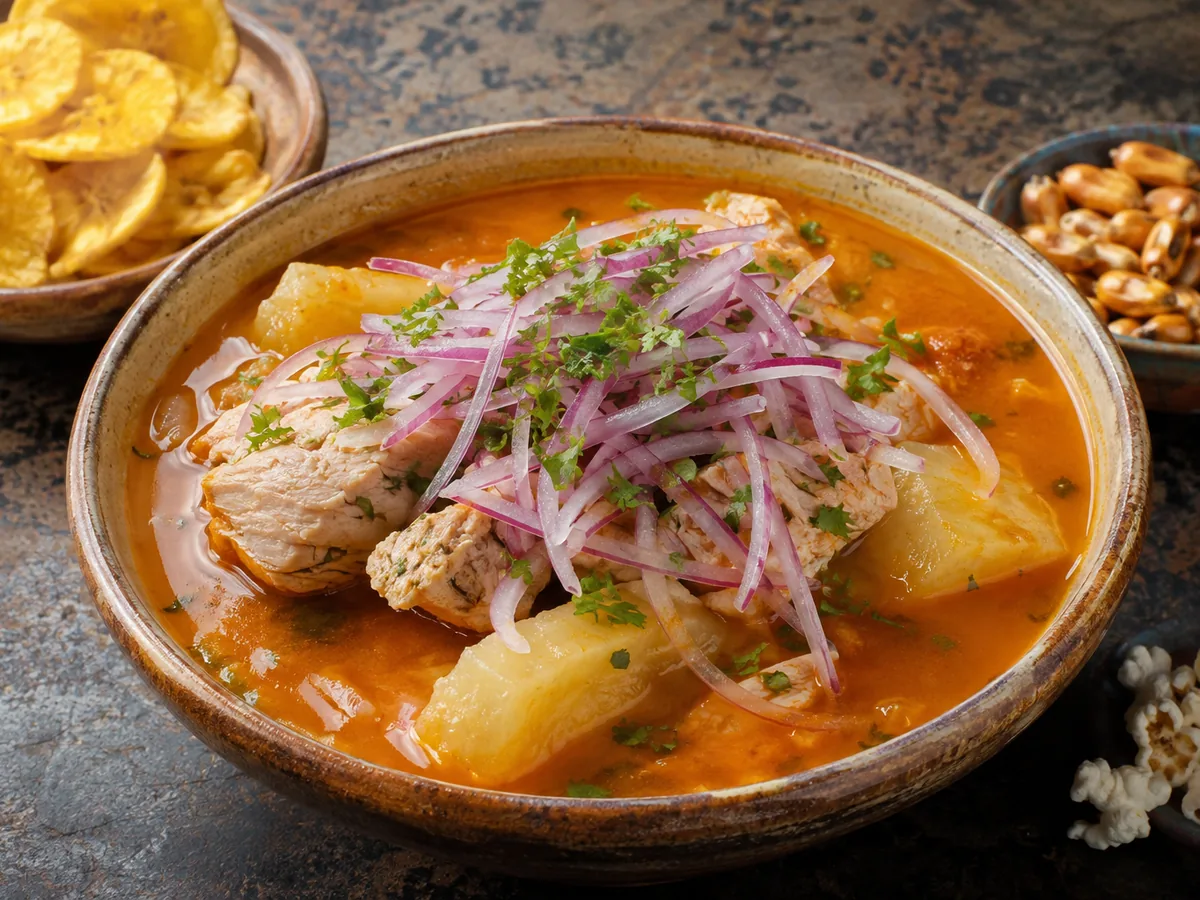
Morning street corners in Guayaquil run on encebollado. Steam pours from giant aluminium stockpots before sunrise, and fishermen, workers and night-shift drivers crowd plastic stools for bowls of deep amber fish broth.
The backbone is fresh albacore tuna, prized for its rich bloodline and firm steak structure. Chunks of starchy yuca soften in the stock, and half the cooked root gets whipped straight back into the pot with tomatoes, garlic and herbs, thickening the liquor into a velvety soup with real body.
On top goes curtido: razor-thin red onions rinsed cold and pickled in lime juice and sea salt. Stir it in, and the acid bites through the tuna oil instantly.
Fish and broth
- 900 g2 lbFresh albacore tuna loin, cut into 5 cm / 2 in thick steaks, skin and bloodline trimmedor yellowfin tuna, or bonito
- 2.5 L10.5 cupsCold filtered water
- 4 large4 largeRipe plum tomatoes, halvedtwo for the broth foundation, two reserved for blending
- 6 cloves6 clovesFresh garlic, peeled and smashed flat
- 1 large1 largeGreen bell pepper, cored and quartered
- 1 bunch (40 g)1 large bunchFresh cilantro stems and leaves, rinsedstems tied for the broth, leaves minced for service
- 15 ml1 TbspAjí para seco paste, or mild ají panca paste or sweet paprika paste
- 8 g2 tspGround cumin seeds, freshly toasted in a dry pan
- 3 g1 TbspDried wild oregano, crushed between the palms
- 18 g1 Tbsp + 1 tspFine sea saltdivided across the broth, the yuca and the curtido
- 3 g1 tspCoarsely ground black peppercorn
Yuca
- 1 kg2.2 lbFresh yuca root (cassava), peeled, woody central fibre removed, cut into 4 cm / 1.5 in chunks
Curtido (the onion crown)
- 2 large2 largeRed onions, peeledone quartered for the broth, one sliced paper-thin into feather half-moons
- 80 ml⅓ cupFreshly squeezed lime juiceabout 4 to 5 limes
- 30 ml2 TbspUnrefined extra-virgin olive oil, or neutral sunflower oil
Why the tuna is poached, never boiled
Albacore muscle fibres are dense with myoglobin. Boiled hard past 60 °C / 140 °F the proteins seize and wring out their moisture, leaving dry, fibrous fish. Held instead in aromatics at about 85 °C / 185 °F, the fibres stay supple and the centre comes to 55–57 °C / 131–135 °F, flaking into thick pink-centred petals.
The yuca is the thickener
Yuca carries dense amylose starches that gelatinise as it boils. Taking 200 g of the soft cooked root and blending it with the stewed tomatoes, onion and broth suspends those swollen starch granules evenly through the liquid, turning a thin fish stock into an opaque, velvety soup that coats a spoon — no wheat flour, no butter.
Salt and rinse the onions first
A 30-second massage with salt followed by a cold rinse strips the harsh sulfurous gases from raw red onion while keeping it crisp, so the lime juice produces a sweet, bright pickle rather than a bitter one.
The five tastes on this plate
Salt seasons the poached tuna, the yuca water and the macerated curtido. Fat is the natural omega-3 lipids of the albacore plus the cold-pressed oil drizzled over the onion crest. Acid is sharp lime juice cutting straight through the rich bloodline. Heat is toasted cumin, cracked black pepper, raw onion sulfur and earthy ají. Umami is concentrated tuna broth married to cooked tomato.
Equipment
- 8 qt enamelled cast-iron Dutch oven
- Slotted spatula
- Spider skimmer
- Blender
- Coarse sieve
- Probe thermometer
Coastal street stalls work from heavy cast aluminium stockpots over high gas burners. An 8-quart enamelled cast-iron Dutch oven is the modern equivalent — enamelled cast iron spreads heat evenly, which stops the blended yuca starches settling and scorching on the bottom of the pot.
Method
Simmer the broth base15 min
Pour 2.5 litres of cold water into an 8-quart Dutch oven. Add the quartered red onion, two halved tomatoes, the green bell pepper, smashed garlic, tied cilantro stems, toasted cumin, ají paste, oregano, black pepper and 12 g fine sea salt.
Bring to a boil over medium-high heat, then drop the heat to low and simmer uncovered for 15 minutes, until the aromatics soften and give up their flavour.
Combine 2.5 L cold water, quartered onion, two halved tomatoes, green pepper, garlic, tied cilantro stems, cumin, ají paste, oregano, black pepper and 12 g salt. Bring to a boil, then simmer uncovered on low for 15 minutes until aromatics soften.
Poach the albacore10–12 min
Lower the tuna steaks gently into the simmering broth. Keep the heat low enough that the surface barely ripples, around 85 °C / 185 °F.
Poach for strictly 10 to 12 minutes. A probe in the centre should read 55–57 °C / 131–135 °F.
Lift the fish out with a slotted spatula onto a clean plate and cover with foil to keep it warm.
Gently lower tuna into broth held around 85 °C / 185 °F, barely rippling. Poach 10–12 minutes to a centre temperature of 55–57 °C / 131–135 °F. Lift onto a clean plate and cover with foil to keep warm.
Boil the yuca20–25 min
Drop the peeled yuca chunks straight into the hot fish broth. Cover partially and simmer over medium-low heat for 20 to 25 minutes, until a knife slides through the thickest piece with zero resistance.
Lift the yuca out with tongs. Cut it into 2 cm / ¾ in bite-sized chunks, discarding any woody fibre from the centre core.
Add peeled yuca to hot fish broth. Partially cover and simmer over medium-low heat 20–25 minutes until a knife passes through without resistance. Lift out, cut into 2 cm / ¾ in pieces and discard woody central fibres.
Blend the yuca-tomato liaison6–7 min
Fish the softened onion, bell pepper and stewed tomatoes out of the broth with a spider skimmer and put them in a blender jar. Add 200 g (about 1 cup) of the cooked yuca and 500 ml of the hot broth.
Blend on high for 60 seconds into a smooth, thick orange purée, then pour it back into the simmering pot through a coarse sieve and whisk it through.
Simmer over low heat for 5 minutes as the starches expand and the broth turns rich and velvety.
Blend softened onion, pepper and tomatoes from the broth with 200 g cooked yuca and 500 ml hot broth on high for 60 seconds. Pass through a coarse sieve into the pot; whisk and simmer gently 5 minutes until velvety.
Macerate the red onion curtido12 min
Put the paper-thin red onions in a bowl and sprinkle with 4 g sea salt. Rub the salt in with clean fingers for 30 seconds, then rinse under cold water and drain dry.
Toss the drained onions with 80 ml lime juice, 30 ml olive oil and half the minced cilantro. Leave for 10 minutes — they will bloom into a bright magenta pink.
Rub thinly sliced onion with 4 g salt for 30 seconds; rinse cold and drain. Toss with 80 ml lime juice, 30 ml olive oil and half the minced cilantro. Leave 10 minutes until bright magenta.
Assemble the bowls
Flake the rested warm albacore into large petals with two forks.
Into each wide bowl goes a generous handful of warm yuca, then the flaked tuna. Ladle the piping-hot velvety broth over the top.
Crown each bowl with a towering mound of pink curtido, spoon over some of the tart pickling juices, and scatter minced cilantro. Serve immediately.
Flake warm tuna into large petals. Divide warm yuca among wide bowls, add tuna and ladle hot broth over them. Top with pink curtido, some pickling juices and minced cilantro; serve immediately.
Sensory cues of doneness
- Visual: the broth is a shimmering, opaque reddish-gold; the tuna flakes cleanly into thick, pink-centred petals; the yuca yields completely to a spoon.
- Auditory: a gentle sub-boil murmur, and the crisp crunch of the raw pickled onions against the hot broth.
- Olfactory: steaming ocean tuna, toasted cumin, fresh cilantro and sharp lime-steeped red onion.
Check for opaque reddish-gold broth, tuna separating into thick pink-centred flakes and yuca that yields completely to a spoon. The onions should remain crisp, with aromas of cumin, cilantro and lime.
Troubleshooting
- Tough, chalky tuna.
Rolling boiling water seizes tuna protein. Poach at a gentle sub-boil, about 85 °C / 185 °F, and pull the fish the moment the centre turns pale pink.
- Thin, watery broth.
The yuca blending step was skipped. Blending cooked yuca back into the pot is what gives authentic encebollado its velvety body.
- Harsh, bitter onions.
The raw onions were not salted and rinsed. A quick salt massage and a cold rinse remove the sulfurous gases, so the lime produces a crisp, sweet curtido.
Substitutions
One-to-one global substitutions, with the technique adjustment each one requires.
Ingredient substitutions
| Ingredient | Replace with | Culinary impact and technique adjustment |
|---|---|---|
| Albacora (albacore) | Yellowfin tuna, bonito or swordfish steaks | One-to-one. Keep the steaks thick, 4 to 5 cm, so they poach gently |
| Fresh yuca | Frozen peeled cassava | One-to-one. Simmer straight from frozen and test with a skewer at 18 minutes |
| Ají para seco | Ají panca paste, or sweet paprika with a pinch of cayenne | One-to-one. Gives the same brick-red colour and earthy pepper aroma |
Scaling
Half, for 3 portions
Halve the ingredients and work in a 4-quart saucepan. The poaching and simmering times stay identical.
Double, for 12 portions
Double the ingredients in a 14-quart stockpot. Simmer the yuca in two batches if the pot is crowded, so every piece cooks evenly.
What to serve it with
- Chifles de plátano verde — thin, salted crisp green plantain chips for dipping straight into the hot broth
- Maíz tostado — crisp toasted Andean corn kernels for crunch
- Canguil — freshly popped salted white popcorn, tipped straight into the bowl, an authentic Guayaquil habit
- Ají criollo — tree-chilli hot sauce with lime, red onion and cilantro
- A cold Pilsener lager or fresh naranjilla juice, either of which cuts the oil and heat cleanly
Questions
Can I substitute another fish for albacore?
Yes. Yellowfin tuna, bigeye or skipjack all work well. If tuna is unavailable, use swordfish or firm mahi-mahi steaks that hold up to poaching.
Can I use frozen yuca?
Absolutely. Frozen peeled yuca is easy to find in Latin markets, cooks faster than fresh, and blends just as smoothly.
Why eat popcorn with fish soup?
The light, salty crunch of warm popcorn floating on the rich, lime-brightened tuna broth is a foundational Guayaquil textural tradition.