Fanesca Tradicional
Ecuador's Holy Week soup, and its most complex dish — twelve grains and legumes each cooked separately to its own texture, folded into a golden base of pumpkin, milk and ground roasted peanuts, with desalted cod, hard-boiled egg, fried plantain and tiny empanadas on top.
- Prep
- 1 hr 30 min
- Cook
- 1 hr
- Serves
- 10 generous feast portions
- Difficulty
- Hard
Researched · Kitchen testing pending
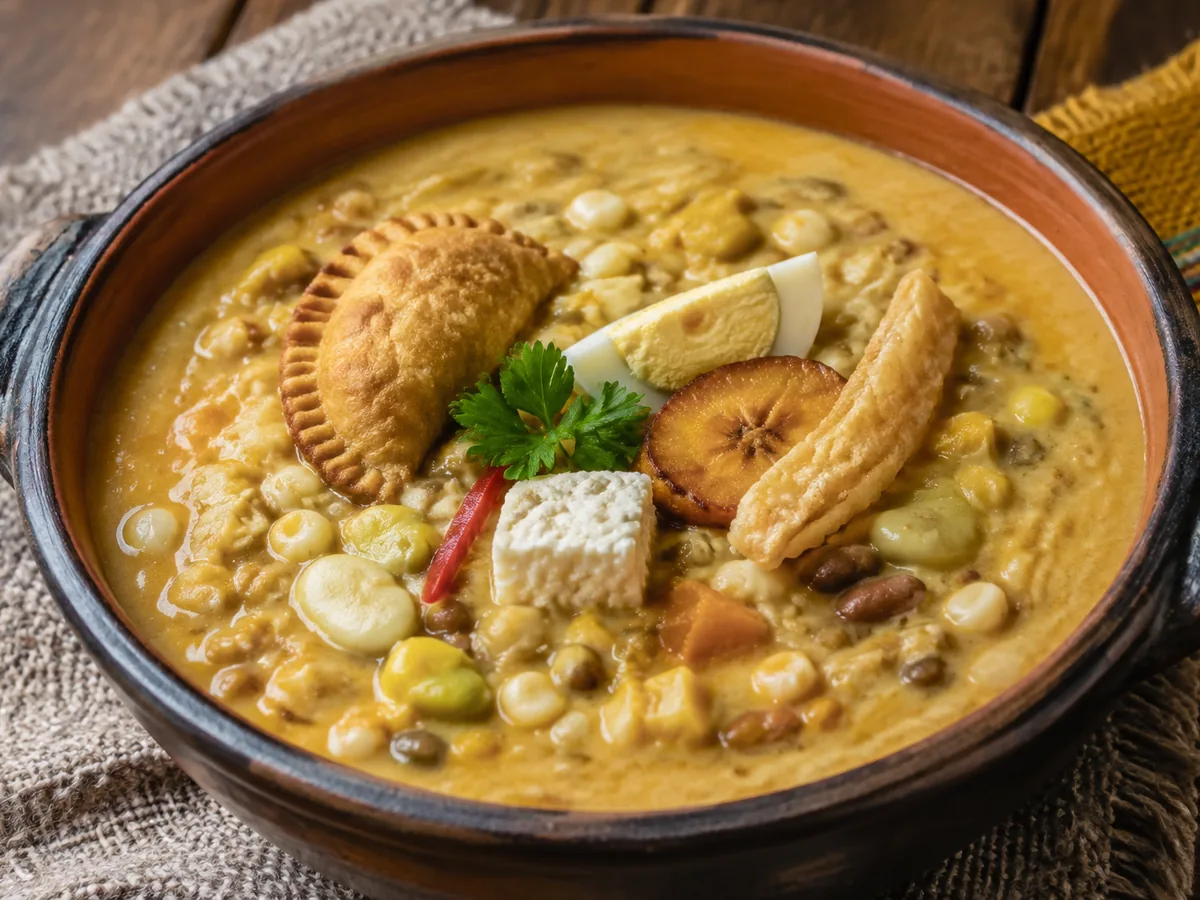
Once a year, during the cold highland rain of Holy Week, every kitchen in Quito and the Andean valleys cooks fanesca. It is Ecuador’s most complex seasonal dish, blending pre-Columbian harvest ritual with Catholic tradition.
The base is tender pumpkin and summer squash simmered with milk, enriched with a savoury paste of freshly ground toasted peanuts and seasoned by dried salted cod. Folded into that velvety golden base are twelve sacred grains and legumes, each pre-cooked separately to its exact texture: choclo, habas, chochos, green peas, lentils, red beans, white beans, chickpeas, mote, rice, mellocos and alverjitas.
Crowned with hard-boiled eggs, fried sweet plantains and tiny empanaditas de viento, a single bowl is an entire culinary universe.
Cod
- 500 g1.1 lbSalted dried cod (bacalao seco), cut into thick filletssoaked in cold water for 24 hours with four water changes
- 1.5 L6.3 cupsWhole milk500 ml to poach the cod, 1 L for the soup base
Squash foundation
- 600 g4 cupsZapallo (Andean pumpkin) or Kabocha squash, peeled, seeded and cut into 3 cm cubes
- 400 g3 cupsSambo (fig-leaf gourd), or yellow crookneck squash or zucchini, peeled and diced
Refrito
- 60 ml4 TbspAchiote oil (annatto oil)
- 60 g4 TbspUnsalted European butter, 82% butterfat
- 2 large2 largeWhite onions, peeled and cut into fine 6 mm / ¼ in brunoise dice
- 6 cloves6 clovesFresh garlic, peeled and minced to a paste
- 8 g2 tspGround cumin seeds, freshly toasted in a skillet
- 4 g1½ TbspDried wild oregano, hand-crushed
Enrichment
- 200 g1½ cupsRoasted unsalted peanuts, ground to a smooth paste with 200 ml warm milkpasta de maní
- 250 g1 cupFresh queso fresco or quesillo, crumbled
- 120 ml½ cupHeavy whipping cream
The twelve grains
- 150 g each (1.8 kg total)1 cup each cookedChoclo (sweet corn), habas (fava beans, peeled), chochos (lupini beans), arvejas (green peas), lentejas (brown lentils), fréjol rojo (kidney beans), fréjol blanco (cannellini beans), garbanzos (chickpeas), mote (hominy), arroz blanco (cooked white rice), mellocos (Andean tubers, or diced new potatoes) and porotos tiernosevery one simmered tender separately in salted water
Garnish
- 3 large3 largeHard-boiled eggs, sliced into rounds
- 2 whole2 wholeRipe plantains, sliced and fried (maduros en rodajas)
- 12 whole12 wholeMini fried empanadas (empanaditas de viento)
- 1 whole1 wholeFresh red chilli, sliced into ringsplus fresh parsley sprigs
Why every grain is cooked separately
Lentils are done in 20 minutes; chickpeas take an hour. Boiling them together would turn the delicate peas to mush while the chickpeas stayed hard. All twelve must be cooked to their own texture in advance and only then folded into the pot.
How the body is built
The squash is simmered soft and blended with milk into a smooth purée, and the cooked rice is mashed until its amylose starches rupture and thicken. Ground roasted peanut paste then adds vegetable fats and proteins: whisked into the hot milk-squash base with achiote butter, the peanut proteins and milk caseins form a stable emulsion that binds the free fats and stops the soup separating.
The cod must soak a full day
Dried salted cod needs 24 hours in cold water with four changes to leach out the excess salt. Cut that short and the finished soup is inedibly salty — and since the cod usually supplies all the seasoning the pot needs, there is no way to correct it afterwards.
Passive time, counted separately
The cod desalinates for 24 hours, and the beans need their own soaking before their separate simmers. None of that is active work, and it all sits outside the times quoted above.
The five tastes on this plate
Salt arrives through the rehydrated cod and the crumbled queso fresco. Fat is whole milk, cream, butter, peanut paste and the oil from the fried plantain garnish. Acid is naturally mellow here, balanced at the table with pickled onions or fresh chilli. Heat is toasted cumin, white pepper, garlic and red chilli rings. Umami is cured cod, reduced milk solids, peanut paste and twelve slow-cooked legumes.
Equipment
- Heavy 10–12 qt enamelled cast-iron stockpot
- Separate pot, for the cod
- Separate pot, for the squash
- Blender
- Wide wooden paddle
- Flat wooden spatula
Traditionally a massive 12-to-16 quart earthenware clay pot or aluminium stockpot. A heavy 10-to-12 quart enamelled cast-iron stockpot is the modern equivalent — enamelled cast iron stops the thick peanut and squash starches scorching on the bottom during the long, slow simmer.
Method
Desalinate and poach the cod12 min
Soak the salted cod in 3 litres of cold water for 24 hours in the refrigerator, changing the water four times. Drain.
Put the desalinated cod in a pot with 500 ml milk and 500 ml water and bring to a gentle simmer for 10 minutes, until the fish flakes easily (65 °C / 149 °F).
Lift out the cod and flake it into large chunks, removing any bones. Strain and reserve the poaching milk.
Soak cod in 3 L cold water, refrigerated, for 24 hours; change water four times and drain. Simmer gently in 500 ml milk and 500 ml water for 10 minutes until flaky (65 °C / 149 °F). Flake, remove bones; strain and reserve poaching liquid.
Cook the squash foundation22 min
In a separate pot, simmer the cubed zapallo and sambo in 500 ml water for 20 minutes, until completely soft.
Transfer to a blender with some of the cooking water and blend into a smooth orange purée. Set aside.
Simmer cubed zapallo and sambo in 500 ml water for 20 minutes until completely soft. Blend with some cooking water into a smooth orange purée and reserve.
Build the refrito base12 min
Melt 60 g butter with 60 ml achiote oil in the heavy stockpot over medium heat.
Add the minced white onions, garlic paste, toasted cumin and crushed oregano, and sweat 12 minutes until soft, sweet and translucent without browning.
Melt 60 g butter with 60 ml achiote oil over medium heat. Add minced onion, garlic paste, cumin and oregano; sweat 12 minutes until soft and translucent, without browning.
Assemble the soup body10 min
Pour the squash purée into the refrito. Add the remaining 1 litre of fresh milk and the reserved cod poaching liquid, and whisk over medium heat until cohesive.
Add the peanut paste, whisking vigorously to incorporate, then simmer over low heat 10 minutes as the peanut fats emulsify into the hot milk base.
Whisk squash purée, remaining 1 L milk and reserved cod liquid into the refrito over medium heat. Add peanuts ground smooth with 200 ml warm milk, whisking vigorously; simmer on low 10 minutes until cohesive.
Fold in the twelve grains and the cod20 min
Add all twelve cooked grains and legumes, stirring gently with a wooden paddle so you do not crush the beans. Fold in two-thirds of the flaked cod, reserving the rest for garnish.
Simmer over low heat 15 minutes, stirring the bottom continuously in figure-eights so the starches do not stick.
Stir in the crumbled queso fresco and the cream, and simmer 5 minutes more until the cheese melts through.
Taste: the cod usually supplies enough salt, but adjust if it needs it.
Soak beans as needed and cook all twelve grains separately until tender; mash cooked rice. Fold into soup with two-thirds of the cod. Simmer gently 15 minutes, stirring the bottom continuously without crushing beans. Add cheese and cream; simmer 5 minutes until melted. Taste before adjusting salt.
Garnish and serve
Ladle the steaming fanesca into wide, warm bowls.
On each, arrange a piece of the reserved cod, a round of hard-boiled egg, two slices of fried sweet plantain, a mini empanada, a sliver of red chilli and a sprig of parsley. Serve hot.
Ladle into warm wide bowls. Garnish each with reserved cod, a hard-boiled egg round, two fried plantain slices, a mini empanada, a sliver of red chilli and parsley; serve hot.
Sensory cues of doneness
- Visual: a dense golden-yellow potage packed with intact multi-coloured grains and beans, crowned with golden fried plantain and white cheese.
- Auditory: heavy, rhythmic plops as the thick, creamy soup bubbles gently on the burner.
- Olfactory: rich milk, roasted peanuts, salted cod, sweet pumpkin, toasted cumin and fried plantain.
Look for thick golden-yellow soup with intact multicoloured grains and beans, golden fried plantain and white cheese. Gentle bubbles should make heavy plops, with aromas of milk, peanuts, cod, pumpkin and cumin.
Storing it
Fanesca keeps in the refrigerator for up to 4 days. It thickens as it cools; reheat gently on the stove, stirring in a splash of warm milk to restore its velvety texture.
Troubleshooting
- A salty, inedible soup.
The dried cod did not soak long enough. It needs a full 24 hours with multiple cold water changes to leach out the excess salt.
- A scorched pot bottom.
The pot was left unattended after the peanuts and squash went in. Those dense starches settle instantly — keep the heat low and stir with a flat wooden spatula.
- Mushy beans.
The beans were cooked together in one pot. Cook every grain separately in advance to guarantee the right texture in each.
Substitutions
One-to-one global substitutions, with the technique adjustment each one requires.
Ingredient substitutions
| Ingredient | Replace with | Culinary impact and technique adjustment |
|---|---|---|
| Bacalao seco (salt cod) | Salted pollock, or fresh sea bass fillets | One-to-one. If using fresh fish, poach gently in milk with no desalination |
| Zapallo and sambo | Kabocha squash and yellow zucchini | One-to-one. Kabocha provides identical dense sweetness and colour |
| Chochos (lupini beans) | Canned lupini beans, rinsed | One-to-one. Peel the skins if they are tough |
Scaling
Half, for 5 portions
Halve the ingredients in an 8-quart Dutch oven. The simmer times stay the same.
Double, for 20 portions
Double the ingredients in a 20-quart commercial stockpot, and stir with extra care to avoid scorching the bottom.
What to serve it with
- Empanaditas de viento — crisp, airy fried cheese turnovers dusted with sugar
- Plátanos maduros fritos — fried sweet ripe plantain slices
- Molo de papa — seasoned Andean potato mash, served as a second course
- Dulce de higos con queso — preserved spiced figs in panela syrup with fresh cheese, the classic Holy Week dessert
- Canelazo or chicha de jora — warm spiced cinnamon-orange tea, or fermented corn chicha
Questions
What can I substitute for bacalao seco?
Authentic Norwegian salted dried cod is best. Failing that, use fresh firm white fish like sea bass or halibut, and season the broth with a touch more sea salt.
Can I make fanesca vegetarian?
Yes. Many Andean households prepare it without the cod entirely, adding extra cheese and peanut paste for savoury depth.
How long does leftover fanesca last?
Up to 4 days in the refrigerator. It thickens as it cools — reheat gently, stirring in a splash of warm milk to bring back the velvety texture.