Caldo de Bolas de Verde
Softball-sized green plantain dumplings poached in clear beef bone broth, each one stuffed with braised beef, hard-boiled egg, raisins and crushed peanuts. The dough is half boiled plantain and half raw grated, which is the only reason it holds together.
- Prep
- 45 min
- Cook
- 1 hr 30 min
- Serves
- 6 large bowls, one dumpling each
- Difficulty
- Hard
Researched · Kitchen testing pending
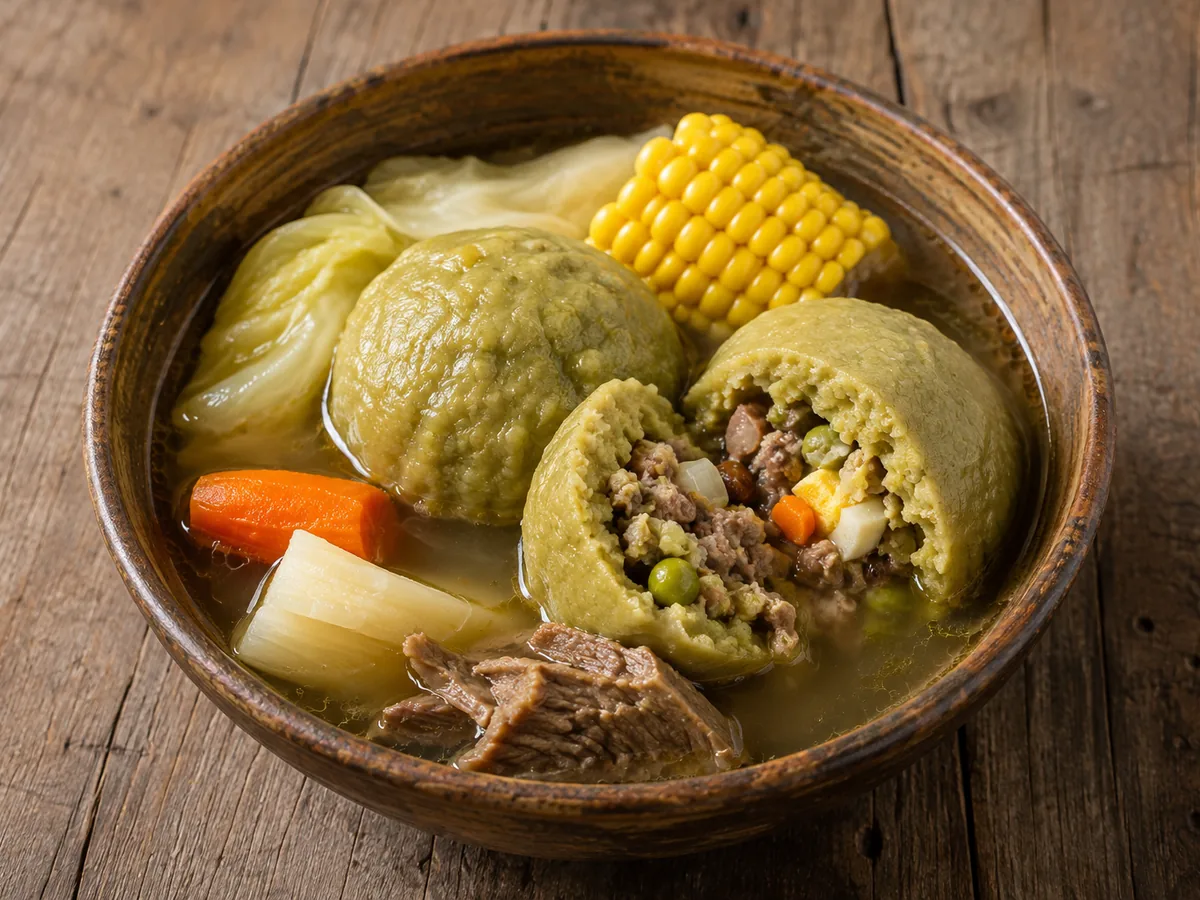
Caldo de bolas is a coastal Ecuadorian engineering marvel. Served in oversized clay bowls, the golden beef broth carries whole rounds of corn, chunks of yuca and cabbage.
The stars are the bolas de verde: dumplings the size of softballs, crafted from green plantain. The dough is a 50/50 hybrid of boiled green plantain and freshly grated raw plantain, kneaded with lard. Inside sits a savoury picadillo of braised beef chuck, hard-boiled egg, sweet raisins, toasted peanuts and peas.
Poached gently in the simmering broth, the dough cooks into a tender, chewy sphere that holds its structure without breaking apart.
Broth
- 1 kg2.2 lbBeef soup bones (marrow and rib bones)plus 500 g beef chuck roast, which becomes the filling
- 2.5 L10.5 cupsCold filtered water
- 2 large2 largeRed onions, peeled and minced into 6 mm dicedivided between the broth and the picadillo
- 6 cloves6 clovesFresh garlic, minced to a paste
- 8 g2 tspGround cumin seeds, freshly toasted
- 4 g1½ TbspDried wild oregano, crushed
- 18 g1 Tbsp + 1 tspFine sea saltdivided across the broth, the dough and the picadillo
Plantain dough
- 4 large4 largeGreen plantains (plátanos verdes), peeledtwo boiled tender, two kept raw for fine grating
- 45 ml3 TbspRendered pork lard, or achiote oildivided between the dough and the picadillo
Picadillo filling
- 1 large1 largeGreen bell pepper, cored and diced
- 50 g⅓ cupRoasted unsalted peanuts, finely crushed
- 40 g¼ cupDark raisins, plumped in warm water
- 2 large2 largeHard-boiled eggs, peeled and chopped fine
- 100 g¾ cupSweet green peas, cooked
Soup vegetables
- 2 ears2 earsChoclo (sweet corn), husked and cut into 6 rounds
- 400 g3 cupsYuca, peeled and cut into chunks
- 200 g2 cupsGreen cabbage, chopped into coarse bite-sized leaves
- 30 g½ cupFresh cilantro leaves, finely chopped
Why the dough is half raw
Cooked plantain starches are already gelatinised, which gives the dough plasticity and softness — but a dumpling made only from cooked plantain disintegrates the moment it hits hot broth. Raw green plantain still carries ungelatinised native amylose granules. Kneaded 50/50 into the hot mash, those raw granules stay suspended through the matrix.
What happens in the pot
Poached gently at about 90 °C / 194 °F, the raw starches gelatinise in place, binding tightly and forming a leak-proof, elastic skin that seals the hot picadillo inside.
Never let it boil
A rolling boil breaks the dumplings mechanically. Hold the broth at a low, trembling poach between 88 °C and 90 °C for the whole 20 minutes.
Passive time, counted separately
The picadillo must cool completely before it is spooned into the dough. That is not active work and sits outside the times quoted above.
The five tastes on this plate
Salt seasons the long-simmered bone broth, the plantain dough and the picadillo. Fat is rendered beef marrow and the warm lard kneaded into the dough. Acid is naturally low, balanced at the table with fresh lime squeezed into the hot broth. Heat is toasted cumin, garlic, black pepper and chilli paste on the side. Umami is concentrated bone broth, the braised chuck fond and crushed roasted peanuts.
Equipment
- 8–10 qt enamelled cast-iron Dutch oven or wide stockpot
- Skimmer
- Skillet, for the picadillo
- Box grater
- Wide bowl, for kneading
- Ladle
Traditionally a massive aluminium or clay cauldron with plenty of surface area. An 8-to-10 quart enamelled cast-iron Dutch oven or wide stockpot works in a modern kitchen — the wide circumference lets all six large dumplings simmer side by side without crowding and knocking into each other.
Method
Simmer the beef bone broth1 hr
Put the beef bones and chuck roast in an 8-quart Dutch oven with 2.5 litres cold water, half the onion, 3 garlic cloves, the cumin, oregano and 12 g salt.
Bring to a boil over medium-high heat, skimming the foam from the surface. Reduce to low, cover partially, and simmer 1 hour, until the chuck is fork-tender.
Lift out the chuck and shred it fine for the filling. Keep the broth simmering on low.
Simmer bones and chuck in 2.5 L cold water with half the onion, 3 garlic cloves, cumin, oregano and 12 g salt. Bring to a boil, skim, then partially cover and simmer gently 1 hour until fork-tender. Shred chuck; keep broth simmering.
Cook the picadillo filling9 min
Melt 15 ml lard in a skillet over medium heat. Add the remaining diced red onion, garlic and bell pepper and sweat 6 minutes until soft.
Stir in the shredded beef, crushed peanuts, raisins, chopped egg and peas. Season with ½ tsp cumin, black pepper and salt, and cook 3 minutes until cohesive.
Pull off the heat and cool completely.
Sweat remaining onion, garlic and pepper in 15 ml lard over medium heat for 6 minutes. Add shredded beef, peanuts, raisins, egg and peas; season with ½ tsp cumin, pepper and salt. Cook 3 minutes; cool completely before filling.
Make the hybrid plantain dough20 min
Cut 2 green plantains into chunks and boil in salted water 15 minutes until tender. Drain and mash hot with 30 ml lard and 1 tsp salt until smooth.
Grate the other 2 raw green plantains on the finest teeth of a box grater into a wet pulp.
In a wide bowl, knead the warm mash and the raw grated plantain together vigorously for 5 minutes, until the dough is smooth, cohesive and slightly elastic.
Boil 2 chopped plantains in salted water for 15 minutes until tender. Drain; mash hot with 30 ml lard and 1 tsp salt. Finely grate the other 2 raw plantains; knead into warm mash for 5 minutes until smooth and elastic.
Stuff and shape the bolas15 min
Divide the dough into 6 equal balls, about 160 g each. Cup one in your palm, poke a deep hollow in the centre, and rotate your thumb to form a smooth cup with walls 1 cm thick.
Spoon 2 generous tablespoons of the cold picadillo into the cavity, bring the edges up and over, and pinch tightly to seal. Roll gently between your palms until the seams vanish into a tight, seamless ball.
Repeat for all six.
Divide dough into 6 balls, about 160 g each. Hollow each into a cup with 1 cm walls; fill with 2 generous tablespoons cold picadillo. Pinch edges tightly together and roll gently until all seams disappear.
Poach the dumplings and vegetables30 min
Add the corn rounds and yuca chunks to the simmering broth and cook 10 minutes.
Turn the heat to medium-low so the broth is barely trembling — it must not boil violently. Lower each dumpling in with a ladle and simmer undisturbed 18 to 20 minutes. They will swell slightly, darken to deep maize-gold and float to the surface.
Add the chopped cabbage for the final 5 minutes.
Cook corn and yuca in broth for 10 minutes. Lower dumplings gently into barely trembling broth at 88–90 °C; poach undisturbed 18–20 minutes without boiling. Add cabbage for the final 5 minutes; dumplings should swell, turn golden and float.
Assemble and serve
Place one dumpling carefully in each wide bowl, then ladle the hot broth with its yuca, corn and cabbage around it.
Scatter fresh cilantro over the top and serve steaming hot with lime halves.
Carefully place one dumpling in each wide bowl. Ladle hot broth, yuca, corn and cabbage around it; scatter with fresh cilantro and serve steaming hot with lime halves.
Sensory cues of doneness
- Visual: smooth golden-yellow spheres floating upright in clear, rich amber broth, with no cracks and no leaking filling.
- Auditory: gentle, quiet simmering murmurs, and the silent, smooth yield of the dumpling skin as a spoon cuts through.
- Olfactory: rich beef bone broth, sweet cooked green plantain, roasted peanuts, cumin and fresh cilantro.
Check that the golden dumplings float without cracks or leaking filling. Their skins should yield smoothly to a spoon; keep the broth at a quiet simmer, with aromas of beef, plantain, peanuts and cumin.
Storing it
Shape and stuff the dumplings, set them on a parchment-lined tray, cover with plastic wrap, and refrigerate up to 12 hours before poaching them in the soup.
Troubleshooting
- Dumplings falling apart in the soup.
Only cooked plantain was used, and cooked plantain has no binding power. The dough must be half raw grated and half cooked, so the raw starches set the shell.
- Violent boiling.
A rolling boil breaks the dumplings mechanically. Hold the broth at a low, gentle poach, 88–90 °C, while they cook.
- Dough cracking while shaping.
It is too dry. Knead in a tablespoon of warm broth or melted lard to restore suppleness.
Substitutions
One-to-one global substitutions, with the technique adjustment each one requires.
Ingredient substitutions
| Ingredient | Replace with | Culinary impact and technique adjustment |
|---|---|---|
| Green plantain (verde) | No substitute — it must be completely green and unripened | Yellow ripe plantains carry sugars that melt away in soup. Only green plantain has the structural starch |
| Beef chuck | Beef flank or shank | One-to-one. Excellent flavour for braising and shredding |
| Roasted peanuts | Toasted slivered almonds or walnuts | One-to-one in the picadillo filling |
Scaling
Half, for 3 dumplings
Halve the ingredients in a 5-quart pot. The poaching stays at 18 to 20 minutes.
Double, for 12 dumplings
Double the ingredients in a 14-quart stockpot, and poach the dumplings in two batches so they do not crush one another.
What to serve it with
- Ají criollo casero — spicy red chilli and scallion sauce on the side
- Fresh lime wedges, squeezed straight into the hot broth at the table
- Arroz blanco — a small dish of hot white rice, for diners who like to add rice to their soup
- Jugo de naranjilla or a cold Pilsener
Questions
Can I prepare the dumplings ahead of time?
Yes. Shape and stuff them, set them on a parchment-lined tray, cover, and refrigerate up to 12 hours before poaching.
What do I do if green plantains are hard to grate raw?
Peel and cut into chunks, then pulse in a high-powered food processor with a splash of water until it forms a fine, wet raw pulp.
Can I make this with seafood instead of beef?
Yes — that is caldo de bolas de mariscos. The filling becomes cooked shrimp and crab, and the broth a rich fish fumet.