South America · 33°27′S 70°39′W · Kitchen testing pending
Chile
Pinned between the Andes and the Humboldt Current, and it tastes like it
The ten
Ranked by what people actually name first
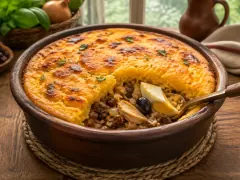 Pastel de ChocloA dark cumin-seasoned beef pino with seared chicken thigh, egg, olives and raisins, under a velvety mantle of fresh corn pounded with milk and basil. Sugar dusted on top blisters into brittle amber lace under the broiler.
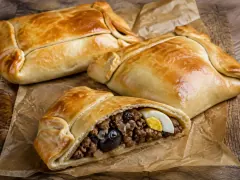 Empanadas de Pino al HornoThe Fiestas Patrias envelope — a half-pound baked turnover of hot-lard dough folded over braised beef and sweet stewed onions rested overnight, with egg, a black olive and raisins. Thick seams, biscuit-like snap, molten juices inside.
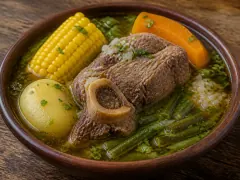 Cazuela de VacunoAn open, clear beef consommé holding large unblemished cuts — bone-in shank with its marrow ring, a skin-on wedge of orange squash, a whole potato, half an ear of corn and julienned green beans. Sip the broth first, then carve.
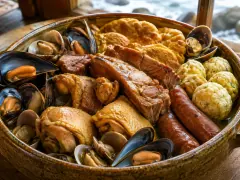 Curanto en Olla (Pulmay)The Chiloé pit feast brought indoors — a stockpot packed in strict tiers over boiling white wine, with smoked pork, longaniza and chicken below and mussels and clams above, sealed under cabbage leaves. The broth at the bottom is the point.
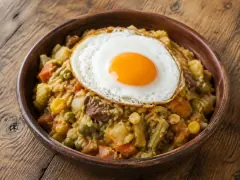 Charquicán con Huevo FritoBeef, potato, squash, corn, peas and green beans simmered then roughly crushed by hand into a chunky golden-orange mash, crowned with a fried egg whose lacy edges blister in hot oil. Break the yolk and it runs through like sauce.
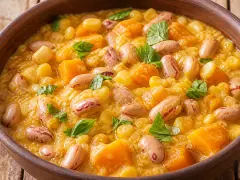 Porotos Granados con MazamorraHigh summer in the central valley — freshly shelled cranberry beans and squash thickened by mazamorra, raw sweet corn blended with basil and milk. A swirl of hot paprika-infused lard goes over the top just before it reaches the table.
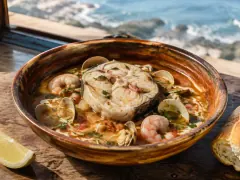 Caldillo de CongrioThe stew Neruda wrote an ode to. A fumet boiled from conger heads and white wine, strained into a sofrito of sweet onion, garlic and ripe tomato, with thick fish medallions poached gently alongside clams and shrimp and finished with warm cream.
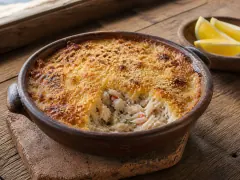 Pastel de JaibaThe marisquería gratin — sweet picked crab folded into a panade of crustless bread soaked in warm milk and cream, over a sofrito of shallot, butter, white wine and ají de color, baked in clay pailas under a browned cheese crust.
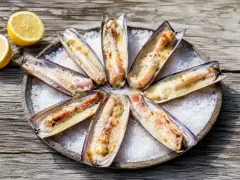 Machas a la ParmesanaRazor clams back in their own half-shells, dotted with cold butter, splashed with Sauvignon Blanc and lemon, buried under Parmigiano and Chanco, then broiled for strictly four minutes until the cheese blisters and the clam poaches in its own liquor.
 Completo ItalianoThe fuente de soda counter classic, named for the Italian flag — fine-diced salted tomato, mashed Hass avocado and a white crest of scratch mayonnaise over a poached vienesa, in a steamed pan copihue elastic enough to hold half a pound of toppings.
Chile sits pinned between mountains and ocean. The Andes wall off the continent to the east; the icy, nutrient-packed Humboldt Current sweeps up from Antarctica along 4,300 kilometres of coastline to the west. Between them lies a sun-drenched central valley fed by glacier meltwater. That geography is why half this list is shellfish and half is farm cooking, with very little in between.
Two techniques carry most of the ten. The first is corn treated as a thickener rather than a vegetable: raw kernels ground with milk and basil, then cooked until the starch granules swell and rupture somewhere past 68 °C. That single move makes the golden mantle on pastel de choclo and the velvety body of porotos granados — no flour, no egg, no roux. The second is restraint with heat. Cazuela wants a trembling sub-boil so the broth stays crystalline; caldillo de congrio poaches fish at 80 °C so it flakes instead of seizing; machas go under a scorching broiler for strictly four minutes, because five turns razor clams into rubber.
The clay is not decoration either. Pomaire potters dig dark local clay for the shallow pailas that pastel de choclo, pastel de jaiba and caldillo are baked and served in, and unglazed greda holds heat at the table for half an hour after it leaves the stove.
Three dishes carry their history on the surface. Charquicán fuses Quechua ch’arki with Mapuche cancan, and predates the country. Curanto belongs to Chiloé, where the original version is buried in a pit under wild rhubarb leaves and hot stones — the stockpot version here is the island feast brought indoors. And the completo italiano is named for a flag that is not Chile’s, assembled at Santiago lunch counters in strict order so the mayonnaise never touches the hot sausage.
One note for the wine: Chile is among the few producing nations phylloxera never reached, so its vines still grow on their own original rootstocks.