Pastel de Choclo
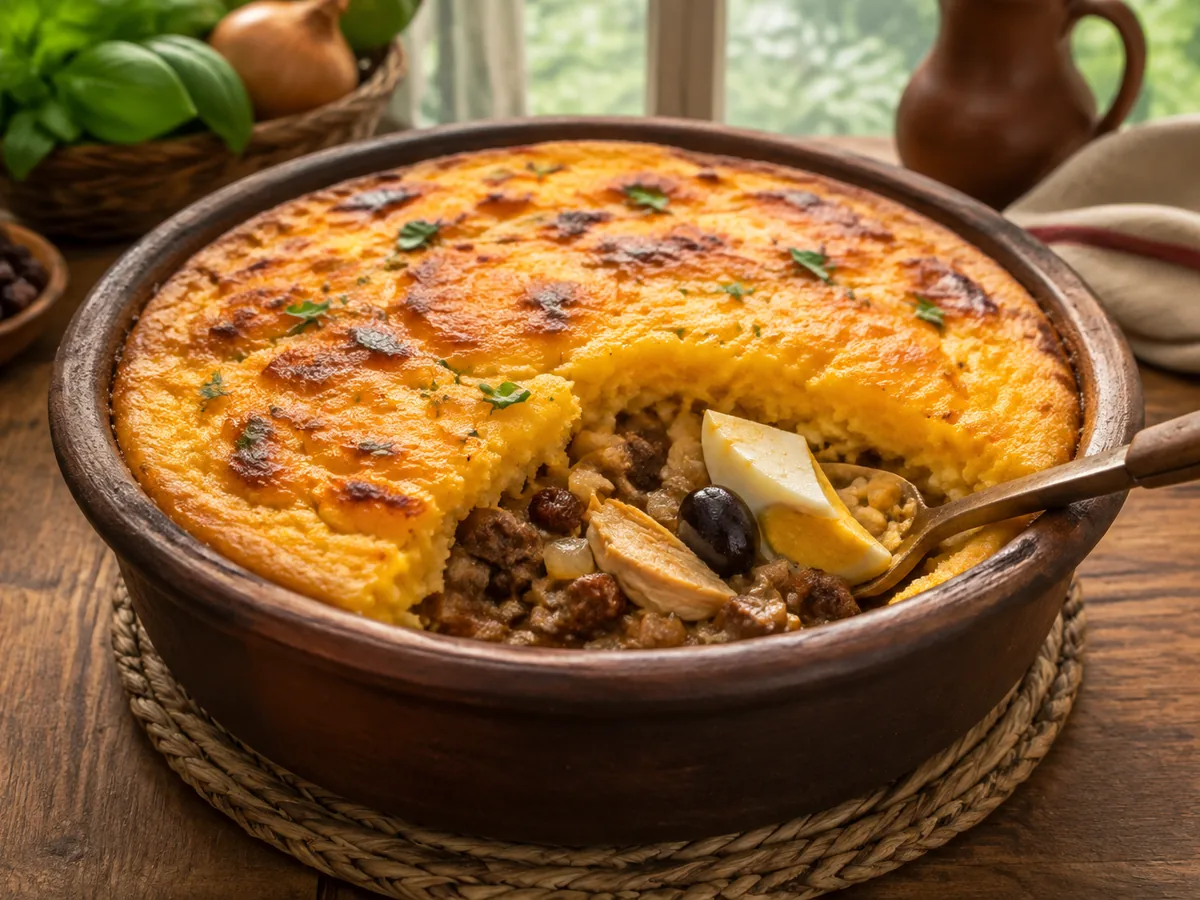
A dark cumin-seasoned beef pino with seared chicken thigh, egg, olives and raisins, under a velvety mantle of fresh corn pounded with milk and basil. Sugar dusted on top blisters into brittle amber lace under the broiler.
- Prep
- 45 min
- Cook
- 50 min
- Serves
- 6 individual clay pailas (20 cm / 8 in), or one 23×33 cm / 9×13 in baking dish
- Difficulty
- Hard
Researched · Kitchen testing pending
Summer in Chile’s Central Valley smells of freshly cut corn stalks and warm river silt. Pastel de choclo was born in farm kitchens where indigenous Mapuche corn preparations met colonial cattle ranches, and Pomaire potters still dig dark clay from the surrounding hills to fire the shallow baking bowls called pailas.
Inside, the contrast is stark. A dark, savoury mince of braised beef chuck seasoned with cumin sits at the bottom, tucked around pan-seared chicken thighs, hard-boiled eggs, black olives and plump raisins. Over this sits a velvety mantle of fresh sweet corn pounded with whole milk and fresh basil leaves, dusted with white sugar that blisters into brittle amber lace under intense oven heat.
Pino (beef filling)
- 600 g1.32 lbLean ground beef chuck, 85/15cold from refrigeration
- 700 g4 cupsYellow onions, peeled and cut into fine 6 mm / ¼ in brunoise dice
- 45 ml3 TbspRendered beef lard, or extra-virgin olive oil
- 15 g1 TbspAjí de color (Chilean sweet mild chilli powder), or sweet Spanish paprika
- 6 g1½ tspGround cumin seeds, freshly toasted in a dry skillet
- 3 g1 TbspDried Chilean wild oregano, hand-crushed
- 12 g2 tspFine sea saltdivided between the filling and the corn paste
- 3 g1 tspCoarsely ground black peppercorns
- 60 ml¼ cupLow-sodium beef stock, or cold filtered water
Chicken
- 6 pieces6 piecesBone-in, skin-on chicken thighsabout 900 g / 2 lb total; seasoned with salt and cumin
- 30 ml2 TbspNeutral high-smoke-point vegetable oil
Corn custard (pasta de choclo)
- 1.2 kg6 large earsChoclo pastelero, or mature yellow sweet cornkernels cut and the cobs scraped for their milk
- 20 g1 cup packedFresh sweet basil leaves (albahaca), washed, spun dry and sliced into thin ribbons
- 240 ml1 cupWhole milk, 3.5% milkfat, warm to the touch
- 45 g3 TbspUnsalted European butter, 82% butterfat
Assembly and finish
- 3 large3 largeHard-boiled eggs, peeled and quartered lengthwise
- 60 g⅓ cupBlack olives (Azapa or Kalamata), pitted or unpitted
- 50 g⅓ cupDark or golden raisinssoaked in warm water for 15 minutes and drained dry
- 30 g2½ TbspGranulated white cane sugarfor the surface brûlée
The two thermal transformations
Starch gelatinisation and sugar pyrolysis govern this bake. South American choclo carries dense amylose and amylopectin; as the ground corn cooks with warm milk and butter past 68 °C / 154 °F, the starch granules absorb free water and swell until they rupture, forming an elastic gel that sets without egg yolks. On top, radiant heat above 160 °C / 320 °F dehydrates the cane sugar into caramel while milk proteins brown, giving crisp bitter-sweet crust patches that balance the rich beef below.
Sweet corn needs help
Standard supermarket sweet corn is high in sugar and low in starch compared with native choclo. If that is what you have, whisk 15 g (2 Tbsp) cornflour into the milk before cooking to guarantee a proper set.
The five tastes on this plate
Salt comes through the sea salt seasoning both beef and corn crust, balancing the natural corn sugars. Fat is rendered beef fat, crisp chicken skin, lard and butter, carrying the fat-soluble spices. Acid arrives from clean pan deglazing and, at the table, from vinegar-dressed ensalada chilena. Heat is dry-toasted cumin, mild ají de color and cracked black pepper cutting the fat. Umami is concentrated browned beef fond, chicken drippings and reduced stock.
Passive time, counted separately
The pino is cooked a day ahead and chilled overnight so its fat and gelatin set firm, and the baked pailas rest 15 minutes before service. Neither is active work, and both sit outside the times quoted above.
Equipment
- Wide Dutch oven, for the pino
- Stainless steel skillet, for searing the chicken
- Food processor
- Wide saucepan and a flat wooden paddle, for the corn custard
- Six clay pailas 20 cm / 8 in, or one 23×33 cm / 9×13 in dish
- Sturdy rimmed baking sheet
- Offset spatula
- Probe thermometer
Traditional heavy unglazed earthenware pailas de greda heat slowly and hold their thermal energy for over half an hour at the table. Cure new clay dishes before first use, and bring them up in the oven gradually to prevent thermal-shock cracks. Heavy enamelled cast iron or stoneware is the modern substitute, but cast iron transfers conductive heat far faster than clay — shave 5 to 8 minutes off the bake and watch the broiler closely so the sugar crust does not burn.
Method
Cook the pino — a day ahead35–40 min
Set a wide Dutch oven over high heat with 45 ml lard. Drop the cold ground beef into the hot fat and leave it alone for 4 minutes, until a deep brown crust forms, then break it up with a wooden spatula.
Add the toasted cumin, ají de color, crushed oregano, black pepper and salt. Tip in the minced onions and turn the heat to low. Sweat the onions slowly for 25 to 30 minutes, until they soften into a glossy, sweet compote.
Pour in 60 ml beef stock and scrape up the fond from the bottom. Simmer 5 minutes.
Take it off the heat, cool it, and chill it in the fridge overnight. The fat and beef gelatin must solidify completely.
Heat 45 ml lard on high; brown cold beef undisturbed 4 minutes, then break up. Add cumin, paprika, oregano, pepper, salt and onions; sweat on low 25–30 minutes until soft. Add 60 ml stock, scrape the bottom and simmer 5 minutes. Cool and refrigerate overnight until firm.
Sear the chicken thighs12 min
Dry the chicken thighs thoroughly with paper towels and season both sides with salt, black pepper and a pinch of ground cumin.
Pour 30 ml oil into a stainless steel skillet over medium-high heat. Lay the thighs skin-side down and sear undisturbed for 7 to 8 minutes, until the skin turns mahogany-brown and brittle. Flip and sear 4 minutes on the flesh side.
Set aside on a plate — the meat finishes cooking in the oven.
Dry chicken and season both sides with salt, pepper and a pinch of cumin. Heat 30 ml oil over medium-high; sear skin-side down undisturbed 7–8 minutes until dark and crisp, then 4 minutes on the flesh side. Reserve to finish in the oven.
Thicken the corn custard10–12 min
Put the cut corn kernels, corn milk and sliced basil into a food processor and pulse to a coarse, thick purée.
Melt the butter in a wide saucepan over medium heat, then pour in the corn purée and the warm milk. Stir constantly with a flat wooden paddle, scraping the bottom in continuous figure-eights.
At around 70 °C / 158 °F the starches swell suddenly, turning the watery mash into a thick, glossy paste that pulls away from the pan sides — about 10 to 12 minutes.
Season with 1 tsp salt and 1 tsp sugar, and pull it off the heat.
Pulse corn, scraped corn milk and basil into coarse purée. For supermarket sweet corn, whisk 15 g / 2 Tbsp cornflour into the milk first. Cook purée and warm milk in melted butter over medium heat, stirring and scraping constantly, 10–12 minutes to about 70 °C / 158 °F, until glossy and pulling from the sides. Add 1 tsp salt and 1 tsp sugar; remove from heat.
Assemble the layers15 min
Preheat the oven to 200 °C / 400 °F and set six clay pailas on a sturdy rimmed baking sheet.
Spoon roughly 150 g of cold pino into the bottom of each dish and press one seared chicken thigh into the centre of the beef. Place two egg quarters, two black olives and a scattering of soaked raisins around the chicken.
Ladle the warm corn custard over the top, smoothing it flat with an offset spatula so it seals flush against the rim.
Preheat to 200 °C / 400 °F; set 6 clay dishes on a rimmed sheet. Fill each with about 150 g cold pino, 1 seared thigh, 2 egg quarters, 2 olives and raisins soaked 15 minutes and drained. Cover with warm corn paste; smooth and seal to the rim.
Bake and brûlée the top33–39 min
Scatter half a teaspoon of granulated sugar over the top of each paila and slide the baking sheet onto the middle rack.
Bake for 30 to 35 minutes, until the custard sets firm and juices bubble actively along the edges.
Switch the oven to high broil and watch through the door for 3 to 4 minutes as the sugar melts, bubbles and chars into scattered amber patches.
Check with a probe thermometer: the core must reach 74 °C / 165 °F.
Sprinkle each dish with ½ tsp sugar. Bake on the middle rack 30–35 minutes until set with bubbling edges. Broil on high 3–4 minutes, watching closely for amber patches; verify the centre reaches 74 °C / 165 °F.
Rest before service15 min
Pull the pailas out and set them on heatproof boards. Let them rest 15 minutes undisturbed.
The corn starches need this window to set firm, so the casserole holds its shape when spooned rather than collapsing into hot liquid.
Set the hot clay dishes on heatproof boards and rest undisturbed for 15 minutes. Allow the corn topping to firm so portions hold their shape when spooned out.
Sensory cues of doneness
- Visual: the corn custard turns from pale cream to deep maize-gold, with irregular brown blisters mottling the surface while savoury juices bubble up the paila rims.
- Auditory: a steady, muffled hiss from the edges as steam forces savoury fat through the crust.
- Olfactory: roasted sweet corn, caramelised table sugar, crushed fresh basil and dark cumin-seared beef.
Look for deep corn-gold custard with irregular brown blisters and juices bubbling around the rims. Expect a muted edge hiss and aromas of roasted corn, caramel, fresh basil and cumin-seared beef.
Storing it
The assembled casserole can be built in its dishes, wrapped tightly in foil and refrigerated up to 24 hours before baking. Bring it to room temperature for 30 minutes, then bake at 190 °C / 375 °F for 45 minutes before broiling the sugar top.
Troubleshooting
- Assembling with warm pino.
Pouring hot pino into the casserole steams the corn paste from below and turns the bake watery. Always cool and chill the pino overnight, so the gelatin and rendered fat set firm before assembly.
- A scorched starch base.
Corn starch settles on hot metal instantly. Keep the heat moderate and use a flat-bottomed wooden spoon to keep the paste moving across every square inch of the pan bottom.
- Using sweet corn without adding starch.
Supermarket sweet corn is high in sugar and low in starch next to native choclo. Whisk 15 g (2 Tbsp) cornflour into the milk before cooking.
Substitutions
One-to-one global substitutions, with the technique adjustment each one requires.
Ingredient substitutions
| Ingredient | Replace with | Culinary impact and technique adjustment |
|---|---|---|
| Choclo pastelero | Frozen yellow corn kernels | Blend with 20 g (2½ Tbsp) cornflour dissolved in the milk, to supply the missing vegetable starches |
| Ají de color | Sweet Spanish paprika (pimentón dulce) | A one-to-one swap that delivers the same warm red tint and sweet dried-pepper flavour |
| Clay pailas | Enamelled cast-iron gratin dishes, or stoneware | One-to-one, but move the rack lower when broiling so the dish rims do not scorch |
Scaling
Half, for 3 portions
Cut the ingredients in half and bake in a 20 cm (8 in) square ceramic dish. The corn paste thickens about 3 minutes faster on the stove, because of the lower volume.
Double, for 12 portions
Double the ingredients, and sweat the onions in two wide pots so they do not pile up and steam. Expect to add 10 minutes to the oven time if you are baking in large hotel pans.
What to serve it with
- Ensalada a la chilena — peeled beefsteak tomato wedges layered with thin sweet onion soaked in salted ice water, dressed with olive oil, salt and fresh cilantro
- Pebre cuchareado — a spoon-salsa of minced ají verde, peeled tomato, scallion, garlic, cilantro, red wine vinegar and fruity olive oil
- A Colchagua Carménère, whose bell pepper and cracked peppercorn notes echo the basil and toasted cumin while soft tannins clear the beef fat
Questions
Can I make pastel de choclo a day ahead?
Yes. Assemble the entire casserole in its dishes, wrap tightly in foil and refrigerate up to 24 hours. Bring it to room temperature for 30 minutes, then bake at 190 °C / 375 °F for 45 minutes before broiling the sugar top.
Why bone-in chicken thighs instead of breasts?
Chicken breast turns stringy and dry past 68 °C / 155 °F. Bone-in thighs retain moisture, shed gelatin into the meat layer, and stay juicy under prolonged oven heat.
Why sprinkle sugar on a meat casserole?
Chilean cooking embraces the interplay of sweet summer produce and savoury braised meat. The sugar brûlée adds a bitter-sweet, crackling texture that cuts through rich beef fat.