Empanadas de Pino al Horno
The Fiestas Patrias envelope — a half-pound baked turnover of hot-lard dough folded over braised beef and sweet stewed onions rested overnight, with egg, a black olive and raisins. Thick seams, biscuit-like snap, molten juices inside.
- Prep
- 1 hr
- Cook
- 30 min
- Serves
- 12 large traditional empanadas, about 200 g / 7 oz each
- Difficulty
- Hard
Researched · Kitchen testing pending
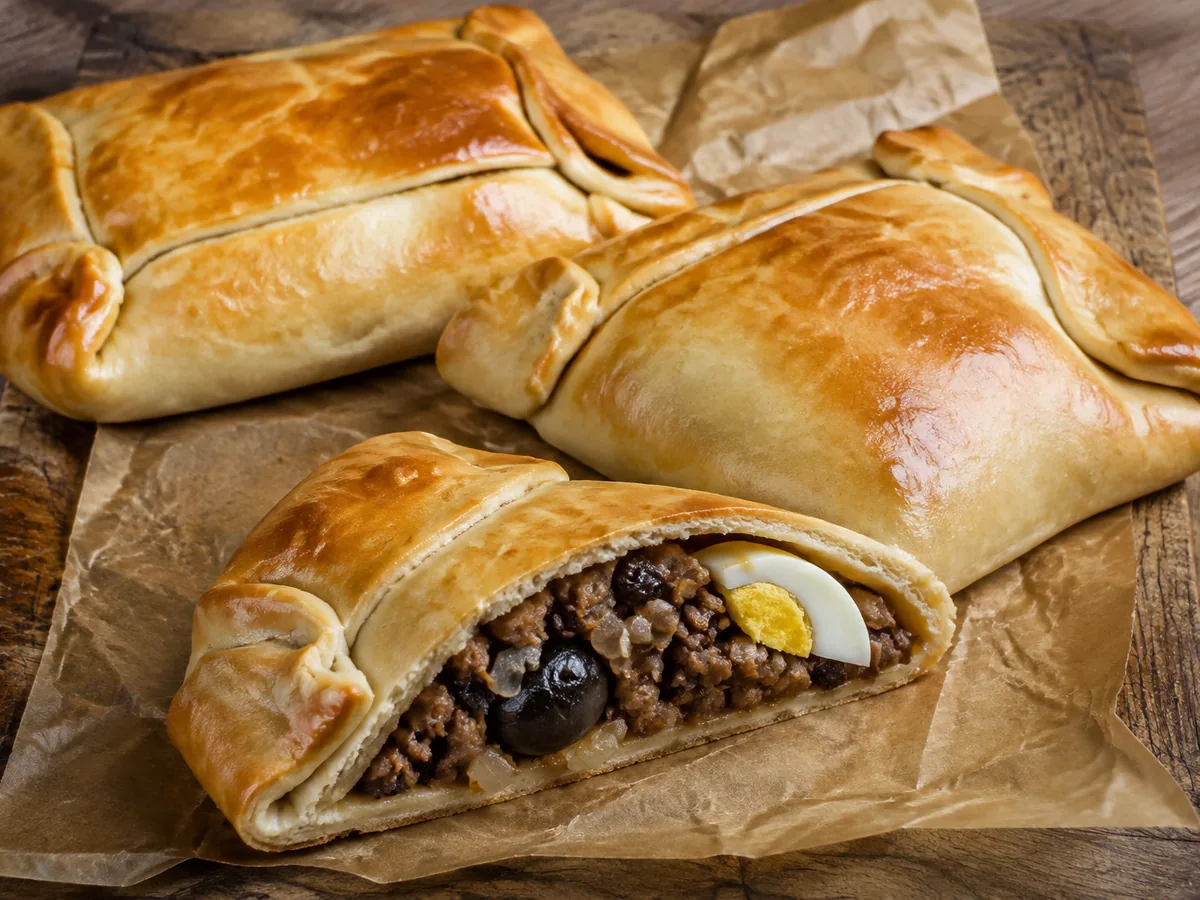
In Chile, September means open wood-fired ovens and the smell of roasting beef fat. Every Fiestas Patrias celebration centres on the empanada de pino: a heavy, golden envelope folded with thick seams.
Unlike small fried turnovers elsewhere, a proper Chilean empanada weighs nearly half a pound. The dough is rolled thin and enriched with hot melted beef lard and warm brine, yielding a crisp, biscuit-like snap. Inside sits a savoury core of braised beef chuck and sweet stewed onions that has rested overnight in the cold, flanked by a slice of hard-boiled egg, a black olive and sweet raisins.
Pastry dough
- 1000 g8 cupsUnbleached all-purpose wheat flour, 11% protein, sifted
- 150 g⅔ cupRendered beef kidney suet lard (manteca de vacuno), or leaf pork lardheated to 50 °C / 122 °F
- 50 g3½ TbspUnsalted butter, melted directly into the warm lard
- 20 g1 Tbsp + 1 tspFine sea salt
- 450 ml1.9 cupsFiltered warm water, 45 °C / 113 °F, for the salmuera brine
- 2 large2 largeEgg yolks, at room temperature
Pino (beef filling)
- 800 g1.76 lbBeef top round, sirloin or chuck roast, hand-cut into 5 mm / ⅕ in diceor coarse ground beef
- 1000 g6 cupsYellow onions, peeled and cut into fine 5 mm / ¼ in brunoise dice
- 60 ml4 TbspRendered beef lard, or vegetable oil
- 20 g1½ TbspAjí de color (Chilean sweet mild chilli powder), or sweet paprika
- 8 g2 tspGround cumin seeds, freshly toasted in a skillet
- 4 g1½ TbspDried wild Chilean oregano, crushed
- 15 g1 TbspAll-purpose flourto bind the pan juices
- 120 ml½ cupRich beef bone broth or stock
Filling and finish
- 3 large3 largeHard-boiled eggs, peeled and cut lengthwise into quarters
- 12 whole12 wholeCured black Azapa or Kalamata olivesunpitted is traditional; pitted works if you pat them dry
- 60 g½ cupDark raisinsplumped in warm water for 15 minutes, then drained dry
- 1 large1 largeWhole egg, whisked with 15 ml / 1 Tbsp whole milkthe doradura egg wash
Why the fat goes in warm
Pastry tenderness hinges on fat temperature and gluten inhibition. Pouring warm melted lard at 50 °C / 122 °F directly over the flour coats the glutenin and gliadin proteins with an oily film before any water enters, which severely limits long gluten chains from forming. The dough stays pliable and rolls thin to 2 mm without snapping back, yet keeps enough structural strength to trap boiling meat juices without rupturing.
Why the pino chills for 24 hours
Chilling locks free moisture inside a cold gelatin matrix. Tucked cold into raw dough it will not melt the pastry fat prematurely; in the oven, as heat penetrates, that gelatin turns to hot broth while the crust bakes crisp.
The five tastes on this plate
Salt arrives through the hot salmuera brine seasoning the dough evenly, plus sea salt balancing the sweet caramelised onions. Fat is melted beef suet lard in the pastry for a flaky, tender crumb, and rendered beef fat enriching the pino. Acid is the deglazed pan fond, cut at the table by vinegary pebre. Heat is pungent toasted cumin, mild ají de color and coarse black pepper. Umami is concentrated browned hand-cut beef, reduced bone stock and cured black olives.
Passive time, counted separately
The pino chills 24 hours, the dough rests 45–60 minutes on the counter, and the baked empanadas rest 10 minutes before serving. None of that is active work, and all of it sits outside the times quoted above — the whole thing is about 2 hours of active work distributed over two days.
Equipment
- Heavy Dutch oven, for the pino
- Shallow tray, for cooling the filling
- Clean work surface for mounding flour
- Rolling pin
- Damp kitchen towel, to keep rolled discs from drying
- Parchment-lined rimmed half-sheet pans
- Toothpick, for venting
- Pastry brush
- Wire rack
Traditional brick wood-fired ovens (horno de barro) reach 240 °C / 465 °F with strong radiant stone-floor heat and bake the crust in 20 minutes. In a modern kitchen, use heavy rimmed half-sheet pans lined with parchment — and for a crisp bottom that mimics a stone oven, preheat a heavy baking steel or pizza stone on the lower-middle rack at 220 °C / 425 °F for 45 minutes and slide the sheet pan directly onto it.
Method
Simmer the pino — day one50–55 min
Melt 60 ml lard in a heavy Dutch oven over high heat. Add the hand-diced beef in two batches, searing hard until a browned crust coats the bottom, 8 to 10 minutes.
Stir in the toasted cumin, ají de color, crushed oregano, salt and black pepper. Scatter 15 g flour over the meat and stir to coat.
Add all 1000 g of diced onions and turn the heat to low. Cover the pot and sweat the onions 35 to 40 minutes, stirring every few minutes, until they turn soft, translucent and sweet.
Pour in 120 ml beef broth, scraping the browned bits from the pan floor, and simmer uncovered 5 minutes until glossy.
Spread the mixture onto a shallow tray, cool it completely, and refrigerate 24 hours to set the gelatin.
Heat 60 ml lard on high; brown beef in 2 batches, 8–10 minutes. Stir in cumin, paprika, oregano, salt, pepper and 15 g flour. Add 1000 g onions; cover on low 35–40 minutes, stirring often until soft. Add 120 ml broth, scrape the bottom and simmer uncovered 5 minutes. Spread on a shallow tray, cool completely and refrigerate 24 hours.
Mix the salmuera and pastry dough — day two15–20 min
Stir 20 g fine sea salt into 450 ml warm water at 45 °C / 113 °F until dissolved.
Mound the sifted flour on a clean work surface and open a wide well in the middle. Whisk together the warm melted lard, melted butter and egg yolks, and pour the warm fat into the well. Rub it into the flour with your fingertips until it resembles wet sand.
Pour in the warm salmuera in a steady stream, working the dough together into a cohesive ball. Knead vigorously 8 to 10 minutes, until smooth, warm and elastic.
Wrap in plastic and rest on the counter 45 to 60 minutes, to relax the gluten.
Dissolve 20 g salt in 450 ml water at 45 °C / 113 °F. Mix lard warmed to 50 °C / 122 °F with melted butter and yolks; rub into the flour well until sandy before adding brine. Knead 8–10 minutes until smooth and elastic; wrap and rest on the counter 45–60 minutes.
Roll out the discs20 min
Cut the rested dough into 12 equal balls, about 120 g each, and shape each into a smooth, tight round.
On a lightly floured board, roll each ball from the centre outward into an even circle roughly 20 to 22 cm (8 to 8½ in) across and 2 mm thick.
Keep the rolled discs covered with a clean damp kitchen towel so they do not dry out.
Divide rested dough into 12 equal balls, about 120 g each. Roll on a lightly floured board from the centre outward into 20–22 cm / 8–8½ in discs, 2 mm thick; cover with a clean damp towel.
Fill and fold — the Chilean envelope20–25 min
Lay a dough circle flat and drop 120 g (about half a cup) of chilled, jellied pino straight into the centre. Top the meat with one hard-boiled egg quarter, one black olive, and 4 or 5 raisins.
Dip your finger in water and run it along the top edge of the circle. Bring the bottom half of the dough up and over the filling, lining up the edges, and press down firmly with your fingers to push out every pocket of trapped air.
Fold the rounded side borders inward by 2 cm on each side, pressing hard to lock. Fold the top curve downward to complete the traditional rectangular envelope shape, and press the corners firmly.
Centre 120 g cold pino on each disc; add 1 egg quarter, 1 olive and 4–5 raisins, soaked 15 minutes and drained. Moisten the upper edge, fold over and expel air. Fold sides inward 2 cm, then fold the top down; press corners firmly.
Vent, glaze and bake25–30 min
Preheat the oven to 220 °C / 425 °F. Transfer the empanadas to parchment-lined baking sheets, leaving 4 cm of space between each.
Prick two small holes in the top crust of each with a toothpick — this vents steam so the seams do not blow open.
Whisk the whole egg with 15 ml milk and brush a light, even coat over the tops and folded edges.
Bake 25 to 30 minutes, rotating the pans front-to-back halfway through, until the pastry turns deep chestnut-gold and the folded walls feel rigid.
Preheat to 220 °C / 425 °F. Space empanadas 4 cm apart on parchment; make 2 toothpick vents in each. Brush tops and folds with egg beaten with 15 ml milk. Bake 25–30 minutes, rotating halfway, until chestnut-gold with rigid folds.
Rest before serving10 min
Transfer to a wire rack and rest 10 minutes before serving.
Warn your guests: the trapped meat juices inside will be molten hot.
Transfer the baked empanadas to a wire rack and rest 10 minutes before serving. Warn guests that the enclosed meat juices are still extremely hot.
Sensory cues of doneness
- Visual: a deep chestnut-gold glaze across the surface with rigid, blistered folds, and no pale undercooked dough along the seams.
- Auditory: a dry, hollow tap when you flick the top crust with a fingernail, and faint steam whistling through the vent pinholes.
- Olfactory: roasted lard pastry, sweet caramelised onions, toasted cumin and seared beef.
Check for chestnut-gold pastry, rigid blistered folds and fully cooked seams without pale dough. Tap the top for a dry, hollow sound; expect roasted pastry, onion, cumin and beef aromas.
Storing it
Freeze them unbaked. Lay them on a parchment-lined tray until frozen solid, then wrap individually in plastic film. Bake straight from the freezer at 200 °C / 400 °F for 35 to 40 minutes, brushing with egg wash right before baking.
Troubleshooting
- Using warm pino.
Assembling with warm filling melts the lard in the raw dough, turning the bottom soggy and bursting the seams in the oven. Always use refrigerator-cold filling.
- Trapping air pockets.
Air left in before folding creates ballooning steam pockets that rip the dough open. Always smooth the pastry down over the filling before folding the borders.
- Cold water in the dough.
Cold water or cold fat stops the dough absorbing moisture and gives tough, rubbery pastry. Both the water and the fat must be warm to the touch.
Substitutions
One-to-one global substitutions, with the technique adjustment each one requires.
Ingredient substitutions
| Ingredient | Replace with | Culinary impact and technique adjustment |
|---|---|---|
| Beef lard (manteca) | Leaf pork lard, or unsalted European 82% butter | One-to-one. Pork lard gives an identical snap; butter adds dairy aroma with a slightly softer crust |
| Ají de color | Sweet Hungarian paprika | One-to-one. Matches the colour and the sweet dried-pepper flavour |
| Hand-diced beef | Coarse ground chuck, 80/20 | One-to-one. Hand-cut beef has the traditional chew; coarse ground chuck cuts prep time while keeping the filling juicy |
Scaling
Half, for 6 empanadas
Cut all quantities in half. The bake time stays at 25 to 30 minutes at 220 °C / 425 °F.
Double, for 24 empanadas
Brown the beef and onions in two separate pans to avoid overcrowding, and bake on separate racks, rotating them halfway through.
What to serve it with
- Pebre tradicional chileno — finely diced green chilli, ripe tomato, sweet onion, garlic, cilantro, red wine vinegar and good olive oil, spooned straight onto the filling after the first bite
- An Alto Maipo Cabernet Sauvignon, whose structured tannins, dried herbs and dark cassis slice through rich lard pastry and sweet onion pino
Questions
Why are traditional olives left unpitted?
Pitting releases brine into the pino and softens the olive, while the pit holds its heat and preserves the olive's texture. Pitted olives are fine for modern dining — just pat them thoroughly dry first.
Can I freeze these empanadas?
Yes, unbaked. Lay them on a parchment-lined tray until frozen solid, then wrap individually in plastic film. Bake straight from the freezer at 200 °C / 400 °F for 35 to 40 minutes, brushing with egg wash right before baking.
Can I use butter instead of lard?
You can swap unsalted European butter for lard one-to-one. The pastry will taste richer and more like brioche, with a softer flake rather than the traditional crisp, biscuit-like snap.