Cazuela de Vacuno
An open, clear beef consommé holding large unblemished cuts — bone-in shank with its marrow ring, a skin-on wedge of orange squash, a whole potato, half an ear of corn and julienned green beans. Sip the broth first, then carve.
- Prep
- 30 min
- Cook
- 1 hr 45 min
- Serves
- 6 hearty portions
- Difficulty
- Medium
Researched · Kitchen testing pending
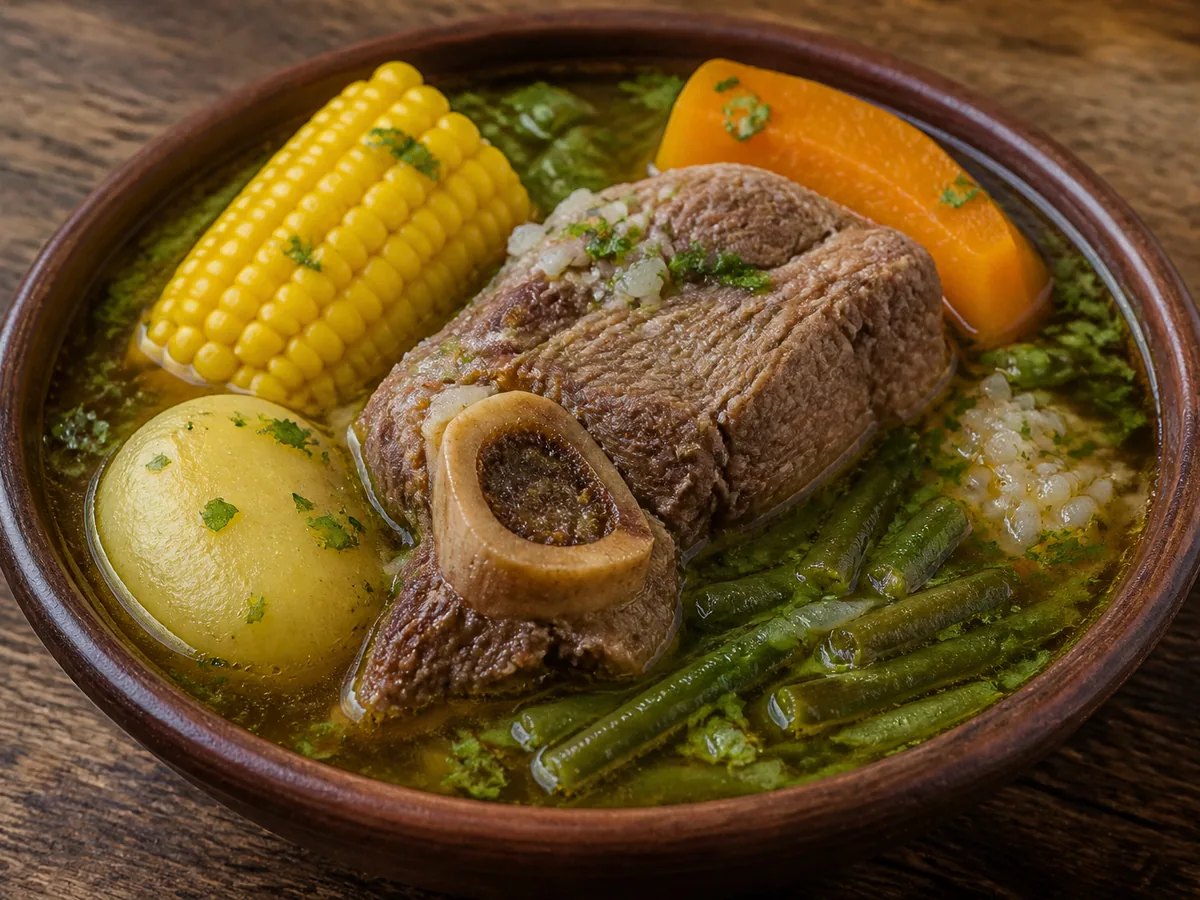
Sunday lunch in a Chilean home revolves around the cazuela pot. Unlike blended purées or thick stews, a classic cazuela de vacuno is an open, clear beef consommé holding large, unblemished cuts: a thick bone-in beef shank with its marrow ring, a sweet wedge of orange squash with the skin still on, a whole peeled yellow potato, half an ear of corn, and long julienned green beans.
The broth stays pale and clear, scented with oregano and toasted cumin. You sip the broth first from wide clay bowls, then carve the fork-tender beef and vegetables.
Beef and aromatics
- 1.5 kg3.3 lbBone-in beef shank (osobuco), cut 4 cm / 1½ in thickor bone-in short ribs, trimmed of excess outer fat
- 30 ml2 TbspExtra-virgin olive oil, or rendered beef tallow
- 1 large1 largeYellow onion, peeled and quartered
- 1 medium1 mediumRed bell pepper, seeded and sliced into thick strips
- 4 cloves4 clovesFresh garlic, peeled and crushed flat
- 1 large1 largeCarrot, peeled and cut into thick matchsticks
- 5 g1 tspGround cumin seeds, freshly toasted in a skillet
- 3 g1 TbspDried Chilean wild oregano
- 15 g1 TbspFine sea saltplus extra to adjust at the end
- 3 g1 tspWhole black peppercorns
- 2.5 L10.5 cupsCold filtered water
Vegetables and finish
- 6 pieces6 piecesZapallo camote (sweet winter squash) or Kabocha, cut into 6 large 150 g wedgesskin left on
- 6 medium6 mediumYellow waxy potatoes (Yukon Gold), peeled and left whole
- 3 ears3 earsChoclo (sweet corn), husked and silk removed, cut crosswise into 6 half-ears
- 60 g⅓ cupLong-grain white rice, rinsed until the water runs clear
- 150 g1½ cupsFresh green beans (porotos verdes), trimmed and sliced lengthwise into thin ribbonschilenitos
- 30 g½ cupFresh flat-leaf parsley and cilantro leaves, finely chopped
Clarity depends on temperature, not skill
Beef shank is packed with type-I collagen, which hydrolyses into silky, water-soluble gelatin only when held between 82 °C and 93 °C / 180–200 °F. If the pot boils hard at 100 °C / 212 °F, the turbulence breaks coagulating blood and muscle proteins into tiny particles and forces rendered fat into a cloudy emulsion. Starting with cold water and holding a lazy sub-boil at 88–90 °C lets denatured proteins rise cleanly as grey foam.
Skim in the first 20 minutes
Skimming that foam early leaves the broth crystalline, fragrant and naturally thickened with dissolved gelatin. Everything after depends on it.
The five tastes on this plate
Salt goes into cold water from the start, so it penetrates the beef muscle down to the bone. Fat is golden tallow and marrow floating in tiny droplets — the ojitos — over the surface. Acid is naturally gentle here, brightened at the table with fresh lemon. Heat is earthy cumin, crushed garlic and black peppercorn. Umami is extracted shank collagen, melted bone marrow and slowly cooked vegetables.
Equipment
- Heavy 7 L / 7 qt Dutch oven or stockpot
- Wide spoon or skimmer
- Meat thermometer
- Six wide ceramic or clay bowls
Traditionally this is a large copper or earthenware pot, served in deep greda clay bowls that hold heat for half an hour. In a modern kitchen a heavy 7-to-8 quart enamelled cast-iron Dutch oven or multi-ply stainless stockpot does the job — thick-bottomed cookware eliminates hot spots on low flame settings.
Method
Brown the meat and aromatics10–12 min
Set a heavy 7-quart Dutch oven over medium-high heat with 30 ml oil, and pat the beef shanks dry.
Sear the beef on its flat sides for 3 to 4 minutes per side until lightly browned — keep it light, so the broth stays pale.
Toss in the crushed garlic, quartered onion, bell pepper, carrot, cumin and oregano. Stir and cook 3 minutes, until fragrant.
Pat the shanks dry. Heat 30 ml oil in a heavy pot over medium-high heat and sear 3–4 minutes per side until lightly browned. Add garlic, onion, pepper, carrot, cumin and oregano; stir and cook 3 minutes.
Add water and skim the scum15–20 min
Pour 2.5 litres of cold filtered water over the beef and vegetables, and keep the heat on medium-low.
Over the next 15 to 20 minutes, as the pot warms toward 85 °C / 185 °F, a thick layer of grey foam floats to the surface. Skim it off with a wide spoon or skimmer.
Keep skimming until the surface stays completely clear.
Pour in 2.5 litres cold water and keep over medium-low heat. As it approaches 85 °C / 185 °F over 15–20 minutes, skim off the grey foam until the surface stays clear.
Simmer low and slow1 hr
Turn the heat to its lowest setting to hold a gentle, trembling simmer around 88–90 °C, and set the lid slightly ajar.
Leave it alone for 1 hour, until the beef yields when poked with a knife tip.
Reduce heat to its lowest setting and leave the lid slightly ajar. Hold a gentle 88–90 °C simmer for 1 hour, until the beef yields to a knife tip; avoid a rolling boil.
Add the vegetables and rice20 min
Gently lower the six whole peeled potatoes, six squash wedges (skin-side down) and six corn half-ears into the broth. Scatter the 60 g of rinsed white rice across the liquid and stir in 15 g fine sea salt.
Cover partially and simmer gently 20 minutes. The potatoes and squash must turn tender without breaking apart into the broth.
Gently add 6 whole potatoes, 6 squash wedges skin-side down and 6 corn half-ears. Stir in 60 g rinsed rice and 15 g salt. Partially cover and simmer 20 minutes, until potatoes and squash are tender but intact.
Finish with green beans5 min
Drop the julienned green beans into the pot for the final 5 minutes. They should turn bright green and tender-crisp.
Check the beef: a thermometer in the centre of the shank should read 93–96 °C / 200–205 °F, and the meat should slip off a fork easily.
Add the green bean ribbons for the final 5 minutes, until bright and tender-crisp. Check that the shank reaches 93–96 °C / 200–205 °F and slips easily off a fork.
Assemble the bowls
Warm six wide ceramic or clay bowls. In each, place one piece of beef shank with its marrow bone, then set one whole potato, one squash wedge and one piece of corn around the meat.
Ladle the hot, rice-flecked broth over everything, spooning green beans across the top. Scatter chopped parsley and cilantro over each bowl and serve immediately.
In each of 6 warm bowls, arrange a shank with marrow bone, a potato, squash wedge and corn piece. Ladle over hot broth, rice and green beans; scatter parsley and cilantro and serve immediately.
Sensory cues of doneness
- Visual: the broth is crystalline amber-gold with tiny yellow fat bubbles, the beef pulls away from the bone with no resistance, and the squash is soft but holds its wedge shape.
- Auditory: a quiet, gentle simmer breaking the surface with a soft bubble every three to four seconds — never a rolling churn.
- Olfactory: warm beef marrow broth, sweet corn steam, dried oregano and earthy squash.
Check for clear amber broth with tiny fat droplets, beef releasing easily from the bone and tender squash retaining its shape. Maintain a quiet simmer, with a bubble every 3–4 seconds.
Troubleshooting
- Letting the pot boil hard.
A rolling boil breaks fat and proteins into a murky, greasy broth. Keep the heat low so the liquid barely trembles.
- Adding the squash too early.
Squash put in at the start cooks to mush. Beef takes an hour and a half to soften; squash takes barely 20 minutes. Stage the vegetables.
- Bland vegetables.
Potatoes and squash cooked in unsalted water have tasteless interiors. Salt the broth before the vegetables go in, so the salt diffuses into their starches.
Substitutions
One-to-one global substitutions, with the technique adjustment each one requires.
Ingredient substitutions
| Ingredient | Replace with | Culinary impact and technique adjustment |
|---|---|---|
| Beef shank (osobuco) | Bone-in English short ribs, or beef chuck with extra marrow bones | One-to-one. Delivers the same gelatin, rich flavour and bone marrow |
| Zapallo camote | Kabocha or butternut squash, skin-on | One-to-one. Kabocha has the same dense, sweet, dry-textured flesh |
| Choclo | Fresh sweet yellow or bi-colour corn on the cob | One-to-one. Cut into 5 cm / 2 in rounds |
Scaling
Half, for 3 portions
Halve all ingredients in a 4-quart pot. The simmer times stay the same, because collagen breakdown depends on temperature, not batch volume.
Double, for 12 portions
Double the ingredients in an 11-to-12 quart stockpot. Make sure the pot is wide enough that the vegetables sit submerged in a single layer.
What to serve it with
- Pan marraqueta and pebre — warm crusty Chilean rolls and fresh spicy salsa for dipping into the hot broth
- Fresh lemon halves, squeezed into the broth to cut the rich marrow
- An Itata Valley old-vine País, or a coastal Pinot Noir — light-bodied, low-tannin, with wild red berry acidity that matches the broth without overpowering the vegetables
Questions
Why keep the skin on the squash?
The skin acts as an anchor. Without it, sweet squash dissolves into pumpkin purée and clouds the broth.
Can I make this with chicken?
Yes — that is the beloved cazuela de ave. Use bone-in chicken thighs or legs, and simmer for just 35 minutes before adding the vegetables.
What does the rice do in the broth?
The small handful sheds just enough starch to give the consommé a silky mouthfeel, without turning it thick.