Curanto en Olla (Pulmay)
The Chiloé pit feast brought indoors — a stockpot packed in strict tiers over boiling white wine, with smoked pork, longaniza and chicken below and mussels and clams above, sealed under cabbage leaves. The broth at the bottom is the point.
- Prep
- 40 min
- Cook
- 50 min
- Serves
- 6 to 8 hearty feast portions
- Difficulty
- Hard
Researched · Kitchen testing pending
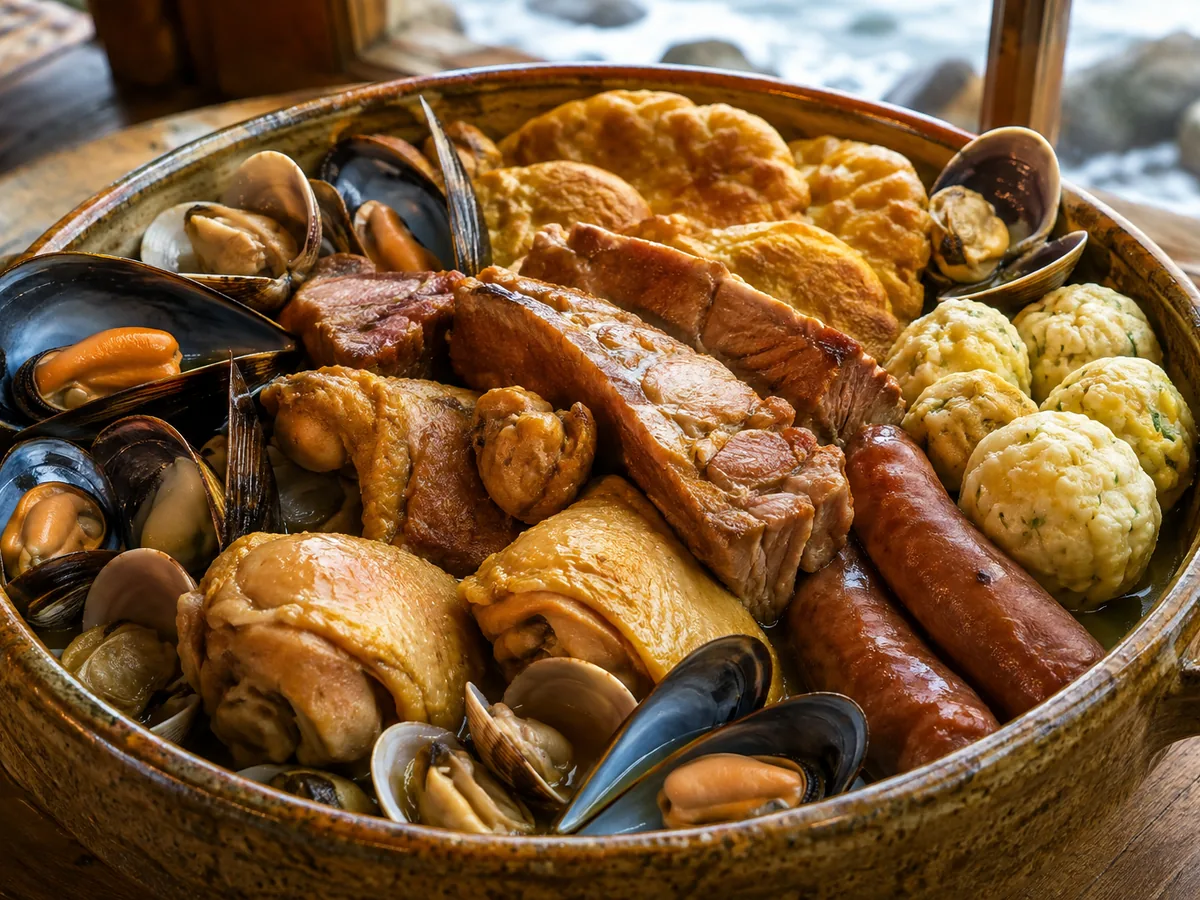
Out in the damp, fog-drenched islands of Chiloé, curanto begins with an open ditch and red-hot granite rocks. Locals pack the pit with cords of smoked pork, thick links of sausage, chicken legs, sacks of live bivalves and dense potato cakes, then bury the mound under giant wild rhubarb leaves and heavy wet sod.
Stove-top cooks bring that same island feast inside using a heavy stockpot, calling it pulmay, or curanto en olla. The pot is packed in strict tiers. Dry white wine boils at the base, sending aromatic steam up through the meats and shellfish. Rendered pork fat and wood smoke drip downward while briny clam and mussel liquor cascades through the layers, pooling into a dark, restorative broth at the bottom of the pot that is ladled piping-hot into mugs.
Shellfish
- 1.5 kg3.3 lbFresh blue mussels (choritos), scrubbed and debearded
- 1.5 kg3.3 lbFresh littleneck or Manila clams (almejas)purged of sand in cold salt water
Meats
- 800 g1.76 lbSmoked pork ribs (costillar ahumado), separated into individual bone ribs
- 500 g1.1 lbTraditional Chilean longaniza, or Spanish fresh cooking chorizosliced into 5 cm / 2 in links
- 6 pieces6 piecesBone-in, skin-on chicken drumsticks or thighsabout 900 g / 2 lb total
Aromatic base and liquid
- 1 large1 largeYellow onion, peeled and cut into thick 1 cm rings
- 6 cloves6 clovesFresh garlic, peeled and crushed flat
- 1 large1 largeRed bell pepper, cored and cut into thick strips
- 750 ml1 bottle / 3 cupsDry Chilean white wine — Sauvignon Blanc or a crisp Chardonnay
- 500 ml2.1 cupsLow-sodium chicken stock, or cold filtered water
- 3 g1 tspGround cumin seeds, toasted
- 3 g1 TbspDried Chilean wild oregano
- 10 g2 tspFine sea saltuse lightly — smoked pork and shellfish release natural brine
- 2 g1 tspCoarsely cracked black peppercorns
Potatoes, seal and garnish
- 6 medium6 mediumYellow waxy potatoes, scrubbed clean with skins left intact
- 1 head1 headSavoy or green cabbageabout 8 large outer leaves, washed clean
- 30 g½ cupFresh cilantro and flat-leaf parsley, finely chopped
Why the tiers are not optional
Pulmay relies on vertical convective distillation and density stratification. Dense meats — smoked pork ribs, sausage, chicken — need direct conductive and convective heat, so they sit on the aromatic vegetable bed directly above the simmering wine, while delicate bivalves sit higher up. As the wine and broth boil, rising water and alcohol vapours strip rendered pork fat downwards while coaxing succinic acid and free glutamates from the opening shellfish.
What the cabbage blanket does
A tight layer of savoy cabbage leaves locks steam under mild positive pressure, forcing condensed aromatic vapours to wash continuously back down through the potatoes. On Chiloé, giant nalca leaves seal the earthen pit; cabbage mimics that botanical blanket and adds a subtle vegetal sweetness.
Season lightly, taste at the end
Smoked pork ribs and fresh clams release a great deal of natural salt. Go light at the start and taste the broth only at the very end.
The five tastes on this plate
Salt is natural sea liquor from the opening bivalves plus cured smoked pork. Fat is smoky rendered pork lard, sausage fat and chicken drippings washing down through the pot. Acid is a full bottle of dry coastal Sauvignon Blanc boiling into steam, cutting the heavy pork fat. Heat is crushed garlic, paprika in the sausage, cracked pepper and toasted cumin. Umami comes from uniting wood-smoked pork and chicken with fresh Pacific bivalves.
Equipment
- 14–16 qt enamelled cast-iron or heavy stainless canning stockpot, with a heavy tight-fitting lid
- Fine sieve
- Pitcher, and warm ceramic mugs for the broth
- Wide serving platters
- Instant-read thermometer
If you lack a 14-quart stockpot, split the ingredients evenly between two standard 7-quart Dutch ovens. Do not cram everything into a small pot, or the top layer will stay cold while the bottom shellfish turn rubbery.
Method
Clean and purge the shellfish25 min
Pick through the mussels and clams. Throw away any with cracked shells, and any that stay open when tapped against the counter.
Scrub the shells clean under cold running water, and yank the stringy beards off the mussels toward the hinge.
Soak the clams in cold salted water — 35 g salt per litre — for 20 minutes so they spit out residual sand, then drain them well.
Discard cracked mussels and clams and any that remain open when tapped. Scrub under cold running water; pull mussel beards toward the hinge. Soak clams 20 minutes in cold water with 35 g salt per litre, then drain well.
Build the aromatic base5 min
In the bottom of a heavy 14-quart stockpot, spread out the onion rings, crushed garlic and sliced bell peppers. Season with the cumin, oregano and black pepper.
Empty the full 750 ml bottle of white wine and the 500 ml stock into the pot, and bring it to a rolling boil over high heat for 3 minutes, to burn off the sharp alcohol vapours.
Spread onion rings, crushed garlic and pepper strips in a heavy 14-quart pot; season with cumin, oregano and black pepper. Add 750 ml white wine and 500 ml stock and boil vigorously over high heat for 3 minutes.
Layer the meats
Turn the heat down to medium. Lay the smoked pork ribs and seasoned chicken pieces in an even layer directly over the onions, and wedge the sliced longaniza in between the meat cuts.
This meat foundation acts as a raised rack for the seafood above.
Reduce heat to medium. Arrange smoked ribs and lightly seasoned chicken evenly over the onions, with longaniza between them. Keep meats underneath the seafood and use salt sparingly because pork and shellfish release brine.
Add potatoes and shellfish
Tuck the scrubbed whole potatoes around the edges of the meat layer.
Pour the cleaned clams and mussels right over the top, spreading them into a broad layer of shells.
Tuck the scrubbed whole potatoes, skins intact, around the edges of the meat layer. Spread the cleaned clams and mussels in a broad layer above the meats.
Seal with cabbage leaves and steam48 min
Cover the seafood layer tightly with overlapping savoy cabbage leaves, tucking them firmly down the inside edges of the pot to form an airtight seal. Put the lid on tight.
Crank the heat to high until steam escapes steadily from under the lid, about 8 minutes, then turn down to medium-low.
Keep it at a steady, enclosed steam for 40 minutes. Do not lift the lid.
Overlap cabbage leaves tightly over the shellfish, tucking edges down inside the pot; cover firmly. Heat on high until steam escapes steadily, about 8 minutes, then steam over medium-low for 40 minutes without lifting the lid.
Plate the feast
Lift off the lid and peel back the wilted cabbage leaves. Make sure all the shells have opened, and throw out any that stayed clamped shut.
Probe the chicken to confirm it has reached 74 °C / 165 °F, and check the potatoes are tender.
Transfer the shellfish, meats and potatoes onto wide platters, keeping the shellfish around the perimeter with the meats in the centre.
Uncover and peel back cabbage. Discard unopened shellfish; confirm chicken reaches 74 °C / 165 °F and potatoes are tender. Transfer to wide platters with shellfish around the edges and meats in the centre.
Decant and serve the caldito
Ladle the broth from the bottom of the pot through a fine sieve into a pitcher, catching any stray bits of shell.
Pour the steaming, golden broth into warm ceramic mugs, and hand each guest a mug of hot caldito alongside their platter — with lemon wedges and fresh pebre on the side.
Strain the bottom broth through a fine sieve into a pitcher to catch shell fragments. Taste seasoning only now; serve hot in warmed mugs alongside the platters, with lemon wedges and fresh pebre.
Sensory cues of doneness
- Visual: shells yawn open showing plump, glistening meats, the cabbage leaves are wilted and soft, and a knife glides through the potatoes without resistance.
- Auditory: a deep, muffled boil churning at the bottom, punctuated by clicking shells expanding against the pot walls.
- Olfactory: wood smoke, oceanic clam brine, boiling white wine, sweet cabbage and toasted garlic.
Check for opened shells with plump, glossy flesh, soft wilted cabbage and potatoes that a knife pierces without resistance. Expect smoky pork, clam brine, white wine, cabbage and garlic aromas.
Storing it
Leftover caldito freezes well, and makes an excellent base for seafood risotto, fish soup or paella.
Troubleshooting
- Overcooked, rubbery shellfish.
Blasting the pot with high heat for too long shrivels clam meat. Keeping the shellfish in the top tier, buffered by the meats, cooks them gently in steam.
- A sandy broth.
The clams were not purged. Soak them in salt water beforehand, and strain the broth through a fine sieve before pouring it into mugs.
- Over-salting.
Smoked pork ribs and fresh clams release plenty of natural salt. Season lightly, then taste the broth at the very end.
Substitutions
One-to-one global substitutions, with the technique adjustment each one requires.
Ingredient substitutions
| Ingredient | Replace with | Culinary impact and technique adjustment |
|---|---|---|
| Chilean longaniza | Spanish fresh cooking chorizo, or Portuguese linguiça | One-to-one. Delivers the same garlic and paprika fat notes |
| Smoked pork ribs | Smoked pork chops, or smoked ham hocks | One-to-one. Supplies the wood smoke and collagen base |
| Blue mussels | Mediterranean or green-lipped mussels | One-to-one. Keep the shells intact |
Scaling
Half, for 3 to 4 portions
Halve all ingredients and use an 8-quart stockpot, with 375 ml wine and 250 ml stock. Steam for 35 minutes.
Do not double in one pot
Use two 14-quart stockpots side by side, so the steam circulates freely.
What to serve it with
- Hot caldito in mugs — the strained broth sipped between mouthfuls of shellfish and pork, and the true centrepiece of the meal
- Pebre with smoked merquén, to cut through the rich pork fat
- Milcaos — pan-fried Chiloé potato patties of raw grated potato starch, mashed cooked potato and crisp pork lard
- A Casablanca Sauvignon Blanc, whose flinty acidity cuts the unctuous smoked pork and echoes the sweet clam brine
Questions
What can I use if I cannot find Chilean longaniza?
Fresh Spanish cooking chorizo or Portuguese linguiça makes a great match, with similar garlic, pork fat and paprika notes.
Why use cabbage leaves inside the pot?
On Chiloé, giant nalca leaves seal the earthen pit. Savoy cabbage mimics that botanical blanket, trapping steam and adding a subtle vegetal sweetness.
Can I freeze leftover caldito?
Yes. It freezes well and makes an incredible base for seafood risottos, fish soups or paella.