Charquicán con Huevo Frito
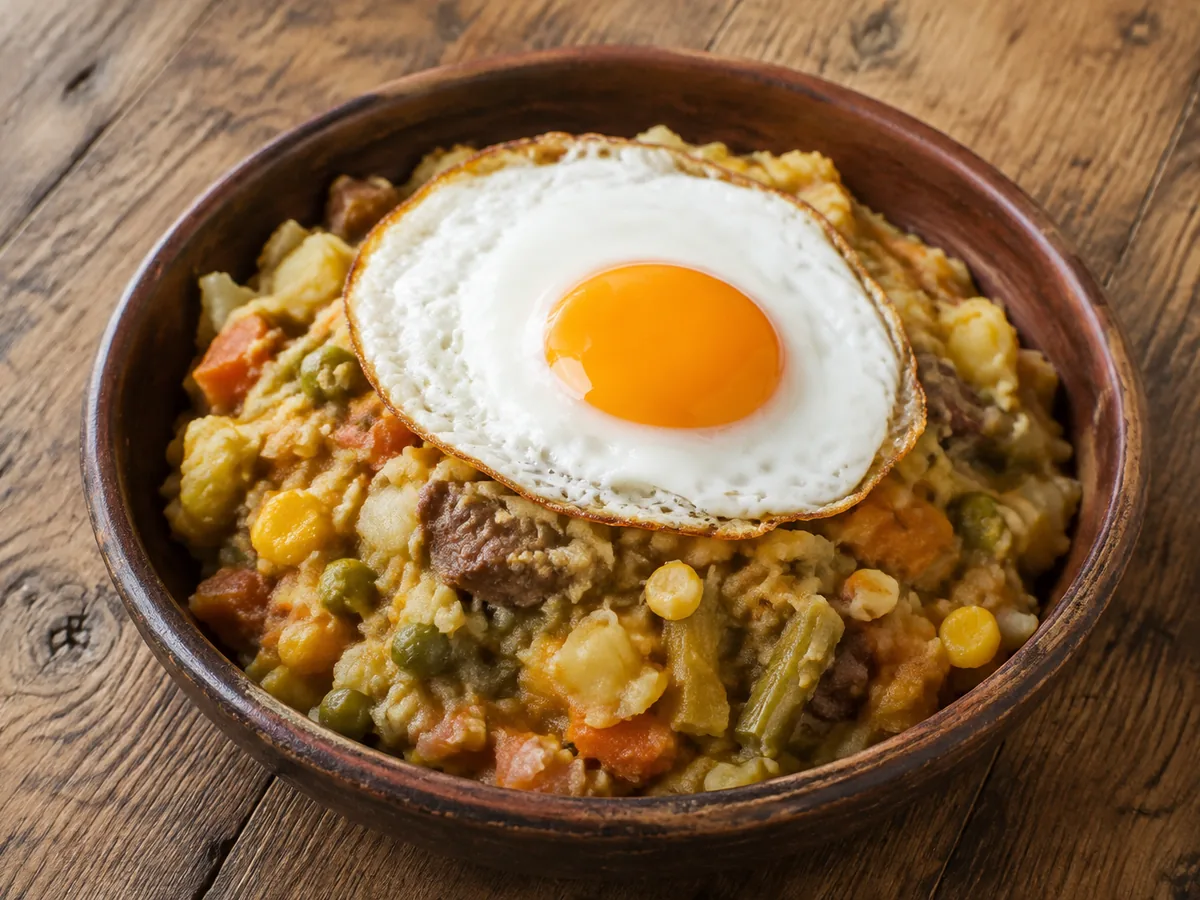
Beef, potato, squash, corn, peas and green beans simmered then roughly crushed by hand into a chunky golden-orange mash, crowned with a fried egg whose lacy edges blister in hot oil. Break the yolk and it runs through like sauce.
- Prep
- 30 min
- Cook
- 35 min
- Serves
- 6 hearty portions
- Difficulty
- Medium
Researched · Kitchen testing pending
Charquicán carries one of the oldest culinary lineages in the Southern Cone. Its name fuses Quechua ch’arki, salted sun-dried beef jerky, with Mapuche cancan, roasted meat. Centuries ago, traders hauling goods over freezing Andean trails pounded dried beef with stones and rehydrated it in clay pots with wild tubers, winter squash and dried maize.
Modern Chilean homes make it with fresh minced beef or ground chuck browned with cumin, simmered with potatoes, sweet squash, corn, peas and green beans. The cook crushes the vegetables roughly with a hand masher, leaving a chunky, golden-orange mash. On top goes a hot fried egg with blistered, lacy edges — break the yolk, and it runs into the warm mash like rich sauce.
Beef and sofrito
- 600 g1.32 lbLean beef chuck or top sirloin, hand-cut into 8 mm / ⅓ in diceor coarse lean ground beef
- 45 ml3 TbspRendered beef lard, or extra-virgin olive oil
- 1 large1 largeYellow onion, peeled and cut into fine 6 mm / ¼ in brunoise dice
- 4 cloves4 clovesFresh garlic, peeled and minced fine
- 15 g1 TbspAjí de color (Chilean sweet paprika), or sweet smoked paprika
- 5 g1½ tspGround cumin seeds, freshly toasted in a dry skillet
- 3 g1 TbspDried Chilean wild oregano
- 12 g2 tspFine sea saltplus extra for the eggs
- 3 g1 tspFreshly ground black peppercorn
Vegetables
- 500 g3 mediumRusset or Yukon Gold potatoes, peeled and cut into 2 cm / ¾ in cubes
- 500 g3 cupsZapallo camote (sweet winter squash) or Kabocha, peeled, seeded and cut into 2 cm / ¾ in cubes
- 500 ml2.1 cupsRich beef bone broth or stock, hot
- 200 g1½ cupsSweet corn kernels (choclo), fresh or frozen
- 150 g1 cupSweet green peas, fresh or frozen
- 150 g1 cupFresh green beans, cut into 1 cm pieces
To finish
- 6 large6 largeFarm-fresh eggs
- 60 ml4 TbspVegetable oilfor frying the eggs to crisp edges
- 20 g⅓ cupFresh flat-leaf parsley or cilantro, finely minced
Where the body comes from
Charquicán thickens through partial cell-wall rupture and starch release. As the diced potato and squash simmer in beef stock, amylose starches swell and the pectin in the squash breaks down. Crushing with a masher ruptures roughly 60% of the cells, releasing starch that binds the free broth into a thick mash with no added flour. Leaving the peas, corn and beans uncrushed creates the textural contrast.
What the yolk does
When the fried egg is broken on top, yolk lecithin acts as an emulsifier, binding the beef fats and squash starches into a rich sauce as you eat.
The name is older than Chile
Charquicán fuses Quechua ch'arki — salted, sun-dried beef jerky — with Mapuche cancan, roasted meat. Traders hauling goods over freezing Andean trails pounded dried beef with stones and rehydrated it in clay pots with wild tubers, winter squash and dried maize.
The five tastes on this plate
Salt seasons the vegetable mash and finishes as flaky salt over the hot yolk. Fat is rendered beef fat enriched by the fluid yolk broken across the plate. Acid is mellow here, cut table-side with pickled red onions or fresh pebre. Heat is earthy cumin, minced garlic and the sweet warmth of ají de color. Umami is caramelised beef fond, reduced bone stock and sweet winter squash.
Equipment
- Wide 6 qt Dutch oven, or a broad clay pot
- Wire or slotted potato masher
- Well-seasoned carbon-steel or cast-iron skillet, for the eggs
- Wide, warm shallow bowls
Traditionally a broad clay pot or wide cast-iron skillet. A heavy 5-to-6 quart enamelled cast-iron Dutch oven works in a modern kitchen. For the eggs, use a well-seasoned carbon-steel pan or cast-iron skillet — that is what gives the blistered lace edges, the encaje.
Method
Brown the beef and sofrito15–17 min
Heat 45 ml lard or olive oil in a wide 6-quart Dutch oven over medium-high heat. Add the diced beef chuck and let it sear without moving for 4 minutes, until a deep brown crust forms, then stir and cook 3 minutes more.
Add the minced onion, garlic, ají de color, toasted cumin, oregano, salt and black pepper. Turn the heat to medium and cook 8 to 10 minutes, until the onions are soft and glossy.
Heat 45 ml fat or oil over medium-high heat. Sear beef undisturbed 4 minutes, then stir and cook 3 minutes. Add onion, garlic, paprika, toasted cumin, oregano, salt and pepper; cook over medium heat 8–10 minutes until onion softens.
Simmer the squash and potatoes20 min
Add the cubed potatoes and squash, stirring to coat them in the spiced beef fat, then pour in 500 ml hot beef broth.
Bring to a gentle boil, turn the heat down to medium-low, cover, and simmer 20 minutes — until the potatoes and squash yield easily when pressed with a fork.
Stir potatoes and squash into the seasoned beef fat. Add 500 ml hot broth, bring to a gentle boil, then cover and simmer over medium-low heat 20 minutes, until both vegetables yield easily to a fork.
Rough-crush the stew — el machacado
Take the lid off. With a wire or slotted potato masher, press down firmly 6 to 8 times across the pot.
You want to crush about half to two-thirds of the squash and potato so they thicken the stew into a cohesive mash, leaving distinct chunks of beef, potato and squash intact.
Do not turn it into a smooth purée.
Uncover and press a potato masher firmly through the stew 6–8 times. Crush half to two-thirds of the potato and squash to bind the broth, leaving distinct vegetable and beef chunks; do not purée smooth.
Fold in the summer vegetables6–8 min
Stir in the corn kernels, peas and green beans. Simmer uncovered over low heat for 6 to 8 minutes, stirring frequently with a wooden spoon, until the green vegetables are tender-crisp and bright.
The stew should be thick and moist, not runny. Taste, and add salt or pepper if needed. Keep warm on low heat.
Fold in corn, peas and green beans without crushing them. Simmer uncovered on low 6–8 minutes, stirring frequently, until bright and tender-crisp. Keep the stew thick and moist; adjust salt and pepper and keep warm.
Fry the crispy-edged eggs — huevos con encaje6 min
Heat 60 ml oil in a heavy carbon-steel or cast-iron skillet over high heat until shimmering, 190 °C / 375 °F.
Crack an egg into a small cup and tip it into the hot oil. The white bubbles instantly and fries into crisp, ruffled golden lace.
Tilt the pan and spoon hot oil over the white nearest the yolk for 45 to 60 seconds, until the white sets firm while the yolk stays warm and liquid. Repeat for all six eggs.
Heat 60 ml oil over high heat to 190 °C / 375 °F. Tip each egg in from a cup; tilt the pan and baste the white near the yolk 45–60 seconds, until firm with crisp edges and a liquid yolk. Repeat for 6 eggs.
Plate and crown
Ladle a generous mound of hot charquicán into wide, warm shallow bowls, and place a hot fried egg directly on top of each serving.
Sprinkle flaky sea salt and cracked pepper over the yolk, scatter chopped parsley around the rim, and serve right away.
Mound hot charquicán in warm shallow bowls and top each portion with a hot fried egg. Season the yolk with flaky salt and cracked pepper, scatter parsley around the rim and serve immediately.
Sensory cues of doneness
- Visual: a chunky orange-gold vegetable mash studded with green peas and dark beef, topped with a crisp-edged white and a fluid amber yolk.
- Auditory: a wet, heavy thud as the mash drops from the spoon, and crackling oil as the eggs hit the pan.
- Olfactory: toasted cumin, fried garlic, sweet squash and crispy fried egg whites.
Look for a chunky orange-gold mash with intact peas and beef, topped with crisp egg whites and a fluid yolk. The stew should drop heavily from the spoon, with cumin, garlic and squash aromas.
Storing it
Leftovers keep well and taste better the next day, as the cumin and squash flavours settle. Warm it in a skillet with a splash of water, and fry a fresh egg to serve on top.
Troubleshooting
- Blending it into baby food.
A food processor turns the potatoes gummy and ruins the dish. Use a manual hand masher with light downward strokes to preserve the bite.
- Overcooking the egg yolk.
Cooking the egg over low heat firms the yolk before the white crisps. Use hot oil to fry the white fast while keeping the yolk runny.
- Too much liquid.
Squash and onions release plenty of water as they cook. Stick to 500 ml broth, and simmer uncovered at the end to cook off any excess.
Substitutions
One-to-one global substitutions, with the technique adjustment each one requires.
Ingredient substitutions
| Ingredient | Replace with | Culinary impact and technique adjustment |
|---|---|---|
| Zapallo camote | Kabocha or butternut squash | One-to-one. Kabocha has the best dense, non-watery texture |
| Ají de color | Sweet Hungarian paprika | One-to-one. Provides the same rich orange-red colour |
| Diced beef chuck | Ground beef, or shredded braised pork | One-to-one. Hand-cut beef gives the best traditional texture |
Scaling
Half, for 3 portions
Cut the quantities in half and use a 3-quart saucepan. Cooking times for the potatoes and squash stay at 20 minutes.
Double, for 12 portions
Double the ingredients in an 8-to-10 quart Dutch oven, and mash carefully in batches so you do not over-crush the bottom layer.
What to serve it with
- Cebollas en escabeche — crisp Chilean pickled red onions steeped in red wine vinegar and bay, whose tart acid cuts the rich mash
- Ensalada a la chilena — sliced tomato, onion and cilantro
- Warm crusty rolls, for dragging through the egg yolk and vegetable mash
- A Colchagua Merlot or Syrah — plummy and soft-tannined, or savoury, matching the sweet squash and rich yolk without harsh astringency
Questions
Can I use traditional dried charqui?
Yes. Toast 200 g of beef jerky over a flame for 1 minute, shred it with a knife or mortar, and simmer it with the potatoes and squash in the broth.
Can I make this vegetarian?
Yes. Skip the beef and lard, increase the potatoes and squash by 200 g, sauté in olive oil, and use a rich vegetable broth — that is the traditional charquicán de verduras.
How do leftovers keep?
Very well. It tastes better the next day as the cumin and squash flavours settle. Warm it in a skillet with a splash of water, and fry a fresh egg on top.