Caldillo de Congrio
The stew Neruda wrote an ode to. A fumet boiled from conger heads and white wine, strained into a sofrito of sweet onion, garlic and ripe tomato, with thick fish medallions poached gently alongside clams and shrimp and finished with warm cream.
- Prep
- 35 min
- Cook
- 45 min
- Serves
- 6 portions
- Difficulty
- Hard
Researched · Kitchen testing pending
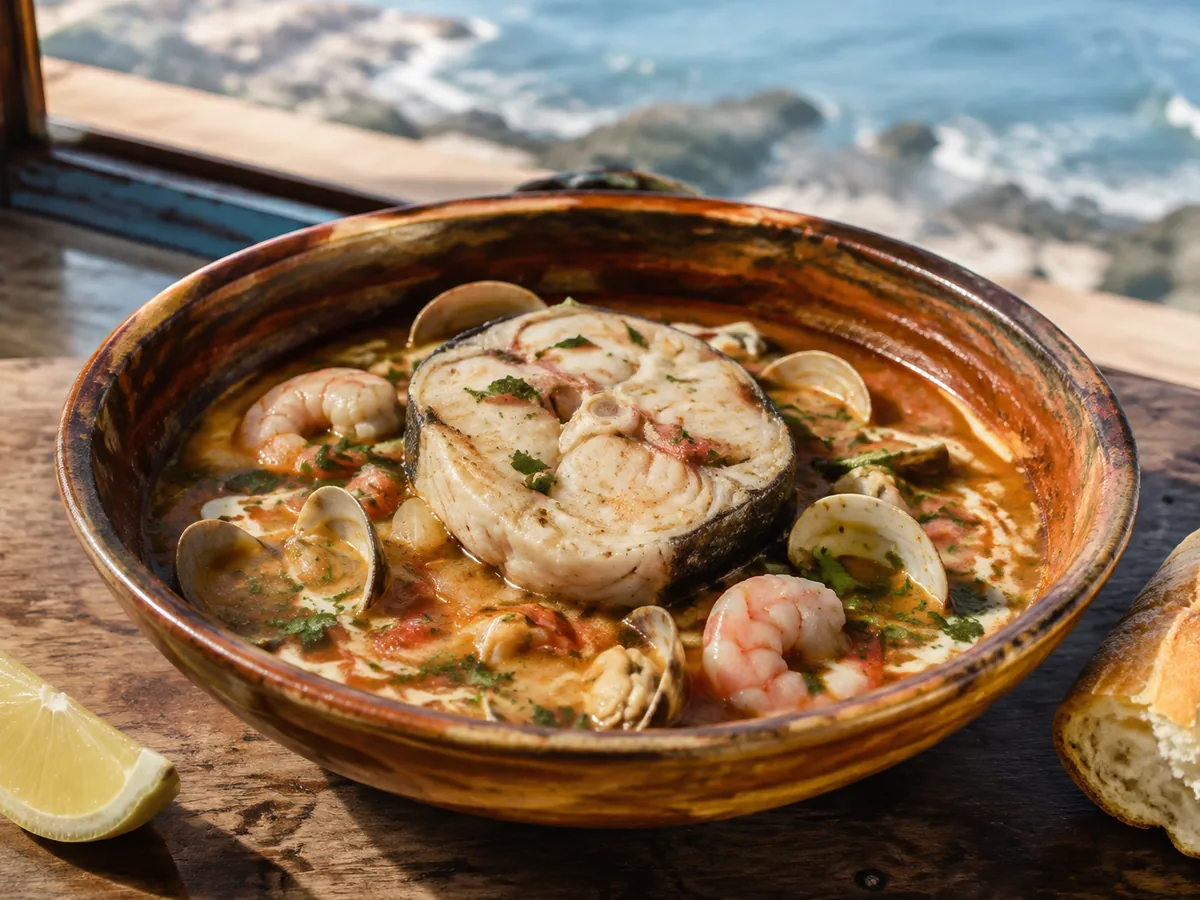
Along Chile’s stormy central coast, fishermen know the power of a hot bowl of caldillo de congrio. Pablo Neruda loved this soup so deeply he wrote an entire poem to its preparation in 1954, the Oda al Caldillo de Congrio.
The dish belongs to the cold, surge-swept Pacific rocks where the pink-bellied conger eel feeds. Its firm, white flesh yields clean, gelatinous flakes that hold together in hot broth. First comes a rich fumet boiled down from the fish heads, spines and white wine. That stock is strained into a fragrant sofrito of sweet onions, garlic, ripe tomatoes and bell peppers. Thick fish medallions poach gently in the broth alongside clams and fresh shrimp, finished with a swirl of heavy cream and a handful of rough-chopped cilantro in smoking-hot clay bowls.
Fish and fumet
- 1.2 kg2.6 lbFresh conger eel (congrio) steaks, cut 4 cm / 1½ in thick, skin-on and bones intactor black sea bass, monkfish or lingcod
- 1 whole1 wholeFish head and backbone frames, gills removed and washed in cold waterabout 800 g / 1.76 lb
- 1.5 L6.3 cupsCold filtered water, for the fumet
- 240 ml1 cupCrisp dry Chilean white wine — Sauvignon Blanc or Chardonnayused in two halves, 120 ml in the fumet and 120 ml to deglaze
- 2 whole2 wholeBay leaves (hojas de laurel)
- 1 large1 largeCarrot, peeled and sliced into thick roundsfor the fumet
Sofrito
- 45 ml3 TbspExtra-virgin olive oil
- 2 large2 largeYellow onions, peeled and cut into thin half-moons (corte pluma)
- 4 cloves4 clovesFresh garlic, peeled and thinly sliced
- 1 large1 largeRed bell pepper, cored and cut into thin strips
- 400 g3 largeRipe plum tomatoes, peeled, seeded and coarsely choppedor canned San Marzano whole peeled tomatoes
- 15 g1 TbspAjí de color (Chilean sweet paprika)
- 4 g1½ tspDried wild Chilean oregano
- 12 g2 tspFine sea salt, divided
- 2 g½ tspFreshly ground white pepper
Shellfish and finish
- 300 g10 ozLarge fresh raw Pacific shrimp, peeled and deveined
- 500 g1.1 lbFresh littleneck or Manila clams, purged and scrubbed clean
- 120 ml½ cupHeavy whipping cream, 36% butterfat, warm
- 30 g½ cupFresh cilantro, washed, dried and coarsely chopped
The two-phase thermal strategy
Fish muscle carries delicate actin and myosin with minimal connective tissue next to red meat. Boiling at 100 °C / 212 °F seizes the fibres and forces out internal moisture, leaving the fish dry and fibrous. So the heads and bones simmer first at 85–90 °C / 185–194 °F for 25 minutes to extract gelatin and savoury nucleotides, and the thick medallions then go into the strained broth off direct boil at 80 °C / 176 °F. Gentle liquid heat brings the centre to 57–60 °C / 135–140 °F, giving tender, pearlescent flakes that stay juicy.
Do not over-boil the bones
Simmering fish bones past 30 minutes draws out bitter minerals and cloudy sediment. Keep the stock extraction to 25 minutes.
The five tastes on this plate
Salt is natural sea liquor from the conger bones and opening clams, plus fine sea salt. Fat is olive oil in the sofrito, enriched by the finishing swirl of warm cream. Acid is the dry coastal Sauvignon Blanc reduction and the tart sweetness of stewed plum tomato. Heat is sliced garlic, wild oregano, sharp white pepper and mild sweet paprika. Umami is fish collagen and clam liquor uniting with cooked tomato glutamates.
Equipment
- 4 qt pot, for the fumet
- Fine-mesh sieve
- Wide 6 qt enamelled cast-iron braiser or Dutch oven
- Flat fish spatula
- Warm deep bowls
Traditionally shallow clay pailas over a low flame, or a deep earthenware pot. A wide 6-quart enamelled cast-iron braiser is the modern equivalent — the wide floor lets the fish steaks and clams sit in a single layer, so delicate flesh is not crushed under stacking.
Method
Simmer the fish fumet25 min
Put the cleaned conger head, backbone frames, sliced carrot, 1 bay leaf, half the sliced onion, 120 ml white wine and 1.5 litres cold water into a 4-quart pot.
Bring to a gentle simmer over medium heat, skimming off any surface foam with a spoon. Simmer gently uncovered at 85–90 °C for 25 minutes.
Strain through a fine-mesh sieve into a bowl, pressing the bones lightly. Discard the solids and keep the stock hot.
Simmer the cleaned head and frames, carrot, 1 bay leaf, half the onion, 120 ml wine and 1.5 litres cold water uncovered at 85–90 °C for 25 minutes. Skim, strain through fine mesh, discard solids and keep hot.
Cook the sofrito16–18 min
Heat 45 ml olive oil in a wide 6-quart enamelled braiser over medium heat. Add the remaining sliced onions, the garlic and the bell pepper strips, and sweat 8 to 10 minutes until soft and translucent.
Stir in the chopped tomatoes, ají de color, oregano, the second bay leaf, 1 tsp salt and the white pepper. Cook down 8 minutes, until the tomatoes form a thick, glossy paste.
Heat 45 ml oil over medium heat. Sweat remaining onion, garlic and pepper 8–10 minutes until soft. Add tomatoes, paprika, oregano, second bay leaf, 1 tsp salt and white pepper; cook 8 minutes into a glossy paste.
Deglaze and build the broth12 min
Pour in the other 120 ml of white wine, scraping up the pan floor, and simmer 2 minutes to cook off the raw alcohol.
Pour in all the hot strained fish stock. Bring to a gentle simmer, cover, and let the flavours marry for 10 minutes over low heat.
Add the remaining 120 ml wine and scrape the pan bottom; simmer 2 minutes. Pour in all the hot strained stock, bring to a gentle simmer, cover and cook over low heat for 10 minutes.
Poach the seafood10–11 min
Season the thick conger steaks with sea salt and lower them into the simmering broth in a single layer. Scatter the scrubbed clams around the fish.
Turn the heat to low — do not let the pot boil hard. Cover tightly and poach 7 to 8 minutes, until the clams start to open.
Drop in the peeled raw shrimp, nestling them into the hot broth, and cook 3 minutes more, until the shrimp turn pink and opaque and the fish core registers 57–60 °C / 135–140 °F.
Salt the fish and arrange in one layer with scrubbed clams in broth around 80 °C / 176 °F; never boil hard. Cover and poach 7–8 minutes. Add shrimp for 3 minutes, until pink and opaque and fish reaches 57–60 °C / 135–140 °F.
Finish with cream
Pull the pan off the burner.
Slowly swirl the 120 ml of warm heavy cream around the edges of the pot with a spoon, blending it into the broth without breaking the tender fish steaks.
Taste the broth, and adjust the salt or add a drop of lemon juice.
Remove from the heat and gently swirl 120 ml warm cream into the broth around the edges, keeping the fish intact. Taste and adjust salt or add a drop of lemon juice.
Plate the bowls
Ladle hot broth, sofrito vegetables and clams into warm deep bowls.
Use a flat fish spatula to lift one conger steak into the centre of each bowl, crown with shrimp, and scatter fresh cilantro across the top.
Serve immediately with warm crusty bread.
Ladle broth, vegetables and clams into warm deep bowls. Lift a fish steak into each with a flat spatula, top with shrimp and cilantro, and serve immediately with warm crusty bread.
Sensory cues of doneness
- Visual: the broth is a shimmering coral-pink, the conger steaks turn snow-white and separate cleanly along the bone lines, and the clams are fully open.
- Auditory: a gentle, sub-boil murmur, with soft clicks as clam shells open in the pot.
- Olfactory: fresh sea fish, reduced white wine, garlic, warm cream and green cilantro.
Check for coral-pink broth, white fish flaking cleanly along the bones and fully opened clams. Keep the liquid below a boil; expect aromas of wine, garlic, cream and cilantro.
Troubleshooting
- Violent boiling.
Boiling tears delicate fish steaks into shredded mush. Keep the broth at a low, trembling poach, around 80 °C / 176 °F.
- Over-boiling the fish bones.
Simmering past 30 minutes draws out bitter minerals and cloudy sediment. Keep the stock extraction to 25 minutes.
- Curdling the cream.
Cold cream added to a hot, acidic tomato-wine broth curdles the dairy proteins. Always warm the cream and stir it in off the heat.
Substitutions
One-to-one global substitutions, with the technique adjustment each one requires.
Ingredient substitutions
| Ingredient | Replace with | Culinary impact and technique adjustment |
|---|---|---|
| Conger eel (congrio) | Monkfish, lingcod or black sea bass | One-to-one. Monkfish holds together in simmering broth |
| Ají de color | Sweet Spanish paprika (pimentón dulce) | One-to-one. Gives identical colour and sweet pepper flavour |
| Littleneck clams | Manila clams or cockles | One-to-one. Make sure the shells are purged of sand |
Scaling
Half, for 3 portions
Halve all ingredients in a 4-quart pan. The poaching times stay the same.
Double, for 12 portions
Use two wide braisers side by side. Never stack fish steaks on top of one another.
What to serve it with
- Warm pan marraqueta — crusty Chilean rolls, for soaking up the cream-laced broth
- Pebre cuchareado, a fresh tomato and chilli spoon salsa
- Lemon wedges, squeezed at the table to brighten the rich broth
- A Casablanca Valley Sauvignon Blanc, whose flinty citrus acidity cuts the cream and echoes the sweet conger and clams
Questions
What fish can I substitute outside Chile?
Monkfish, lingcod or black sea bass. Monkfish is the closest match, offering the same firm, lobster-like flaking texture that holds up in hot broth.
What is the difference between congrio colorado and negro?
Congrio colorado, the red conger, has the firmest, sweetest flesh and is prized for soups. Congrio negro is leaner and often fried, and congrio dorado is preferred for roasting.
Can I make this without dairy?
Yes. Traditional coastal fishermen often made it without cream. The cream adds a silky mouthfeel, but the broth is delicious clear.