Machas a la Parmesana
Razor clams back in their own half-shells, dotted with cold butter, splashed with Sauvignon Blanc and lemon, buried under Parmigiano and Chanco, then broiled for strictly four minutes until the cheese blisters and the clam poaches in its own liquor.
- Prep
- 25 min
- Cook
- 5 min
- Serves
- 24 gratinéed half-shell clams — serves 4 to 6 as an appetiser
- Difficulty
- Easy
Researched · Kitchen testing pending
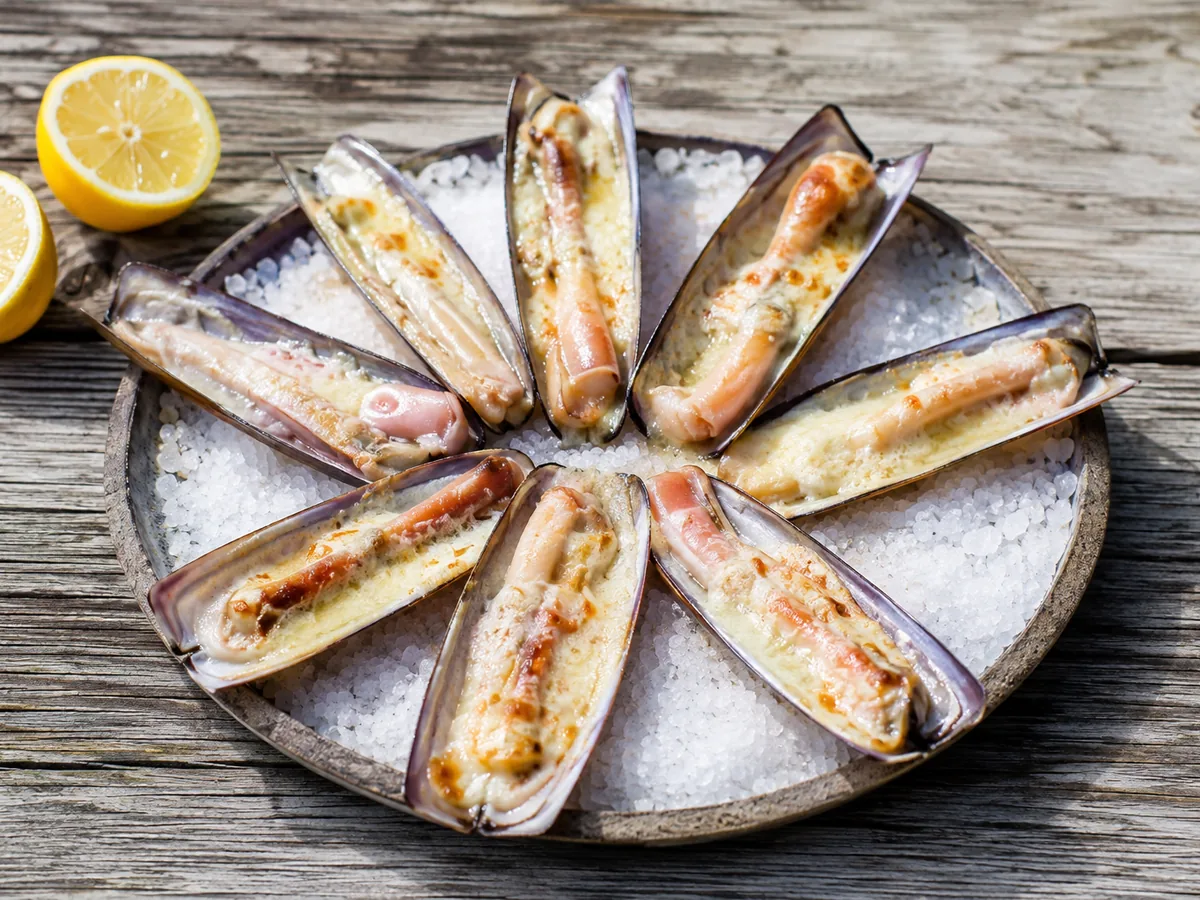
Machas a la parmesana was created in the 1950s at the Italian-Chilean restaurant El Pollo Dorado in Viña del Mar, and spread quickly to every coastal table in the country.
The recipe stars the Chilean pink-tongued razor clam, dug from sandy Pacific surf beaches. Cleaned and placed back into their natural half-shells, the clams are dotted with cold butter, splashed with crisp Sauvignon Blanc, seasoned with white pepper, lemon and sea salt, and buried under grated Parmigiano-Reggiano and melting Chanco.
They go under a scorching broiler for barely four minutes, until the cheese erupts into golden bubbles while the clam tongue inside poaches tender and sweet in its own shell liquor.
Clams
- 24 whole24 wholeFresh Chilean pink razor clams (machas) in their shellsor fresh Atlantic razor clams, or surf clam tongues
Seasoning and liquid
- 60 g4 TbspUnsalted European butter, 82% butterfatchilled hard and cut into 24 small uniform cubes
- 60 ml4 TbspCrisp dry Chilean white wine — Casablanca Valley Sauvignon Blanc
- 15 ml1 TbspFreshly squeezed lemon juice, strained
- 30 ml2 TbspHeavy creamfor traditional restaurant richness
- 3 g½ tspFine sea salt
- 1 g¼ tspFreshly ground white pepper
Cheese crust
- 100 g1 cupParmigiano-Reggiano or Grana Padano, freshly grated on a microplane
- 50 g½ cupChilean Chanco cheese, finely shreddedor young Gouda or Fontina
For the pan
- 1 kg4 cupsCoarse rock salt or kosher saltto stabilise the shells on the sheet pan
Why four minutes and no more
Razor clam tongues are dense, delicate muscle fibres. Heated past 65 °C / 149 °F for more than a few minutes, those fibres contract violently, wringing out moisture and turning tough and rubbery. Fast infrared broiler heat at 260 °C / 500 °F avoids that: in strictly 4 minutes, radiant heat brings the clam to its sweet, tender target of 60–63 °C / 140–145 °F just as the cheese reaches bubbling golden blisters.
What the cold butter cube does
Set straight onto the clam, it melts under the broiler and forms a protective lipid blanket with the wine and lemon juice, basting the meat while the cheese lid melts and browns above it.
Why two cheeses
Parmigiano-Reggiano brings deep umami and browning but does not stretch; Chanco, or Gouda, melts smoothly and gives a creamy texture. Together they make the ideal crust.
The five tastes on this plate
Salt is natural ocean liquor in the clams plus aged Parmigiano. Fat is cold European butter and melting Chanco creating rich pan juices. Acid is crisp Sauvignon Blanc and fresh lemon cutting cleanly through the butter. Heat is clean white pepper warmth, which does not darken the pale cheese crust. Umami is glutamate-dense razor clam tongues paired with aged parmesan.
Equipment
- Rimmed half-sheet pan
- Thin clam knife
- Microplane
- Small spoon, for dosing wine and cream
Traditionally clay pailas holding 6 to 8 shells, or direct half-shell baking. In a modern kitchen, use a heavy commercial half-sheet pan filled with 1 cm of coarse rock salt. The salt bed keeps the round shells from rocking, which stops the melted butter, wine and clam juices spilling out.
Method
Prepare the salt bed3 min
Spread 1 kg of coarse rock salt across a rimmed baking sheet — this anchors the rounded clam shells and keeps them level.
Set the oven broiler to high, 260 °C / 500 °F, with the top rack 15 cm (6 in) below the heating element.
Spread 1 kg coarse salt over a rimmed baking sheet to hold shells level. Set the broiler to high, 260 °C / 500 °F, with the rack 15 cm / 6 in below the element.
Shuck and clean the clams15 min
Slide a thin clam knife along the shell edge to cut the adductor muscle. Open the clams, keep the 24 deepest half-shells, and discard the flat halves.
Rinse the clam meat in cold salted water to flush sand out of the tip, then tap each clam tongue twice with the flat side of a knife to tenderise it.
Wash and dry the empty shells.
Cut the adductor muscle with a thin clam knife and open the clams; keep 24 deep half-shells. Rinse meat in cold salted water and tap each tongue 2 times with the knife’s flat side. Wash and dry the shells.
Nestle the shells and meat
Press the 24 half-shells firmly into the rock salt bed so they sit level, and place one clam tongue in each shell.
Press the 24 cleaned half-shells firmly into the salt bed so they stay level. Put one cleaned, tenderised clam tongue into each shell.
Season the clams4 min
Sprinkle sea salt and white pepper over all the clams.
Using a small spoon, drop ½ teaspoon of white wine, 3 drops of lemon juice and ½ teaspoon of cream into each shell.
Season all the clams with sea salt and white pepper. Spoon ½ tsp white wine, 3 drops lemon juice and ½ tsp cream into each shell.
Top with butter and cheese3 min
Set one cube of cold butter, about 2.5 g, directly on each clam tongue.
Toss the grated Parmigiano-Reggiano and shredded Chanco together in a bowl, then mound the cheese over each shell, completely burying the clam under a tidy dome — about 1 heaping tablespoon per shell.
Place one cold butter cube, about 2.5 g, directly on each tongue. Mix grated parmesan and shredded Chanco; cover each clam completely with a neat dome of cheese, about 1 heaping tablespoon.
Broil fast under high heat4–5 min
Slide the sheet pan directly under the broiler and broil for strictly 4 to 5 minutes.
Watch closely: the cheese will melt, bubble violently, and brown into golden spots. The second the tops are golden, pull the pan out immediately.
Broil directly under the heat for 4–5 minutes, watching constantly. Check for a clam temperature of 60–63 °C / 140–145 °F; remove immediately when the bubbling cheese develops golden spots.
Serve immediately1 min
Rest for 1 minute, and warn guests that the shells are very hot.
Serve directly on the salt bed with fresh lemon wedges and chilled pisco sours.
Rest for 1 minute and warn guests that the shells remain very hot. Serve on the salt bed with fresh lemon wedges and chilled pisco sours.
Sensory cues of doneness
- Visual: the cheese mantle is violently bubbling with speckled golden-brown blisters, and the clam tongue turns from translucent pink to tender opaque cream.
- Auditory: a rapid, high-frequency hissing and sputtering from each shell under the broiler.
- Olfactory: sea brine, nutty toasted parmesan, browned butter and boiling white wine.
Look for vigorously bubbling cheese with golden-brown blisters and clam tongues changing from translucent pink to opaque cream. Expect rapid sizzling and aromas of toasted parmesan, browned butter, wine and sea brine.
Storing it
Assemble the cold shells and chill them in the fridge up to 4 hours in advance, then broil right before serving.
Troubleshooting
- Broiling too long.
Even 2 minutes too long turns razor clams into rubber bands. Broil strictly until the cheese melts and browns — 4 to 5 minutes maximum.
- Spilling the shell juices.
Baking on a bare flat tray lets the shells tip over and dump their butter into the pan. Always use a bed of coarse salt.
- Gritty clams.
The rinse was skipped, leaving sand in the digestive tip. Always wash clam tongues in cold salted water before assembling.
Substitutions
One-to-one global substitutions, with the technique adjustment each one requires.
Ingredient substitutions
| Ingredient | Replace with | Culinary impact and technique adjustment |
|---|---|---|
| Chilean machas | Atlantic razor clams, fresh surf clams, or Manila clam meat | One-to-one. Tap lightly with the flat of a knife before seasoning |
| Chanco cheese | Young Gouda, Fontina or low-moisture mozzarella | One-to-one. Provides the same smooth melt |
| Casablanca Sauvignon Blanc | A crisp Pinot Grigio or Albariño | One-to-one. Matches the clean acidity |
Scaling
Half, for 12 shells
Cut the ingredients in half onto a quarter-sheet pan. The broil time remains strictly 4 to 5 minutes.
Double, for 48 shells
Double the ingredients, but broil one sheet pan at a time so the broiler heat stays concentrated.
What to serve it with
- A classic Chilean pisco sour — pisco, fresh lime, simple syrup and egg white shaken with ice, whose bracing acidity cuts the butter and cheese
- A Casablanca Sauvignon Blanc, crisp and mineral-driven against the melted cheese and salinity
- Fresh lemon wedges, for anyone wanting an extra splash of citrus
Questions
Can I make this if fresh razor clams are unavailable?
Yes. Use frozen Chilean machas from Latin seafood grocers, fresh Atlantic razor clams, or tender surf clam tongues. Bake them in porcelain escargot dishes or small ramekins if you lack shells.
Why combine Parmesan and Chanco cheese?
Parmigiano-Reggiano brings deep umami and browning but does not stretch; Chilean Chanco, or Gouda, melts smoothly and gives a creamy texture. Together they make the ideal crust.
Can this be assembled ahead?
Assemble the cold shells and chill them up to 4 hours in advance, then broil right before serving.