Completo Italiano
The fuente de soda counter classic, named for the Italian flag — fine-diced salted tomato, mashed Hass avocado and a white crest of scratch mayonnaise over a poached vienesa, in a steamed pan copihue elastic enough to hold half a pound of toppings.
- Prep
- 30 min
- Cook
- 25 min
- Serves
- 6 large completos, with 6 scratch buns
- Difficulty
- Medium
Researched · Kitchen testing pending
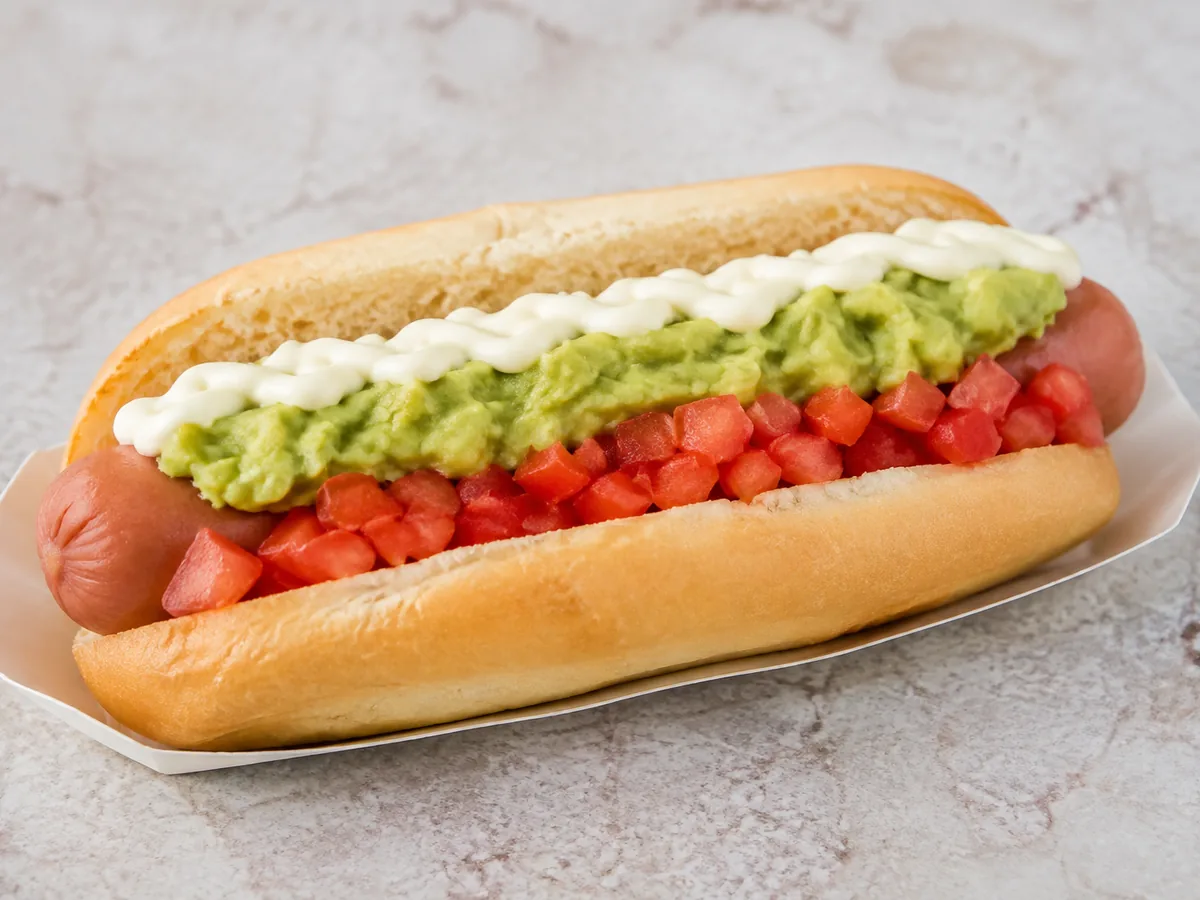
In Santiago, evening commuters crowd the counters of classic fuentes de soda like Elkika, Dominó and Fuente Alemana. The centrepiece of that counter culture is the completo italiano.
It takes its name from the bands of colour matching the Italian flag: bright red peeled summer tomatoes diced fine and salted, buttery green mashed Hass avocado, and an enormous white crest of scratch-made whole-egg mayonnaise spread from end to end.
The bun is an artisanal pan copihue, steamed warm until pillow-soft yet elastic enough to hold half a pound of toppings without splitting, cradling a hot poached pork-and-beef vienesa with a distinct snap.
Pan copihue (the buns)
- 500 g4 cupsBread flour, about 12% protein, sifted
- 7 g2¼ tsp / 1 packetInstant dry yeast
- 10 g2 tspGranulated cane sugar
- 10 g1½ tspFine sea salt
- 40 g3 TbspUnsalted butter or vegetable shortening, softened at room temperature
- 280 ml1.15 cupsLukewarm filtered water, 38 °C / 100 °F
Sausage and poaching water
- 66Artisanal Chilean pork-and-beef frankfurters (vienesas), or German wienersabout 18 cm / 7 in long
- 1 whole1 wholeBay leaf (hoja de laurel)
- 1 clove1 cloveFresh garlic, crushed
The three bands
- 4 large4 largeRipe Hass avocados (palta), peeled, pitted and the flesh scooped into a bowl
- 15 ml1 TbspExtra-virgin olive oilto season the avocado
- 6 g1 tspFine sea saltdivided between the avocado and the tomatoes
- 3 large3 largeRipe firm beefsteak or Roma tomatoes, peeled, seeded and cut into fine 5 mm / ¼ in dice
Scratch Chilean mayonnaise
- 2 large2 largeFresh whole eggs, at room temperature
- 15 ml1 TbspFreshly squeezed lemon juice, or white wine vinegar
- 5 g1 tspDijon mustardemulsion stabiliser
- 350 ml1½ cupsNeutral vegetable oil — canola, sunflower or avocado
Three pieces of chemistry hold this together
The mayonnaise is a permanent oil-in-water emulsion: whisking room-temperature yolk proteins with lemon juice while streaming in neutral oil suspends microscopic oil droplets in water, giving a dense, spoonable spread that holds its shape without weeping. The pan copihue crumb uses 56% hydration and high-protein flour, and steaming the baked bun for 60 seconds re-gelatinises retrograded starches into an elastic, tender crumb with the tensile strength to cradle 300 g of wet toppings without tearing. And salting the tomatoes draws out free juice by osmosis, which is what keeps the bread from turning soggy.
Assembly order is not cosmetic
Mayonnaise placed directly against the hot sausage melts the emulsion into greasy oil. Sausage first, then cold tomato, cold avocado, and mayonnaise last.
The five tastes on this plate
Salt is seasoned mashed avocado, salted drained tomato and the savoury cured vienesa. Fat is dense scratch mayonnaise paired with the buttery monounsaturated fats of Hass avocado. Acid is fresh lemon in the mayonnaise cutting the fat, backed by tart ripe tomato. Heat is garlic in the poaching water, with optional ají verde at the table. Umami is cured pork and beef glutamates meeting tomato ribonucleotides.
Passive time, counted separately
The dough rises 1 hour until doubled, then the shaped buns proof another 40 minutes, and the baked buns cool completely before slitting. None of that is active work, and all of it sits outside the times quoted above — the whole session runs about 1 hour 55 minutes.
Equipment
- Stand mixer with a dough hook
- Parchment-lined baking sheet and a damp cloth
- Wire rack
- Tall immersion blender jar, and an immersion blender
- Colander set over a bowl
- Wide saucepan, for poaching
- Bamboo or stainless steamer basket
- Serrated knife and tongs
Traditionally this runs on a commercial Chilean completera, a hot dog steamer with separate wells for bread and sausages. At home, a bamboo or stainless-steel steamer basket set over simmering water warms the buns, and a wide saucepan poaches the sausages.
Method
Mix and bake the pan copihue buns14–16 min baking
Combine the bread flour, yeast, sugar, salt, soft butter and lukewarm water in a stand mixer with a dough hook. Knead 8 to 10 minutes, until elastic and smooth.
Shape into a ball, set in an oiled bowl, cover, and let rise 1 hour until doubled.
Divide into 6 pieces of about 135 g each. Roll each piece on an unfloured counter into a smooth, blunt-ended cylinder about 18 cm (7 in) long. Place on a parchment-lined baking sheet, cover with a damp cloth, and proof 40 minutes until puffy.
Bake at 200 °C / 400 °F for 14 to 16 minutes, until pale gold, then cool completely on a wire rack.
Knead flour, yeast, sugar, salt, softened butter and water at 38 °C / 100 °F for 8–10 minutes until elastic. Cover in an oiled bowl; rise 1 hour until doubled. Shape 6 roughly 135 g cylinders, 18 cm / 7 in long, on an unfloured counter. Cover on parchment; proof 40 minutes. Bake at 200 °C / 400 °F for 14–16 minutes until pale gold; cool completely.
Make the Chilean mayonnaise5 min
In a tall immersion blender jar, combine 2 room-temperature eggs, 15 ml lemon juice, 5 g Dijon and ½ tsp salt. Pour all 350 ml of oil on top.
Push the blender head all the way to the bottom. Run on high, holding the head stationary for 10 seconds as a thick white emulsion forms.
Slowly draw the blender head upward to incorporate the remaining oil into a glossy, spreadable mayonnaise. Taste for lemon and salt, then chill.
In a tall jar, combine 2 room-temperature eggs, 15 ml lemon juice, 5 g Dijon and ½ tsp salt; top with 350 ml oil. Blend on high with the head stationary at the bottom 10 seconds, then lift slowly. Adjust lemon and salt; chill.
Prep the tomatoes and avocado15 min
Toss the peeled, finely diced tomatoes with ½ tsp salt in a colander set over a bowl, and let them drain 15 minutes to shed excess tomato water.
In another bowl, mash the Hass avocado flesh with a fork — keep a slight rustic texture, do not blend it smooth. Stir in 15 ml olive oil and ½ tsp salt, until rich, glossy and creamy.
Salt peeled, finely diced tomatoes with ½ tsp salt and drain in a colander over a bowl for 15 minutes. Fork-mash avocado with 15 ml olive oil and ½ tsp salt, retaining some texture; do not blend smooth.
Poach the vienesas6–8 min
Bring 1 litre of water with the bay leaf and crushed garlic clove to a low simmer, 80 °C / 176 °F, in a saucepan.
Slide in the 6 vienesas and poach gently 6 to 8 minutes, until hot to the centre at 71 °C / 160 °F.
Keep them warm in the poaching liquid until you are ready to assemble.
Heat 1 litre water with bay leaf and crushed garlic to 80 °C / 176 °F. Gently poach 6 sausages for 6–8 minutes, until their centres reach 71 °C / 160 °F; keep warm in the liquid.
Slit and steam the buns2 min
With a serrated knife, cut each cooled bun down the top centre, slicing three-quarters of the way through to form an open pocket without cutting through the bottom or the ends.
Place the buns cut-side up in a steamer basket over simmering water, cover, and steam for strictly 60 to 90 seconds, until warm, soft and pliable.
Slit cooled buns along the top with a serrated knife, cutting three-quarters deep without piercing the bottom or ends. Place cut-side up in a covered steamer over simmering water; steam only 60–90 seconds until warm and pliable.
Build in strict order
Hold a warm steamed bun in your hand. Use tongs to pull a hot vienesa from the water, shake off the excess drops, and tuck it into the bun floor.
Spoon a generous layer of drained diced tomato over the sausage — the red band.
Spread a thick layer of seasoned mashed avocado over the tomato, smoothing the top flat — the green band.
Finally, spoon or pipe a thick, continuous blanket of scratch mayonnaise from one end of the bun to the other — the white band.
Serve right away.
Drain a hot sausage and tuck it into each steamed bun. Layer cold drained tomato, then cold seasoned avocado, then a continuous blanket of mayonnaise. Keep mayonnaise off the hot sausage and serve immediately.
Sensory cues of doneness
- Visual: three clean, vivid flag bands — red diced tomato on the bottom, bright green avocado in the middle, and a thick continuous crest of white mayonnaise.
- Auditory: a clean, distinct snap as your teeth break the natural sausage casing, and the soft, silent yield of the steamed bun.
- Olfactory: warm yeasty bread steam, spiced poached sausage, buttery avocado and bright lemon mayonnaise.
Check for distinct red tomato, green avocado and white mayonnaise layers. The steamed bun should yield softly, the sausage casing snap cleanly, and the mayonnaise hold a thick continuous crest.
Troubleshooting
- A soggy bun.
Flimsy store-bought buns, or the tomato draining step skipped. Draining the salted tomatoes and using elastic steamed bread keeps the bun intact.
- Broken mayonnaise.
Cold eggs straight from the fridge. Always use room-temperature eggs, and keep the blender head flat on the bottom until the base emulsion takes hold.
- The wrong assembly order.
Mayonnaise directly against the hot sausage melts the emulsion into greasy oil. Sausage first, then cold tomatoes, cold avocado, and mayonnaise on top.
Substitutions
One-to-one global substitutions, with the technique adjustment each one requires.
Ingredient substitutions
| Ingredient | Replace with | Culinary impact and technique adjustment |
|---|---|---|
| Chilean vienesas | High-grade German frankfurters, or all-beef wieners | One-to-one. Choose sausages with natural casing for the best snap |
| Pan copihue | Brioche hot dog buns, or French hoagie rolls | One-to-one. Steam for 60 seconds before filling |
| Hass avocado (palta) | Fuerte or Reed avocado | One-to-one. Make sure it is fully ripe and soft |
Scaling
Half, for 3 completos
Cut the ingredients in half. You can bake all 6 buns and freeze 3 for later.
Double, for 12 completos
Double the ingredients, but make the mayonnaise in two separate batches so you do not overflow the immersion blender jar. Steam the buns in batches, right before assembly.
What to serve it with
- Salsa de ají verde — Chilean green chilli sauce of pickled green chillies, oil and salt, served on the side
- Yellow mustard, drizzled in a thin zigzag over the mayonnaise
- A cold Chilean lager, crisp enough to cut the rich mayonnaise and avocado
A stack of paper napkins is essential for true Chilean street-food eating.
Questions
What is the difference between a completo italiano and a tradicional?
A completo italiano uses tomato, avocado and mayonnaise — the Italian flag colours. A completo tradicional uses tomato, sauerkraut (chucrut), salsa americana (pickled relish) and mayonnaise.
Can I use store-bought buns?
You can, but standard hot dog buns are often too soft and tear under the weight of the toppings. Look for dense bakery rolls, or make the pan copihue here.
Can I use jarred mayonnaise?
Chilean fuentes de soda make their own fresh daily. Commercial jarred mayonnaise lacks the eggy richness and fresh lemon brightness that defines an authentic completo.