Central America · 9°56′N 84°05′W · Kitchen testing pending
Costa Rica
Sweet sofritos, not chilli heat, and a bottle of Lizano on every table
The ten
Ranked by what people actually name first
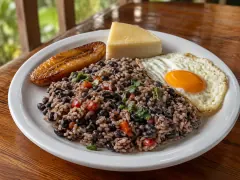 Gallo PintoThe "spotted rooster" — black bean broth staining white rice into mottled patches. It only works with rice that has spent twelve hours in the fridge: chilled, the amylose recrystallises into rigid retrograded starch, and rigid grains fry loose instead of collapsing into porridge.
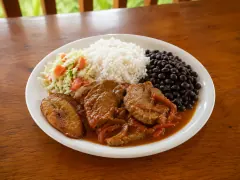 Casado con Carne en SalsaThe midday platter of every neighbourhood soda, and the point is the geometry: rice, beans, plantains, slaw and beef each keep their own zone on the plate. The gravy thickens on dissolved collagen alone — ninety minutes at a sub-boil, and not a spoonful of flour.
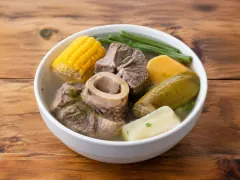 Olla de CarneThe weekend pot, and not a thick stew — a crystalline beef consommé loaded with rustic chunks. Clarity comes from cold water, twenty minutes of patient skimming and a surface that never rolls; the vegetables go in on a strict density timetable so nothing dissolves into paste.
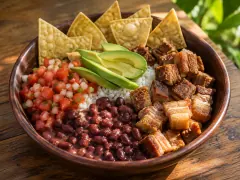 ChifrijoCHI-charrón plus FRIJO-les, invented in a Tibás cantina in the 1990s and now on every bar counter in the country. The pork is simmered in water first so the skin softens, then blasted at 180 °C so the trapped moisture flashes to steam and blows the collagen into brittle crackling.
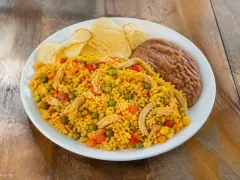 Arroz con Pollo a la TicaNo birthday, Sunday gathering or match happens without a yellow pot of it. What separates the Tico version from every other chicken rice is minced celery in the sofrito — its phthalides are the herbal signature — and grains that stay loose because parboiled rice is sealed in achiote oil before any broth arrives.
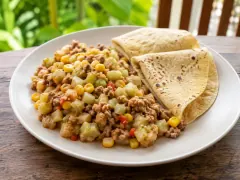 Picadillo de Chayote con Carne MolidaThe backbone of Central Valley home cooking, and a lesson in restraint with liquid. Chayote is 93% water behind delicate pectin walls, so it steams in its own released juices with barely any stock — then a splash of cream at the end binds the drippings into a glaze instead of a puddle.
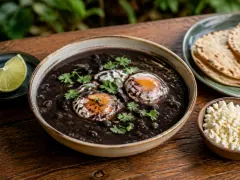 Sopa NegraEggs cracked straight into the simmering bean liquor, where the anthocyanins leaching out of the seed coats stain the setting whites black around a yolk that stays gold and fluid. The body comes from two cups of beans blended back in — no flour, no cream.
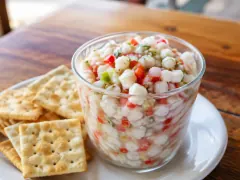 Ceviche Tico de PescadoNothing cooks here — lime at pH 2.2 unfolds the myosin and actin in the fish and cross-links them into a solid white network. The Costa Rican signature is minced celery, whose terpenes buffer the citric acid into something clean rather than sharp, and it is eaten from a glass cup with soda crackers.
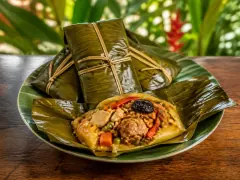 Tamal Navideño CostarricenseDecember is the tamaleada, and the Costa Rican tamal is silkier than any of its neighbours because hot riced potato goes into the masa. Potato amylopectin traps moisture that corn alone cannot hold, and the parcels are tied face-to-face in pairs so boiling water never finds a seam.
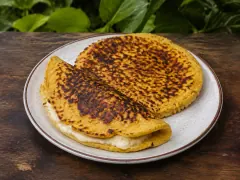 Chorreadas de Maíz DulceFrom *chorrear*, to pour — thick raw corn batter dropped onto a hot comal, with no wheat flour in it anywhere. Pulse the kernels, never purée them: rupture every cell and the batter goes watery and gluey instead of setting into a custardy cake under a caramelised crust.
The first thing to understand about Tico cooking is that it is not spicy. Costa Rica sits between Nicaragua and Panama and shares their ingredients, but it took a different turn: the flavour base here is sweet vegetable sofrito — white onion, chile dulce, garlic, celery — bloomed in achiote oil until it is golden rather than hot. Chilli, when it appears at all, appears on the side in a jar of pickled chilera that you can decline.
What stands in for it is Salsa Lizano, and it is genuinely difficult to overstate how central it is. A thin vegetable-molasses condiment seasoned with cumin and mustard, it goes into gallo pinto at breakfast, into the braising liquid of carne en salsa at lunch, into the rice of arroz con pollo, into the tamal masa at Christmas. Six of these ten dishes call for it. The usual substitute — Worcestershire — is too sour on its own and misses the carrot and molasses entirely, which is why every recipe here gives the fuller mix.
The techniques worth studying are about water. Gallo pinto only works with rice that has spent twelve hours in the fridge, because chilling recrystallises the amylose into retrograded starch that fries loose instead of collapsing. Picadillo de chayote gets barely half a cup of stock, because chayote is 93% water and brings its own. Olla de carne stays crystalline because it starts cold, is skimmed for twenty minutes and never once rolls, and its vegetables go in on a strict density timetable — plantain and corn at forty-five minutes out, yuca and camote at twenty-five, chayote and green beans at fifteen. Chorreadas are pulsed rather than puréed for the same reason.
Two dishes do something you will not find next door. Sopa negra poaches whole eggs directly in the black bean liquor, where the anthocyanins leaching out of the seed coats stain the setting whites black around a yolk that stays gold. And the Christmas tamal folds hot riced potato into the corn masa, whose amylopectin traps the moisture that corn alone cannot hold — which is why the Costa Rican tamal is silkier than any of its neighbours, and why it has to rest fifteen minutes before the twine comes off.