Chifrijo
CHI-charrón plus FRIJO-les, invented in a Tibás cantina in the 1990s and now on every bar counter in the country. The pork is simmered in water first so the skin softens, then blasted at 180 °C so the trapped moisture flashes to steam and blows the collagen into brittle crackling.
- Prep
- 30 min
- Cook
- 25 min
- Serves
- 4 cantina bowls
- Difficulty
- Medium
Researched · Kitchen testing pending
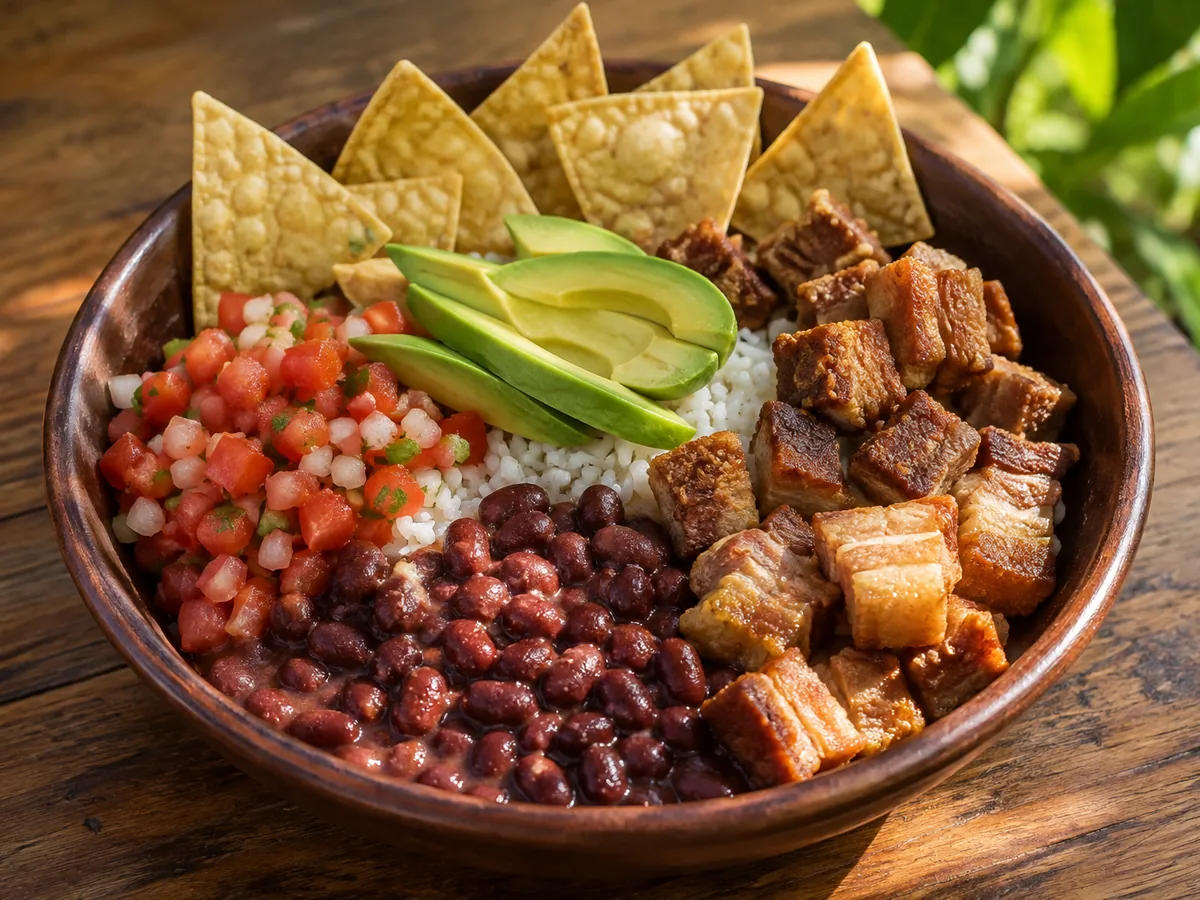
Chifrijo was created in the 1990s by Miguel Cordero at Cantina Cordero in Tibás, San José, and it is Costa Rica’s greatest bar dish. The name is a portmanteau: CHI-charrón and FRIJO-les.
It is built in a deep earthenware bowl and designed around cold beer. Warm white rice on the bottom, tender red beans and their garlicky pot liquor spooned over, then freshly fried pork belly cut into crisp blistered nuggets.
On top goes a heap of fresh lime-cured tomato and onion pico de gallo, buttery avocado, and crisp corn tortilla chips planted around the rim like petals.
The chicharrón
- 800 g1.76 lbFresh pork belly with the skin on, cut into 2.5 cm cubes
- 250 ml1 cupWater, for the initial render
- 4 cloves4 clovesFresh garlic, minced to a paste
- 3 g1 tspCumin seeds, freshly toasted and ground
- 2 g½ tspFreshly ground black pepper
- 500 ml2.1 cupsRendered pork lard, or a neutral high-smoke-point oil, for frying
- 15 ml1 TbspCoarse sea salt, for rubbing the skin and salting straight out of the oil
The base
- 400 g2.5 cupsWarm cooked long-grain white rice
- 400 g2 cupsTender cooked red kidney beans or cubaces, hot
- 120 ml½ cupSavoury bean broth, reserved from the beans
The pico de gallo
- 4 large4 largeRipe plum tomatoes, seeded and cut into fine 4 mm brunoise
- 1 medium1 mediumWhite onion, peeled and cut into fine 3 mm brunoise
- 60 ml¼ cupFreshly squeezed lime juice, about 3 limes
- 30 g½ cupFresh cilantro leaves, chopped fine
- 8 g1.5 tspFine sea salt5 g for the pork, 3 g for the pico
To finish
- 1 large1 largeRipe Hass avocado, peeled, pitted and cut into wedges
- 200 g7 ozCrisp corn tortilla chips, or fried plantain chifles
Boil first, then fry
The pork simmers in a little water with garlic and cumin until the water goes and the meat is frying in its own rendered lard. That first stage is what softens the skin — going straight into hot oil leaves it leathery.
180 °C blows the skin open
At that temperature the moisture still trapped in the rind flashes to steam and expands the collagen into brittle, blistered crackling. Below it the skin just toughens.
The bean broth is the connective tissue
Two tablespoons of garlicky red bean liquor over the rice is what joins the dry grain to the crisp meat. Skip it and the bottom of the bowl is choking.
Chips around the rim, never stirred in
Planted upright they stay bone-dry and crisp to the last bite. Stirred through, they are soggy in ninety seconds.
Hot meets cold on purpose
Piping-hot crackling and hot bean broth against chilled lime-dressed pico is the whole architecture — the acid strips the pork fat off the palate between mouthfuls.
Passive time, counted separately
The pico macerates 10 minutes so the lime softens the raw onion. That sits outside the times quoted above.
The five tastes on this plate
Salt is the salted cracklings, the seasoned bean liquor and the cured pico. Fat is rendered pork and buttery avocado melting against hot beans. Acid is sharp lime cutting straight through the pork fat. Heat is raw onion, toasted cumin, black pepper and optional pickled jalapeño. Umami is fried pork fond, red bean broth and ripe tomato.
Equipment
- 5 qt Dutch oven
- Oil thermometer
- Spider skimmer
- Glass bowl, for the pico
- Four wide deep bowls
Traditionally a cast-aluminium caldero for the frying and glazed clay cazuelas for service. A 5-quart Dutch oven with an oil thermometer works in a modern kitchen — the point of the thermometer is holding 180 °C, since the oil neither smoking nor sagging is what makes the crackling.
Method
Simmer and render the pork18 min
Put the pork belly cubes in the Dutch oven with 250 ml water, the garlic paste, 5 g salt, the cumin and the black pepper.
Bring to a boil over medium and simmer uncovered 15 to 18 minutes, until the water has gone entirely and the pork is sizzling in its own rendered fat.
Combine pork, 250 ml water, garlic paste, 5 g salt, cumin and black pepper. Bring to a boil over medium; simmer uncovered 15–18 minutes until all water evaporates and pork sizzles in its own fat.
Crisp the cracklings10 min
Pour in the 500 ml lard to submerge the pork and raise the heat to 180 °C.
Fry 8 to 10 minutes, stirring occasionally, until the skin blisters into crisp bubbles and the meat is deep mahogany-gold. Lift out with a spider onto paper towel and salt immediately with coarse sea salt.
Add 500 ml lard to submerge pork; heat to 180 °C. Fry 8–10 minutes, stirring occasionally, until skin blisters and meat is deep mahogany-gold. Lift onto paper towels with a spider; immediately season with coarse salt.
Mix the pico de gallo10 min
In a glass bowl toss the tomato, white onion, cilantro, lime juice and 3 g salt.
Leave to macerate 10 minutes, so the lime takes the raw edge off the onion.
In a glass bowl toss the tomato, white onion, cilantro, lime juice and 3 g salt.
Leave to macerate 10 minutes, so the lime takes the raw edge off the onion.
Layer the bowls
In each of four wide bowls lay down ½ cup of warm rice, spoon ½ cup of hot red beans over it, and drizzle 2 tablespoons of the bean broth across the grains.
In each of four wide bowls lay down ½ cup of warm rice, spoon ½ cup of hot red beans over it, and drizzle 2 tablespoons of the bean broth across the grains.
Crown and serve
Pile the hot crackling straight over the beans, mound the cold pico on top, and lay avocado wedges alongside.
Plant four or five tortilla chips upright around the rim like petals, add a dash of Salsa Lizano if you like, and serve immediately.
Pile the hot crackling straight over the beans, mound the cold pico on top, and lay avocado wedges alongside.
Plant four or five tortilla chips upright around the rim like petals, add a dash of Salsa Lizano if you like, and serve immediately.
Sensory cues of doneness
- Visual: a layered bowl reading white rice, dark red beans, golden blistered pork, ruby pico and green avocado.
- Auditory: a loud, glass-like crunch as the crackling shatters, and the snap of the chips.
- Olfactory: rendered pork fat, toasted corn, sharp lime, fresh cilantro and warm garlic-cumin beans.
Keep the layers distinct: white rice, red beans, blistered golden pork, ruby pico and green avocado. The crackling should shatter crisply and chips snap; expect pork, toasted corn, lime, cilantro, garlic and cumin aromas.
Troubleshooting
- Chewy, leathery pork skin.
It went into hot oil without the water stage. The initial simmer softens the skin; the oil then puffs it.
- A dry, choking layer of rice.
The bean broth was left out. That spoonful of liquor is what ties the bowl together.
- Soggy chips.
They were stirred in. Plant them around the rim instead.
Substitutions
One-to-one global substitutions, with the technique adjustment each one requires.
Ingredient substitutions
| Ingredient | Replace with | Culinary impact and technique adjustment |
|---|---|---|
| Pork belly | Crisp-fried pork shoulder, or smoked pork belly burnt ends | One-to-one, keeping the balance of crisp fat and tender meat |
| Red kidney beans | Cubaces, or pinto beans | One-to-one. They must be tender and come with savoury broth |
| Tortilla chips | Fried green plantain chifles | One-to-one. An equally sturdy crunchy shovel |
Scaling
Half, for 2 bowls
Halve everything. Every timing is unchanged.
Double, for 8 bowls
Double everything and fry the pork in two batches so the oil holds 180 °C.
What to serve it with
- An ice-cold Imperial or Pilsen
- Warm corn tortillas, for wrapping the pork and beans
- Chileras caseras — pickled cauliflower, carrot, onion and habanero in vinegar
- Guaro Cacique with lime and salt
Questions
Can I use tinned red beans?
Yes. Drain half the liquid and simmer them 5 minutes with a little minced garlic, onion and cilantro to build the broth.
Belly, or lean pork?
Many cantinas offer chicharrón de carne (lean) or de concha (skin). A mix of both gives the best bite.
Can the pork be air-fried?
Yes. Toss the boiled cubes in oil and air-fry at 200 °C for 15 minutes, shaking halfway, until the crackling blisters.