Olla de Carne
The weekend pot, and not a thick stew — a crystalline beef consommé loaded with rustic chunks. Clarity comes from cold water, twenty minutes of patient skimming and a surface that never rolls; the vegetables go in on a strict density timetable so nothing dissolves into paste.
- Prep
- 40 min
- Cook
- 2 hr 30 min
- Serves
- 8 large feast bowls
- Difficulty
- Medium
Researched · Kitchen testing pending
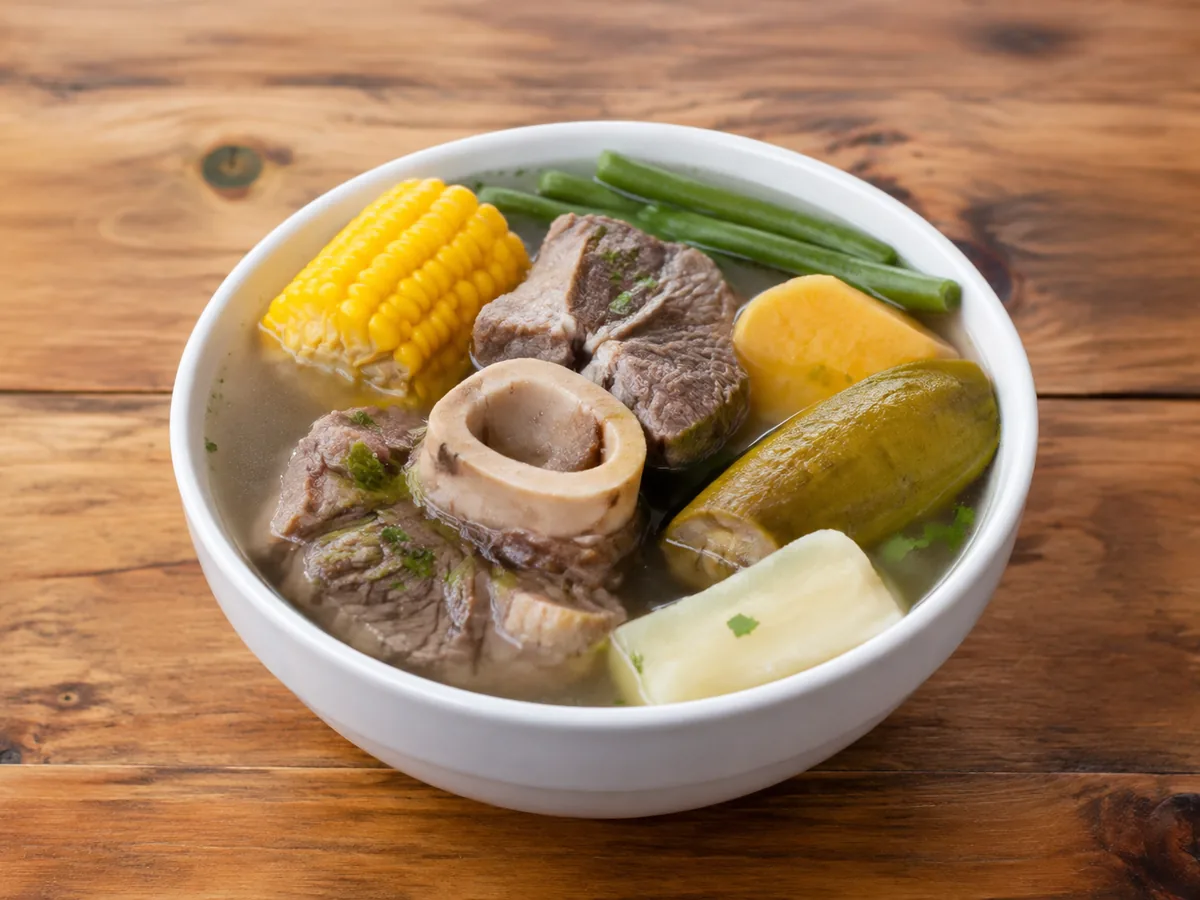
Weekend family reunions across Costa Rica centre on the giant bubbling pot of olla de carne. It descends from the Spanish colonial cocido, but the Costa Rican version belongs entirely to tropical highland agriculture.
It is not a thick stew. It is an intensely aromatic, crystal-clear beef consommé loaded with huge rustic chunks: bone-in shank with its marrow, flank steak, half ears of sweet corn, dense green plantain, creamy yuca, camote, chayote and green beans.
Cooked gently, never turbulently, the vegetables keep their distinct shapes while giving the broth their sweet garden starch.
The beef and broth
- 1.2 kg2.6 lbBone-in beef shank (jarrete), cut 4 cm thick with the marrow bone intact
- 600 g1.3 lbBeef flank or chuck ribs (cecina), cut into large 6 cm chunks
- 4 L17 cupsCold filtered water
The aromatics
- 1 large1 largeYellow onion, peeled and quartered
- 1 large1 largeRed sweet pepper (chile dulce), quartered
- 8 cloves8 clovesFresh garlic, peeled and crushed flat
- 2 stalks2 stalksCelery with its leaves, coarsely chopped
- 40 g1 large bunchFresh culantro coyote, or cilantro stems, tied with kitchen twine
- 8 g2 tspCumin seeds, freshly toasted and ground
- 4 g1.5 TbspDried wild oregano
- 25 g1 Tbsp + 1 tspFine sea saltseasoned in stages
- 4 g1 tspWhole black peppercorns
First in, at 45 minutes out
- 2 ears2 earsSweet corn on the cob, husked and cut crosswise into 8 rounds
- 2 large2 largeGreen plantains, peeled and cut into 4 cm chunksgreen, never ripe
Second in, at 25 minutes out
- 600 g4 cupsFresh yuca, peeled, woody core removed, cut into 5 cm chunks
- 400 g2 mediumSweet potato (camote), peeled and cut into 5 cm chunks
- 300 g2 cupsCarrots, peeled and cut into thick 3 cm chunks
Last in, at 15 minutes out
- 2 medium2 mediumChayote squash, peeled, cored and cut into large wedges
- 200 g2 cupsGreen beans (vainicas), trimmed and snapped in half
To serve
- 30 g½ cupFresh cilantro leaves, chopped fine
Cold water, then skim
Starting cold lets the surface proteins coagulate slowly and rise as a single grey raft. Skim every trace of it over the first 20 minutes and the consommé stays crystalline for the rest of the cook.
Never let it roll
A turbulent boil shatters coagulating proteins into fragments and emulsifies rendered fat into the water — cloudy, greasy broth. Hold a murmur that breaks the surface every two or three seconds.
The vegetable timetable is not a suggestion
Green plantain and corn need 45 minutes; yuca, carrot and camote 25; chayote and green beans 15. Everything in at once means baby-food squash beside rock-hard plantain.
Green plantains only
Ripe yellow ones turn the soup sugary and collapse into mush. Green fruit has the firm structural starch the bowl needs.
Leave the marrow bone in
Marrow dissolves slowly into the broth and gives it gelatin, body and a savoury depth that water alone cannot reach.
Passive time, counted separately
The spent aromatics are discarded and the bowls warmed while the pot settles. That sits outside the times quoted above.
The five tastes on this plate
Salt seasons the beef to the bone and penetrates the dense roots. Fat is golden marrow lipids shimmering in rings on the surface. Acid is mellow, brightened at the table with lime. Heat is crushed garlic, peppercorns, toasted cumin and herbal culantro. Umami is the glutamate load of simmered shank, marrow and sweet root vegetables.
Equipment
- 12 qt heavy stainless or enamelled cast-iron stockpot
- Wide skimmer
- Thin skewer, for testing
- Eight large deep bowls
Traditionally a 12-to-16 quart aluminium or clay pot over a wood hearth. A heavy 12-quart stockpot works in a modern kitchen — a thick base spreads a low flame evenly, which is what keeps dense yuca and plantain off the bottom.
Method
Blanch and skim20 min
Put the shank and flank into the stockpot with the 4 litres of cold water and bring slowly to a gentle boil over medium heat.
Over the first 20 minutes a thick grey foam rises. Skim off every trace of it with a wide skimmer until the liquid stays clear.
Place shank and flank in 4 litres cold water. Bring slowly to a gentle boil over medium heat; thoroughly skim grey foam during the first 20 minutes until the broth stays clear.
Aromatics, and the long simmer1 hr 30 min
Add the onion, sweet pepper, garlic, celery, the tied culantro bundle, toasted cumin, oregano, peppercorns and 15 g salt.
Drop to low, set the lid slightly ajar, and hold 88–90 °C for 1 hour 30 minutes, until the beef begins to soften.
Add the onion, sweet pepper, garlic, celery, the tied culantro bundle, toasted cumin, oregano, peppercorns and 15 g salt.
Drop to low, set the lid slightly ajar, and hold 88–90 °C for 1 hour 30 minutes, until the beef begins to soften.
First stage — corn and green plantain20 min
Add the corn rounds and green plantain chunks straight into the simmering broth. Cover partially and simmer 20 minutes.
Add the corn rounds and green plantain chunks straight into the simmering broth. Cover partially and simmer 20 minutes.
Second stage — yuca, carrot, camote15 min
Add the yuca, carrots and sweet potato, stirring gently so they submerge without breaking the plantain. Simmer 15 minutes.
Add the yuca, carrots and sweet potato, stirring gently so they submerge without breaking the plantain. Simmer 15 minutes.
Third stage — chayote and green beans15 min
Add the chayote wedges and green beans and simmer 12 to 15 minutes more.
Test with a thin skewer: yuca, camote and chayote must be fork-tender, and the shank should read 93–96 °C and slip off the bone. Adjust the salt.
Add the chayote wedges and green beans and simmer 12 to 15 minutes more.
Test with a thin skewer: yuca, camote and chayote must be fork-tender, and the shank should read 93–96 °C and slip off the bone. Adjust the salt.
Build the bowls
Discard the spent onion, pepper and culantro bundle. Warm eight deep bowls.
Centre a piece of shank and its marrow bone in each, surround it with one piece each of corn, yuca, plantain, camote, chayote and green bean, and ladle the clear golden broth over. Scatter cilantro and serve with white rice and lime halves.
Discard spent onion, pepper and culantro. Warm eight bowls; add shank with marrow bone and a piece each of corn, yuca, plantain, sweet potato, chayote and green bean. Ladle over clear broth, scatter cilantro and serve with rice and lime.
Sensory cues of doneness
- Visual: golden-amber broth with small yellow fat droplets, beef pulling cleanly from the marrow bone, and root vegetables tender but still holding their cut edges.
- Auditory: a quiet sub-boil breaking the surface every two or three seconds — never a rolling boil.
- Olfactory: simmered marrow, sweet corn steam, earthy yuca and aromatic culantro coyote.
Look for clear golden-amber broth with small fat droplets, beef releasing from its bone and tender roots retaining their edges. Keep bubbles breaking every 2–3 seconds, never a rolling boil. Expect marrow, corn, yuca and culantro aromas.
Troubleshooting
- Cloudy, greasy broth.
The pot boiled turbulently. Keep it at a gentle murmur, and skim thoroughly in the first 20 minutes.
- Some vegetables mush, others still hard.
They all went in together. Follow the staged timetable strictly.
- A sugary, collapsing soup.
Ripe yellow plantains were used. It has to be green, unripened fruit.
Substitutions
One-to-one global substitutions, with the technique adjustment each one requires.
Ingredient substitutions
| Ingredient | Replace with | Culinary impact and technique adjustment |
|---|---|---|
| Beef shank (jarrete) | Bone-in short ribs, or oxtail | One-to-one. The same gelatin and rich marrow |
| Culantro coyote | Cilantro stems tied in twine with a pinch of dried oregano | One-to-one. Matches the herbal pungency |
| Chayote | Zucchini or yellow crookneck squash, in large wedges | Add for the final 8 minutes only, or it overcooks |
Scaling
Half, for 4 portions
Halve everything in a 6-quart Dutch oven. Every timing is unchanged.
Double, for 16 portions
Double everything in an 18-to-20 quart stockpot, wide enough that the vegetables submerge in a single layer.
What to serve it with
- A separate bowl of warm white rice, spooned into the broth at the table
- Halved limón mandarina, squeezed in hot
- Minced chile panameño in vinegar, on the side
- Agua dulce, panela cane water with lime, hot or cold
Questions
What is culantro coyote?
Eryngium foetidum — a long serrated herb that holds its pungency through hours of boiling, unlike delicate leaf cilantro.
Can I make it in a pressure cooker?
Cook the shanks 35 minutes at high pressure first, release, then add the vegetables in stages and simmer uncovered about 20 minutes.
Why keep the marrow bone in?
It dissolves slowly into the broth and adds gelatin, body and savoury depth nothing else supplies.