Casado con Carne en Salsa
The midday platter of every neighbourhood soda, and the point is the geometry: rice, beans, plantains, slaw and beef each keep their own zone on the plate. The gravy thickens on dissolved collagen alone — ninety minutes at a sub-boil, and not a spoonful of flour.
- Prep
- 35 min
- Cook
- 1 hr 45 min
- Serves
- 6 hearty lunch platters
- Difficulty
- Medium
Researched · Kitchen testing pending
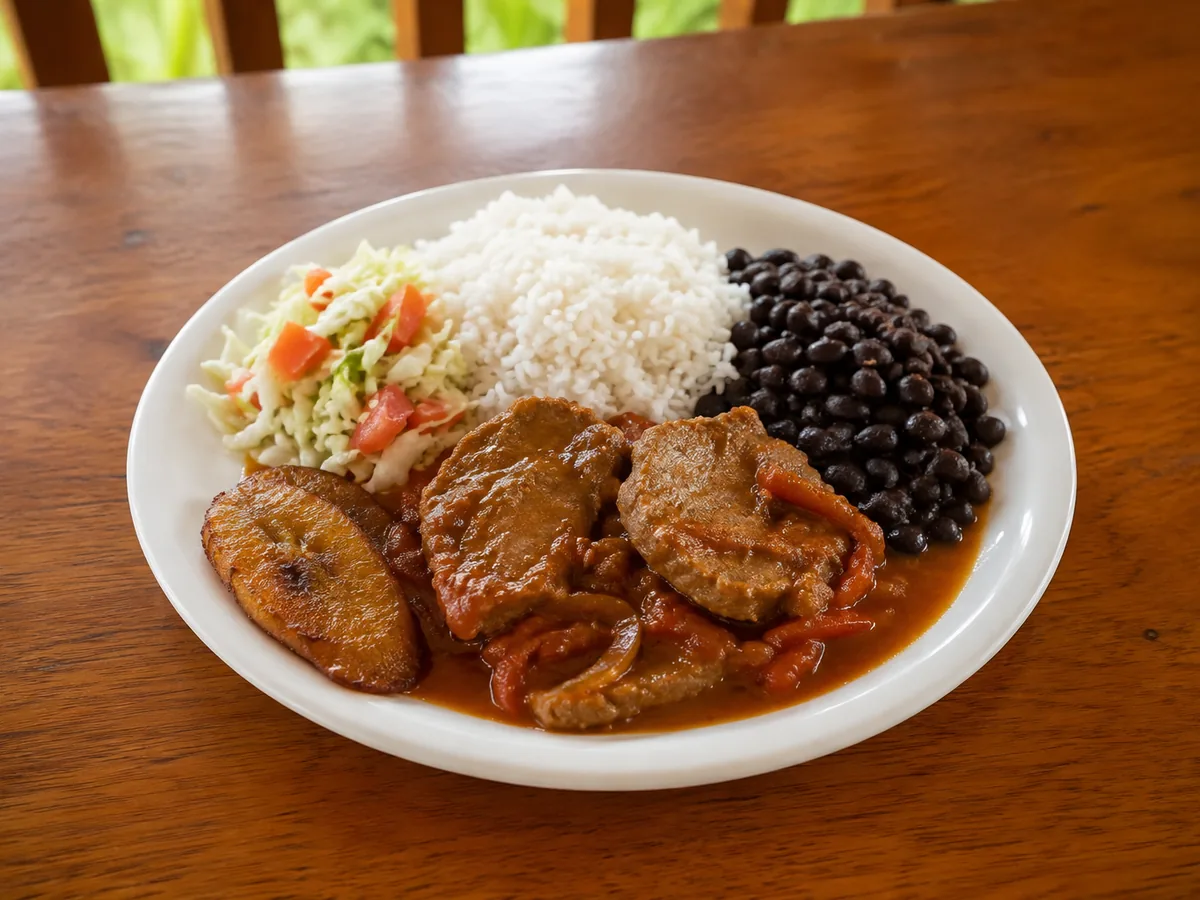
No midday meal in Costa Rica rivals the casado. It is on the counter of every neighbourhood soda, and the word means “married man” — a reference to the complete, generous plate a wife would pack for a husband working the fields.
The plate balances five elements: white rice, stewed black beans, sweet fried plantains, a crisp cabbage-and-tomato salad, and the centrepiece, carne en salsa. Tough cuts of chuck or round are seared hard, then braised with sweet peppers, onions, tomatoes, garlic and Salsa Lizano until the connective tissue gives way.
What comes out is tender beef medallions in a rich, pourable red gravy that was thickened by nothing but its own dissolved collagen.
The beef
- 1.2 kg2.6 lbBeef chuck or top round, trimmed of silverskin and cut into 5 cm cubes
- 45 ml3 TbspVegetable oil or rendered beef tallowdivided between the sear and the sofrito
- 15 g1 TbspFine sea saltdivided across the meat and the sauce
- 3 g1 tspFreshly ground black pepper
The sauce
- 2 large2 largeYellow onions — one cut into fine dice, one into thick rings
- 1 large1 largeRed sweet pepper (chile dulce), cored, seeded and finely diced
- 6 cloves6 clovesFresh garlic, minced to a paste
- 4 large4 largeRipe plum tomatoes, peeled, seeded and puréed, or 400 g crushed tinned tomatoes
- 30 g2 TbspDouble-concentrated tomato paste
- 45 ml3 TbspSalsa Lizano
- 8 g2 tspCumin seeds, toasted and grounddivided between the meat and the sofrito
- 4 g1.5 TbspDried wild oregano, hand-crushed
- 750 ml3.2 cupsRich beef bone stock, hot
- 30 g½ cupFresh cilantro, chopped fine, to finish
To plate
- 1 platter set1 platter setWarm steamed white rice, stewed black beans, fried sweet plantain tajadas, and lime-dressed cabbage slaw
The gravy thickens on gelatin
Beef chuck is dense in type-I collagen. Ninety minutes at 88–92 °C hydrolyses those rigid fibres into gelatin, and the dissolved gelatin is what turns the tomato juices glossy and spoon-coating. No flour, no cornstarch.
Sear in two batches
Crowding drops the pan below browning temperature and the cubes release water instead of building crust. Two batches, 4 to 5 minutes a side.
Sweat the sofrito in the drippings
The fond on the pan floor is the backbone of the sauce. Onions and pepper go straight into it, and the wooden spatula does the scraping.
Onion rings go in late
They join for the final uncovered reduction only, so they turn tender and sweet rather than dissolving into the gravy.
Keep the zones separate
A casado is an orderly platter, not a bowl. Each component holds its own space on the plate.
Passive time, counted separately
The seared beef rests on a plate while the sofrito is built. That sits outside the times quoted above.
The five tastes on this plate
Salt is the seasoned seared beef, the bone broth and the Lizano. Fat is rendered beef fat in the gravy and plantains fried in clean oil. Acid is stewed plum tomato and the lime on the slaw. Heat is crushed garlic, toasted cumin and black pepper. Umami is caramelised beef fond, reduced tomato paste and long-simmered bone broth.
Equipment
- 6 to 7 qt enamelled cast-iron Dutch oven
- Wooden spatula
- Instant-read thermometer
- Six wide platters
Traditionally a heavy cast-aluminium caldero over a gas flame. A 6-to-7-quart enamelled Dutch oven works in a modern kitchen — the enamel keeps acidic tomato off bare iron, and the heavy lid holds steam through the long low braise.
Method
Sear the beef20 min
Pat the cubes completely dry and season hard with salt, pepper and half the cumin.
Heat 30 ml oil in the Dutch oven over medium-high until shimmering and sear the beef in two batches, 4 to 5 minutes a side, until darkly crusted. Onto a resting plate.
Dry beef thoroughly; season with salt, pepper and half the cumin. Heat 30 ml oil over medium-high until shimmering. Sear in two batches, 4–5 minutes per side, until darkly crusted. Transfer to a plate.
Build the sofrito10 min
Add the remaining 15 ml oil to the drippings over medium heat, then the diced onion, sweet pepper and garlic. Sweat 6 to 8 minutes, scraping the fond off the floor of the pot.
Add the tomato paste, oregano and remaining cumin and cook 2 minutes until brick-red. Pour in the puréed tomatoes and the Salsa Lizano and cook 5 minutes until glossy.
Heat remaining 15 ml oil in drippings over medium. Sweat diced onion, pepper and garlic 6–8 minutes, scraping fond. Cook tomato paste, oregano and remaining cumin 2 minutes until brick-red; add tomato purée and Lizano, cooking 5 minutes until glossy.
Braise low and slow1 hr 30 min
Return the beef and its resting juices, then the 750 ml hot stock — the meat should be about two-thirds submerged.
Bring to a boil, cover tightly, and drop to the lowest setting. Hold 90 °C for 1 hour 30 minutes, until the beef yields with no resistance at all (core 92–95 °C).
Return beef and juices; add 750 ml hot stock to submerge meat two-thirds. Boil, cover tightly and lower heat. Hold 90 °C for 1 hour 30 minutes until completely tender; check for a 92–95 °C beef centre.
Reduce the gravy15 min
Uncover and drop in the thick onion rings.
Simmer uncovered over medium 12 to 15 minutes, stirring now and then, until the sauce is thick and velvety and coats the beef and the rings are tender and sweet. Adjust the salt, stir in the cilantro, and pull it off the heat.
Add onion rings; simmer uncovered over medium 12–15 minutes, stirring occasionally, until rings are tender and the thick, velvety sauce coats the beef. Adjust salt, stir in cilantro and remove from heat.
Build the platters
Warm six wide plates and give each one clean, distinct zones: a dome of white rice, a ladle of stewed black beans beside it, a pile of crisp cabbage slaw, two golden plantain tajadas on the rim.
In the centre, the carne en salsa with generous spoonfuls of its gravy. Serve steaming.
Warm six plates. Arrange rice, stewed black beans, crisp cabbage slaw and two plantain tajadas in separate areas on each. Place beef centrally with generous gravy and serve steaming.
Sensory cues of doneness
- Visual: deep crimson-brown sauce clinging to fork-tender beef, oil separating at the edges, and white, black, green and red holding their own sections of the plate.
- Auditory: a quiet bubbling murmur from the pot, and the crisp rustle of the slaw as it is tossed.
- Olfactory: stewed tomato, sweet pepper, toasted cumin, roasted beef and the tang of the Lizano.
Check for fork-tender beef coated in crimson-brown sauce, with oil at the edges. Keep the platter components separate. Expect gentle bubbling and aromas of tomato, sweet pepper, cumin, roasted beef and Lizano.
Troubleshooting
- Tough, chewy meat.
It was boiled hard, or the braise was cut short. Chuck needs at least 90 minutes below the boil for the collagen to turn to gelatin.
- Thin, watery sauce.
Too much stock, or the uncovered reduction was skipped. Finish uncovered so the water goes and the tomato and gelatin concentrate.
- A muddled plate.
Everything was tipped into one bowl. Keep each component in its own zone.
Substitutions
One-to-one global substitutions, with the technique adjustment each one requires.
Ingredient substitutions
| Ingredient | Replace with | Culinary impact and technique adjustment |
|---|---|---|
| Beef chuck | Beef round, skirt steak, or boneless shank | One-to-one, braised until genuinely fork-tender whatever the cut |
| Salsa Lizano | Worcestershire with molasses and cumin | One-to-one. Matches the savoury vegetable acidity |
| Cas juice | Passion fruit, or lime-guava juice | One-to-one. The same high-acid tropical refreshment |
Scaling
Half, for 3 platters
Halve everything in a 4-quart pot. The braise stays 90 minutes.
Double, for 12 platters
Double everything in an 11-quart stockpot and brown the meat in three batches so the pan never drops out of browning range.
What to serve it with
- A scoop of picadillo de chayote or potato hash on the platter
- Shredded cabbage and grated carrot dressed with lime, salt and olive oil
- Refresco natural de cas or maracuyá, shaken over ice
- A cold Imperial
Questions
Can I use flank steak instead of chuck?
Yes — cecina is standard in the sodas. Slice it across the grain into thin strips and it turns tender in about 50 minutes.
Can this be done in a pressure cooker?
Yes. Brown the beef and build the sofrito in the pot, lock the lid, and cook 35 minutes at high pressure with a natural release.
What does "casado" mean?
Married man. It refers to how a man's meals went from simple single items to elaborate multi-component platters once he married.