Gallo Pinto
The "spotted rooster" — black bean broth staining white rice into mottled patches. It only works with rice that has spent twelve hours in the fridge: chilled, the amylose recrystallises into rigid retrograded starch, and rigid grains fry loose instead of collapsing into porridge.
- Prep
- 15 min
- Cook
- 15 min
- Serves
- 4 generous breakfast portions
- Difficulty
- Easy
Researched · Kitchen testing pending
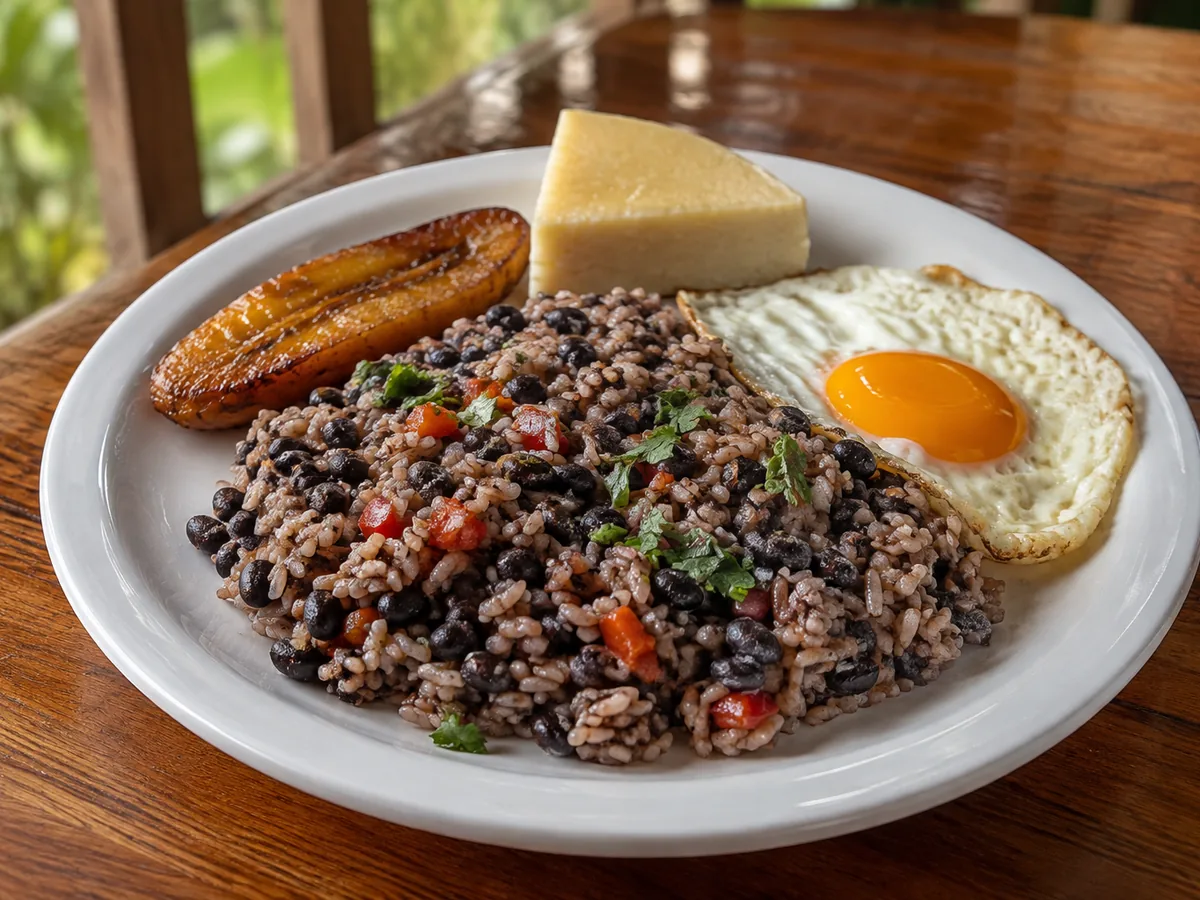
Dawn in Costa Rica begins with the clatter of a cast-iron skillet and the sharp smell of sweating onions. Gallo pinto is not yesterday’s rice reheated out of convenience — it is an engineered breakfast.
The name means “spotted rooster”, after the way dark bean broth stains white rice into mottled patches. Sweated with chile dulce, onion, garlic and cilantro, the rice and beans drink in Salsa Lizano, the thin, smoky vegetable-molasses condiment seasoned with cumin and mustard that no Tico kitchen is without.
Fried hot until the grains separate and toast lightly, it lands on the plate moist but never mushy, flanked by sweet fried plantains, a fried egg and cold tangy natilla.
The rice and beans
- 400 g2.5 cupsCooked long-grain white rice, chilled at 4 °C for at least 12 hoursday-old, and not negotiable
- 300 g1.5 cupsCooked black beans, drained
- 80 ml⅓ cupRich black bean cooking liquor, reserved from the beans
The sofrito
- 30 ml2 TbspUnsalted butter, neutral oil, or rendered pork lard
- 150 g1 cupYellow or white onion, peeled and cut into fine 4 mm brunoise
- 120 g1 cupRed sweet pepper (chile dulce), cored, seeded and cut into fine 4 mm brunoise
- 3 cloves3 clovesFresh garlic, peeled and minced to a fine paste
The seasoning
- 45 ml3 TbspSalsa Lizano
- 5 g1 tspCumin seeds, freshly toasted in a dry pan and ground
- 6 g1 tspFine sea salt, adjusted to how the bean broth is already seasoned
- 2 g½ tspFreshly ground black pepper
- 30 g½ cup packedFresh cilantro leaves and tender stems, washed, spun dry and chopped fine
Twelve hours in the fridge, minimum
Freshly steamed rice is full of warm gelatinised amylose that turns gluey the moment it is stirred in a pan. Chilling forces those linear chains to recrystallise into rigid retrograded starch. Cold grains hitting foaming butter at 165 °C get individually coated in fat instead of fusing.
Measure the bean broth
Strictly 80 ml. More liquid and the rice boils rather than fries — the pan should sizzle itself dry within five minutes.
Salsa Lizano is the engine
A thin vegetable-molasses condiment seasoned with cumin and mustard. Plain Worcestershire on its own is too sour and misses the carrot and molasses undertones entirely.
Toast the cumin
Thirty seconds in a dry pan before grinding. The volatile aromatics that define the dish are driven out of whole seed by heat, not by time in the pan.
Passive time, counted separately
The rice chills 12 hours beforehand and the finished pan rests 2 minutes. Neither is active work.
The five tastes on this plate
Salt is seasoned bean liquor, sea salt and the mineral base of the Lizano. Fat is butter or lard coating each chilled grain. Acid is the mild vinegar tang of the Lizano against sweet cooked onion. Heat is raw garlic, toasted cumin and black pepper. Umami is concentrated black bean broth and the molasses in the condiment.
Equipment
- 12 in cast-iron or heavy carbon-steel skillet
- Wide wooden paddle or spatula
- Small dry pan, for the cumin
Traditionally a seasoned cast-aluminium paila or a round-bottomed iron pot. A 12-inch cast-iron skillet works in a modern kitchen — the mass matters, because a thin pan drops in temperature when cold rice lands in it and the grains steam instead of frying.
Method
Sweat the sofrito7 min
Melt the butter in the skillet over medium heat until foaming. Add the diced onion and sweet pepper and cook 5 to 6 minutes, stirring often, until translucent, soft and sweet.
Stir in the garlic and toasted cumin and cook 1 minute more, without letting the garlic colour.
Toast cumin seeds in a dry pan 30 seconds, then grind. Melt butter over medium; cook onion and pepper 5–6 minutes, stirring, until soft and translucent. Add garlic and toasted cumin; cook 1 minute without browning garlic.
Deglaze with beans and Lizano3 min
Add the beans with the 80 ml reserved liquor, then the Salsa Lizano.
Bring to a lively simmer over medium-high and let it bubble 2 to 3 minutes until the liquor reduces slightly and coats the vegetables in a dark, glossy sauce.
Add the beans with the 80 ml reserved liquor, then the Salsa Lizano.
Bring to a lively simmer over medium-high and let it bubble 2 to 3 minutes until the liquor reduces slightly and coats the vegetables in a dark, glossy sauce.
Fold in the cold rice6 min
Break up any clumps in the cold rice with your fingers and tip it into the pan.
Over medium-high heat, fold with a wide paddle in lifting, tossing motions, keeping the rice moving continuously 5 to 6 minutes as the white grains drink the dark liquid and turn speckled.
Use rice chilled at 4 °C for at least 12 hours. Break up clumps with your fingers; add to the pan. Lift and toss continuously with a wide paddle over medium-high 5–6 minutes until the grains absorb liquid and become speckled.
Drive off the moisture3 min
Spread the rice across the pan floor and leave it undisturbed 60 seconds to take on a light toast.
Scrape up from the bottom and toss 2 minutes more, until the mixture looks dry, loose and glossy with no standing moisture. Season with salt and pepper.
Spread the rice across the pan floor and leave it undisturbed 60 seconds to take on a light toast.
Scrape up from the bottom and toss 2 minutes more, until the mixture looks dry, loose and glossy with no standing moisture. Season with salt and pepper.
Cilantro, off the heat
Pull the pan completely off the burner, scatter over all the cilantro, and fold three times so the herbs meet the steam rather than the metal.
Rest 2 minutes in the warm pan before serving.
Pull the pan completely off the burner, scatter over all the cilantro, and fold three times so the herbs meet the steam rather than the metal.
Rest 2 minutes in the warm pan before serving.
Sensory cues of doneness
- Visual: distinct glossy grains stained light mahogany-grey, scattered whole beans, flecks of red and green, and no pooling broth at all.
- Auditory: a lively crackling hiss as the cold rice lands, settling into a quiet rhythmic rustle as the moisture goes.
- Olfactory: warm cumin, sweet sautéed pepper, toasted butter and the spicy-molasses tang of the Lizano.
Check for separate glossy mahogany-grey grains, whole beans, red and green flecks, and no pooled broth. The lively initial hiss should soften as moisture evaporates; expect cumin, sweet pepper, toasted butter and Lizano aromas.
Storing it
Keeps 4 days in an airtight container. Reheat in a screaming-hot skillet with a knob of butter and a splash of water, tossing fast for 3 minutes.
Troubleshooting
- Gummy, wet porridge.
Freshly cooked warm rice was used. It has to dry out in the refrigerator overnight first.
- The rice boils instead of frying.
Too much bean broth. Measure 80 ml exactly.
- Flat, sour flavour.
Worcestershire alone stood in for the Salsa Lizano. Build the substitute properly with molasses, cumin and mustard.
Substitutions
One-to-one global substitutions, with the technique adjustment each one requires.
Ingredient substitutions
| Ingredient | Replace with | Culinary impact and technique adjustment |
|---|---|---|
| Salsa Lizano | 2 parts Worcestershire, 1 part molasses, a pinch of cumin and yellow mustard | One-to-one. Matches the smoky vegetable-molasses acidity |
| Home-cooked black beans | Canned black beans, rinsed, with their canned liquid | One-to-one. Simmer them 5 minutes with garlic and cilantro first |
| Natilla | Latin crema agria, or equal parts sour cream and heavy cream with salt | One-to-one. Matches the pourable, tangy richness |
Scaling
Half, for 2 portions
Halve everything in a 10-inch skillet. The whole cook drops to about 10 minutes.
Double, for 8 portions
Double everything but use two 12-inch skillets. Crowding 800 g of rice into one domestic pan makes it steam instead of fry.
What to serve it with
- Two eggs fried sunny-side up, the runny yolks spooned over the rice
- Thick slices of ripe plantain fried in butter until mahogany
- Cold salted natilla, and griddled queso Turrialba
- Café chorreado, brewed through the cloth filter
Questions
What if I cannot find Salsa Lizano?
Mix 2 Tbsp Worcestershire with 1 Tbsp dark molasses, ½ tsp ground cumin, ½ tsp yellow mustard and 1 Tbsp water. It gets close to the sweet-sour cumin profile.
Can it be made with red beans?
Yes. Limón cooks rice and beans in coconut milk, and some Central Valley homes prefer small red beans. Black beans are the Valle Central standard.
How long do leftovers keep?
Four days, refrigerated in an airtight container.