Ceviche Tico de Pescado
Nothing cooks here — lime at pH 2.2 unfolds the myosin and actin in the fish and cross-links them into a solid white network. The Costa Rican signature is minced celery, whose terpenes buffer the citric acid into something clean rather than sharp, and it is eaten from a glass cup with soda crackers.
- Prep
- 25 min
- Serves
- 6 appetiser portions
- Difficulty
- Easy
Researched · Kitchen testing pending
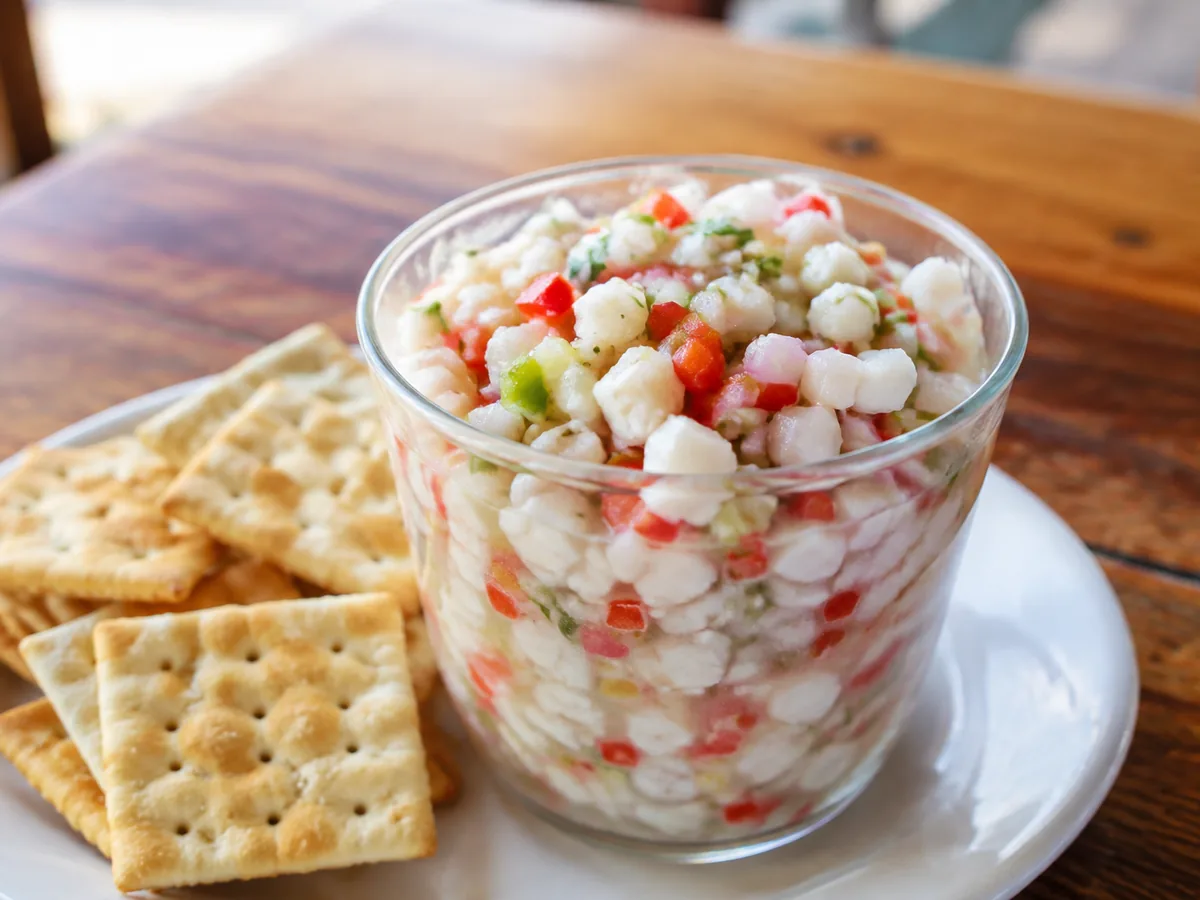
Ceviche in Costa Rica has a personality entirely its own. At every beachside kiosk in Puntarenas and Puerto Viejo it comes cut into tiny uniform dice and served cold in clear glass cups with saltine soda crackers.
The traditional fish is corvina reina, the Pacific sea bass, prized for its sweet clean flavour and delicate white flake. What makes it unmistakably Tico is finely minced celery alongside the red sweet pepper and white onion — an herbal crunch that tempers the acidity of the lime.
Cured gently in the cold, the fish turns snow-white and tender, and the cold citrus juice left in the bottom of the cup is drunk straight.
The fish
- 800 g1.76 lbVery fresh Pacific sea bass (corvina reina), skinned, pin-boned, cut into uniform 8 mm dice
- 15 g1 TbspFine sea salt, seasoned onto the raw fish before any lime
- 2 g½ tspFreshly ground white pepper
The cure
- 240 ml1 cupFreshly squeezed lime juice, about 10 to 12 limes, strained of pulp and seeds
- 60 ml¼ cupCold club soda or ginger ale, optional — the cantina trick for softening the acid
The vegetables
- 150 g1 cupWhite onion, peeled and minced into fine 3 mm brunoise
- 80 g⅔ cupFresh celery, strings removed, minced into fine 3 mm brunoisethe signature Tico element
- 120 g1 cupRed sweet pepper (chile dulce), cored, seeded and minced into fine 3 mm brunoise
- 30 g½ cupFresh cilantro leaves and tender stems, washed, dried thoroughly and chopped fine
Salt five minutes before the lime
Salt draws surface water out of the dice by osmosis, which concentrates the fish flavour and lets the acid penetrate each cube evenly rather than chasing a film of water.
What the lime actually does
At pH 2.0 to 2.4 the hydrogen ions break the hydrogen bonds and salt bridges holding myosin and actin folded. The proteins unfold and cross-link into a solid network, and the translucent pink flesh turns snow-white, firm and opaque.
Celery is the Tico secret
Its apiol and volatile terpenes buffer sharp citric acid, and its watery snap does something onion alone cannot.
Hand-squeeze the limes
A mechanical press crushes the peel and drives bitter limonene into the juice. Bottled juice is flat before it starts.
Uniform 8 mm dice
Uneven cuts over-cure the small pieces into dryness while the large ones stay raw in the middle.
Never aluminium or copper
Citric acid reacts with bare aluminium, copper and unlined cast iron, giving grey discolouration and a metallic taste. Glass, ceramic or stainless only.
Passive time, counted separately
The fish cures 2 to 3 hours in the coldest part of the refrigerator, and firms 15 minutes in the freezer before slicing. Neither is active work, which is why no cook time is listed above.
The five tastes on this plate
Salt is rubbed into the raw dice before curing. Fat is naturally scarce — it arrives at the table as mayonnaise or avocado. Acid is electric fresh lime denaturing the proteins. Heat is raw white onion, celery pungency and white pepper. Umami is sweet sea bass juice, cured fish peptides and sweet red pepper.
Equipment
- Chilled glass or stainless steel mixing bowl
- A larger bowl of crushed ice
- Very sharp knife
- Chilled glass coupes or shallow bowls
Traditionally non-reactive glass or ceramic bowls chilled over ice. A stainless bowl set inside a larger bowl of crushed ice works in a modern kitchen — what matters is that nothing touching the ceviche is aluminium, copper or unlined cast iron.
Method
Dice and salt the fish12 min
Firm the fillets in the freezer 15 minutes so they slice cleanly, then cut into uniform 8 mm dice.
Into a chilled bowl, season with the 15 g salt and the white pepper, toss gently, and leave 5 minutes while the salt draws out surface moisture and tightens the flesh.
Firm fish in the freezer 15 minutes; cut into uniform 8 mm dice. In a chilled glass, ceramic or stainless-steel bowl, toss gently with 15 g salt and white pepper. Leave 5 minutes before adding lime; avoid bare aluminium, copper or cast iron.
Fold in the vegetables3 min
Add the minced white onion, celery and red pepper and toss gently so they are evenly distributed among the fish cubes.
Add the minced white onion, celery and red pepper and toss gently so they are evenly distributed among the fish cubes.
Add the lime3 min
Pour over the 240 ml strained lime juice — it should cover everything completely — and stir gently.
For the cantina version, splash in the 60 ml cold club soda to mellow the acidity.
Pour over the 240 ml strained lime juice — it should cover everything completely — and stir gently.
For the cantina version, splash in the 60 ml cold club soda to mellow the acidity.
Cure cold2 to 3 hr
Cover tightly and put it in the coldest part of the refrigerator, about 3 °C.
Cure 2 to 3 hours, stirring gently once halfway, until the fish has gone from translucent to snow-white and firm.
Cover tightly and put it in the coldest part of the refrigerator, about 3 °C.
Cure 2 to 3 hours, stirring gently once halfway, until the fish has gone from translucent to snow-white and firm.
Finish and serve5 min
Fold in all the chopped cilantro. Taste the liquid — it should be clean, tart, briny and fresh — and adjust with salt or a splash more lime.
Spoon into chilled glass coupes with the juices and serve immediately with soda crackers or hot patacones, and mayonnaise and ketchup on the table.
Fold in cilantro. Taste for a fresh, tart, briny liquid; adjust salt or lime. Serve immediately with juices in chilled glass coupes, accompanied by soda crackers or hot patacones, with mayonnaise and ketchup alongside.
Sensory cues of doneness
- Visual: completely opaque, snow-white, firm cubes speckled with red pepper, green celery and cilantro in clear citrus juice.
- Auditory: an audible crunch from the celery and onion, and the shattering snap of the crackers.
- Olfactory: fresh lime, cold sea bass, bruised cilantro, sweet pepper and herbal celery.
Look for firm, opaque white cubes in clear citrus juice with red pepper, green celery and cilantro. Expect crunchy vegetables and aromas of lime, cold fish, cilantro, sweet pepper and celery.
Storing it
Best within 6 to 8 hours. Past 24 the acid has broken the fish proteins down and the cubes soften and weep.
Troubleshooting
- Bitter juice.
The limes were pressed hard and the peel oils went in. Hand-squeeze gently, and never use bottled juice.
- Mushy fish.
It cured at room temperature, or for too long. Cure at 4 °C or below and eat within 8 hours.
- Some cubes raw, some dry.
The dice was uneven. Cut a uniform 8 mm.
Substitutions
One-to-one global substitutions, with the technique adjustment each one requires.
Ingredient substitutions
| Ingredient | Replace with | Culinary impact and technique adjustment |
|---|---|---|
| Corvina | Halibut, wild red snapper, or grouper | One-to-one, provided it is ultra-fresh sashimi-grade fish |
| Galletas soda | Saltine crackers, or water biscuits | One-to-one. Crisp, dry and lightly salted |
| Celery | Jicama, or the outer stalks of a fennel bulb | One-to-one. The same clean watery crunch |
Scaling
Half, for 3 portions
Halve everything. The cure stays 2 hours.
Double, for 12 portions
Double everything across two wide glass bowls, so the fish sits in an even layer fully submerged in lime.
What to serve it with
- Sleeves of galletas soda — the universal beach accompaniment
- Hot salted patacones, twice-fried green plantain rounds
- Salsa rosada, mayonnaise and ketchup stirred into the broth cantina-style
- A cold Imperial, or a guaro sour
Questions
What can I use instead of corvina?
Wild red snapper, halibut, grouper or striped bass. The requirement is freshness, not the species.
How long does it keep?
Six to eight hours at its best. After a day the acid has softened the cubes and they weep liquid.
Why celery?
It is the defining Costa Rican element — a crisp watery snap and herbal aroma that balances the lime in a way onion cannot.