Tamal Navideño Costarricense
December is the tamaleada, and the Costa Rican tamal is silkier than any of its neighbours because hot riced potato goes into the masa. Potato amylopectin traps moisture that corn alone cannot hold, and the parcels are tied face-to-face in pairs so boiling water never finds a seam.
- Prep
- 2 hr
- Cook
- 2 hr
- Serves
- 20 tamales, tied as 10 piñas
- Difficulty
- Hard
Researched · Kitchen testing pending
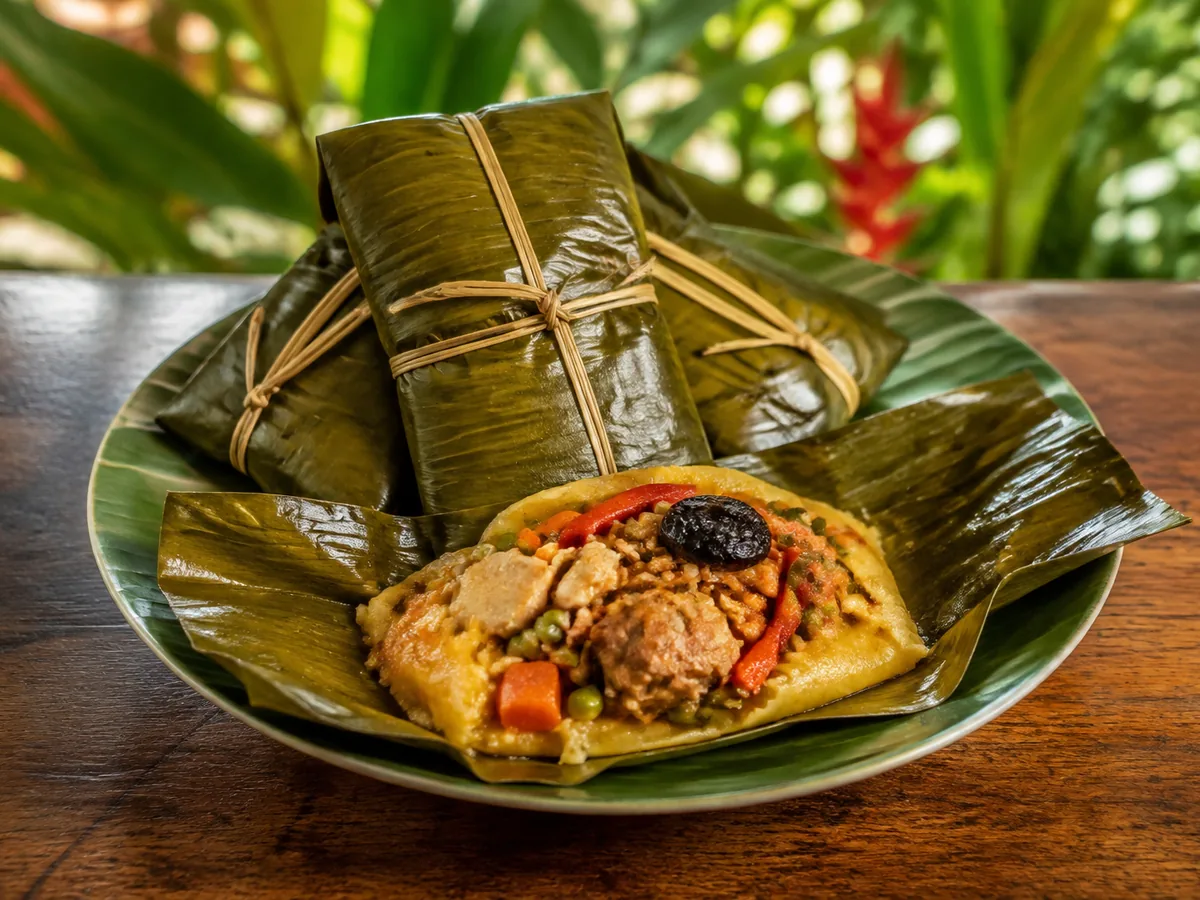
In Costa Rica, December is defined by the tamaleada — an all-day multi-generational gathering where families wrap hundreds of tamales to hand out to neighbours through the holidays.
Unlike its Mexican or Peruvian counterparts, the Costa Rican tamal has a uniquely silky, melting texture. The secret is in the masa: nixtamalised corn dough enriched with collagenous pork stock, warm lard and silky mashed potato.
Each parcel is filled with braised pork, achiote rice, carrot, peas, red pepper and a single sweet prune, wrapped tightly in smoked plantain leaves and tied in pairs called piñas, then boiled for hours until the smell of the leaves has worked into every grain of corn.
The pork and its stock
- 1 kg2.2 lbPork shoulder, cut into 4 cm cubes
- 500 g1.1 lbBone-in pork ribs or neck bones, for a gelatinous stock
- 2.5 L10.5 cupsCold filtered water
The masa
- 1 kg6.5 cupsPrecooked white corn masa flour for tamales
- 500 g3 mediumRusset or Yukon Gold potatoes, peeled, boiled tender and riced smooth while hot
- 250 g1.1 cupsRendered pure pork lard
- 60 ml4 TbspAchiote oil
- 1.8 L7.6 cupsThe hot strained pork broth
The seasoning
- 2 large2 largeYellow onions — one quartered for the stock, one minced for the masa sofrito
- 8 cloves8 clovesFresh garlic, minced to a pastedivided between stock and masa
- 60 ml4 TbspSalsa Lizano30 ml onto the pork, 30 ml into the masa
- 10 g2.5 tspCumin seeds, freshly toasted and ground
- 4 g1.5 TbspDried wild oregano, crushed
- 25 g1 Tbsp + 1 tspFine sea saltdivided across stock, masa and filling
- 4 g1 tspFreshly ground black pepper
The filling
- 300 g1.5 cupsCooked white rice tossed with achiote oil and cumin (arroz arreglado)
- 20 strips20 stripsRed sweet pepper, cut into 6 cm lengths
- 2 medium2 mediumCarrots, peeled, sliced into thin coins and blanched 3 minutes
- 100 g¾ cupSweet green peas, cooked
- 20 pieces20 piecesPitted dried prunes, or dark raisins
To wrap
- 2 kg4.4 lbSmoked plantain leaves, cleaned, deveined and cut into 30 × 30 cm sheets
- 1 roll1 rollCotton butcher's twine, cut into 80 cm lengths
Potato is what makes it silky
Plain corn masa goes dry and crumbly when boiled. Hot riced potato brings cooked amylopectin that traps moisture, and with lard and collagen-rich stock whipped in, the dough sets custard-like and releases cleanly from the leaf.
Whip it, do not stir it
Five full minutes of beating. The masa should end up glossy, smooth and spreadable like soft mashed potato — that is a starch-protein-lipid emulsion, and it will not form by folding.
The leaves season the dough
Boiling drives volatile wax and polyphenol vapours out of the plantain leaf and into the porous masa. That earthy smoked note is not an accident of packaging.
Tie tightly, in pairs
Two tamales face-to-face with the seams meeting seals the openings against boiling water. Loose twine floods the parcel and the masa turns to soup.
The fifteen-minute rest is mandatory
Unwrapped straight from the pot the masa slumps like pudding. Fifteen minutes on a rack and the starches set into something sliceable.
Passive time, counted separately
The potatoes boil and the tamales rest 15 minutes after the pot. That sits outside the times quoted above.
The five tastes on this plate
Salt is seasoned pork bone stock and sea salt through the masa. Fat is lard and achiote oil whipped into the corn. Acid is the Lizano against the pork fat, plus the sweet-sour prune. Heat is crushed garlic, toasted cumin and black pepper. Umami is long-simmered bone broth, braised pork and the polyphenols steaming out of the leaves.
Equipment
- 6 qt pot, for the stock
- Large bowl and an electric mixer or sturdy wooden spoon
- Potato ricer
- Skillet, for the lard sofrito
- 16 to 20 qt stainless stockpot
- Steamer rack or leftover leaf stems, for the pot floor
- Wire rack
Traditionally a 20-to-30 quart aluminium tamalera over gas or an outdoor fire. A 16-to-20 quart stockpot works in a modern kitchen — line the floor with a metal rack or leftover leaf stems so the bottom parcels never touch bare metal and scorch.
Method
Simmer the pork, take the stock1 hr 15 min
Combine the pork shoulder, bones, 2.5 L cold water, quartered onion, 4 garlic cloves, cumin, oregano and 15 g salt. Boil, skim, and simmer gently 1 hour 15 minutes until the pork is tender.
Strain and keep the broth hot. Cut the shoulder into 20 bite-sized chunks and toss with 30 ml Salsa Lizano.
Combine shoulder, bones, 2.5 L water, quartered onion, 4 garlic cloves, cumin, oregano and 15 g salt. Boil, skim; simmer gently 1 hour 15 minutes until tender. Strain, keeping broth hot. Cut shoulder into 20 pieces; toss with 30 ml Lizano.
Whip the potato masa20 min
Whisk the masa flour with the hot riced potato. Melt the lard with the achiote oil in a skillet and sauté the minced onion and remaining garlic 5 minutes, then pour the whole hot lot over the masa.
Add 1.8 L of the hot broth gradually, whisking hard, then the 30 ml Lizano, cumin, pepper and remaining salt. Beat 5 minutes until glossy, smooth and spreadable.
Whisk masa with hot riced potato. Melt lard and achiote oil; sauté minced onion and remaining garlic 5 minutes, then add to masa. Gradually whisk in 1.8 L hot broth, then 30 ml Lizano, cumin, pepper and remaining salt. Beat 5 minutes until glossy and spreadable.
Prepare the leaves15 min
Wipe the sheets with a clean damp towel and trim the stiff central ribs so they bend without cracking.
If the leaves are raw rather than smoked, pass each briefly over a low flame — about 3 seconds — to make it pliable.
Wipe the sheets with a clean damp towel and trim the stiff central ribs so they bend without cracking.
If the leaves are raw rather than smoked, pass each briefly over a low flame — about 3 seconds — to make it pliable.
Assemble40 min
Lay two overlapping leaf squares down. Spoon about 120 g of warm masa into the centre and spread it 1 cm thick.
Set a piece of pork in the middle, then 1 tablespoon of achiote rice, a strip of red pepper, a carrot coin, three peas and one prune.
Overlap two leaf squares. Spread 120 g warm masa 1 cm thick; add one pork piece, 1 tablespoon achiote rice, one pepper strip, one blanched carrot coin, three cooked peas and one prune.
Fold and tie the piñas30 min
Fold the top and bottom edges over the filling with a firm overlap, then the sides inward, into a compact rectangle.
Put two parcels face-to-face with the seams meeting and tie them firmly in a cross with twine. That paired unit is a piña.
Fold top and bottom firmly over filling, then sides inward into a rectangle. Pair parcels face-to-face with seams meeting; tie tightly crosswise with twine to keep water out. Each pair is a piña.
Boil2 hr
Line the stockpot floor with leaf scraps and stand the piñas upright inside.
Cover completely with boiling salted water, bring back to a boil, cover, and boil steadily 2 hours, topping up with boiling water so they stay submerged.
Line the stockpot floor with leaf scraps and stand the piñas upright inside.
Cover completely with boiling salted water, bring back to a boil, cover, and boil steadily 2 hours, topping up with boiling water so they stay submerged.
Rest, then open
Lift them onto a wire rack and rest 15 minutes before cutting the twine — this is not optional.
Cut the string, peel the leaf open, and serve with Salsa Lizano and hot coffee.
Lift them onto a wire rack and rest 15 minutes before cutting the twine — this is not optional.
Cut the string, peel the leaf open, and serve with Salsa Lizano and hot coffee.
Sensory cues of doneness
- Visual: a neat tied rectangle; opened, the masa is golden-yellow, smooth and glistening, holding pork, rice, pepper and prune cleanly in place.
- Auditory: the rhythmic bubbling of the pot and the clink of parcels bobbing together.
- Olfactory: steamed smoked plantain leaf, rendered lard, toasted cumin, garlic and sweet stewed prune.
Check for golden, smooth, glossy masa holding pork, rice, pepper and prune in place when opened. Maintain steady bubbling during cooking; expect smoky plantain leaf, lard, cumin, garlic and sweet prune aromas.
Storing it
Cooked tamales freeze in their leaves for up to 6 months. Reheat by steaming or boiling 20 minutes straight from frozen.
Troubleshooting
- Dry, crumbly masa.
The riced potato was left out, or there was too little lard. Those two are the whole reason this tamal is silky.
- The masa turns to soup in the pot.
The twine was loose and boiling water got inside. Tie firmly and evenly.
- It slumps like pudding when opened.
It was unwrapped straight from the boil. Rest 15 minutes so the starches set.
Substitutions
One-to-one global substitutions, with the technique adjustment each one requires.
Ingredient substitutions
| Ingredient | Replace with | Culinary impact and technique adjustment |
|---|---|---|
| Plantain leaves | Parchment paper inside heavy-duty foil | Wrap tightly in parchment first, then foil. The boil stays 2 hours |
| Pork lard | Unsalted European butter, or vegetable shortening | One-to-one. Butter brings a rich dairy note instead |
| Dried prunes | Dark seedless raisins | One-to-one. The same sweet fruit contrast |
Scaling
Half, for 10 tamales
Halve everything, boiled as 5 piñas in an 8-quart stockpot for the same 2 hours.
Double, for 40 tamales
Double everything, boiled as 20 piñas in a 30-quart commercial tamalera.
What to serve it with
- Salsa Lizano drizzled straight over the warm masa
- Café chorreado, the classic holiday-morning pairing
- Pan casero or pan bon
- Rompope, the Costa Rican rum-spiced eggnog
Questions
Why tie them in pairs?
Face-to-face with the seams inward, the two parcels seal each other against the boiling water and nothing escapes into the pot.
Can they be frozen?
Yes, in their leaves for up to 6 months. Steam or boil 20 minutes from frozen.
Can I make them with chicken?
Yes. Tamal de pollo uses bone-in thighs for the stock and shredded chicken in the masa.