Chorreadas de Maíz Dulce
From *chorrear*, to pour — thick raw corn batter dropped onto a hot comal, with no wheat flour in it anywhere. Pulse the kernels, never purée them: rupture every cell and the batter goes watery and gluey instead of setting into a custardy cake under a caramelised crust.
- Prep
- 20 min
- Cook
- 20 min
- Serves
- 8 large chorreadas, about 18 cm across
- Difficulty
- Easy
Researched · Kitchen testing pending
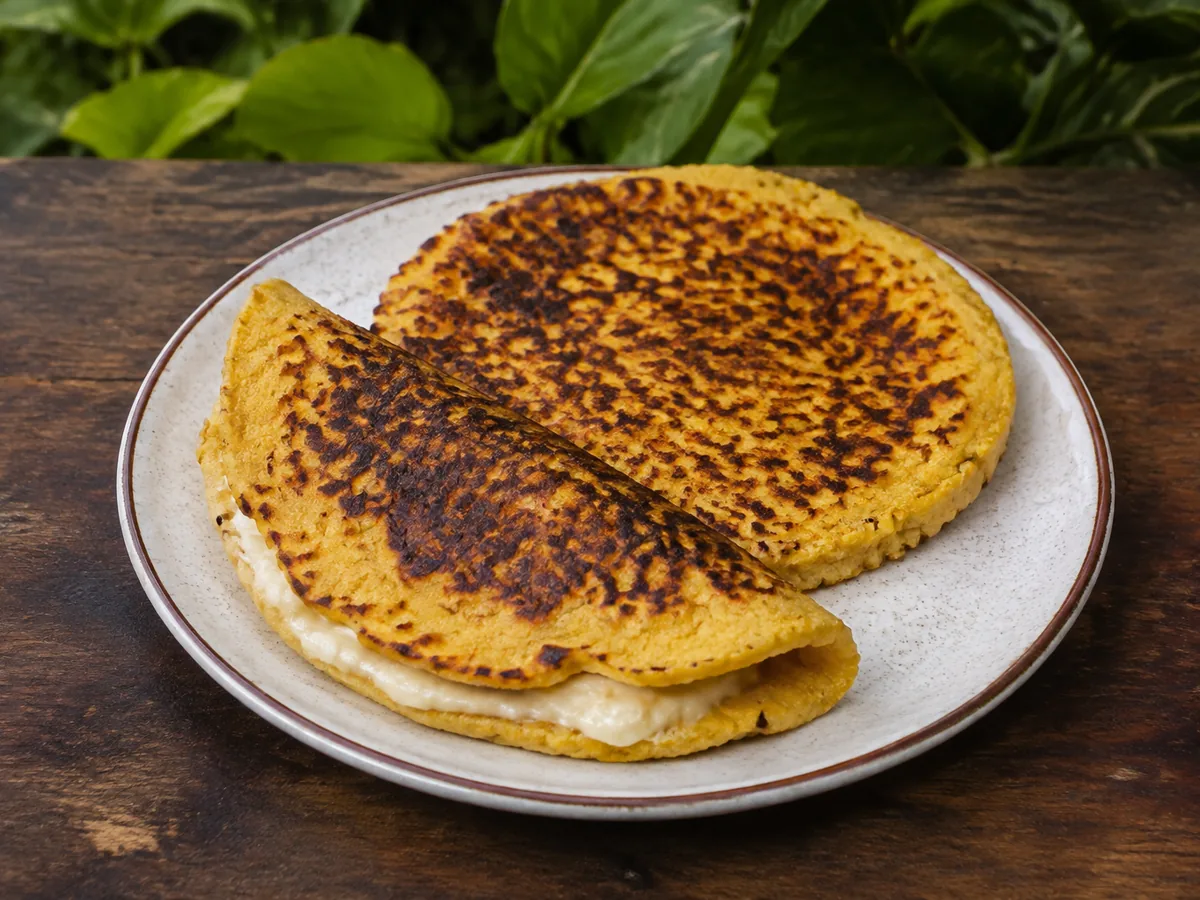
Afternoons in rural Costa Rica smell of wood smoke, wet earth and roasting corn. When the ears of sweet yellow maíz tierno come in, families fire up the comal and make chorreadas.
The name comes from chorrear, to pour, and describes how the thick raw batter drops onto the hot griddle. Unlike pancakes made from dry flour, an authentic chorreada contains no wheat at all — the kernels are cut straight off the cob and ground raw with a splash of milk, sugar, salt and melted butter.
On the griddle the corn sugars caramelise into dark golden patches while the interior starches set into a soft custardy cake. Folded over cold salted natilla and eaten with hot coffee, it is pure country tradition.
The batter
- 1 kg5 cups kernelsFresh sweet yellow corn cut from 6 large ears, the cobs scraped with the knife spine for corn milk
- 60 ml¼ cupWhole milk or heavy creamsparingly — fresh corn brings its own moisture
- 50 g4 TbspGranulated cane sugar, adjusted to how sweet the corn already is
- 8 g1.5 tspFine sea salt
- 30 g2 TbspPrecooked white corn flour, or cornstarch, to bind the free liquid
- 2 large2 largeFarm-fresh eggs, at room temperature
- 60 g4 TbspUnsalted European butter, melted, plus cold butter for the griddle
To serve
- 240 ml1 cupCold salted natilla, and fresh queso Turrialba
Pulse, do not purée
Six to eight pulses. You want visible corn texture and a fine grit — over-blending ruptures every cell, releases all the water and turns the batter thin and gluey.
Scrape the cobs
The dull spine of the knife pulls out the sweet starchy corn milk left behind after cutting. That milk is a real part of the batter, not a flourish.
Two eggs and a spoon of corn flour
Egg albumin coagulates at 65–70 °C and gives the cake structure; the corn flour absorbs the free water fresh kernels release. Between them the interior sets custardy rather than wet.
Medium-low, not hot
At high heat the natural corn sugars burn inside a minute while the middle is still raw. Hold about 180 °C so caramelisation and starch gelatinisation finish together.
If it runs, thicken it
Sweet corn varies enormously in moisture. A runny batter takes another tablespoon of corn flour, not less milk after the fact.
Passive time, counted separately
The batter rests 5 minutes so the corn flour hydrates. That sits outside the times quoted above.
The five tastes on this plate
Salt is in the batter and in the cultured cream on top. Fat is melted butter in the batter and butter foaming on the griddle. Acid is the lactic tang of cold natilla against the sweet cake. Heat is absent by design — this is pure agricultural corn. Umami is caramelised corn sugar, browned butter solids and cultured dairy.
Equipment
- Blender or food processor
- Wide bowl and a sharp chef's knife
- 12 in cast-iron skillet or flat carbon-steel griddle
- Wide thin spatula
Traditionally a broad cast-iron or clay comal over wood coals. A 12-inch cast-iron skillet works in a modern kitchen — steady surface temperature is everything here, because sweet corn sugars scorch the moment the pan spikes.
Method
Cut and scrape the corn10 min
Stand each shucked ear upright in a wide bowl and cut downward to release the kernels.
Then scrape firmly down the stripped cob with the dull spine of the knife to take every drop of sweet corn milk.
Stand each shucked ear upright in a wide bowl and cut downward to release the kernels.
Then scrape firmly down the stripped cob with the dull spine of the knife to take every drop of sweet corn milk.
Pulse the batter10 min
Combine the kernels, corn milk, milk, sugar, salt, eggs, melted butter and corn flour and pulse 6 to 8 times into a coarse thick batter with visible corn grit.
Rest 5 minutes so the corn flour hydrates and thickens.
Pulse corn kernels, scraped corn milk, milk, sugar, salt, eggs, melted butter and corn flour 6–8 times to a thick, coarse batter; do not purée. Rest 5 minutes. If runny, add another tablespoon corn flour.
Heat and butter the griddle2 min
Set the skillet over medium-low, about 180 °C, and rub the surface with a knob of cold butter until it foams.
Set the skillet over medium-low, about 180 °C, and rub the surface with a knob of cold butter until it foams.
Ladle and cook4 min
Ladle about 120 ml of batter on and spread it with the back of the ladle into an even 18 cm circle, 6 mm thick.
Cook undisturbed 3 to 4 minutes: bubbles pop on the surface, the edges go dry and firm, and the underside turns deep golden-amber with dark toasted spots.
Spread 120 ml batter into an even 18 cm circle, 6 mm thick. Cook undisturbed 3–4 minutes until bubbles pop, edges become dry and firm, and the underside is deep golden-amber with dark toasted spots.
Flip and finish3 min
Slide a wide thin spatula fully underneath and flip in one motion.
Cook 2 to 3 minutes on the second side until browned and set through, a core of 85–88 °C. Onto a warm plate under a clean towel.
Slide a wide thin spatula fully underneath and flip in one motion.
Cook 2 to 3 minutes on the second side until browned and set through, a core of 85–88 °C. Onto a warm plate under a clean towel.
Plate
Serve piping hot off the griddle — a generous spoonful of cold salted natilla in the centre, or folded over a thick slab of queso Turrialba.
Hot black coffee alongside.
Serve piping hot off the griddle — a generous spoonful of cold salted natilla in the centre, or folded over a thick slab of queso Turrialba.
Hot black coffee alongside.
Sensory cues of doneness
- Visual: a golden-amber disc with deep chestnut blistering, firm dry edges, and bubbles popping across the top.
- Auditory: a lively sizzle as the batter lands, then quiet hissing as steam vents through the surface craters.
- Olfactory: roasted sweet corn, browned butter, toasted caramel and warm milk.
Look for golden-amber discs with chestnut blisters, dry firm edges and popping surface bubbles. The initial sizzle softens as steam escapes; expect roasted sweet corn, browned butter, caramel and warm milk aromas.
Storing it
Reheat in a dry hot cast-iron skillet for 2 minutes a side, which brings the caramelised edges back.
Troubleshooting
- Thin, gluey batter.
It was blended to a purée. Pulse only until ground, keeping the rustic grit.
- Burnt outside, raw inside.
The pan was too hot. Medium-low, around 180 °C.
- The batter runs off the griddle.
Too much liquid for this corn. Whisk in another tablespoon of corn flour.
Substitutions
One-to-one global substitutions, with the technique adjustment each one requires.
Ingredient substitutions
| Ingredient | Replace with | Culinary impact and technique adjustment |
|---|---|---|
| Fresh sweet corn | Frozen sweet corn, thawed, drained and patted dry | One-to-one, with one extra tablespoon of corn flour for the water |
| Natilla | Latin crema agria, or sour cream loosened with cream and salt | One-to-one. The same tangy pourable texture |
| Precooked corn flour | Cornstarch, or fine yellow cornmeal | One-to-one. It is there to bind excess liquid |
Scaling
Half, for 4 chorreadas
Halve everything in a 10-inch skillet. Every timing is unchanged.
Double, for 16 chorreadas
Double everything and use a two-burner griddle, or two skillets side by side.
What to serve it with
- Cold salted natilla, spooned over the hot cake
- Slices of fresh queso Turrialba folded inside
- Café chorreado from the cloth drip stand
- Hot agua dulce, panela cane water
Questions
Can I use frozen corn?
Yes. Thaw and drain it thoroughly, pat dry, and add 2 tablespoons of corn flour to make up for the extra water.
What is the savoury version?
Chorreadas de maíz tierno con queso — drop the sugar and mix crumbled cheese straight into the batter.
Can they be reheated?
Yes, in a dry hot cast-iron skillet, 2 minutes a side.