Picadillo de Chayote con Carne Molida
The backbone of Central Valley home cooking, and a lesson in restraint with liquid. Chayote is 93% water behind delicate pectin walls, so it steams in its own released juices with barely any stock — then a splash of cream at the end binds the drippings into a glaze instead of a puddle.
- Prep
- 25 min
- Cook
- 25 min
- Serves
- 6 portions, or 12 to 14 gallos
- Difficulty
- Easy
Researched · Kitchen testing pending
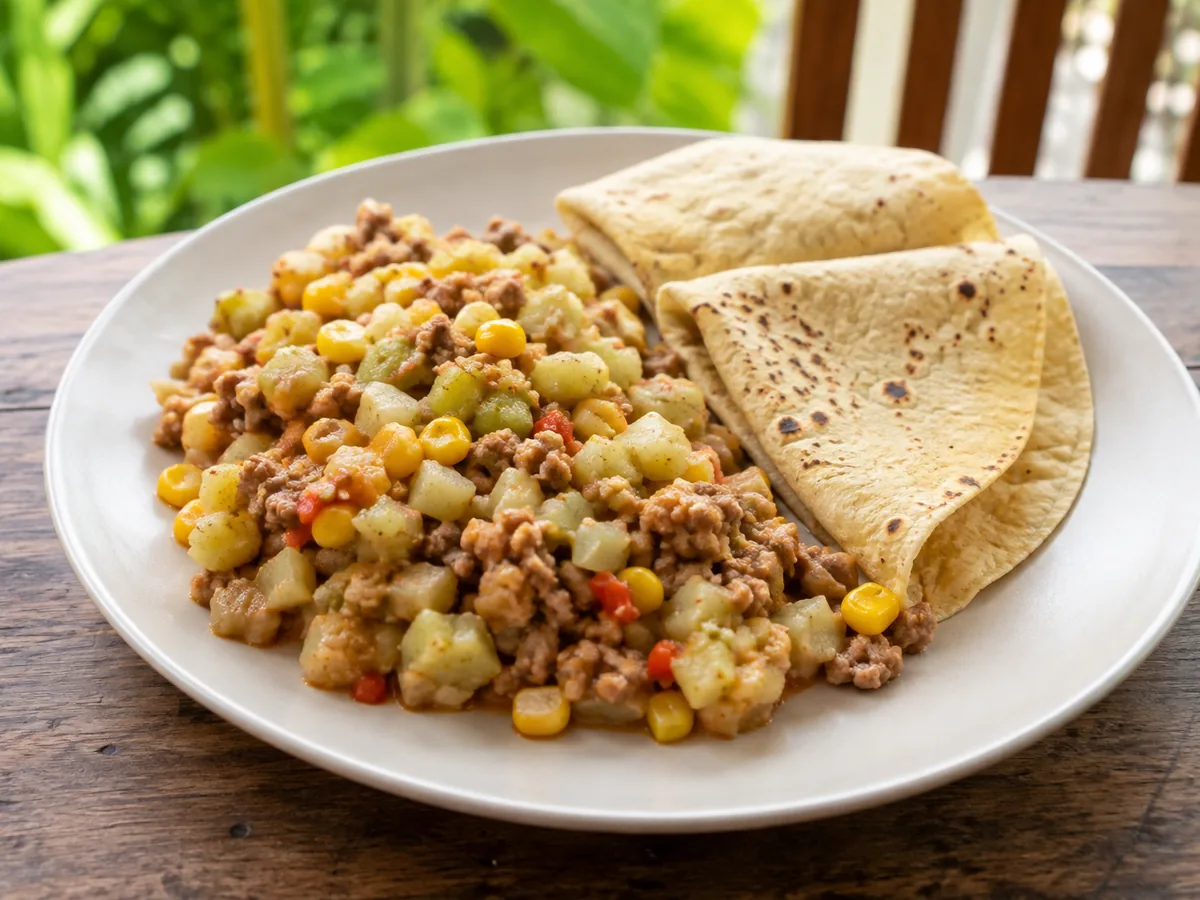
Picadillo is the backbone of daily home cooking across the Central Valley. The word comes from picar, to mince, and refers to how every vegetable in it is cut into tiny uniform cubes.
The standard among Costa Rican picadillos is made with chayote, the crisp water-rich squash native to Mesoamerica. Peeled and diced into 5 mm jewels, it is stewed with lean ground beef, sweet corn, onion, chile dulce, garlic and achiote.
Towards the end many cooks stir in a splash of cream or fresh natilla, which coats the tender cubes in a pale-orange sauce. Wrapped in warm corn tortillas as gallos, it is as rustic and satisfying as Tico cooking gets.
The hash
- 800 g3 mediumFresh chayotes, peeled, soft central seed discarded, cut into uniform 5 mm dice
- 500 g1.1 lbLean ground beef chuck (85/15), or finely minced beef round
- 150 g1 cupSweet yellow corn kernels, fresh or frozen
The sofrito
- 30 ml2 TbspAchiote oil, or neutral oil with 1 tsp achiote paste
- 15 g1 TbspUnsalted butter
- 150 g1 cupYellow onion, peeled and cut into fine 3 mm brunoise
- 120 g1 cupRed sweet pepper (chile dulce), cored, seeded and finely diced
- 4 cloves4 clovesFresh garlic, minced to a paste
The seasoning
- 30 ml2 TbspSalsa Lizano
- 5 g1.5 tspCumin seeds, freshly toasted and ground
- 3 g1 TbspDried wild oregano, crushed
- 10 g2 tspFine sea saltdivided between the sofrito and the squash
- 2 g½ tspFreshly ground black pepper
To finish
- 120 ml½ cupRich beef stock, or warm water
- 60 ml¼ cupHeavy cream, or Costa Rican natilla
- 25 g½ cupFresh cilantro leaves, chopped fine
Chayote is mostly water
About 93% of it, held behind delicate pectin cell walls. Simmered in too much liquid it goes watery and loses the crisp-tender bite entirely. Half a cup of stock is the ceiling.
Uniform 5 mm dice
Irregular cuts mean the small pieces melt while the large ones stay hard. This is the one place in the recipe worth taking time over.
Brown the beef properly first
Three minutes undisturbed to build a crust. The Maillard compounds from that sear are the savoury floor the squash later sits on.
Cream in the last two minutes
Stirred in at the end it emulsifies with the achiote fat and pan drippings into a velvety glaze that clings to each cube. Added early, it just breaks and pools.
Peel chayote under cold water
It secretes a clear sap that dries tight on the skin. Peel under a running tap, or wear gloves.
Passive time, counted separately
The tortillas are warmed on a comal while the pan finishes. That sits outside the times quoted above.
The five tastes on this plate
Salt seasons the beef and penetrates the squash. Fat is rendered beef, butter and cream coating the cubes. Acid is the tangy Lizano cutting the dairy and the beef juices. Heat is toasted cumin, sweet pepper, garlic and black pepper. Umami is caramelised beef fond, corn sugars and reduced stock.
Equipment
- 12 in enamelled cast-iron braiser or deep sauté pan
- Wooden spatula
- Comal or dry skillet, for the tortillas
Traditionally a heavy cast-aluminium paila or deep iron skillet. A 12-inch braiser works in a modern kitchen — the wide floor is the point, because it lets the water the chayote releases evaporate instead of pooling.
Method
Brown the beef7 min
Heat the achiote oil in the braiser over medium-high. Add the beef, breaking it into small morsels.
Leave it undisturbed 3 minutes to crust, then stir and cook 4 minutes more until through. Drain off excess grease, leaving about 2 tablespoons of fat in the pan.
Heat achiote oil over medium-high; add beef in small pieces. Leave undisturbed 3 minutes to crust, then stir and cook 4 minutes until cooked through. Drain excess grease, leaving about 2 tablespoons fat.
Sweat the sofrito6 min
Add the butter, then the onion, sweet pepper and garlic. Cook 5 minutes, stirring often, until soft and translucent.
Stir in the cumin, oregano, black pepper and 1 tsp salt and cook 1 minute until fragrant.
Add the butter, then the onion, sweet pepper and garlic. Cook 5 minutes, stirring often, until soft and translucent.
Stir in the cumin, oregano, black pepper and 1 tsp salt and cook 1 minute until fragrant.
Chayote and corn2 min
Add the diced chayote and corn, stirring to coat everything in the beef fat and achiote.
Pour in the Salsa Lizano and the 120 ml stock, and season with the remaining 1 tsp salt.
Peel chayote under cold running water or wear gloves; discard seed and cut uniform 5 mm dice. Add chayote and corn, coating in fat. Add Lizano, 120 ml stock and remaining 1 tsp salt; do not exceed the stock quantity.
Simmer to crisp-tender12 min
Bring to a gentle boil, drop to medium-low, and cover with the lid slightly ajar.
Simmer 10 to 12 minutes, stirring every few minutes. The chayote drinks the beef juices and turns tender-crisp while keeping its sharp cube edges.
Bring to a gentle boil, drop to medium-low, and cover with the lid slightly ajar.
Simmer 10 to 12 minutes, stirring every few minutes. The chayote drinks the beef juices and turns tender-crisp while keeping its sharp cube edges.
The cream liaison5 min
Uncover and raise to medium to drive off any watery liquid, about 2 to 3 minutes.
Pour in the cream and stir continuously 2 minutes as it emulsifies with the achiote fat into a glaze that coats every cube. Stir in the cilantro and pull it off the heat.
Uncover; increase to medium and evaporate watery liquid, 2–3 minutes. Add cream and stir continuously 2 minutes until it forms a glaze coating the cubes. Stir in cilantro and remove from heat.
Build the gallos
Warm the tortillas on a dry comal until soft and pliable, spoon a generous mound of hot picadillo into the centre of each, and serve open-faced.
Warm the tortillas on a dry comal until soft and pliable, spoon a generous mound of hot picadillo into the centre of each, and serve open-faced.
Sensory cues of doneness
- Visual: a glistening golden-orange hash of uniform dice, browned beef and yellow corn, with no standing liquid at all.
- Auditory: a lively sizzle settling into a quiet, thick simmer as the cream goes in.
- Olfactory: browned beef, sweet sautéed chayote, toasted cumin, sweet corn and cream.
Look for a glistening golden-orange hash of uniform dice, browned beef and yellow corn with no standing liquid. Listen for a lively sizzle settling into a quiet, thick simmer as the cream goes in; smell browned beef, sweet sautéed chayote, toasted cumin, sweet corn and cream.
Troubleshooting
- Mushy, collapsed chayote.
It simmered too long. Ten to twelve minutes is all it needs.
- A watery hash.
Too much stock. Keep it to half a cup and reduce uncovered at the end.
- Some cubes hard, some melted.
The dice was uneven. Cut a uniform 5 mm.
Substitutions
One-to-one global substitutions, with the technique adjustment each one requires.
Ingredient substitutions
| Ingredient | Replace with | Culinary impact and technique adjustment |
|---|---|---|
| Chayote | Kohlrabi, or peeled and cored zucchini | Cut zucchini slightly larger and give it only 6 minutes |
| Natilla | Heavy cream, or sour cream loosened with a splash of milk | One-to-one. The same velvety binding |
| Salsa Lizano | Worcestershire with molasses and cumin | One-to-one |
Scaling
Half, for 3 portions
Halve everything in a 10-inch skillet. The simmer drops to 8 minutes.
Double, for 12 portions
Double everything in a wide 14-inch rondeau, broad enough that moisture evaporates rather than boiling the squash.
What to serve it with
- Thick handmade tortillas palmeadas, for wrapping
- Slices of mild fresh queso Turrialba
- Chilera criolla, for a sharp vinegar crunch
- Black coffee, or chilled tamarind refresco
Questions
How do I peel chayote without the sticky sap?
Peel it under cold running water, or wear kitchen gloves. The sap dries tight on the skin otherwise.
Can I use pork?
Yes. Finely diced pork shoulder or ground pork is a common and authentic variation.
Can it be vegetarian?
Yes. Drop the meat, use vegetable stock, and add an extra cup of sweet corn and some diced carrot.