Habichuelas Guisadas
Pink beans stewed in fried recaíto and smoked pork, with calabaza smashed against the pot until the liquor clings to a grain of rice instead of running off it.
- Prep
- 30 min
- Cook
- 2 hr 30 min
- Serves
- 6–8 plates with rice
- Difficulty
- Medium
Researched · Kitchen testing pending
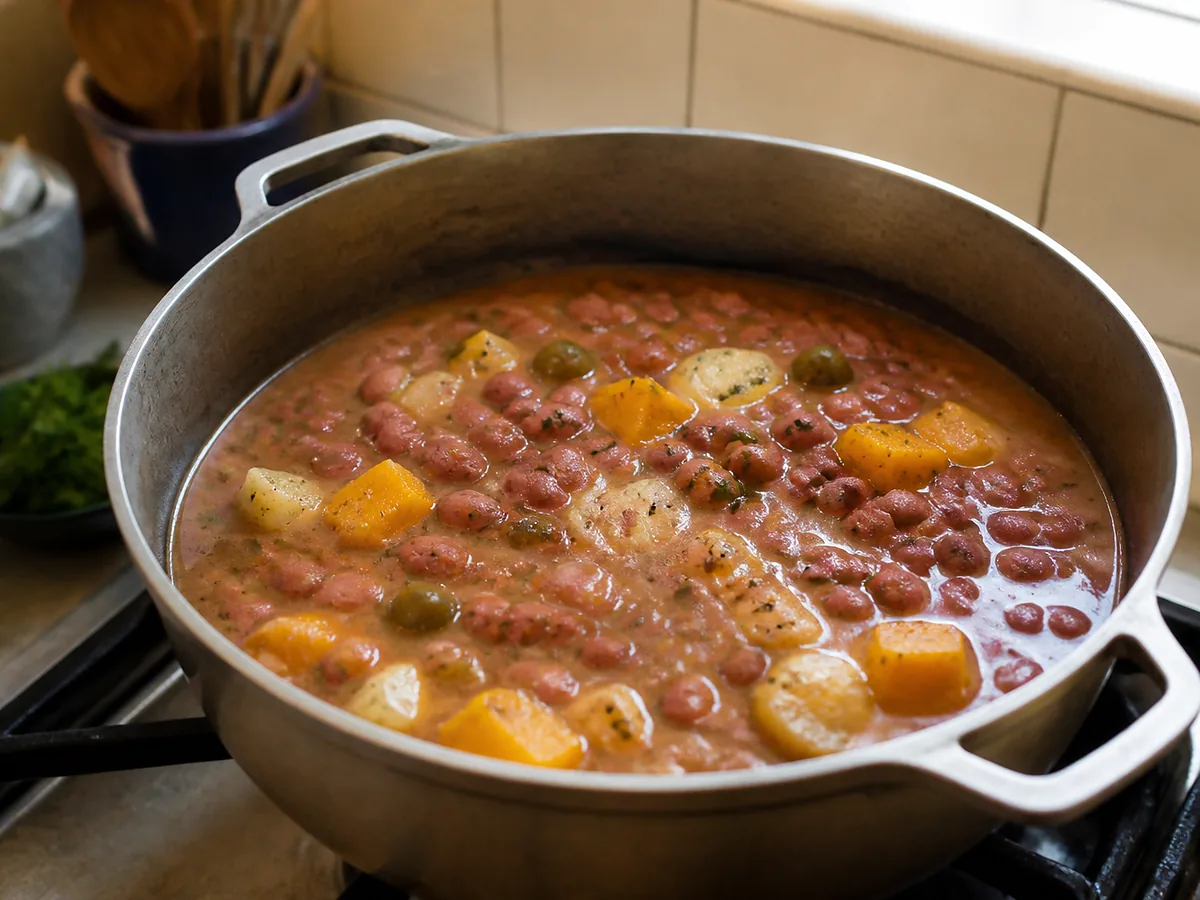
I ladle these over white rice on a Tuesday because that is the Puerto Rican plate when nobody is performing: beans that taste of recaíto and smoked pork, liquor the colour of achiote, thick enough to cling to a grain and not run off like soup.
They sit under leftover pernil, under pollo guisado, under a chuleta. They are not a garnish. The rice is already on.
I cook small pink beans — habichuelas rosadas. Small reds are just as common on the island and I treat them as the same pot.
Body is not a blender trick. Calabaza breaks. Bean starch leaks. You smash a few pieces against the pot and the broth goes from watery to a coat on the spoon.
Cuban black beans are a cumin-and-bay black pot, often with vinegar, with no recaíto and no orange achiote liquor. Dominican habichuelas are a tomato-redder, cilantro-and-bouillon cousin that does not start from recao, ají dulce, and sazón.
The night before — dried beans
- 450 g1 lbDried pink beans / habichuelas rosadas, picked oversmall red beans at the same weight are the other island default. Pinto is the labelled diaspora stand-in
Smoked pork, if you have it
- 400–500 g14–18 ozSmoked ham hock, or a meaty pernil bone with skin and fator 200 g smoked ham plus 100 g tocino
Recaíto — the green Puerto Rican sofrito
- 80 gabout 3 cups looseRecao / culantro leaves, packedcilantro is a labelled stand-in, not the same herb
- 80 g8–12 peppersAjí dulce, stemmed
- 100 g1 smallYellow onion, rough chop
- 60 g½ pepperCubanelle or Italian frying pepper, rough chop
- 25 g6–8 clovesGarlic
- 30 ml2 tbspOlive oil or achiote oilto help the blender. Use 120 ml of the finished recaíto in the pot; the rest freezes
The pot
- 45 ml3 tbspAchiote oilor olive oil warmed with 8 g annatto seeds, then strained
- 80 g½ mediumYellow onion, small diceon top of what is already in the recaíto
- 200 g1 mediumRipe tomato, choppedor 120 ml plain tomato sauce
- 300 g10.5 ozCalabaza or West Indian pumpkin, peeled and seeded, in 3 cm chunkspotato is the labelled body stand-in — 250 g Yukon gold, same cut
- 4 g2 tspDried oregano, crushed between your palms
- 4–5 g1 packetSazón with achioteor homemade — 2 g ground annatto, 1 g garlic powder, 1 g salt, a pinch of cumin and coriander
- 8 g1⅓ tspCoarse salt, to startthen more after you taste — the hock is salty
- 2 g1 tspBlack pepper
- 1 leaf1 leafBay leaf
- 1.8–2.2 L7½–9⅓ cupsWater, to coverplus more as the beans drink
Canned beans — the labelled diaspora reality
- 3 × 439 g3 × 15.5 ozCanned pink or small red beans, drainedsave 240 ml of the can liquor. Skip the soak; everything else as written. Times are in the method
Yield and ratio
6 to 8 plates with rice. Overnight soak plus about 2 to 2½ hours of stove time for dried beans; about 50 minutes once the recaíto hits the pan for canned. Pink or small red : recaíto in the pot : calabaza starts at 450 g : 120 ml : 300 g. Not a locked formula — the liquor decides.
On the beans
Pink beans and small reds are the island beans for this pot. They cook creamy and they cloud the liquor. Large dark-red kidneys stay mealy and do not throw the same silk. Pinto is what the mainland shelf often hands you — I will use it and say so. Soak 8 to 12 hours in cold water by 8 to 10 cm. Dump the soak water; it is not the stew. No baking soda — it blows skins and flattens flavour. Canned pink or small red beans are how a lot of Puerto Rican kitchens in the diaspora actually cook on a weeknight. That is not a failure of character; it is a labelled path. Do not use black beans and call this habichuelas guisadas.
On the recaíto
Recaíto is the green Puerto Rican paste: recao, ají dulce, onion, garlic, a little cubanelle. Recao is culantro — sawtooth and pungent. Cilantro is a different plant, and they are not interchangeable in the nose, only on a mainland counter when recao is gone. Ají dulce is a small sweet pepper with perfume, not heat; jalapeño is the wrong idea. Blitz it to a wet pesto, not a smoothie — you want flecks. Jarred recaíto is the honest freezer-door version; use 120 ml and taste for salt, because jars are seasoned.
On the calabaza, and the smash
Calabaza is West Indian pumpkin, dry-fleshed and sweet — the piece that breaks and silks the liquor. Kabocha is the closest foreign-shelf squash; butternut works. Cut 3 cm so the cubes survive until you smash on purpose. Potato is the labelled stand-in when calabaza is gone. You lose the sweet squash note. You still smash. The smash is later, against the wall of the pot: a third of the squash and a handful of beans. Not a processor. Not an immersion blender. Those make baby food.
On the smoked pork
A ham hock is collagen, smoke, and salt. A leftover pernil bone with some skin is the Sunday version of the same idea. Tocino renders. I am not making a meat stew. I am making beans that tasted a pig. If you have no smoked pork, cook the pot anyway and say so — add a tablespoon more recaíto and do not pretend the smoke is there. Bacon is a departure: it crisps instead of giving gelatin. A smoked turkey wing is a labelled stand-in for a house that does not eat pork. The hock stays in the pot. At the end you pull it, shred what meat there is, dump the bone, and return the meat.
On tomato, oregano, and sazón
Tomato is modest — chopped ripe fruit or a small pour of plain sauce. Too much tomato turns the liquor red and acid and fights the recao. Sazón with achiote is the orange. Achiote oil in the pan does the same job in fat: warm the seeds until brick-orange, 2 to 3 minutes, do not blacken them, strain. A Cuban teaspoon of cumin in this pot is a drift I can taste. Bay is one leaf, and it is not the point.
Equipment
- A heavy pot, 5 to 7 L — enamelled Dutch oven or a thick aluminium olla. Thin stainless scorches starch once the beans and squash break
- A blender or food processor, for the recaíto
- A wooden spoon with an edge you can smash with
- A soak bowl, and a ladle
Do not use: a blender to "finish" the body; a slow cooker on low all day without a smash; a pressure cooker as the lead — the island-reality times are in the substitutions, labelled.
Method
Soak the beans8–12 hours, overnight
Cover the dried beans with cold water by 8 to 10 cm. Room temperature unless the kitchen is hotter than 25 °C / 77 °F, in which case the fridge. Drain in the morning.
The smell should be clean and slightly sweet. Foamy and sour: dump it and start over.
*Canned path: skip this step.*
They hydrate from the outside in. A short soak leaves a hard heart, and a violent boil then bursts skins and still leaves chalk.
Soak dried beans 8–12 hours under 8–10 cm cold water; refrigerate if the kitchen exceeds 25 °C / 77 °F. Drain and discard soaking water. Discard beans if foamy and sour. For canned beans, skip soaking and reserve 240 ml can liquor.
Achiote oil, if you are making it3 min
Warm the oil with the annatto seeds over medium-low until the oil is orange and smells earthy, 2 to 3 minutes — about 120–140 °C / 250–285 °F. Do not let the seeds blacken. Strain into the pot.
Annatto colour is fat-soluble. Dumping a dry packet into water later is dye without the fried note.
If making achiote oil, warm oil with annatto seeds over medium-low at 120–140 °C / 250–285 °F for 2–3 minutes until orange and earthy-smelling. Do not blacken the seeds; strain into the pot.
Recaíto in fat8–10 min
Set the heavy pot over medium heat with the achiote oil. Add the extra diced onion and a pinch of salt, and cook until translucent, 4 to 5 minutes.
Add 120 ml of recaíto and fry it. The raw green smell should cook into something sweeter, 4 to 5 minutes, stirring. The paste darkens a shade and the fat goes cloudy-green, then orange-green. Garlic already in the recaíto should smell sweet, not brown. If it sticks, lower the flame and add a spoon of water.
Recao and ají dulce need fat and time. Dumping raw recaíto into bean water is grass in a broth, and burned garlic is bitter for the whole simmer.
If making recaíto, pulse its listed ingredients to a flecked wet pesto; use 120 ml and freeze the rest. Heat achiote oil over medium; soften diced onion with a pinch of salt 4–5 minutes. Add recaíto and stir 4–5 minutes until sweet and darker. If sticking, lower heat and add a spoonful of water.
Tomato, oregano, sazón3–4 min
Add the tomato or tomato sauce and cook until it slumps and the raw smell leaves, 2 to 3 minutes.
Off the heat ten seconds. Stir in the oregano and the sazón for thirty seconds. The pot should smell of recao, oregano, and annatto — not dust.
Add tomato or sauce and cook 2–3 minutes until softened and no longer raw-smelling. Remove from heat for 10 seconds, then stir in oregano and sazón for 30 seconds.
Beans, hock, and water75–105 min dried · 20 min canned
Add the drained soaked beans and the ham hock. Pour on 1.8 L of water, then more until the food sits under 3 to 4 cm of liquid. Add the salt, pepper, and bay.
It will look too watery. Beans drink, squash goes in later, and you will smash.
Bring to a boil, then immediately drop to a low simmer — a lazy break of bubbles, 90–95 °C / 195–205 °F. Lid ajar. Skim dirty foam in the first 15 minutes, but not every slick of orange fat; you need that fat.
At 60 minutes the beans yield at the edge and still have a little chalk at the heart. At 75 to 105 minutes a bean should smash against the roof of your mouth with no dry centre. Old beans take longer. Add hot water only if the bottom is catching.
*Canned path:* add the drained beans, the 240 ml of saved can liquor, the hock if using, and water to cover by 2 cm. Simmer 20 minutes so they take the recaíto before the squash.
Undercooked beans are a gastrointestinal problem, not a texture choice.
Add soaked beans, hock, 1.8 L water, then enough to cover by 3–4 cm; add salt, pepper and bay. Boil, immediately reduce to 90–95 °C / 195–205 °F and simmer lid ajar 75–105 minutes until fully creamy, longer for old beans. Skim foam during first 15 minutes; add hot water if catching. Canned version: add drained beans, 240 ml reserved liquor, optional hock and water to cover by 2 cm; simmer 20 minutes.
Calabaza20–25 min
When the beans smash, add the calabaza. Simmer until the squash yields to a spoon, 20 to 25 minutes. Potato as the stand-in takes about the same.
Taste for salt now, before the smash. The liquor should already be cloudy and orange-brown, smelling of recao and smoke.
Squash in from the start dissolves into a purée that then scorches while you wait on the beans. Late squash still gives you cubes to smash on purpose.
Only when beans mash easily, add calabaza or the listed potato substitute. Simmer 20–25 minutes until it yields to a spoon. Taste and adjust salt before mashing.
Smash for body5–10 min
Pull the hock. Shred the meat, discard the bone and hard skin, and return the meat.
Mash about a third of the calabaza and a handful of beans against the wall of the pot. Stir. The liquid should go from brothy to opaque and heavy, and coat a spoon.
If it still reads as soup, smash more and simmer uncovered 5 to 10 minutes. If it reads as porridge, loosen with hot water. Leave most beans intact.
Body is broken starch and broken squash in the liquor, plus gelatin from the hock. A blender makes baby food, and it cannot stop when the spoon is right.
Remove hock, shred meat, discard bone and hard skin and return meat. Mash one-third of squash and a handful of beans against the pot; leave most beans intact, never blend. If soupy, mash more and simmer uncovered 5–10 minutes; if too thick, add hot water.
Rest in the pot10–15 min
Off the heat, lid on. The starch sets a little.
Taste: seasoned, porky if you used the hock, herbal from recao, a little sweet from calabaza, orange from achiote. Not watery. Not paste.
Better 15 minutes after you thought they were done, and better still the next day.
Rest covered off heat for 10–15 minutes. Taste for salt and check that the orange-brown, herbal stew coats a spoon while staying fluid, with squash sweetness and smoke if using pork.
Storing it
Keeping and reheating
Cool in shallow containers and refrigerate within 2 hours. Keeps 3 to 4 days cold. The stew thickens hard in the fridge as starch retrogrades — that is normal. Loosen with water when you reheat to a simmer, 74 °C / 165 °F in the centre. Freeze up to 2 months; thaw in the refrigerator. Recaíto freezes in ice-cube trays.
The bean rule
If a bean is still hard at two hours, keep cooking. Do not serve from a pot that sat in the danger zone overnight. A hock that smells rotten rather than smoky does not go in.
Troubleshooting
- It is soup.
You did not smash, or you flooded it. Smash calabaza and beans against the pot, then simmer uncovered 10 to 15 minutes. Do not add flour, cornstarch, or cream.
- It is paste.
Too much smash, or the squash went in too early. Add hot water and stop crushing.
- Beans still hard at two hours.
Old beans, a short soak, hard water, or a timid simmer. Keep going. Do not add more tomato before they soften — acid slows the skins.
- Watery and pale.
No achiote oil, sazón dumped into a huge volume of water, or recaíto not fried. Bloom the paste in fat, and reduce uncovered.
- Too salty.
The hock did the salting and you matched it. Dilute. Under-salt early and finish at the end.
- Flat.
Recaíto went in raw, or you skipped the oregano and sazón in the fat. Fry the paste. Crush oregano in the palm.
- Bitter or scorched.
Garlic burned in the recaíto fry, or the bottom caught after the starch leaked. Transfer what is not burnt. Burnt beans do not hide.
- Canned beans blew apart.
You boiled them hard for an hour as if they were dried. Twenty minutes in the recaíto is enough.
Substitutions
Traditional
Dried pink or small red beans, soaked; recaíto of recao, ají dulce, onion, garlic; ham hock or smoked pork if the house has it; tomato in modest amount; oregano; sazón or achiote oil; calabaza smashed with beans for a silky liquor; white rice. An everyday plate.
Acceptable home shifts
Pinto, labelled as the bean. Jarred recaíto. Cilantro labelled as the recao stand-in. Cubanelle when ají dulce is gone. Kabocha or butternut for calabaza. Potato labelled as the body stand-in. Canned pink or small red beans as the weeknight path. Smoked turkey wing labelled as the pork stand-in. A leftover pernil bone.
Departures, named as such
Black beans. Blender body. Cumin-forward Cuban seasoning. A bouillon-and-cilantro Dominican drift. Bacon as the only pig. Cream. Flour to thicken. Calling it chilli.
The pressure cooker, as an island reality
Puerto Rican kitchens have used an olla de presión for decades, because a two-hour burner is not always honest. It is not my first pot. Soak as usual; fry the recaíto in the cooker on sauté. Add beans, hock, and water toward the low end, about 1.4 L. High pressure 25 to 30 minutes, natural release 15. Open, add calabaza, simmer uncovered 15 minutes, smash, rest. The beans still have to smash.
Scaling
Simmer time does not halve. Beans still need their clock, and liquid is the variable — food covered by 3 to 4 cm.
Smaller and larger
For 12 to 16, double everything except the bay — still 1 or 2 leaves — and use an 8 to 10 L pot. Do not triple in one thin pot. Halve for 3 to 4: 225 g dried beans, 60 ml recaíto, 150 g calabaza, and a small piece of hock or 100 g smoked ham.
What to serve it with
White rice. That is the plate.
- White rice, always
- Under pernil, pollo guisado, chuletas, or bistec encebollado
- A fried egg, when the meat did not happen
- Tostones or amarillos, for a second starch
- Avocado, if it is ripe
Hot sauce at the table, not in the pot. I do not put cheese on this.
Questions
Pink, red, or pinto?
Pink or small red on the island. Pinto when that is the bag — say which you used. Not black.
Do I have to soak?
For dried beans, yes, if you want even skins and a sane clock. Canned is the no-soak path.
Do I have to use pork?
No. The pot is still recaíto, achiote, oregano, squash. You will miss smoke and gelatin. Say so.
Why not a blender?
You want intact beans in a thickened liquor, not a purée. The spoon against the pot lets you stop when it coats.
Can I make it the day before?
Yes, and you should if you can. Cool fast, refrigerate, reheat to a simmer, loosen with water.
Jarred recaíto?
Yes. 120 ml in the pot, fried in fat. Taste for salt.
How do I know it is done?
Beans smash with no chalk, squash yields, the spoon coats, recao and achiote in the nose. If those are true it is done, even if the clock disagrees.