Tembleque
A coconut-and-cornstarch pudding cooked to a nappe and chilled until it shivers on the plate. No eggs, no caramel, no dairy — the name is the instruction.
- Prep
- 10 min
- Cook
- 18 min
- Serves
- One 18–20 cm mould, or 8 ramekins
- Difficulty
- Easy
Researched · Kitchen testing pending
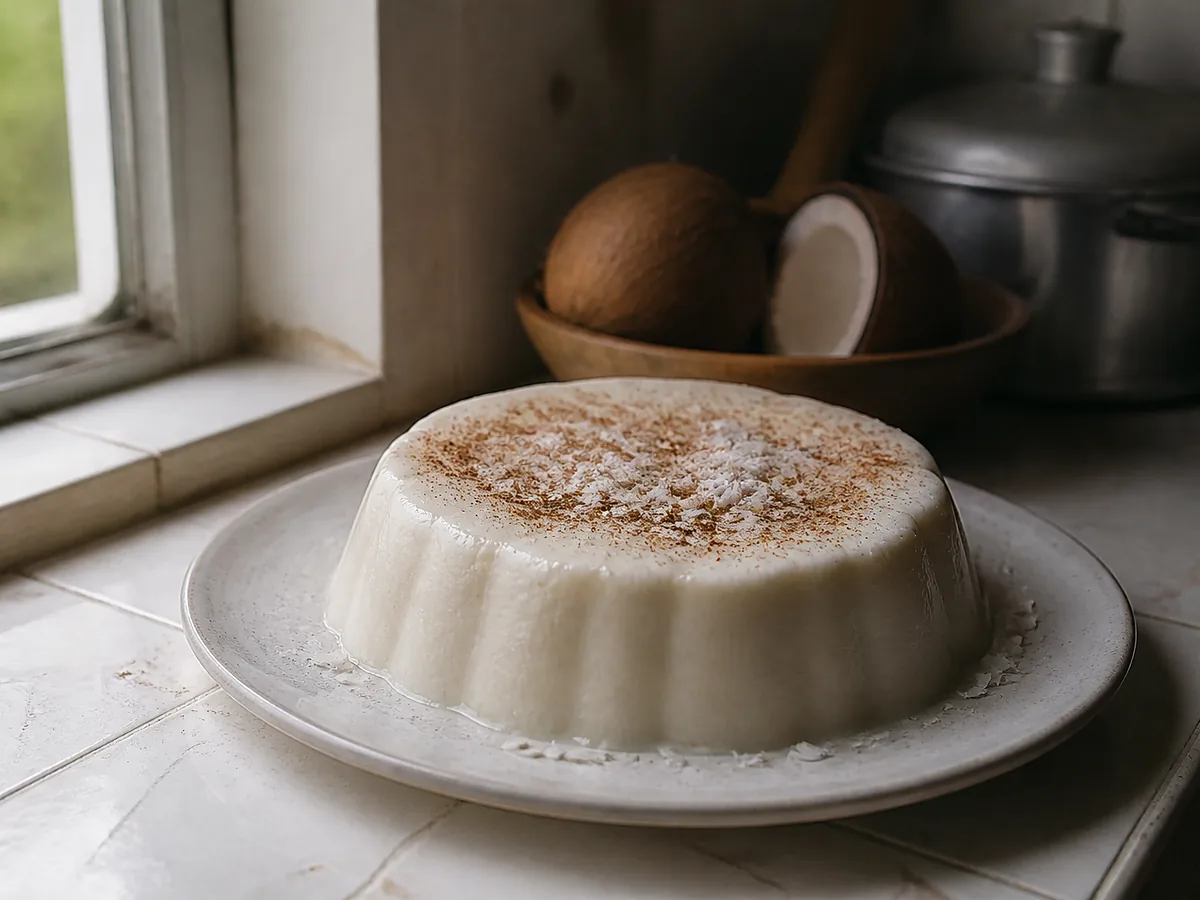
The name is the instruction. Tembleque means it trembles.
I cook a coconut-and-cornstarch pudding until it thickens to a nappe, pour it, and I do not touch it until the refrigerator has turned that starch gel into something that shivers on the plate and still holds a shape when it leaves the mould. If it sits there like cake, I cooked it too far. If it puddles, I did not cook it enough, or I inverted it warm.
This is not flan. Flan is eggs, milk, caramel, a water bath, protein coagulation. This is not coconut flan either — flan de coco is still a custard, still eggs, still caramel, with coconut in the dairy.
Tembleque has no eggs and no caramel. Coconut milk, cornstarch, sugar, salt. Dairy-free by nature; coconut is not a cow. Cinnamon or cocoa on top.
The science is starch gelatinisation. The failure I see most is lumps, and lumps come from dumping dry cornstarch into hot liquid so the outside of each clump gels into a skin around a pocket of raw powder. That is not a whisking problem. That is a sequence problem.
The pudding
- 800 ml3⅓ cupsFull-fat coconut milk, well stirredtwo 400 ml cans, or the same volume homemade
- 90 g⅔ cupCornstarch / maicena75 g for a softer tremble that barely unmoulds; 100 g for a cleaner slice at a party. I cook 90 g
- 100 g½ cupGranulated white sugar
- 2 g⅓ tspFine saltnot optional in the way people think
- 1 stick1 stickCinnamon stickoptional, in the pot — pull it before you pour
The garnish
- 1–2 g½–1 tspGround cinnamon, to dust
- 1 g½ tspUnsweetened cocoa powder, to dustinstead of, or with, the cinnamon — optional
- 20 g¼ cupUnsweetened shredded coconut, toastedoptional
Yield and timing
One 18 to 20 cm mould, or 8 small ramekins of 120 ml. Stove time 12 to 18 minutes once the liquid is in the pan. Chill at least 6 hours, overnight is better. Do not unmould warm. That is the formula. No eggs. No condensed milk. No dairy. Vanilla is a departure I like in the substitutions, not in the lead.
On the coconut milk
Full-fat. Shake or stir so the cream and the thin milk are one liquid before you measure. Light coconut milk makes a timid gel that weeps and tastes like starch. Coconut cream alone is too heavy. Homemade milk is island practice: grate mature brown coconut, pour hot water over it, squeeze through cloth. First press is thick, second press is thin — use a mix that looks like canned full-fat. Do not use coconut water. Do not use cream of coconut from the cocktail aisle, which is sugar syrup. Do not use coconut beverage from the carton, which is watered juice with gums.
On the cornstarch, and why lumps happen
Cornstarch is the structure. Wheat flour tastes pasty; tapioca sets stretchy. Dry cornstarch is packed granules. In cold liquid they suspend; as you heat, they take on water and swell — roughly 62–85 °C / 144–185 °F — and in this concentrated pudding you keep going until it is thick, glossy, and a nappe. Around 90–95 °C / 194–203 °F you should be there. Under-gelatinised starch tastes raw and will not set in the fridge. Overcooked, over-stirred starch can thin again as the granules shear — do not beat it like cream after it thickens. Lumps are a sequence problem, not a whisking problem. Rain dry cornstarch into hot coconut milk and the outer granules gelatinise instantly, gluing together around dry centres. Those lumps will not whisk out. Cold into cold, then the stove.
On sugar and salt
100 g of sugar in 800 ml of coconut milk is sweet but not candy. Cut it to 60 g and it still sets — sugar is not the gelling agent — and it tastes like a starch experiment. Push to 150 g and it weeps more. Salt is not optional. 2 g makes the coconut taste like coconut instead of white paste. Skip it and you will chase a flavour with more cinnamon that was never missing — it was buried.
On the garnish and the mould
Cinnamon on the inverted top is the classic. Cocoa if you want a darker dust. Toasted coconut is optional texture — the tremble is the garnish. The mould should be metal, ceramic, or glass, rinsed with cold water and not dried, or very lightly greased with a drop of oil wiped almost off. A wet mould releases; a thick coat of oil makes a greasy skin. A bundt is the party shape; ramekins are the weeknight shape.
Equipment
- A heavy saucepan, 2 to 3 L — thin pans scorch coconut solids before the starch gels
- A whisk, and a heatproof spatula for the corners
- An instant-read thermometer — useful, not mandatory if you can read a nappe
- A mould or ramekins, a thin knife, and a rimmed plate
Do not use: a blender to mix hot pudding, which makes foam; a microwave as the lead; eggs; a water bath; a caramel lining. Those are flan tools.
Method
Slurry the starch3 min
Stir the cans so there is no hard cream cap. Pour 800 ml of coconut milk into a bowl, then take 200 ml of that cold milk into a second bowl.
Whisk the cornstarch into the 200 ml until there is no dry pocket — a white, smooth slurry, like heavy cream. Whisk the sugar and salt into the remaining 600 ml of cold milk until the sugar dissolves. Combine slurry and sweetened milk, and whisk again.
No lumps. No heat yet. If you see lumps now, they are dry starch — press them out. Heat will not help.
Granules have to be separate and wet before gelatinisation starts. Cold liquid lets them disperse; hot liquid gels the surface and traps powder.
Stir coconut milk smooth and measure 800 ml. Whisk cornstarch into 200 ml cold milk until completely smooth; dissolve sugar and salt in the remaining 600 ml. Combine and whisk out all dry lumps before applying any heat.
Cook to a thick nappe12–18 min
Pour the mix into the saucepan and add the cinnamon stick if using. Medium heat. Whisk from the start, including the corners. It will look like coconut milk for a while. Do not walk away.
Around 60–70 °C it thickens a little and looks satiny. Around 80–85 °C it goes from satiny to heavy. Keep whisking. At 90–95 °C / 194–203 °F it should be a thick nappe: it coats the back of a spoon, and a finger drawn across leaves a line that holds. It falls from the whisk in a slow ribbon — not a watery stream, not a blob that sits in the whisk like paste.
Small lazy bubbles, not a rolling boil. A hard boil can scorch, and can shear the starch.
It should smell of coconut and cooked starch going sweet — not raw flour, not browned coconut. If it smells toasted or the bottom is catching, you were too hot. Get it off the heat.
Pull the cinnamon stick and whisk 30 seconds more off the heat; residual heat is still cooking.
Stopping at "a bit thicker than milk" gives you soup in the morning. Cooking to mashed-potato stiff gives you a rubber that does not tremble.
Add optional cinnamon stick and cook over medium, whisking corners continuously, 12–18 minutes. Mixture turns satiny at 60–70 °C and heavy at 80–85 °C; at 90–95 °C / 194–203 °F it should coat a spoon and fall in slow ribbons. Keep bubbles gentle, never boil hard. Remove if scorching; remove cinnamon and whisk 30 seconds off heat without overbeating.
Pour2 min
Rinse the mould with cold water and shake out the excess. Do not dry it. Pour the hot pudding in.
If there is a skin already, you waited too long in the pan — whisk it off. Tap the mould once or twice to release bubbles. Do not whip air in.
Press plastic wrap onto the surface if you hate skins; I often skip it and accept a thin skin that becomes the bottom after unmoulding.
A dry mould grabs. A wet mould lets the gel slip later. Air bubbles leave pockmarks on the unmoulded face.
Rinse an 18–20 cm mould or 8 small ramekins with cold water; shake off excess but leave wet. Pour in hot pudding, whisking away any skin first. Tap once or twice to release bubbles; optionally press plastic wrap onto the surface.
Chill until it tremblesat least 6 hours, better overnight
Cool on the counter 20 to 30 minutes until the steam is gone, then refrigerate at about 4 °C / 39 °F until the centre is cold and the gel is set.
Done in the mould: the surface is firm to a light finger, it jiggles as a piece, and a small knife at the edge shows a gel, not liquid. If the centre still sloshes, wait.
Do not freeze to rush this. Freezing wrecks the gel — ice crystals, then a weepy sponge when it thaws.
People unmould at two hours because they are hungry. Then they have coconut soup with a skin.
Cool on the counter 20–30 minutes until no longer steaming. Refrigerate at about 4 °C / 39 °F for at least 6 hours, preferably overnight, until cold throughout and wobbling as one set piece without sloshing. Do not freeze to accelerate setting.
Unmould2–3 min
Run a thin knife around the edge, vertical, against the mould, once. Dip the bottom of the mould in warm water for 8 to 10 seconds — warm, about 40–45 °C. Not hot, not a minute.
Invert onto a rimmed plate. If it does not drop, wait ten seconds, lift the mould a millimetre, and tap. If it still holds, another 5-second warm dip. Too much heat melts the outer gel and you get a slumped pudding with a wet shine.
It should land with a shiver. That is tembleque.
Dust with cinnamon, or cocoa, or both. Toasted coconut around the base if you made it — not a blizzard that hides the surface.
Run a thin knife vertically around the edge once. Dip mould bottom in 40–45 °C warm water for 8–10 seconds, then invert onto a rimmed plate. If stuck, wait 10 seconds, lift slightly and tap; repeat a 5-second warm dip if needed. Dust with cinnamon, optional cocoa and cooled toasted coconut.
Toast the coconut, if using3–4 min
Anytime before serving: dry pan, medium heat, 20 g of shredded coconut, stirring, until the edges go gold and it smells nutty. Cool it.
Hot coconut on a cold pudding sweats.
Before serving, stir 20 g shredded coconut in a dry pan over medium heat for 3–4 minutes until golden-edged and nutty. Cool completely before adding to the cold pudding.
Storing it
Keeping it
Coconut milk is perishable once opened and once cooked. Cool, then refrigerate. Keeps 3 days cold, covered. The surface may weep a little syrup — starch retrogradation squeezing out water. Blot it; do not stir an unmoulded pudding back to smoothness or you will break it. I do not freeze tembleque. Thawed starch gel weeps and turns spongy. If it sat above 4 °C for more than 2 hours, treat it as done. Raw coconut milk that smells sour or metallic before you cook: throw it out.
Troubleshooting
- Lumps.
You added starch to hot liquid, or did not whisk the slurry smooth. Strain immediately while still hot, through a medium mesh, into the mould. Next time: cold slurry, then heat.
- It never thickened on the stove.
Heat too low, or light coconut milk. Keep cooking to 90–95 °C. If it is still thin at 18 minutes, whisk 1 tsp extra cornstarch into 1 tbsp cold water and stream it in, then cook a minute more so it does not taste raw.
- Rubber, no tremble.
Too much starch, or you cooked it to paste. Next time 75 to 90 g. Serve this batch in the mould with a spoon and call it coconut pudding.
- A puddle on the plate.
Under-cooked starch, unmoulded warm, or light coconut milk. Chill longer if it is only soft. If it is liquid you cannot save the shape — eat it as a sauce over fruit and cook again.
- Weeping.
Overcooked, too much sugar, or frozen. Blot. Next time pull at nappe, not at glue.
- Scorched coconut.
Thin pan, no stirring, high heat. Do not scrape the bottom into the mould.
- It will not unmould.
Not cold enough, a dry sticky mould, or you skipped the knife. Chill more. Wet the mould next time. A warm dip, not a hot soak.
- It tastes like raw flour.
You stopped at thick-ish and never hit gelatinisation. The fridge cannot finish what the stove skipped.
- It tastes flat.
No salt, or light coconut milk. Salt in the pot, and dust the top.
- Split, oily-looking.
Boiled hard and neglected. Whisk off the heat; sometimes it comes back. Next time medium heat, constant motion.
Substitutions
Traditional
Coconut milk, cornstarch, sugar, salt, cooked on the stove to a thick nappe, poured, chilled until it trembles, unmoulded, cinnamon on top. Christmas, and any day you want a cold dessert that does not need an oven. Dairy-free because it never had dairy.
Acceptable home shifts
Canned full-fat coconut milk instead of grated coconut. 75 g or 100 g starch as a texture choice you name. Cocoa dust with or instead of cinnamon. Toasted coconut. Individual ramekins. A cinnamon stick in the pot, pulled before pouring. A wet mould, or a barely oiled one.
Departures, named as such
Eggs. Caramel. Condensed milk. Evaporated cow's milk. Cream cheese. Vanilla in the lead — a teaspoon of extract off the heat is a named extra. Coconut extract on top of canned milk. Gelatin sheets to "help it set." Freezing. Microwave. Calling it flan de coco.
Scaling
Nappe and 90–95 °C decide, not the clock.
Doubling and halving
For a crowd, double in a wider pot so you can still whisk: 1.6 L coconut milk, 180 g cornstarch, 200 g sugar, 4 g salt. Cooking time may add 3 to 5 minutes. Halve for a small mould or 4 ramekins: 400 ml coconut milk, 45 g cornstarch, 50 g sugar, 1 g salt, in a smaller pan. Ramekins set faster than a deep mould — check at 4 to 5 hours — but I still prefer overnight if I have to invert them.
What to serve it with
Nothing required.
- Fruit on the side, if you want acid — pineapple, mango
- Coffee
After pernil, arroz con gandules, and pasteles, this is the cold quiet plate. I do not pour chocolate sauce on it, and I do not put whipped cream on it — that would be dressing a dairy-free pudding in dairy because someone missed flan.
Questions
Can I use light coconut milk?
You can, and it will set weak and taste thin. Full-fat.
Can I use coconut cream from the cocktail bottle?
No. That is sugar and thickeners. Wrong product.
Why not eggs?
Because then you are making a custard. That is flan de coco, a different dessert with a caramel and a bath.
How do I avoid lumps?
Cold cornstarch into cold coconut milk, whisked smooth, then heat. Never dump the box into a hot pan.
Can I unmould after two hours?
Only if you like collapse. Six hours minimum, overnight if you can.
Is it vegan?
As written, yes: coconut, starch, sugar, salt. No eggs, no dairy, no gelatin.
Can I freeze it?
I would not. Starch gels weep and go spongy after ice.
Is toasted coconut required?
No. Optional texture. The tremble is the point.
How do I know it is done on the stove?
Nappe: it coats a spoon, a line holds, it falls in a slow ribbon, about 90–95 °C, glossy, no raw-flour smell. The fridge does the tremble. The stove does the gel.