Bistec Encebollado
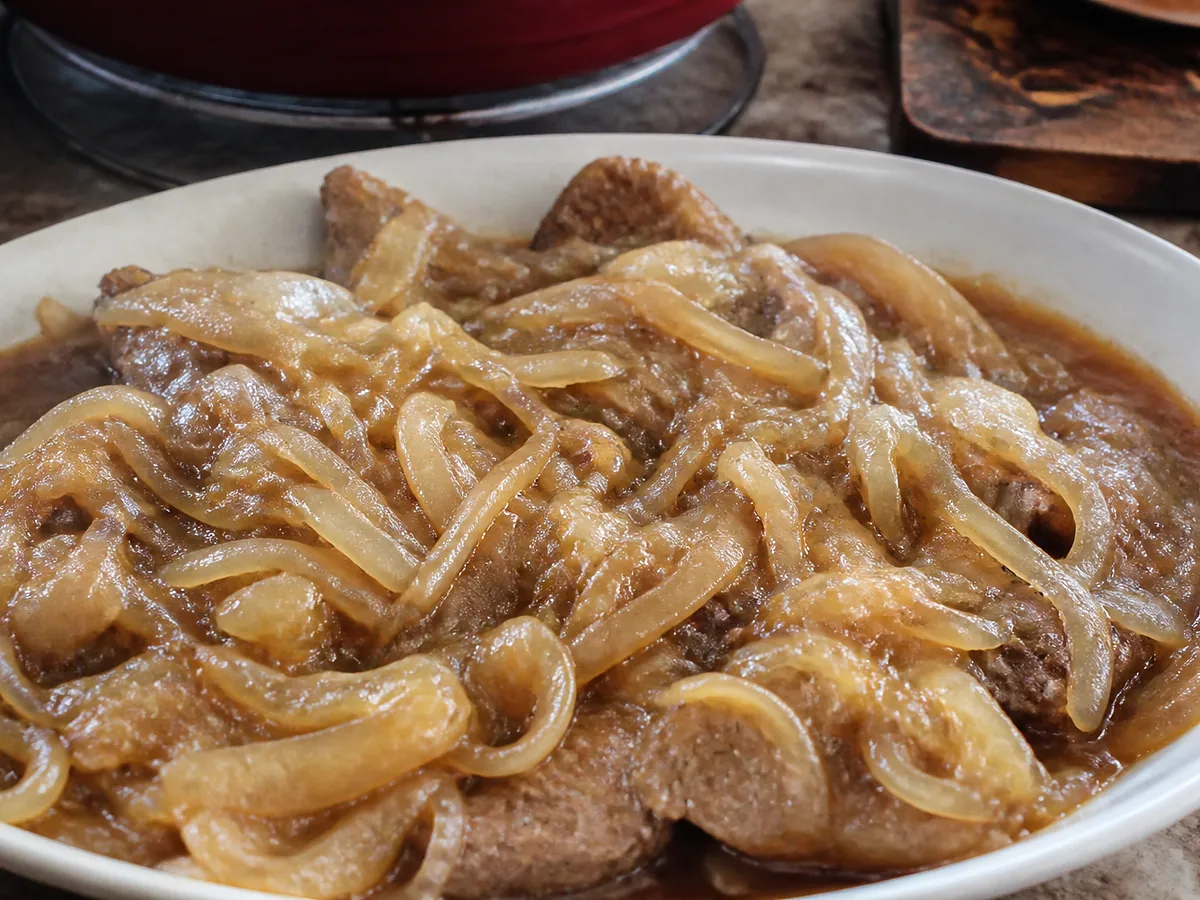
Thin beef marinated in garlic, oregano, and sour orange, then cooked with more onion than seems decent until the onions collapse and become the sauce.
- Prep
- 45 min
- Cook
- 35 min
- Serves
- 4 plates with rice
- Difficulty
- Easy
Researched · Kitchen testing pending
Palomilla is a thickness, not a breed of cow.
Bistec encebollado is thin beef — 5 to 8 mm, palomilla-style, cube steak, or a sirloin I take a mallet to — marinated in garlic, oregano, and vinegar or naranja agria, then cooked with more onion than seems decent until the onions collapse and become the sauce.
There is no separate gravy. The onions are the sauce. If you bought a thick ribeye and seared it medium-rare with a garnish of onion, you made steak with onions, which is a fine dinner and not this plate.
I cook it in a wide caldero, not a grill pan chasing crust. Adobo on the meat. A mountain of onion in the same fat. Rice under it.
The beef
- 800 g1¾ lbThin beef steaks — palomilla-style top sirloin, cube steak, or pounded sirloin4 to 6 pieces at 5–8 mm. I refuse a 2.5 cm steak for this recipe
Marinade and adobo
- 20 g6 clovesGarlic, mashed to a paste with 4 g of the salt
- 8 g1½ tspKosher saltdivided — 4 g mashed with the garlic, 4 g on the meat
- 3 g1½ tspDried oregano, crumbled
- 2 g1 tspBlack pepper, freshly ground
- 2 g½ tspGarlic powderoptional, if you are using a commercial adobo habit on top of fresh garlic
- 1 g¼ tspGround cuminoptional — a pinch some houses add
- 60 ml¼ cupBitter orange juice (naranja agria), or white vinegaror 30 ml of each. Not sweet orange
- 30 ml2 tbspOlive oil or neutral oil
- 15 ml1 tbspMore vinegar or bitter orangeheld for the pan, if the onions need a lift at the end
The onions — they are the sauce
- 900 g2 lbYellow onions, sliced pole-to-pole 5–8 mmabout 4 large. This should look like too many onions. It is not
- 2 g⅓ tspKosher salt, for the onions
- 1 g½ tspDried oregano, for the onions
- 45 ml3 tbspOil, lard, or a mix, for the pan
- 30–60 ml2–4 tbspWateronly if the pan goes dry before the onions collapse
Yield and timing
4 plates with rice. Marinade 30 minutes to 4 hours. Active pan time 25 to 35 minutes. About an hour total if the marinade is short. Commercial adobo — the shaker — is the supermarket habit. If you use it, skip the extra 4 g salt and the garlic powder, and still mash fresh garlic into the marinade. Do not double-salt.
On the cut — thickness is the spec
Palomilla, in the Caribbean butcher sense, is top sirloin cut thin, almost a scallop. The argument is thinness. At 5 to 8 mm the steak cooks through in a minute or two per side and then has the manners to sit in onion juices without turning into a roast. At 2 cm you are making a different dinner: a thick steak that wants a cool centre, which fights the vinegar marinade and the long onion wilt. Cube steak is mechanically tenderised round, and it is what many island and diaspora supermarkets actually sell for bistec. The cube marks are not a flavour — they are a tenderiser that already broke the fibres. Thin sirloin gets pounded under plastic until it is even. Uneven steaks give you leather at the thin end and raw at the thick. Trim thick silver skin; a little fat bastes the onions.
On the marinade
Vinegar or bitter orange, garlic, oregano. That is the acid-garlic soak that makes this taste like the island pan and not like onion soup. Naranja agria is the fruit I want: floral, sour, not sweet. Sweet orange juice is the wrong citrus — it burns and goes marmalade in the pan. Lime is a known stand-in when bitter orange is missing; I use it, and I say so. White vinegar is everyday and honest. Balsamic is a departure I will not pretend is traditional. Thirty minutes on the counter is enough for thin meat. Four hours in the fridge is better. Meat coated, not drowned in a cup of vinegar.
On adobo
Adobo here is garlic, salt, pepper, oregano, sometimes a little cumin in the commercial blend. Mash garlic with salt in a pilón until it is a paste, then rub. The shaker exists. Using only the shaker and no fresh garlic is how the pan tastes dusty. Using the shaker plus a full extra tablespoon of salt is how it tastes like the ocean. Pick one salt source and taste.
On the onions
The onions are the sauce. I use about as much onion by weight as beef, sometimes more. They go into the same pan after the steaks, into the fond and the leftover marinade, and they cook until they collapse: translucent, sweet, stringy, sitting in a mahogany syrup of their own juice plus the vinegar and beef drippings. They should not be raw crunch. They should not be jam so dark it tastes burnt. Pole-to-pole slices hold as strands instead of turning to mush in the first five minutes; they still fall apart by the end, which is the point. If you add a cup of stock you are making French onion soup adjacent. If you add cream you have left the island. A splash of water to keep them from scorching is not stock.
On what this is not
Not a thick ribeye with onion garnish. Not [vaca frita](/cuba/vaca-frita/), which is shredded and fried hard on another island. Not bistec empanado, which is breaded. Not steakhouse medium-rare. Thin palomilla is cooked through. Cube steak is cooked through. Pink in a 6 mm steak is a few seconds of pan time, not a temperature project.
Equipment
- A 30 to 32 cm caldero or heavy skillet, wide — onions need floor
- Tongs
- A mallet or small skillet, for pounding
- A pilón, or the side of a knife, for the garlic
Do not use as the method: a grill for a thick steak, a slow cooker, or a pressure cooker. This is a skillet. I do not reverse-sear, and I do not finish it in a 200 °C oven. A thermometer is optional — on meat this thin I trust time and colour more than a probe, which is hard to seat.
Method
Pound and marinate15 min work, 30 min–4 hours rest
If the steaks are thicker than 8 mm, put them between plastic and pound from the centre out until they are even, 5 to 8 mm. Do not beat holes in them. Cube steak, leave alone.
Mash the garlic with 4 g of the salt to a paste. Stir in the oregano, pepper, garlic powder and cumin if using, the bitter orange or vinegar, and the oil. Rub the paste over every piece. Sprinkle the remaining 4 g of salt — unless you already used a salty commercial adobo.
Cover. Thirty minutes at cool room temperature, or up to 4 hours refrigerated. Pull refrigerated meat out 15 minutes before the pan so the surface is not fridge-wet.
Acid and salt move a little way into thin meat fast. On a thick steak they would sit on the surface and leave a grey band — one more reason palomilla is the cut.
Pound steaks thicker than 8 mm evenly to 5–8 mm without holes; leave cube steak alone. Mash garlic with 4 g salt; mix oregano, pepper, optional garlic powder and cumin, sour orange or vinegar and oil. Rub onto steaks; add remaining 4 g salt unless using salty commercial adobo, which also replaces garlic powder. Cover 30 minutes at cool room temperature or refrigerate up to 4 hours; remove refrigerated meat 15 minutes before searing.
Sear in batches6–10 min
Heat the caldero over medium-high with the oil. When it shimmers and a scrap of onion sizzles on contact — about 180–190 °C / 355–375 °F at the metal — lift the steaks from the marinade, let them drip, and lay them in a single layer.
Save the remaining marinade. It goes to the onions, not down the drain.
Do not crowd; two batches is normal. 1 to 2 minutes on the first side — you want colour in spots, grey-brown to mahogany, not a black crust and not a grey steam. Flip, 1 to 2 minutes.
The meat will still look a little underdone in the middle; it finishes in the onions. 65–70 °C / 149–158 °F in the centre is plenty, and it will climb. You are not hunting 54 °C like a ribeye — that target is for thick steak, and here it would be raw-cool in a vinegar bath.
Lift the steaks to a tray. Do not wash the pan.
Heat oil over medium-high to a pan temperature of 180–190 °C / 355–375 °F. Drain steaks, reserving marinade, and sear in uncrowded batches 1–2 minutes per side until browned in spots. The centre reaches 65–70 °C / 149–158 °F and finishes later in onions. Transfer to a tray; keep the fond.
The mountain of onions15–22 min
Drop the heat to medium. Add the sliced onions and 2 g salt. They will heap above the rim. Stir, scraping the beef fond into them. In 3 to 4 minutes they wilt enough to sit in the pan.
Add the oregano and the reserved marinade. It should hiss — garlic, sour orange, sweet onion, beef.
Cook, stirring every couple of minutes, 12 to 18 minutes more. They go from white and sharp to translucent, then gold, then collapsed and shiny, sitting in a small amount of mahogany juice.
If the pan dries and threatens to burn, 30 ml of water and a scrape. If they pool in a lot of water, the heat is too low — raise it slightly, lid off.
A strand should pull apart with almost no crunch and taste sweet, not raw, and the juices should coat a spoon. Burnt onion sugar is not caramel; it is acrid.
Reduce to medium; add onions and 2 g salt, scraping fond as they wilt 3–4 minutes. Add oregano and reserved marinade; cook 12–18 minutes more, stirring every couple of minutes, until collapsed, sweet and glossy with spoon-coating juices. If catching, add 30 ml water and scrape; if watery, increase heat slightly uncovered.
Return the steaks3–5 min
Nestle the steaks into the onions with any tray juices, and spoon onions over the top. Simmer together 3 to 5 minutes, turning once, until the meat is cooked through and has taken the sauce.
Cube steak should be tender-chewy, not bouncy. Palomilla should slice with a fork. If the pan looks dry, a spoon of water; if it looks flooded, 2 minutes more uncovered.
Taste, and salt. If the onions are sweet and tired, 15 ml of vinegar or bitter orange at the end — acid lifts the jam. Rest 3 minutes in the pan off the heat.
Finished: a pile of collapsed onions, mahogany, glossy, steaks buried in them, enough pan juice to wet the rice but not a puddle you could soup. The onions should be the first thing the fork hits.
Nestle steaks and tray juices into onions; spoon onions over them. Simmer 3–5 minutes, turning once, until cooked through and tender. If dry, add a spoonful of water; if flooded, cook uncovered 2 minutes more. Adjust salt and add 15 ml vinegar or sour orange if needed. Rest off heat 3 minutes.
Storing it
Keeping and reheating
Cool with the lid off, then refrigerate in a shallow container within 2 hours. Keeps 3 days at 4 °C / 40 °F or below. Reheat gently in a skillet to a simmer, 74 °C / 165 °F, with a splash of water so the onions loosen. The microwave makes the steaks tight.
Freezing
I do not love this frozen — thin steaks dry and onions go limp. If you must: 1 month, thaw in the fridge, reheat in a pan with a little water and a squeeze of vinegar. Raw marinating meat stays in the fridge, not on the counter, if the soak is longer than 30 minutes.
Troubleshooting
- The steaks are tough, like shoe.
Too thick, or cooked like a roast, or boiled in a flood of liquid for 20 minutes. Slice thinner across the grain and bury in the onions. Next time, 5 to 8 mm and a short sear.
- The steaks are dry and grey.
Crowded pan, steamed, no colour, then a long simmer. Sear in batches, and finish only 3 to 5 minutes in the onions.
- The onions are still crunchy and raw-tasting.
Time and heat. Keep going, lid off, medium. Do not add sugar to fake the sweet.
- The onions burned.
Heat too high, no stirring, no splash of water. Transfer what is not black to a new pan. Burnt onion will not hide under steak.
- It tastes only of vinegar.
Too much marinade dumped in late, or no time for the onions to sweeten. Cook the onions longer. Next time, 60 ml of acid in the marinade, not a cup.
- It tastes flat.
Under-salted, no oregano, or sweet orange instead of sour. Salt, and a squeeze of bitter orange or vinegar at the end.
- No sauce — just fried onion and dry meat.
The pan was too hot and too dry, and the onion juice evaporated. Water or a spoon of leftover marinade, 2 minutes, lid on.
- A soup of grey liquid.
Lid on the whole time, or the steaks were wet and crowded. Uncover, raise the heat, and reduce until the onions sit in a coat.
- I used a thick sirloin and it is raw in the middle.
That is the cut argument. Finish it in the onions, covered, a few minutes, and it will be more like Swiss steak. Next time, pound it.
- It tastes dusty, like a spice jar.
Commercial adobo and no fresh garlic. Mash fresh garlic next time.
Substitutions
Traditional, in my practice
Thin palomilla or cube steak; adobo of garlic, salt, pepper, oregano; a marinade of vinegar or naranja agria; a mountain of yellow onion cooked in the same pan until collapsed; the onion juices as the sauce; white rice. Lard or oil. A caldero.
Acceptable home shifts
Lime if bitter orange is missing. White vinegar as the everyday acid. Commercial adobo as the salt-spice, with fresh garlic still in the paste. A mix of yellow and white onion. A pinch of cumin.
Departures, named as such
Thick ribeye or strip cooked medium-rare. Gravy from flour. Stock or wine as the main liquid. Cream. Balsamic. A slow cooker. Grilling the steak and putting raw onion on top. Breading — that is empanado. I do not pressure-cook this. Nothing here needs collagen conversion under pressure: the meat is thin and the onions need evaporation, which a sealed cooker will not give you.
Scaling
The onion clock does not halve.
Smaller and larger
For 8, double the steaks and the onions, and use two pans or cook the meat in more batches. Onions in a heap that deep will steam — you want a wide floor. For 2: 400 g steak, 450 g onion, same times.
What to serve it with
White rice. That is the plate.
- White rice
- Tostones, if the oil is already out
- Pink beans, if the table is hungry
- A sliced avocado
I do not put this meat in a bun and call it a steak sandwich as the dish.
Questions
What cut do I buy if the label does not say palomilla?
Ask for top sirloin sliced thin, or cube steak, or round you will pound. Thickness is the spec: 5 to 8 mm.
Can I use a ribeye if that is what I have?
You can cook a ribeye with onions. It is not bistec encebollado. Slice it thin against the grain first if you insist on this marinade.
Vinegar or bitter orange?
Both are traditional. Bitter orange is the fruit I prefer; vinegar is the weeknight bottle. Not sweet orange.
Do the onions really need to equal the meat?
They need to look excessive. 900 g of onion on 800 g of steak is my starting mountain. Half that onion and you have a garnish.
How do I know the onions are done?
They collapse, taste sweet, and sit in a glossy juice. If they still bite like salad, keep going.
Can I marinate overnight?
Yes, in the fridge. The surface will be a little firmer from the acid. Still a short sear.
Is pink acceptable?
On a 6 mm palomilla, a blush already going grey in the onion pan is fine. A cool red centre is a thick-steak habit. Cube steak I cook opaque.
Can I make it ahead?
The onions actually improve; the steaks tighten. Reheat gently in the onions with a splash of water and a little vinegar. Same-day is better.