Vaca Frita
Flank simmered until it shreds, wrung genuinely dry, then fried hard with onion, garlic, and lime. Crust and citrus — the opposite of ropa vieja.
- Prep
- 45 min
- Cook
- 2 hr 15 min
- Serves
- 4 as a main, 6 as a shared platter
- Difficulty
- Medium
Kitchen-tested
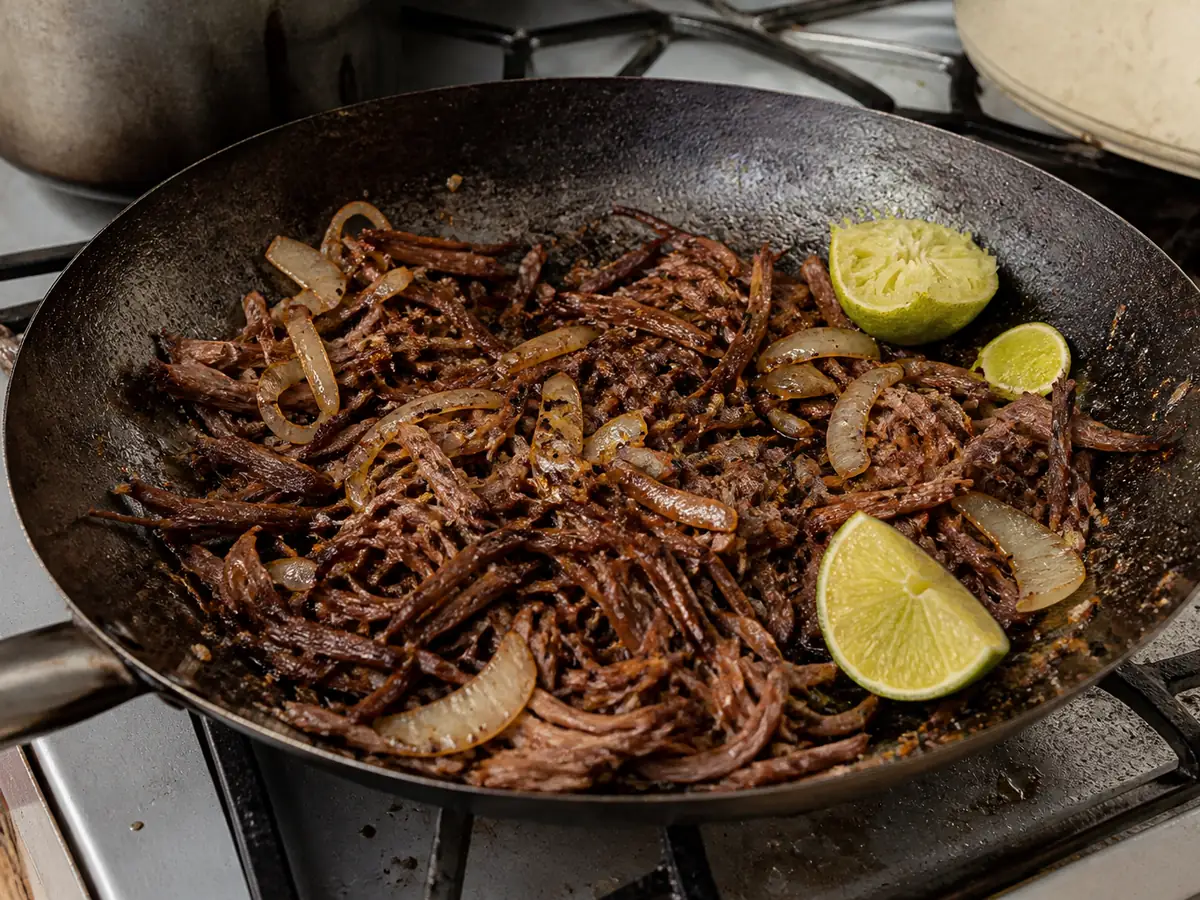
Vaca frita is flank steak simmered until it shreds, wrung dry, then fried hard with onion, garlic, and lime. Crust and citrus. That is the plate.
It is not ropa vieja. Ropa vieja is the same family of cut, cooked into a tomato-pepper gravy until the shreds live in sauce. If you leave this beef in a wet sofrito, you made the other dish.
I simmer falda whole with onion, garlic, bay, and salt until a fork opens the grain. Then I shred with the grain, squeeze until the pile looks almost mean, season with lime, garlic, cumin, and oregano, and fry it in a wide pan that is actually hot. Onions go in late so they wilt in the beef fat rather than steaming the crust off.
Wet protein sits at the boiling point of water until the surface dries; Maillard does not start in a puddle. Crowd the pan and you make steam. Add onion too soon and you make steam on purpose.
The simmer
- 900 g2 lbBeef flank / falda, wholeexcess hard fat trimmed, thin silver skin left
- 150 g5 ozYellow onion, peeled and halved1 small
- 15 g4 clovesGarlic, smashed, skins on
- 2 leaves2 leavesBay leaves
- 8 g1½ tspCoarse salt
- 4 g1 tspBlack peppercorns
- 1.5–1.8 L6½–7½ cupsWaterto cover by 2 to 3 cm
After the squeeze, before the fry
- 45 ml3 tbspLime juice, freshfrom 2 to 3 limes, plus extra wedges for the table
- 12 g1 tbspGarlic, mashed to a paste3 to 4 cloves
- 3 g1 tspGround cumin
- 2 g1 tspDried oregano, crushed in the palm
- 4 g¾ tspFine saltor to taste, after the simmer
- 1 g½ tspBlack pepper, freshly ground
Fry and finish
- 60–75 ml4–5 tbspNeutral high-smoke-point oil, or rendered lard
- 400 g14 ozYellow onion, in 8 mm half-moons2 large
- 8 g2 clovesGarlic, minced
- 15 ml1 tbspLime juice, freshfor the pan at the end, off the heat
- 1 g¼ tspFine salta pinch at the end if the crust tastes shy
Yield
4 plates as a main with rice, moros, or tostones. As a shared platter, toward 6. The home starting point is 900 g flank to 400 g finish onion — not a locked formula.
On the cut
Falda is flank: a working muscle, long parallel fibres, modest collagen, little marbling. After a simmer you pull along that grain and get shreds, not cubes. Skirt is thinner and richer; it works, and it cooks faster. I buy flank when I can see the grain run the length of the piece. Chuck shreds, but it is a braise cut with a stew personality. Brisket's grain is coarser. Pre-cut stew meat has no grain to follow. Trim only thick hard fat — a heavy fat cap will spit in the pan and keep the shreds greasy instead of crusted.
On the simmer
This is a tenderising bath, not a sauce. Water, onion, garlic, bay, salt, peppercorns. Bring to a boil, then drop to a low simmer at 90–95 °C / 195–205 °F. A rolling boil tightens myosin hard and squeezes juice out before collagen becomes gelatin — you get dry corks that still fight the fork. I do not put tomato, wine, or cumin in this pot. The liquid is spent: I throw it out, or freeze it for a soup that is not this recipe.
On the squeeze — the step that decides it
Shredded simmered beef is a sponge. Drop it wet into oil and the pan temperature collapses, and you steam grey strings. Shred with the grain into ribbons about 6 to 10 cm long — hair-thin shreds burn. Then squeeze, by hand or in a clean towel, until the pile looks darker, drier, slightly compacted, and the runoff is cloudy beef juice. You will lose volume. That is water you did not want in the pan. Do not rinse the shreds.
On the fry, the onions, and the lime
High heat, wide pan, one layer, patience. Pan surface around 190–200 °C / 375–390 °F. Nonstick will not brown at this heat. Two batches for 900 g of squeezed beef is normal. Onions last, not first. Raw onion is mostly water; sweat 400 g of it before the beef and you flood the surface you need dry. Fry the beef to crust, then add the half-moons — they wilt in the beef fat in 3 to 5 minutes. Garlic burns in a screaming pan, so minced garlic goes in for 30 to 45 seconds at the end. Cuban kitchens often use naranja agria; lime is the citrus I am writing. Cook lime juice for ten minutes and you get a dull, metallic tang — the last 15 ml hits the pan off the heat.
Equipment
- A 4 to 6 L pot with a lid
- A colander, a board, a sharp knife, and two forks
- A clean kitchen towel, if you do not squeeze by hand
- A 30 to 32 cm cast-iron or heavy carbon-steel skillet
- Tongs, and an instant-read thermometer for leftover reheats
Do not use: a crowded 20 cm pan; a lid on the fry; a blender; nonstick for the hard fry; a pressure cooker unless you take the labelled departure.
Method
Simmer the flank90–120 min
Put the flank in the pot with the halved onion, smashed garlic, bay, salt, peppercorns, and water to cover by 2 to 3 cm. Bring to a boil and skim the dirty foam. Drop to a low simmer, lid partly on, 90–95 °C / 195–205 °F.
Test at 75 minutes. At 90 to 120 minutes the grain should open with modest pressure. If it still fights like a steak, keep going. Add hot water only if the meat is poking out — cold water knocks the simmer down.
It should smell of boiled beef and onion, not sofrito, and the meat will look pot-roast grey and wet. That is the correct ugly stage; colour happens in the pan.
Cover flank, onion, garlic, bay, salt and peppercorns with water by 2–3 cm. Boil and skim, then partially cover and simmer at 90–95 °C / 195–205 °F. Test at 75 minutes; usually allow 90–120 until fibres separate easily. Add hot water only if meat emerges.
Rest and shred15–20 min
Lift the meat onto a board. Discard the simmer aromatics and liquid, or save the liquid for another pot. Rest until you can handle it, 10 to 15 minutes.
Pull with the grain into ribbons — not mince, not leftover slabs. Remove large waxy fat the pot did not render.
Remove beef and rest 10–15 minutes until manageable. Discard aromatics and save broth for another use if desired. Pull with the grain into 6–10 cm ribbons, removing large waxy fat; do not mince.
Squeeze dry3–5 min
Wring handfuls, or wrap in a towel and press hard. You want runoff. The pile should feel like wrung cloth, not pulled meat sitting in juice.
Spread it on the board for a minute so steam can leave. Surface water must go before browning can start.
Squeeze handfuls firmly, or press in a clean towel, until juice runs out and the meat feels wrung dry. Do not rinse. Spread on a board 1 minute to release steam before seasoning.
Season the dry shreds15–30 min
Toss with the 45 ml of lime juice, the mashed garlic, cumin, oregano, salt, and black pepper. It should smell sharp, not wet.
Fifteen minutes is enough; an hour in the fridge is fine if covered. No oil yet. No sliced onion yet — onion now weeps onto beef you just dried.
Toss dry shreds with 45 ml lime juice, mashed garlic, cumin, oregano, salt and pepper. Rest 15 minutes, or cover and refrigerate up to 1 hour. Do not add oil or sliced onion yet.
Heat the pan4–5 min
Skillet over medium-high to high. Add 45 ml of the oil. Wait until it shimmers and a shred sizzles hard — about 190–200 °C / 375–390 °F on the pan surface if you check.
First contact sets the crust. A timid pan welds boiled beef into grey clumps.
Heat a wide skillet over medium-high to high and add 45 ml oil. Wait until shimmering and a shred sizzles strongly, around 190–200 °C / 375–390 °F at the pan surface.
Fry hard, in batches8–12 min per batch
A loose layer, with pan visible between the shreds. Do not stir for 2 to 3 minutes. Steady sizzle, not a wet hiss. Turn, then wait again. Total 8 to 12 minutes per batch, mahogany in spots.
If the pan dries, add a thin film of the remaining oil. If the fond is going black, lower it a notch. Spread cooked batches on a plate, not in a steaming bowl.
The edges should rattle in the pan, and it should smell of roasted lime-garlic rather than boiled beef. A shred has crust and a tender middle.
Crowding drops the pan into a stew. Batches are the method.
Fry in loose, uncrowded layers, leaving untouched 2–3 minutes before turning; allow 8–12 minutes per batch until mahogany in spots with tender centres. Add a film of remaining oil if dry, reduce heat if blackening and spread finished batches on a plate.
Onions late3–5 min
Return all the beef to the pan over medium-high. Add the sliced onion. Toss 3 to 5 minutes until wilted and translucent with gold edges — still half-moons, not jam.
If a puddle appears, keep the heat up until it is gone. You should still see crust on the beef.
Return all beef over medium-high and add onion half-moons. Toss 3–5 minutes until wilted and translucent with golden edges but still distinct. Evaporate any puddled liquid, keeping the beef crust visible.
Garlic and lime, then the table1 min
Drop to medium. Add the minced garlic and stir 30 to 45 seconds until pale gold, not brown. Off the heat. Add the last 15 ml of lime juice and toss once.
Taste for salt. It should be beefy, fried, sharp with lime, cumin in the background, onion sweet against the crust. If it is dull it needs salt or more lime at the table — not tomato.
Serve immediately. Garlic perfume and lime top notes are fragile in hard heat, and the crust is already built.
Reduce to medium and stir in minced garlic 30–45 seconds until pale gold. Remove from heat, add the final 15 ml lime juice and toss once. Adjust salt and serve immediately with extra lime if needed.
Storing it
The crust does not survive the fridge
Cool in a shallow container and refrigerate within 2 hours. It keeps 3 days cold. Reheat in a hot skillet with a film of oil until it sizzles and the centre is at least 74 °C / 165 °F. A microwave makes it steamy — I would rather eat it cold in a sandwich.
Cooking ahead
You can simmer, shred, squeeze, season, and refrigerate up to a day, then fry to serve. Freeze squeezed seasoned shreds up to 2 months; thaw in the fridge, squeeze again if they wept, then fry. I do not freeze the finished fried plate. Lime juice is not a preservative. Sour or sticky: throw it away.
Troubleshooting
- Boiled beef with onion on top.
You did not squeeze, or you crowded a cold pan. Wring it, wide pan, batches, wait for the sizzle.
- Grey and wet in the pile.
Same problem, or you covered the skillet. No lid on the fry.
- The onion turned the pan to stew.
Onion too soon, pan too small, or minced instead of half-moons. Garlic last, or it burns.
- Tough, dry strings.
A rolling boil, or you shredded too fine and fried to jerky. Simmer gently. Stop when you have crust and a tender middle.
- It will not shred.
Not done. Back to the simmer — a thick piece can need 30 minutes more.
- Bitter.
Burnt garlic, burnt cumin, or lime cooked a long time. Garlic at the end, lime off the heat.
- Bland.
Under-salted simmer, skipped post-squeeze seasoning, or no lime at the end.
- Greasy.
Too much oil, or a fat cap you left on. A film of oil, not a deep fry.
- It smells like ropa vieja.
You added tomato or pepper sauce. That is the other recipe.
Substitutions
Traditional
Falda or flank; a water simmer with onion, garlic, bay, salt; shred; squeeze dry; lime or naranja agria, garlic, cumin, oregano; a hard fry in oil or lard; onion late; more citrus. Rice, moros, or tostones. No tomato gravy.
Acceptable home shifts
Skirt for flank, watching the clock. Sour orange for some or all of the lime. Lard for oil. A few thin cubanelle or bell pepper strips with the late onion — a known add, not a sauce.
Departures, named as such
Tomato, wine, and peppers cooked into a gravy is ropa vieja. Chuck or brisket. Soy sauce as the brown. A lid on the fry. Baking the shreds on a sheet as the main crust.
Pressure cooker, for the simmer only
I do not call this the home method. Same aromatics, meat just covered. High pressure 25 to 35 minutes, natural release 10 to 15. Then shred, squeeze, season, and fry as above. The cooker replaces the simmer only. If the meat is wetter, squeeze harder.
Scaling
Simmer time does not halve, and each fry batch still needs its 8 to 12 minutes.
Smaller and larger
For 2: 450 g flank, 200 g finish onion, half the seasoning — a smaller piece may be ready at 70 to 90 minutes, so use the fork test. For 8: 1.8 kg flank and two pans, or four fry batches. Do not heap 1.8 kg into one skillet. Simmer salt around 14 to 16 g, then adjust after the squeeze.
What to serve it with
Lime wedges on the table, always.
- White rice, or moros y cristianos
- Tostones
- A ripe maduro, if you want sweet against the lime
- Avocado, onion, salt
- Cold beer
Black beans on the side are fine; on top they turn it into a wet pile. I do not sauce this with tomato gravy.
Questions
Is this just dry ropa vieja?
No. Ropa vieja is stewed in sauce. This is simmered to shred, dried, and fried.
Can I use a slow cooker for the simmer?
Yes, on low 6 to 8 hours — and you will still squeeze and fry. A departure for the first stage only.
Why squeeze if I am going to fry anyway?
Frying wet meat is boiling. The squeeze is how you get to the fry.
Can I fry it the next day?
Yes. Simmer, shred, squeeze, season, refrigerate. Fry from cold, maybe an extra minute, still in batches.
Naranja agria or lime?
Sour orange is the older Cuban acid. Lime is correct here and on many Cuban-American tables. Half-and-half is honest if you have both.
What oil?
Lard is excellent. Neutral high-smoke oil is what I use most Tuesdays. Extra-virgin olive oil smokes too early for the hard fry.
How do I know the simmer is done?
Fork twist, grain opens, no hard core. Tenderness is the test — the thickest part is often around 90 °C / 195 °F.
Why not crowd the pan if I use a hotter burner?
The meat still dumps water. A piled pan scorches the bottom and steams the top. Two batches.