Arroz con Pollo
A Tuesday pot — bone-in chicken, sofrito in the same fat, medium-grain rice, a bottle of beer, and bija for the yellow. Covered and moist, not paella.
- Prep
- 25 min
- Cook
- 55 min
- Serves
- 6 plates as a weekday main
- Difficulty
- Medium
Kitchen-tested
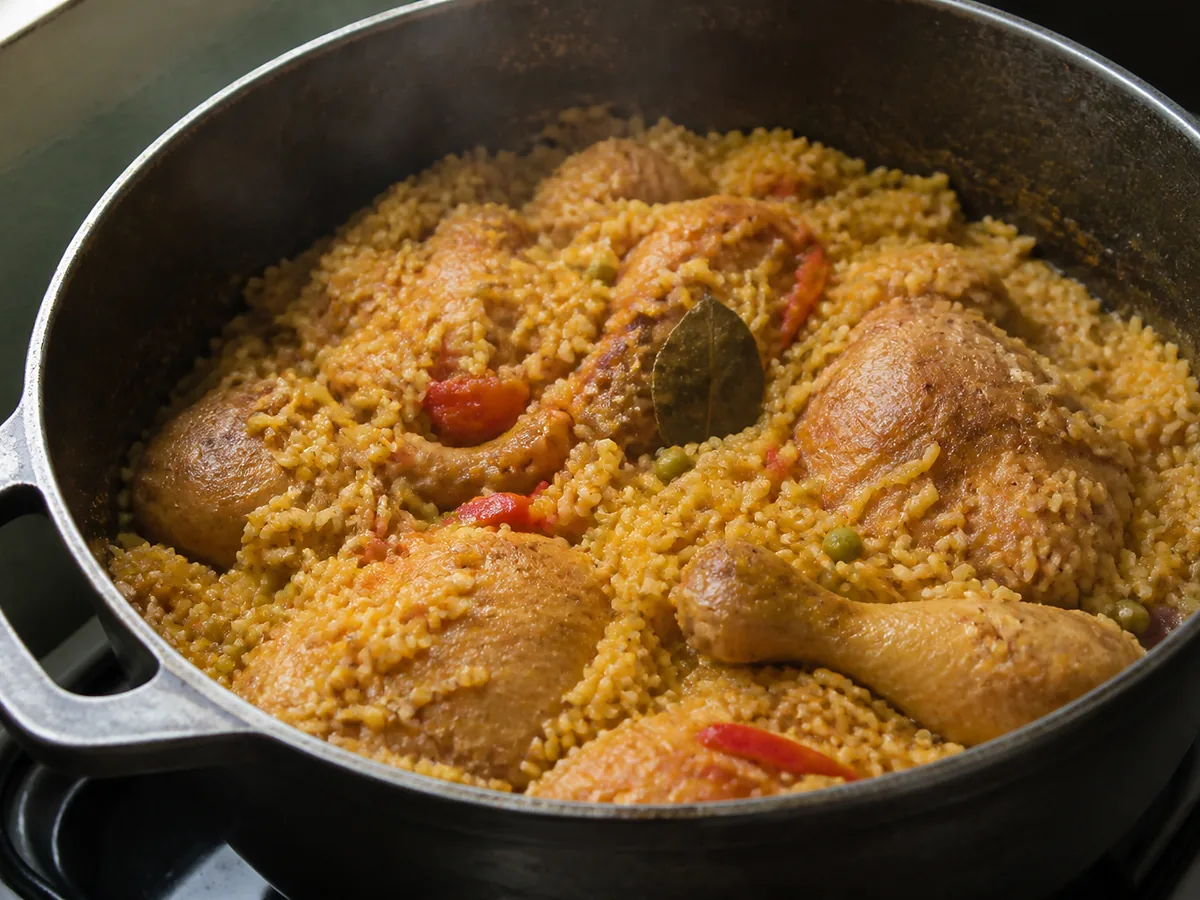
I cook Cuban arroz con pollo as a Tuesday pot: bone-in chicken, sofrito in the same fat, medium-grain rice, a bottle of beer, bija for the yellow, peas and roasted peppers at the end. The rice drinks what the chicken left. You serve it from the pot onto plates.
You do not hunt a socarrat. You do not stir in shrimp. You do not treat turmeric as the traditional colour.
This is not Spanish paella. Paella is a wide shallow pan, often saffron, often mixed proteins, and a deliberate dry-bottom crust. Cuban arroz con pollo is a covered absorption pot: stained grains, distinct, slightly clingy, moist enough to eat with a fork. Party versions add olives, capers, sometimes raisins. I am writing the Tuesday pot.
The chicken
- 1.4 kg3 lbBone-in, skin-on chicken pieces — mixed thighs and drumsticks6 to 8 pieces, fat flaps trimmed, patted dry
- 8 g1½ tspFine salt, for the chicken
- 2 g1 tspBlack pepper, freshly ground
- 3 g1 tspGround cumin
- 2 g1 tspDried oregano, crushed in the palm
- 15 ml1 tbspLime juice
- 15 ml1 tbspOilfor browning, if the skin is shy of fat
Sofrito and colour
- 250 g9 ozYellow onion, small dice1 large
- 200 g7 ozGreen bell pepper, seeded and small-diced1 large
- 20 g5–6 clovesGarlic, minced
- 120 g1 smallRipe tomato, seeded and choppedor 60 g / 2 tbsp tomato paste
- 2 g¾ tspGround cumin
- 2 g1 tspDried oregano
- 1 leaf1 leafBay leaf
- 4 g1 tspBijol, ground annatto / bija / achioteor 15 ml annatto oil. Not turmeric
- 4 g¾ tspFine salt, for the potplus more at the end
Rice and liquid
- 400 g2 cupsMedium-grain rice — Valencia or Calroserinsed until the water runs mostly clear, drained 10 minutes
- 355 ml12 fl ozPale lager beer, at room temperature1 bottle
- 550–600 ml2⅓–2½ cupsChicken stock or water, warmtotal liquid with the beer is about 900–955 ml
- 40 g¼ cupPimiento-stuffed green olives, drainedan optional Tuesday add
- 15 g1 tbspCapers, rinsedan optional Tuesday add
The finish
- 150 g1 cupFrozen peasnot thawed
- 120 g4 ozRoasted red peppers / pimientos morrones, in stripsjarred is normal
- 15 ml1 tbspLime juicefor the table more than the pot
Yield
6 plates as a weekday main, 4 if people are hungry. This is dinner, not a side of yellow rice with a lonely drumstick.
On the chicken
Bone-in, skin-on thighs and drumsticks. Bone gives body to the liquid, skin renders fat for the sofrito, and dark meat forgives the 20 minutes the rice needs. Breast dries on this clock unless you pull it early. Boneless skinless thighs are a named shift: less fat, less flavour in the rice. Pat it dry — wet skin will not brown. Twenty minutes seasoned on the board is enough. Pale chicken makes pale rice; you want gold to amber skin, not a black crust that will taste burnt in beer.
On the rice
Medium-grain. Valencia-style if you can buy it; Calrose is the honest US stand-in. Rinse until the water is no longer milky, then drain: you wash off loose surface starch so the pot does not go gluey, and keep starch inside the grain so it can gelatinise in the seasoned liquid. This is an absorption dish. Medium grain's amylopectin gives a slight cling. Long-grain at the same weight, liquid at the low end, gives a drier plate. Bomba wants a dry top; arborio wants stirring. Both are the wrong instinct here.
On the colour — bija, not turmeric
Yellow comes from bija — annatto, achiote. Bijol is the Cuban cabinet powder built on it. Annatto oil, made by warming seeds in oil until the fat goes brick and straining, is the from-scratch version. Bixin prefers fat, so bloom it in the sofrito, not in a cold cup of water. Turmeric is a labelled departure. Curcumin is a different pigment: earthy, a little bitter, loudly "curry" to a table that did not ask for it. It will make yellow rice. It will not make this yellow rice. Saffron is Spanish money in a paella; a pinch here is a departure, not a correction.
On the beer and the liquid
A pale lager. Beer deglazes the fond, adds malt, and the alcohol mostly cooks off. Total liquid for 400 g of rinsed medium-grain sits near 900 to 955 ml including the beer, and the chicken will contribute juices. A wide pot evaporates more. I start with 355 ml beer plus 550 ml stock. If the rice is still chalky when the liquid is gone, add 60 to 80 ml hot stock for 5 more minutes — cold liquid late stops gelatinisation. Wine instead of beer: 150 ml dry white plus more stock to the same total.
On not being paella
Frozen peas go in late so they stay green and pop. Jarred roasted red peppers in strips go on top — without them this is just yellow chicken rice. Olives and capers are a known add; raisins are a party split and I leave them off a Tuesday. No socarrat hunt. A little toasted bottom you may like, but burning the pot waiting for a crust is how you ruin the rice. No mixed seafood. Cover, simmer, rest.
Equipment
- A heavy 5 to 7 L pot or Dutch oven with a tight lid
- Tongs, a wooden spoon, a fine-mesh strainer
- An instant-read thermometer and a measuring jug
Do not use: a thin paella pan as a moral obligation; a 2 L saucepan; a rice cooker dump of raw chicken; a pressure cooker unless you take the labelled departure.
Method
Season and rinse20 min, overlapping
Pat the chicken dry. Season with the salt, pepper, cumin, oregano, and lime. Rinse the rice in cold water until it runs mostly clear and drain it 10 minutes. Warm the stock.
Dry skin browns. Wet rice dumps extra water into a ratio you already measured.
Pat chicken dry and season with salt, pepper, cumin, oregano and lime; let stand seasoned 20 minutes while preparing ingredients. Rinse medium-grain rice until nearly clear and drain 10 minutes. Warm the stock.
Brown the chicken12–16 min
Pot over medium-high. Film with oil if the first skin looks dry. Skin-side down, in batches. Do not move it for 4 to 5 minutes. You want gold to amber skin and rendered fat. Turn for 2 to 3 minutes.
You are after colour now, not 74 °C / 165 °F — it finishes in the rice.
Set the pieces on a plate and pour off fat until about 45 ml remains. The fat should smell like chicken and the fond should be brown, not black. If it is black, wipe the pan and start the sofrito with fresh oil.
Over medium-high, add oil if needed and brown chicken skin-down in batches, untouched 4–5 minutes, then 2–3 minutes on the other side; it finishes cooking later. Remove and retain about 45 ml fat. Keep brown fond; if blackened, wipe out and use fresh oil.
Sofrito8–10 min
Medium heat. Onion and green pepper with a pinch of salt until translucent, 8 to 10 minutes. If the fond threatens to burn, a splash of beer.
Add the tomato or paste for 1 to 2 minutes, then the garlic for 30 to 60 seconds.
You are driving water out of the onion and pepper so they sweeten.
Over medium, soften onion and green pepper with a pinch of salt 8–10 minutes. Add a splash of beer if the fond threatens to burn. Cook tomato or paste 1–2 minutes, then garlic 30–60 seconds.
Bloom the colour and spices30–45 seconds
Off the highest heat. Stir in the bijol or annatto, the cumin, oregano, bay, and salt. The fat should go orange-yellow and smell earthy-sweet, not scorched. Annatto oil goes in here if that is your colour.
Bixin and the spice oils are fat-soluble. Bloom now, or eat pale rice with dusty cumin.
Reduce from the highest heat. Stir in bijol or annatto, cumin, oregano, bay and salt until the fat turns orange-yellow and smells sweet-earthy, not scorched. Add annatto oil here if using.
Beer, scrape, rice2–3 min
Pour in the beer and scrape the brown bits. Bubble 30 to 60 seconds.
Add the drained rice and stir for 1 minute, until every grain looks stained. No white pockets.
Coating the grain in fat and pigment is how the yellow gets even.
Pour in beer, scrape up brown bits and bubble 30–60 seconds. Add drained rice and stir 1 minute until every grain is evenly yellow, without white pockets.
Liquid, chicken back, lid on18–22 min at a simmer
Add 550 ml of warm stock — hold 50 ml back if your pot is narrow. Stir once. Taste the liquid: it should be a little too salty, and clearly chicken-sofrito-beer. Olives and capers now if you are using them. Nestle the chicken in, skin side up, with the plate juices.
Bring to a gentle boil, then low: a quiet simmer, lid on, 18 to 22 minutes. Do not stir — stirring knocks starch off the grains and makes glue.
At 18 minutes, peek fast. The liquid should be absorbed, the rice tender with a faint firmness in the centre, and the thickest chicken at least 74 °C / 165 °F. Thighs often sit at 80–85 °C and are better there.
Chalky rice and a dry pot: add 60 to 80 ml hot stock, lid, 5 minutes more. Soupy pot: lid off, high heat 2 to 3 minutes, watching the bottom.
Add 550 ml warm stock, holding back 50 ml for a narrow pot; stir once, taste and add optional olives and capers. Nestle chicken skin-up with juices. Simmer covered on low 18–22 minutes without stirring. Check at 18 minutes: rice tender, liquid absorbed, chicken at least 74 °C / 165 °F; thighs may reach 80–85 °C. If dry and chalky, add 60–80 ml hot stock and cook covered 5 minutes more; if soupy, uncover over high 2–3 minutes, watching the bottom.
Peas, peppers, rest10–12 min
Scatter the frozen peas and lay the roasted pepper strips on top. Lid on, still low, 3 to 4 minutes, until the peas are hot and bright.
Off the heat, lid on, rest 8 to 10 minutes. Do not skip the rest — bottom moisture moves up and the grains set from wet to forkable.
Peas only need heating through; the rest is hydration evening out.
Scatter frozen peas and roasted pepper strips on top. Cover over low heat 3–4 minutes until peas are hot and bright. Remove from heat and rest covered 8–10 minutes; do not skip the rest.
Fork the rice, then the table1 min
Lift the chicken if you need room. Fork the rice loosely: separate-but- clinging yellow grains, peas, pepper strips. Taste for salt. Lime on the plate. Return the chicken on top and serve from the pot.
A light toast on the bottom is fine. A black sheet is a scorch — leave it.
Lift chicken aside if needed and fluff rice gently with a fork. Adjust salt, return chicken on top and serve with lime. Leave any burned black bottom behind.
Storing it
Cooked rice is not a counter project
Cool fast, in shallow containers, into the refrigerator within 2 hours. Cooked rice is a Bacillus cereus problem if it sits warm: spores survive the cook, and some toxins do not care that you reheated. I do not leave this pot on the stove all evening.
Keeping and reheating
Keeps 3 days cold. Reheat until the chicken is at least 74 °C / 165 °F and the rice is hot through — a skillet with a splash of water and a lid is kinder than a microwave. Freeze up to 1 month and thaw in the fridge. Bijol is colour, not a preservative.
Troubleshooting
- Rice hard in the centre, pot dry.
Not enough liquid, heat too high, or a wide pot. Add hot stock, lid on, 5 minutes, then rest.
- Rice mushy or soupy.
You stirred, used too much liquid, or did not rinse. Lid off 3 minutes if it is soup. Next time rinse, and do not stir after the lid goes on.
- Pale rice.
No bijol, or bijol dumped into water. Bloom the colour in the sofrito.
- It tastes like turmeric tea.
You used turmeric as if it were bijol. That is a departure, and it reads.
- Burnt bottom, raw top.
Heat too high, thin pot, or you refused the lid. Heavy pot, low simmer, lid on.
- The chicken is dry.
You used breast and treated it like a thigh. Thighs and drumsticks, lid on.
- Chicken underdone, rice finished.
Oven-safe pot into a 180 °C / 350 °F oven for 8 to 12 minutes. Check for 74 °C / 165 °F.
- Bland.
Under-salted liquid, no cumin, pale chicken. Salt the broth before the rice goes in.
- The peas went grey.
They cooked the whole time. Late peas only.
- You are hunting a crust.
Wrong recipe. Cover the pot. Serve it moist.
Substitutions
Traditional
Bone-in chicken; onion-pepper-garlic-tomato sofrito; cumin, oregano, bay; bija, bijol, or annatto; medium-grain rice that absorbs the pot; beer or wine plus stock; peas; roasted peppers. One covered pot. No seafood mix, no socarrat as the point.
Acceptable home shifts
Calrose for Valencia. Long-grain at the same weight with liquid at the low end. Dry white wine for some or all of the beer. Water plus a bouillon cube if you have no stock. Jarred pimientos. Frozen peas. Olives and capers. Boneless thighs. Annatto oil made from seeds.
Departures, named as such
Turmeric for colour. Saffron as the main yellow. A paella pan and a socarrat hunt. Mixed seafood. Chorizo as the primary meat. Coconut milk. Brown rice.
Pressure cooker, labelled departure
I do not cook Tuesday arroz con pollo this way. If you do: brown the chicken and make the sofrito on sauté, bloom the bijol, add beer, rice, and reduced liquid — start around 700 ml total including beer. Nestle the chicken. High pressure 6 to 8 minutes, natural release 10. Peas and peppers on sauté at the end, 3 minutes. Wetter, and easier to mush.
Scaling
Rice scales by weight; liquid scales, then adjust 60 ml at a time. Taste the liquid before the lid goes on.
Smaller and larger
For 3: 700 g chicken, 200 g rice, about 475 ml total liquid. The sofrito can be slightly more than half — a tiny sofrito burns. Simmer time stays in the same band; check the rice, not the clock. For 10 to 12: double only if you have a 9 to 10 L pot or two Dutch ovens. A doubled batch in a too-small pot steams unevenly.
What to serve it with
This is the meal. White rice on the side is redundant — this is the rice.
- Avocado, lettuce, onion, lime, oil, salt
- Ripe maduros, if you want sweet
- Tostones, if the table wants extra starch
- Cold lager, and lime wedges
The pot is seasoned, not chilli-hot. On leftovers, a fried egg is a known breakfast habit.
Questions
Can I use boneless skinless chicken?
Yes, as a shift. You lose fat and bone. Brown it anyway, and check the temperature early.
Valencia or long-grain?
I cook Valencia or Calrose so the pot clings. Long-grain is the Cuban-American cabinet default: drier, more separate — same method, liquid at the low end. Do not mix half and half; they finish differently.
Is bijol required?
The yellow from annatto is part of the identity of this plate. Use bijol, ground achiote, or annatto oil. Not turmeric, unless you choose that departure.
Do I have to use beer?
No. Wine and stock, or all stock. The rice still needs the same total liquid.
Why no socarrat?
This is Cuban arroz con pollo, not paella — moist absorption rice. If you want crust, make paella and stop using this name.
Can I make it ahead?
Same day is better. Reheat with a splash of water, covered.
My family puts raisins in.
Party pot. I leave them off a Tuesday. Add 40 g with the liquid if that is your table.
How yellow should it be?
Clearly yellow, not neon. White grains mean you did not coat the rice in the pigmented fat.