Yuca con Mojo
Cassava boiled until a knife meets no chalk, then hot garlic-citrus fat poured over while it still steams — so the starch drinks it instead of wearing it.
- Prep
- 15 min
- Cook
- 35 min
- Serves
- 4 as a side, 2–3 as a plate of its own
- Difficulty
- Easy
Kitchen-tested
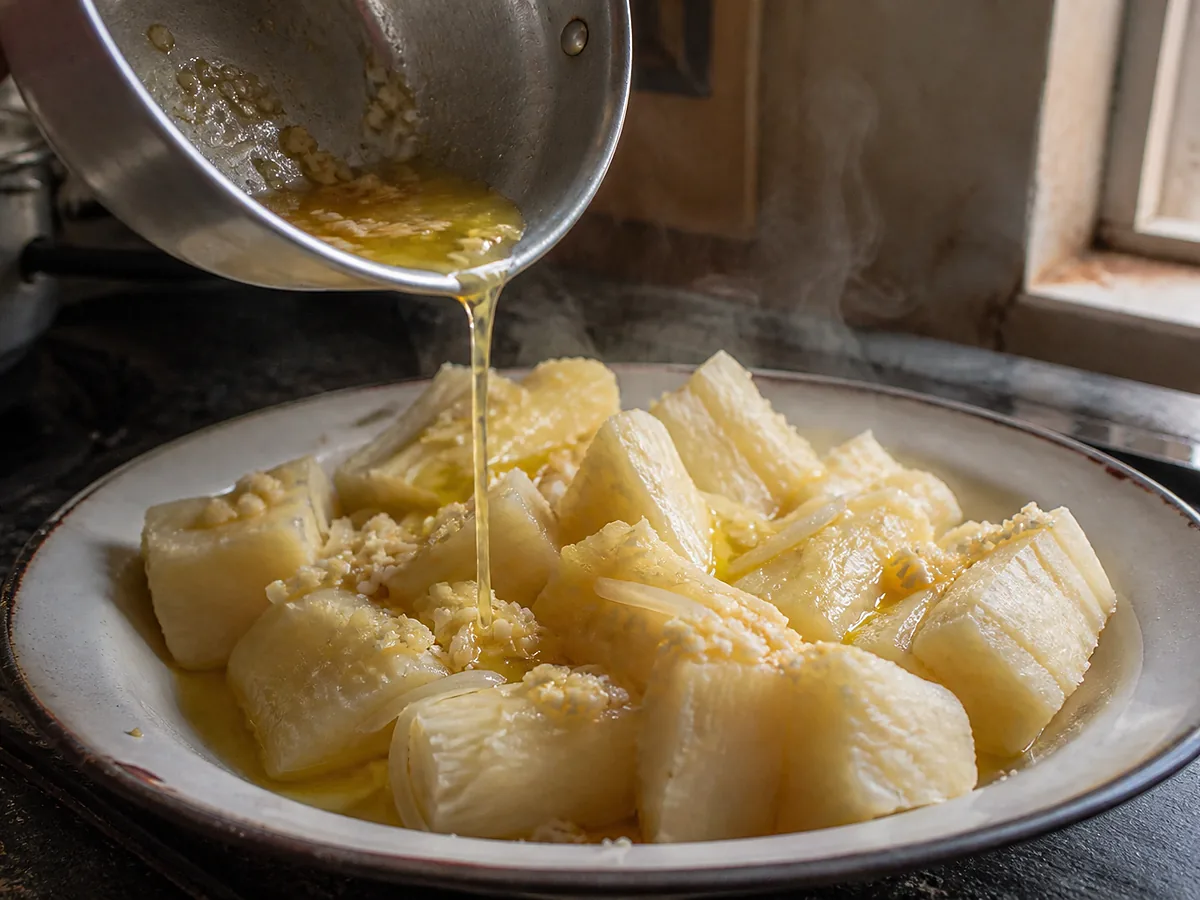
Pour the mojo while the yuca is still steaming. That is the plate: cassava boiled in salted water until a knife meets no chalk, then a hot garlic-citrus fat poured on so the starch takes it instead of wearing it.
Five minutes later the chunks are glossy and the onion has wilted into the cracks. Ten minutes later, if you waited, you have dressed starch with a sauce sitting on top.
I cook this as a side for lechón and for vaca frita, and I also eat a bowl of it as the plate. It is not mashed yuca. It is not yuca frita. It is boiled root and a finishing mojo.
This mojo is a cousin of the Nochebuena mojo you put on a pig, not the same sauce. Lechón mojo is a marinade for raw pork, often with more cumin, sitting for hours. What you make here is a finishing sauce: fat heated, garlic toasted pale gold, citrus off the heat, poured on food that is already cooked.
The yuca — pick one
- 1.2 kg2 lb 10 ozFresh yuca / cassava, as boughtwaxed bark on, firm, no ferment smell. Peel, cut, pull the core — about 800–900 g prepared
- 900 g2 lbFrozen peeled yucastill frozen or barely thawed. Check each piece for core once it softens in the pot
Salted water
- 2.5–3 L10½–12½ cupsCold waterto cover by 3–4 cm, in a 5–6 L pot
- 18 g1 tbspCoarse salt, for the waterit should taste clearly salty, like pasta water
The finishing mojo
- 25 g8–10 clovesGarlic, peeled and thinly slicedsliced, not pasted — you want surface to toast
- 80 g½ mediumYellow onion, in thin half-moons
- 100 ml⅓ cup plus 1 tbspNaranja agria (sour orange), juiced, seeds strained
- 2 g1 tspDried oregano, crumbledMediterranean or Mexican dried leaf — not the succulent sold as "Cuban oregano"
- 90 ml6 tbspLard (manteca), or a neutral oil
- 4 g¾ tspFine salt, for the mojoplus a pinch at the table
If you cannot buy naranja agria — a labelled substitute
- 65 ml¼ cupSweet orange juice
- 35 ml2 tbsp plus 1 tspLime juice
- 1 g½ tspLime zest, gratedsweeter and less bitter than the real thing, but acid enough
Yield
4 as a side, 2 to 3 as a plate of its own. About 45 minutes, most of it the pot.
On the yuca, fresh and frozen
Yuca is cassava: bark off, fibrous axis out, the flesh dense and white and almost neutral. Starch gelatinises around 60–70 °C / 140–158 °F. Done yuca is creamy and just translucent at the edges. Undercooked squeaks; overcooked goes gluey, then falls apart. Fresh roots are often waxed — buy them firm and heavy, with no long cracks and no sour smell. Grey or blue streaks are age. Frozen peeled yuca is how a lot of Cuban-American kitchens cook this on a Tuesday. Already peeled, often still carrying core, a little wetter. It breaks if you boil past tender. Do not eat yuca raw. Table yuca is sweet cassava; glycosides sit in the peel and outer flesh. Peel completely, cook in open water, and discard the cooking liquid.
On the woody core
A tough central fibre that stays woody after the starch is done — a white string or a triangular plug. Cut peeled yuca into 5–6 cm chunks, split them, and pull the core before the pot; or fish it out after a few minutes of boiling, when the flesh lets go. Frozen pieces still have it. Leaving it is a mouthful of splint.
On naranja agria
Sour orange, *Citrus aurantium*: acid, a little bitter, floral. Bottled Latin-aisle juice is usable if it is juice — not a neon "mojo marinade" already loaded with oil and cumin. The labelled substitute is sweet orange plus lime: rounder, less bitter. Use it, and say so. All lime is too sharp; all sweet orange is a dressing for fruit. 65:35 orange-to-lime with a little zest is the stand-in I trust. Not vinegar.
On the garlic, the fat, and the citrus
Lard is the older Cuban kitchen fat and it matches pork. Neutral oil is the weeknight default. Extra-virgin olive oil is a known coastal habit and smokes earlier — keep the pan calmer if you use it. Heat the fat to a shimmer, 140–160 °C / 285–320 °F. Garlic in: pale gold, toasted smell, tiny bubbles, 45 to 90 seconds. Past deep gold you are in bitter. Burnt garlic is not "more garlic." Citrus goes in off the heat. Juice into screaming oil gives you a steam explosion and a harsh cooked-orange note. Pull the pan, wait two seconds, add the juice. It will hiss. That is enough.
Equipment
- A heavy 5–6 L pot
- A sturdy peeler or paring knife
- A chef's knife and board, for the core
- A colander
- A small skillet or saucepan for the mojo, and a wooden spoon
- An instant-read thermometer, useful for the fat
What not to use: a blender to "finish" the yuca — that is mash; a microwave as the cook; a pressure cooker as the default; a cold bowl, which kills the drink.
Method
Peel, cut, core10–15 min fresh · 2 min for the bag
Fresh: ends off, score the bark, pry under the waxed brown layer and the pinkish underlayer, and strip both. The flesh should be white. Cut into 5–6 cm chunks. Split each and pull the woody core. Rinse.
Frozen: do not thaw on the counter for an hour. Pull any remaining core once the pot has softened the pieces, about 8 to 10 minutes in.
Bark is not food, and more of the cyanogenic load sits there. The core never becomes tender.
For fresh yuca, remove ends, waxed bark and pink under-layer completely. Cut 5–6 cm chunks, split, remove woody cores and rinse. For frozen yuca, do not thaw on the counter; remove remaining cores after 8–10 minutes of cooking when loosened.
Salted water, then simmer20–35 min fresh · 15–25 min frozen
Fresh: cover by 3–4 cm, add the salt, bring to a boil uncovered, then hold a steady simmer at 95–100 °C / 203–212 °F.
Frozen: salted water to a boil first, then the pieces.
Start checking at 15 minutes; a thick fresh shoulder can need 35.
Doneness: a knife slides with no chalky drag, the edges look slightly glassy, the centre is creamy white rather than wet paste, and a piece breaks under a fork without dissolving. A hard white core that is not the woody fibre is undercooked starch — five more minutes. Cloudy water and feathering pieces means you are late.
You are gelatinising a dense starch cylinder from the outside in. A chaos-boil batters the corners off before the middle is done; a timid poach leaves a raw axis. Salt now, or the interior stays bland.
Cover fresh yuca with salted water by 3–4 cm, boil uncovered and maintain 95–100 °C / 203–212 °F; add frozen pieces to already-boiling salted water. Check from 15 minutes; a thick fresh piece can need 35. Cook until a knife slides through and the centre is creamy, not chalky; give hard centres 5 more minutes. Never eat raw.
The mojo, while the pot works8 min
When the yuca is about 8 minutes from done, bring the lard or oil to a shimmer, 140–160 °C / 285–320 °F.
Garlic and onion in. Pale gold garlic, translucent onion, 3 to 5 minutes. Oregano for 10 seconds. Off the heat. Then the naranja agria — or the labelled orange-lime mix — and the salt. One spit.
It should smell of toasted garlic and citrus peel, not of a fryer. Taste for salt, acid, garlic, and a little bitterness if you used true sour orange.
If the garlic went past gold into brown, start the mojo again. Juice will not hide it.
About 8 minutes before yuca finishes, heat fat to 140–160 °C / 285–320 °F. Cook garlic and onion 3–5 minutes until garlic is pale gold and onion translucent; add oregano 10 seconds. Remove from heat, wait 2 seconds and carefully add sour orange or substitute and salt; it spatters. Restart if garlic burns.
Drain and dress while it steams2 min, then 3–5 min to drink
Drain. Shake once. Do not rinse. Into a warm bowl, or back into the hot empty pot.
Pour the mojo over — fat, onion, and all — and fold once or twice. Optionally press each chunk once with a fork so it opens a seam. A full mash is a different plate.
Leave it 3 to 5 minutes. The surface should be wet-glossy, not pooled. Taste a middle piece and add a pinch of salt if the water was timid.
Gelatinised starch is a sponge while it is hot and wet. As it cools the gel retrogrades, the surface seals, and the sauce sits on top like oil on a cold potato. A yellow lake at the bottom means the yuca was too dry and cold.
Drain and discard cooking water; shake once without rinsing. Put hot yuca in a warm bowl or empty pot and fold in all mojo once or twice. Optionally press pieces once with a fork. Rest 3–5 minutes until glossy and dressed; taste a centre piece and adjust salt.
The tablenow
Serve hot, spooning onion and garlic over each plate.
This is a now food. Fat firms as it cools; the drink is a temperature trick, not a marinade you can walk away from.
Serve the yuca hot, spooning onion, garlic and mojo over each portion. Bring it to the table promptly while the fat remains liquid and the pieces are glossy.
Storing it
Cassava rules
Peel and boil. Do not serve raw or undercooked cassava. Discard the cooking water. Frozen raw yuca stays frozen until you cook it, and fresh peeled yuca browns and ferments — cook it the day you peel.
Leftovers, and the garlic-in-oil rule
Cool within 2 hours, refrigerate in the mojo, covered, up to 3 days at 4 °C / 40 °F or below. Reheat in a covered skillet with a spoon of water until steaming. Garlic in oil at room temperature is a botulism case. This mojo is made, poured, and eaten. Any extra goes in the fridge the same day, keeps 3 days, and is reheated to a simmer. Sour smell, slime, or grey paste: throw it away.
Troubleshooting
- Chalky middle, tender edges.
Underboiled, or uneven pieces. Cut more evenly and give it 5 to 10 minutes. The woody core is not this — pull that separately.
- Glue, feathers, pieces in the water.
Overboiled, or a hard rolling boil. Simmer, and pull when the knife slides. Frozen overcooks faster.
- Woody strings in every bite.
You left the core in.
- The mojo sits on top.
The yuca cooled, or you rinsed it. Reheat the yuca, make a small hot mojo, and pour again.
- Bitter, acrid garlic.
Burnt. New fat, new garlic, paler toast.
- Harsh, raw garlic.
The fat never got hot enough. Toast it.
- Splattered ceiling, harsh orange.
Citrus into smoking oil. Off the heat next time.
- Bland.
Undersalted water, or too much yuca for 90 ml of fat. Salt the water until it tastes like something.
- Watery sauce.
You did not drain, or the frozen yuca wept. Drain hard.
- Grey or sour yuca.
Old root, or a bad bag. Throw it away.
- Too sharp.
All lime, or too much juice for the fat. A spoon of hot oil. Do not add sugar.
Substitutions
Traditional versus known departure
| Component | Traditional | Known departure |
|---|---|---|
| Yuca | Fresh cassava, peeled, cored | Frozen peeled yuca — a Cuban-American freezer staple. Canned yuca is already soft; I do not use it. Potato is a different plate |
| Core | Removed | Leaving it. Do not |
| Water | Salted, open pot, simmer | Unsalted water is bland. Pressure cooker glues easily — if you insist, high pressure 5 to 7 minutes, natural release, check immediately |
| Acid | Naranja agria | Orange + lime, labelled, 65 ml + 35 ml. All lime is harsh. Vinegar is a different sauce |
| Fat | Lard, or neutral oil | Extra-virgin olive oil at calmer heat. Butter browns too fast |
| Aromatics | Garlic, onion, dried oregano | A pinch of cumin is a family habit. Fresh oregano scorches. The succulent "Cuban oregano" plant is the wrong herb |
| Texture | Whole chunks, hot, folded | One fork press per chunk. Full mash is a different dish, and so is yuca frita |
| Mojo type | Finishing sauce, poured hot | A lechón marinade used as a dressing — too raw, often too much cumin. I do not do that here |
Scaling
Boil time does not halve; piece size sets the clock.
Smaller and larger
For 2 as a side: 600 g fresh as bought, or 450 g frozen, and half the mojo — 12 g garlic, 40 g onion, 50 ml citrus, 45 ml fat. For 8: double the yuca, double the mojo, wider pot. Do not triple the yuca in the same 90 ml of mojo.
What to serve it with
Starch next to the pig, or a bowl of it as the plate.
- Lechón asado
- Vaca frita
- Rice, if you want a second starch
- Black beans, white rice, beer
Tostones on a large table, but not usually both on a Tuesday. Do not bury it in mayonnaise.
Questions
Fresh or frozen?
Fresh if you have a good root. Frozen if that is what the freezer has — a known Cuban-American reality. Frozen goes gluey sooner.
Do I have to remove the core?
Yes. It does not cook through. It is wood.
Can I make the mojo ahead?
Juice, salt, and oregano ahead. Toast the garlic when the yuca is draining. A cooled, fully made mojo is leftover sauce — reheat it to a shimmer, and it will not drink the same way.
Why is my garlic bitter?
You browned it past gold. Pale gold, at 140–160 °C / 285–320 °F.
Naranja agria or orange plus lime?
Naranja agria if you can buy it. Orange plus lime, labelled, if you cannot. Vinegar is not this sauce.
Is this the same mojo as for lechón?
No — a cousin, not identical. Lechón mojo is a marinade for raw pork. This is a finishing sauce: fat heated, garlic toasted, citrus off the heat, poured on food that is already cooked.
Is cassava dangerous?
Raw and bitter cassava can be. Table yuca is sweet cassava, peeled completely, boiled in open water, with the cooking water discarded. Do not eat it raw.