Tostones
Twice-fried green plantain, smashed in the middle of the cooking and salted while they hiss. Green, starchy, salted. Never sugared.
- Prep
- 12 min
- Cook
- 25 min
- Serves
- 4 as a side — about 18 to 24 tostones
- Difficulty
- Easy
Kitchen-tested
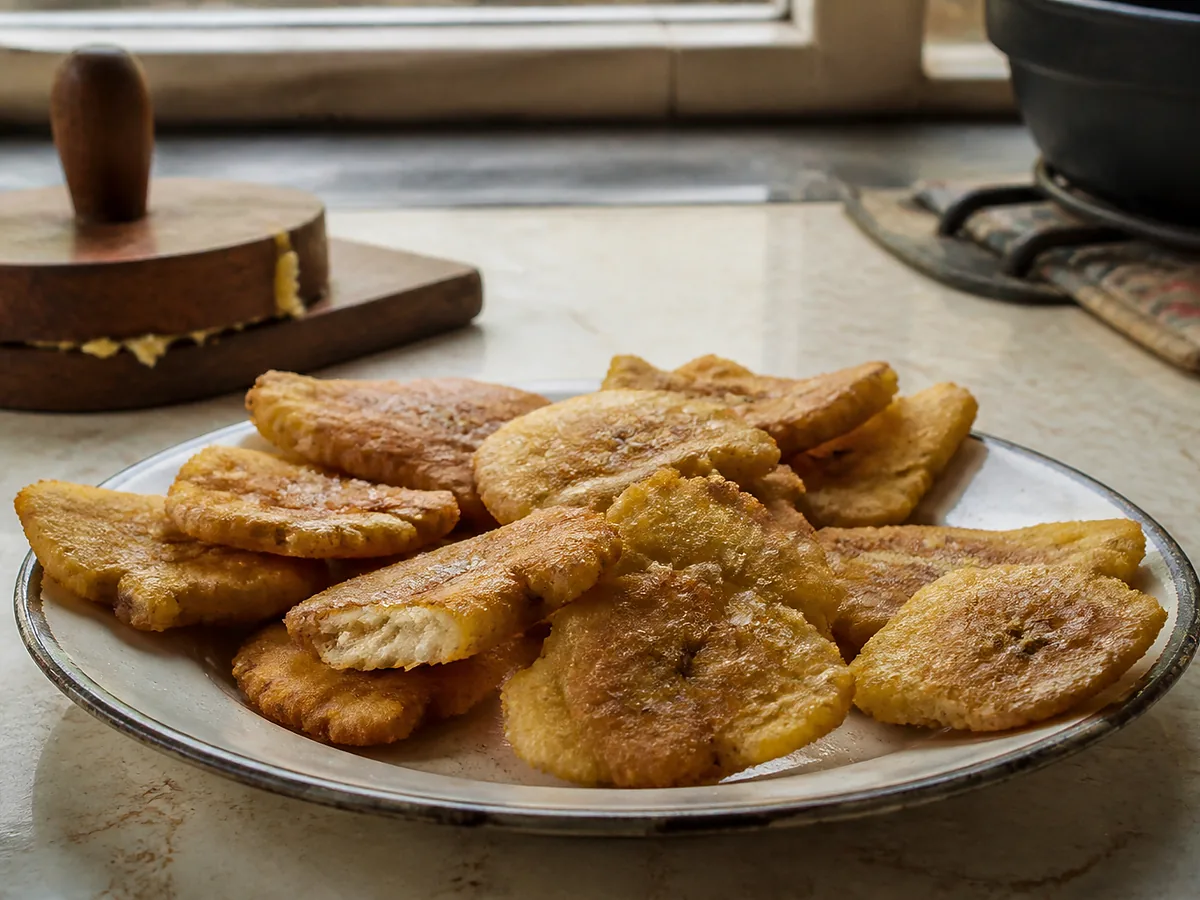
Tostones are twice-fried green plantain, smashed in the middle of the cooking, salted while they hiss. They are not maduros. Maduros are ripe, yellow-to- black, fried once, sweet, and they collapse. These stay green, starchy, and salted. Sugar does not belong in the oil, on the plantain, or at the table for this plate.
Green plantain is a starch, closer to boiled yuca than to a banana. As it ripens, enzymes turn that starch into sugar — which is why maduros brown fast and taste like dessert. Fry a yellow plantain by this method and you get a sweet disc that tears when you smash it.
Two oil temperatures, and a smash to about 1 cm, not paper. First fry, cooler, so the interior gelatinises without a hard crust. Smash. Second fry, hotter, so the new surface dehydrates and blisters.
A tostonera is the Cuban press. The bottom of a glass is the honest stand-in.
Plantains and salt
- 1.2 kg2 lb 10 ozGreen plantains — deep green, firm, heavy3 large or 4 medium. Peeled, cut into 3.5 cm cylinders
- 1–1.2 L4–5 cupsNeutral frying oil — peanut, canola, sunflowerenough for 2–3 cm depth in a heavy skillet
- 6–8 g1–1½ tspCoarse salt, for the hot discsnot in the oil, and never mixed with sugar
Optional dipping mojo — a finishing sauce, not a marinade
- 12 g4 clovesGarlic, mashed with a pinch of salt
- 60 ml¼ cupNaranja agriaor 40 ml orange juice plus 20 ml lime juice, labelled as the substitute
- 45 ml3 tbspNeutral oil, or light olive oilheated until it shimmers, then poured over the garlic
- 1 g½ tspDried oregano
- 2 g⅓ tspFine salt
Yield
4 as a side, about 18 to 24 tostones, in 30 to 40 minutes including peeling. Eat them as they come out.
On the plantain — green, not ripe
Plátano verde: thick skin, deep green, no yellow field, flesh cream-white and tight. Unripe plantain is packed with starch and very little free sugar, so it fries pale, stays structured, and tastes clean and lightly nutty. Ripe, the same fruit is a maduro: yellow to black skin, high sugar, low structure. Maduros fry once, go mahogany, and sag. They are their own plate. A yellow tip on a green body will smash but browns faster on the second fry; a fully yellow plantain smears on the tostonera; black-ripe is dessert. In some Cuban kitchens these discs are also called tachinos. Patacones is the name elsewhere in the Caribbean — same family, not a licence to sugar them.
On peeling
Green skin is tight. Ends off, score the peel lengthwise in two or three lines just through the skin, then pry under a corner and peel in strips. A knife, not a dull peeler. If a strip refuses, a 60-second dip of the whole fruit in the already-hot oil, or in boiling water, loosens it. Oil on your hands helps more than water. Trim stringy under-skin so it does not fry into a bitter thread. Cut into 3.5 cm cylinders. Shorter than 2.5 cm and the smash becomes a wafer; longer than 4.5 cm and you get a lumpy oval with a raw middle.
On the two oil temperatures
First fry: 160–165 °C / 320–330 °F. Three to five minutes, turning, until pale gold, slightly puffed, and cooked through — not browned. Interior around 90–95 °C, starch gelatinised, like a cooked potato. Too hot and you set a crust that splits when you smash; too cool and the plantain drinks oil and smears. Second fry: 185–190 °C / 365–375 °F. One to two minutes per smashed disc, until deep gold, blistered, crisp at the edge. Past 195 °C they race toward brown and bitter; under 175 °C they come out limp and greasy. A thermometer in the oil is the right instrument. Crowding drops the temperature — fry in batches and let the oil recover.
On the smash
About 1 cm after the press. Not paper. Paper-thin tostones are chips: they shatter, they dry out, and they have no starchy middle left. Thicker than 1.5 cm is a gummy pillow with a fried face. A tostonera is two plates on a hinge — press once, firmly, not a slam. The bottom of a heavy glass does the same job, with parchment or a small paper bag between glass and plantain. A meat mallet splits them into petals. A few radial cracks at the edge are normal. A complete split means the first fry went too far, or the plantain was not green.
On salt, and on sugar
Salt the discs the second they leave the second fry, while the surface is still wet with oil — coarse salt sticks. Do not salt the first fry; the crystals fall off in the smash. Never sugar these. No syrup, no cinnamon sugar, no honey. If you want sweet, cook maduros, on purpose, as maduros.
On the air fryer, as a labelled departure
An air fryer will not be this plate. You are blowing hot air at starch instead of immersing it in oil, and you lose the blister and the thin fried shell around a dense middle. If you do it: brush or spray the cylinders with oil, 180 °C / 350 °F for 8 to 10 minutes turning once, until just cooked through. Smash to 1 cm. Brush again. 200 °C / 400 °F for 6 to 8 minutes, turning, until as gold as they will get. Salt. Drier, paler, more like baked tostones — do not pretend you twice-fried them.
Equipment
- A heavy skillet or Dutch oven, 25–30 cm
- An instant-read or fry thermometer that can sit in oil
- A tostonera, or a heavy flat-bottomed glass
- Parchment or a small paper bag, for the press
- A spider or slotted spoon, and a sheet tray with a rack
- Tongs, and a knife and board for peeling
What not to use: a nonstick skillet too shallow to hold temperature; a fryer basket slammed down as a smash; sugar; a microwave as the main cook; an air fryer as the unnamed method — name it if you use it.
Method
Peel and cut8–12 min
Ends off. Score. Peel in strips. Cut into 3.5 cm cylinders.
A long water soak is not required and it wets the surface. If you are slow, lay a damp towel over the cut pieces.
Even cylinders smash into even discs. A mix of nubs and logs gives you chips and pillows on the same tray.
Use firm, deep-green plantains. Trim ends, score peel lengthwise and strip away skin and stringy under-layer. Cut evenly into 3.5 cm cylinders. Cover cut pieces with a damp towel if delayed; no long water soak is needed.
Heat the oil for the first fry8–10 min
1 to 1.2 L of oil, 2–3 cm deep. Medium heat to 160–165 °C / 320–330 °F. A small scrap of plantain should fizz steadily — not thrash, not sit mute.
The first fry is a cook, not a colour. Starch has to gelatinise in fat: hot enough to set the outside before it soaks, calm enough not to crust.
Heat 1–1.2 L oil, 2–3 cm deep, over medium to 160–165 °C / 320–330 °F. A plantain scrap should bubble steadily; maintain this gentler temperature for the first fry.
First fry3–5 min per batch
Cylinders in with space. Do not crowd. Turn every minute or so.
Pull them when they are pale, slightly swollen, and a knife tip finds no raw white squeak in the centre. Drain on the rack 30 to 60 seconds.
You want the colour of cooked potato, not toast; a faint plantain smell, not caramel; a cylinder that yields to a press without collapsing into mash. Already brown means your oil was in the second-fry range — drop the heat.
Ungelatinised starch will not smash into a disc. It smears, or it shatters. This stage is the structure.
Fry uncrowded batches, turning about every minute, until pale, slightly swollen and cooked through with no raw white centre. Drain on a rack 30–60 seconds; lower the heat if they are already browning.
Smash to about 1 cm1 min per batch, while hot
One cylinder at a time, tostonera or glass, parchment on top. Press once to about 1 cm. Do not iron them thin.
Smash one batch while the oil climbs to the second temperature.
You have just multiplied the surface area, and that new surface is what the second fry will crisp. Smash cold and they crack; smash paper-thin and you made chips.
While hot, press each cylinder once with a tostonera or heavy glass and parchment to about 1 cm thick. Keep a substantial centre rather than flattening paper-thin; raise oil toward the second frying temperature meanwhile.
Second fry1–2 min per batch
Let the oil come up to 185–190 °C / 365–375 °F. Use the thermometer. Discs in, no crowding. They should hiss hard. Turn once.
Pull when the faces are gold and the edges look dry and blistered — not mahogany, not pale and shiny-wet. A few darker blisters are right. Tap two together and you should hear a crisp edge; break one and it steams, the interior still pale and dense.
High heat drives surface water off faster than it can migrate out from the middle, so you get a shell. Low heat does the opposite: oil in, limp disc.
Heat oil to 185–190 °C / 365–375 °F. Fry discs without crowding, turning once, until golden with dry blistered edges and a steaming, pale centre. Let the oil recover between batches.
Salt, and the optional mojoimmediately
Salt in the air as they hit the rack. Coarse crystals. Serve within a few minutes.
For the dip: mash the garlic with the salt, add the naranja agria or the labelled orange-lime mix, and crumble in the oregano. Heat the 45 ml of oil until it shimmers, 140–160 °C / 285–320 °F, and pour it over the garlic so it sizzles but does not go brown. Spoon it on the side.
Salt sticks to oil. Wait five minutes and you are salting a dry crust. The dip is optional — salt alone is a complete tostón.
Salt immediately on the rack and serve within minutes. For optional mojo, mash garlic with salt, add sour orange or listed substitute and oregano. Heat 45 ml oil to 140–160 °C / 285–320 °F and pour carefully over garlic to sizzle without browning; serve alongside.
Storing it
A now food
Ten minutes later they are still good. Thirty minutes later they are limp. Fry in waves. A 95 °C / 200 °F oven on a rack for 10 to 15 minutes is as far as I will hold them. Leftovers: refrigerate within 2 hours, up to 2 days. Re-crisp in a hot skillet with a film of oil, or at 200 °C / 400 °F for 8 to 10 minutes. Do not microwave them.
The plantains, the oil, and the mojo
Raw peeled plantain browns — cut and fry the same hour. Cool used oil and strain it. The optional garlic mojo goes in the fridge the same day, keeps 3 days, and the oil part is reheated to a simmer. Garlic in oil on the counter is not a pantry item. Mould, a ferment smell, or a collapsed soft end: throw the plantains away.
Troubleshooting
- They smeared when I smashed them.
Not green enough, or the first fry was too short. Cook them through at 160–165 °C before you press.
- They shattered into petals.
First fry too long or too hot, or you slammed the tostonera. Cooler first fry, one firm press.
- Greasy, limp.
Second-fry oil too cool, or crowded. 185–190 °C, and work in batches.
- Pale and hard.
The first fry never cooked the middle. A knife after the first fry should meet cooked starch.
- Mahogany and bitter.
Second fry too hot, or a yellowing plantain. 185–190 °C, and green fruit.
- Raw white core after both fries.
Cylinders too tall, or the first oil was not actually at 160 °C. 3.5 cm blanks, and use a thermometer.
- Stuck to the glass.
Smash while hot, use parchment, press and lift.
- The salt bounced off.
You waited. Salt them as they leave the oil.
- They taste sweet.
You bought maduros, or you sugared them. Start over with green fruit and salt.
Substitutions
Traditional versus known departure
| Component | Traditional | Known departure |
|---|---|---|
| Fruit | Green plantain, deep green, firm | Slightly yellow-tipped is softer and browns faster. Ripe maduro is a different dish — fry those once, do not smash them. Dessert banana collapses |
| Cut | 3.5 cm cylinders | Longer logs give gummy middles. Thin coins give chips |
| Smash | ~1 cm, tostonera or glass | Paper-thin makes chips. A garlic-water dip after the smash is a known variant — drain hard. A meat mallet splits them |
| Fat | Neutral oil, or lard | Olive oil for the whole fry smokes on the second stage. Butter burns |
| Cook | Twice-fried, 160–165 °C then 185–190 °C | Air fryer, labelled, drier, not the same. Oven-only is pale. A single hard fry is raw or burnt |
| Seasoning | Coarse salt, immediately | Finishing mojo on the side. Lime at the table. Sugar, cinnamon, honey — no |
| Name | Tostones (tachinos in some Cuban speech) | Patacones is a related plate elsewhere. Tostones with sugar is not this page |
Scaling
Smash and second-fry in waves, so nothing sits smashed and cooling for 20 minutes.
Smaller, larger, and a party tray
Three large green plantains feed 4 as a side. For 8, use 6 plantains and a wider pan or two pans — not one crowded batch. Halve for 2 with one large plantain plus a small one, same temperatures, still 2–3 cm of oil. For a party: first-fry all the plantains and hold the pale cylinders on a rack, then smash and second-fry in the last 15 minutes. Finished tostones under foil is steam.
What to serve it with
Salt. That is enough.
- A small bowl of garlic-citrus mojo, spooned not poured
- Vaca frita, or picadillo
- Roast pork
- Black beans and rice
- Lime, and beer
No ketchup. No sugar. Yuca con mojo is another Cuban starch; on a Tuesday I pick one.
Questions
Green or yellow?
Green. Yellow is on the way to maduros. Smash-and-fry is a green-fruit method.
Can I use ripe plantains if I salt them extra?
No. You will make sweet broken discs. Cook maduros as maduros.
Tostonera or a glass?
Tostonera if you have one, a heavy glass if you do not. Press to 1 cm, not to transparency.
Why two fries?
The first fry cooks the starch. The smash makes a new surface. The second fry crisps that surface. One fry at high heat gives you a raw middle or a burnt face.
What oil temperature, exactly?
160–165 °C / 320–330 °F first. 185–190 °C / 365–375 °F second.
Can I air-fry them?
Yes, as a labelled departure, and they will not be the same. Twice-fried in oil is the method.
Do I sugar them?
No.
Mojo on them, or salt only?
Salt is canonical. Mojo on the side is ordinary. Wet mojo dumped over a pile will soften the crust — spoon, do not soak.
How thin?
About 1 cm. Paper is a chip. A fat smash is a gummy cake.