Ajiaco Criollo
Cuba's mixed-meat, mixed-vianda stew — tasajo, pork, chicken, and roots you let break until the broth thickens itself. A Sunday pot, not a Colombian one.
- Prep
- 1 hr
- Cook
- 3 hr 30 min
- Serves
- 8–10 bowls as a main
- Difficulty
- Hard
Kitchen-tested
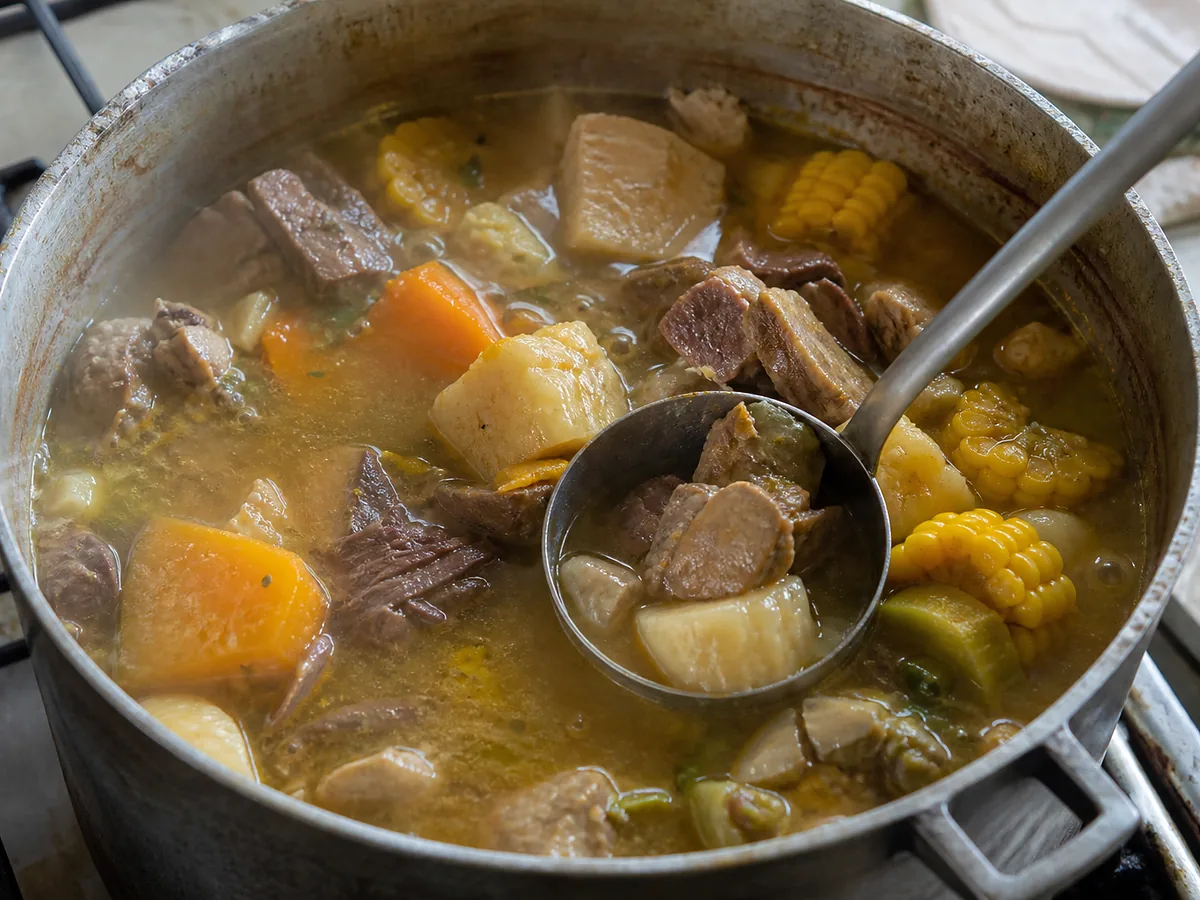
Ajiaco criollo is Cuba’s mixed-meat, mixed-vianda stew: tasajo if you can get it, pork, chicken, sometimes chorizo, then yuca, malanga, plantain, calabaza, and corn, in a broth that thickens because the roots break. You cook it on a Sunday or a holiday. The clock is three hours after the soak.
Colombian ajiaco — ajiaco santafereño — is a different dish that happens to share a Taíno-derived name. That Bogotá pot is chicken, three potatoes including papa criolla, corn, and the herb guascas, finished with cream, capers, and often avocado. No tasajo, no pork, no yuca, no malanga, no plantain, no Cuban sofrito. If the bowl is pale, potato-thick, and smells of galinsoga, you made the Andean one.
Sancocho is a cousin in the same Caribbean family of meat-and-root pots, not a synonym for this page.
Cuban ajiaco is dried or salted beef with pork and chicken, a sofrito of onion, ají, garlic, cumin, and oregano, viandas you let break, and bitter orange or lime at the end. Body from starch and collagen. Not cream. Not a blender.
The night before
- 350 g12 ozTasajo / dried salted beefin 2 or 3 pieces if it came as a sheet
The meats
- 700 g1 lb 9 ozPork shoulder / paleta, in 4 cm cubessome fat left on
- 1 kg2.2 lbBone-in chicken thighs and drumsticks, skin on6 to 8 pieces
- 200 g7 ozSpanish-style semi-cured chorizo, in 1.5 cm coinsoptional — the "sometimes" meat. Not Mexican fresh sausage
Viandas — peeled weights
- 600 g1 lb 5 ozYuca / cassava, in 4–5 cm chunksbark and pink under-layer removed, woody core pulled
- 450 g1 lbMalanga blanca, peeled, in 4 cm chunks
- 450 g1 lbGreen plantains, peeled, in 3 cm chunks2 large
- 200 g7 ozRipe plantain, peeled, in 3 cm chunks1 large, yellow with black spots
- 500 g1 lb 2 ozCalabaza or West Indian pumpkin, peeled and seeded, in 4 cm chunks
- 400 g2 earsCorn on the cob, husked, cut into 4 cm rounds
The sofrito
- 45 ml3 tbspLard, or olive oil
- 300 g10 ozYellow onion, small dice2 medium
- 200 g7 ozGreen cubanelle or green bell pepper, small dice1 large
- 25 g6–8 clovesGarlic, minced
- 200 g7 ozRipe tomato, peeled and choppedoptional but common
- 5 g2 tspGround cumin
- 4 g2 tspDried oregano, crushed between your palms
- 2 leaves2 leavesBay leaves
- 10 g1¾ tspCoarse salt, to startthen more after you taste — the tasajo brings salt
- 2 g1 tspBlack pepper
Liquid and finish
- 3–3.5 L12½–15 cupsWater, to cover
- 15 ga small handfulRecao / culantro, choppedor 20 g cilantro as a labelled stand-in
- 45 ml3 tbspNaranja agria / bitter orange juiceor 30 ml lime plus 15 ml orange juice as a stand-in
Yield
8 to 10 bowls as a main. Stretch toward 12 as a holiday first plate and you are serving a cup. Overnight soak plus about 3½ hours of stove time.
The ratio
Prepared yuca : malanga : green plantain : calabaza starts at 600 g : 450 g : 450 g : 500 g. Meats around 2 kg before the optional chorizo. Not a locked formula.
On the tasajo
Tasajo is dried salted beef — concentrated, a little funky, salty until you wash it. Soak 8 to 12 hours in cold water with two or three changes, then give it a plain simmer of its own for 45 to 60 minutes and dump that first cooking water. If you cannot find it, 400 g of boneless beef chuck or brisket in 4 cm cubes is a labelled substitute; you lose the dried-beef note. Do not use jerky — wrong cure, often sweet — or canned corned beef, which is deli brine.
On the meats
Pork shoulder for meat and collagen, with some fat left on; lean loin dries. Chicken is bone-in thighs and drumsticks, skin on — breast in a three-hour pot becomes string. Add the chicken after the pork and tasajo have a head start. Chorizo is *sometimes*: Spanish-style semi-cured, not Mexican fresh sausage. A hard fry at the start makes corks; it should poach after a brief pass through the sofrito fat.
On the yuca and malanga
Yuca is cassava. Peel the bark, the pinkish under-layer, and any woody core. Sweet cassava still carries linamarin, a cyanogenic glycoside — never eat it raw, never serve it al dente. Cook until a knife slides. The pieces will fray, and that fray is starch going into the broth. Malanga blanca is a corm, not a potato. It cooks to a dense starch that thickens broth the way potato does not. Peel it — calcium oxalate in the skin itches some people — and hold cut pieces in water. Potato in place of malanga drifts toward the Colombian architecture I already refused.
On the plantains, calabaza, and corn
Green plantain is a starch; peel it with a lengthwise slit. Ripe plantain — skin yellow going to black — is sugar, and it will collapse, so it goes in late. Two ripe plantains candy this pot; I use one. Sweet bananas vanish into breakfast paste. Calabaza is West Indian pumpkin, dry-fleshed. Kabocha is the closest foreign-shelf squash; butternut works. Cut big so the cubes survive the smash. Corn goes in on the cob, cut into rounds, added late so the kernels still pop. Not dried hominy.
On the sofrito, recao, and the acid
Onion, green pepper, garlic, cumin, oregano, and tomato if you have a ripe one. Cuban sofrito, not recaíto. Bloom the cumin and oregano in fat off the heat. The ají here is the sweet pepper — this is not a chile stew. Recao is culantro, more pungent than cilantro; use it if you have it, and label cilantro as the stand-in. Naranja agria is bitter orange, with lime plus a little sweet orange as the stand-in. Acid goes on at the end. Early acid tightens meat and can keep the roots from softening on time.
Equipment
- A heavy pot, 8 to 10 L — an enamelled Dutch oven or a thick aluminium olla. Thin stainless scorches starch once the viandas break
- A small saucepan for the tasajo's first simmer
- A wooden spoon with an edge you can smash with
- A sharp knife — yuca fights a dull blade
- A ladle, and bowls that hold heat
Do not use: a blender to "finish" the body; cream; a pressure cooker as the lead method. Island-reality pressure timings are in the substitutions — a labelled departure, not my first pot.
Method
Soak the tasajo8–12 hours, overnight
Cover the tasajo with cold water by 8 to 10 cm. Keep it refrigerated throughout the soak. Change the water two or three times. Drain in the morning.
Salt has to leave the muscle. A short soak leaves a brine bomb you cannot un-salt once the roots are in.
Cover tasajo with cold water by 8–10 cm and refrigerate throughout the 8–12-hour soak. Change water two or three times, then drain in the morning.
Pre-simmer the tasajo45–60 min
Cover the drained tasajo with fresh water and simmer at 90–95 °C / 195–205 °F for 45 to 60 minutes. Taste a shred: still salty, no longer harsh.
Drain, and discard that water. Cut into 3 cm pieces.
If you are using chuck as the substitute, skip this step — it goes in raw with the pork.
Cover drained tasajo with fresh water and simmer at 90–95 °C / 195–205 °F for 45–60 minutes until a shred tastes salty but not harsh. Discard cooking water and cut into 3 cm pieces. For the chuck substitute, skip this and add raw with pork.
Sofrito12–15 min
Set the heavy pot over medium heat with the lard or oil. If you are using chorizo, lay the coins in for 2 to 3 minutes until the fat runs, then scoop them out.
Add the onion and pepper with a pinch of salt. Cook until the onion is translucent and a little gold at the edges, 8 to 10 minutes. Garlic for 30 to 45 seconds, until it smells sweet, not brown. Tomato, if using, for 2 to 3 minutes, until it slumps.
Off the heat ten seconds. Stir in the cumin and oregano for thirty seconds. The fat should smell like cumin and oregano, not dust.
Those spices are fat-soluble. Burnt garlic is bitter for the whole three hours.
Heat fat over medium; render optional chorizo 2–3 minutes and remove. Cook onion and pepper with a pinch of salt 8–10 minutes until translucent and lightly golden. Add garlic 30–45 seconds, then optional tomato 2–3 minutes. Remove from heat 10 seconds; stir cumin and oregano in for 30 seconds without scorching.
Meats and broth60–75 min
Return the chorizo if you used it. Add the tasajo and pork. Pour on 3 L of water, to cover by 3 to 4 cm. Add the salt, pepper, and bay.
Bring to a boil, then drop to a low simmer — a lazy break of bubbles, 90–95 °C / 195–205 °F. Lid ajar. Skim dirty foam in the first 15 minutes, but not every slick of fat.
At 45 minutes the pork should be going from tight to yielding. Add the chicken and simmer another 20 to 30 minutes, until the chicken at the bone is past raw — 74 °C / 165 °F in a thigh — but not falling into threads yet.
Pork collagen converts to gelatin with time above roughly 80 °C. A rolling boil shreds chicken. The chicken waits so it does not spend the whole pork clock in the pot.
Return optional chorizo; add tasajo and pork, 3 L water to cover by 3–4 cm, salt, pepper and bay. Boil, then simmer at 90–95 °C / 195–205 °F with lid ajar, skimming early foam for 15 minutes. At 45 minutes add chicken; cook another 20–30 minutes until thighs reach 74 °C / 165 °F without falling apart.
Hard viandas40–50 min
Add the yuca, malanga, and green plantain. Add hot water if the food is not under 2 to 3 cm of broth. Stir from the bottom every 10 to 15 minutes once the starch starts to leak.
At 25 minutes the green plantain edges are matte and tender and the yuca still has a waxy heart. At 40 to 50 minutes a knife should slide through the yuca and malanga. If it does not, keep going.
Do not smash yet. Smash too early and you get a purée that scorches while you wait on the last hard chunk.
Add peeled yuca with bark, pink layer and woody core removed, peeled malanga and green plantain. Keep under 2–3 cm broth, adding hot water as needed; stir from the bottom every 10–15 minutes. Cook 40–50 minutes or longer until a knife slides through yuca and malanga. Never serve yuca raw or al dente; do not mash yet.
Soft viandas20–25 min
Add the calabaza, corn rounds, and ripe plantain. Simmer until the squash yields and the ripe plantain starts to fray, 20 to 25 minutes. The corn kernels should still pop.
Taste for salt. The broth should be cloudy and gold-orange, smelling of cumin, pork, and sweet squash.
Calabaza and maduro collapse on a shorter clock, which is why they go in late — so you still have cubes.
Add large calabaza chunks, corn rounds and ripe plantain. Simmer 20–25 minutes until squash yields and ripe plantain begins fraying while corn retains its pop. Taste and adjust salt.
Smash for body5–10 min
When the yuca is tender and the pork yields, mash about a third of the malanga, some yuca, and a couple of squash chunks against the wall of the pot. Stir.
The liquid should go from brothy to opaque and heavy, and coat a spoon. If it still reads as soup, smash more. If it reads as porridge, loosen with hot water. Leave most pieces intact.
Stir in most of the recao or cilantro, saving a little for the bowls.
Body is broken starch in the liquor plus gelatin from the bones. Cream is a costume. A blender makes baby food.
Once yuca and pork are tender, mash about one-third of the malanga, some yuca and a couple of squash pieces against the pot. Stir until opaque and spoon-coating, leaving most pieces intact. Mash more if thin; add hot water if porridge-thick. Stir in most recao, reserving garnish.
Acid, then rest15–20 min
Off the heat. Stir in the naranja agria, or the lime-and-orange stand-in.
Taste: seasoned, porky, a little sweet from the calabaza and maduro, with a sharp edge that was not there before the acid.
Lid on, 15 to 20 minutes. The starch sets a little.
Acid at the end is perfume. Acid at the beginning fights the simmer.
Remove from heat and stir in bitter orange juice, or the lime-orange substitute. Taste for balanced salt, meatiness, sweetness and acidity, then cover and rest 15–20 minutes before serving.
Storing it
Keeping and reheating
Cool in shallow containers and refrigerate within 2 hours. Keeps 3 to 4 days cold. It thickens hard in the fridge as the starch retrogrades — that is normal. Loosen with water when you reheat to a simmer, 74 °C / 165 °F in the centre. Freeze up to 2 months and thaw in the refrigerator.
The yuca rule
Undercooked yuca is not a texture choice. If a piece is hard at the heart, keep cooking. Do not serve from a pot that sat in the danger zone overnight. Tasajo that smells rotten rather than salty after the soak: throw it out.
Troubleshooting
- It is soup.
You did not smash, or you flooded it. Smash malanga and yuca against the pot, then simmer uncovered 15 to 20 minutes. Do not add flour or cream.
- It is paste.
Too much smash, or the ripe plantain went in too early. Add hot water and stop crushing.
- Yuca still hard at 50 minutes.
Old root, core left in, or a timid simmer. Keep going. Do not serve it waxy.
- Chicken in threads, pork still tight.
The chicken went in at minute zero. Give the pork and tasajo a 45-minute head start.
- Too salty.
Under-soaked tasajo, or you salted as if there were no dried beef. Dilute. Under-salt at the broth stage and finish at the end.
- Flat.
The spices went into water, or you skipped the acid. Bloom cumin in fat. Naranja agria and recao at the end.
- Scorched bottom.
Thin pot, or you stopped stirring after the starch leaked. Transfer what is not burnt. Burnt ajiaco does not hide.
Substitutions
Traditional
Tasajo soaked and pre-simmered, pork, chicken, sometimes Spanish chorizo; yuca, malanga, green and ripe plantain, calabaza, corn on the cob; a sofrito of onion, green pepper, garlic, cumin, oregano; recao; bitter orange at the end; a long simmer; a smash for body. A Sunday and holiday pot.
Acceptable home shifts
Chuck or brisket, labelled as the tasajo substitute. Cubanelle or green bell. Cilantro labelled as the recao stand-in. Lime plus orange labelled as the naranja agria stand-in. Kabocha or butternut for calabaza. A little ñame or boniato alongside the listed viandas — not instead of yuca.
Departures, named as such
Pressure cooker. An all-chicken pot. Cream. Potato as the malanga. Blender body. Colombian guascas, capers, and avocado. Calling it sancocho. A weeknight 30-minute "ajiaco" with canned broth and two potatoes.
The pressure cooker, as an island reality
Cuban kitchens have used an olla de presión for decades, because fuel is expensive and a three-hour burner is not always honest. It is still not my first pot. Soak and pre-simmer the tasajo as usual; make the sofrito in the cooker on sauté. Add pork, tasajo, chicken, and water toward the low end, about 2.5 L. High pressure 20 minutes, natural release 15. Open, add the hard viandas, high pressure 8 minutes, quick release. Add calabaza, corn, and maduro; simmer uncovered 10 to 15 minutes, smash, acid, rest. Cookers vary. The yuca still has to be tender.
Scaling
Simmer time does not halve. Pork and yuca still need their clocks, and liquid is the variable — food covered by 3 to 4 cm.
Smaller and larger
For 16 to 20, double everything except the bay — use 3 leaves — and use a 16 L pot or two Dutch ovens. Do not triple in one thin pot. Halve for 4 to 5: 175 g tasajo, 350 g pork, 500 g chicken, half the viandas.
What to serve it with
Many bowls do not need a starch beyond the viandas.
- White rice, if the table wants one anyway
- Sliced avocado — a Cuban-American plate habit, not required
- Beer, rum, or water
- Tostones before it, with ajiaco as the weight
No sour cream, no cheese. Lime wedges only if you already under-acidified the pot.
Questions
Do I have to find tasajo?
It is the traditional dried beef. Chuck is an honest labelled substitute. Jerky is not.
Can I skip the plantains?
You can skip the ripe one. I would not skip both — the green one is starch, the ripe one is sugar and body.
Why not cream?
Body is supposed to come from broken viandas and gelatin. Cream is the other ajiaco's finish.
Can I make it the day before?
Yes, and you should. Cool fast, refrigerate, reheat to a simmer, loosen with water, then add the naranja agria and fresh recao.
How do I know it is done?
Yuca yields, malanga smashes, pork yields, chicken is cooked, the spoon coats, and the acid is in. If those are true it is done, even if the clock disagrees.