Flan Cubano
Condensed milk, evaporated milk, eggs, and vanilla over a dry-sugar caramel, baked in a water bath until the middle still moves. Not crème caramel.
- Prep
- 25 min
- Cook
- 1 hr 10 min
- Serves
- One 20–23 cm flan, 8–10 slices
- Difficulty
- Medium
Kitchen-tested
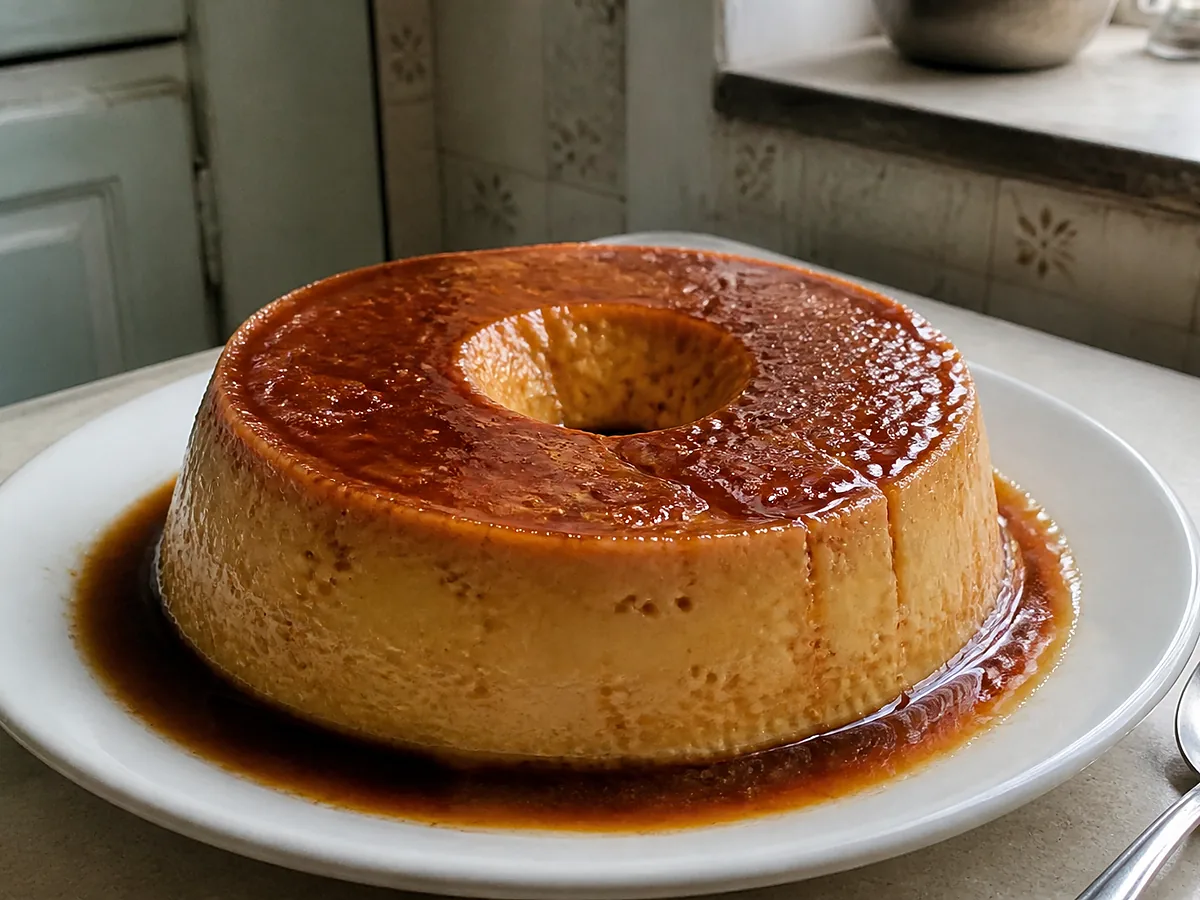
Cuban flan is condensed milk, evaporated milk, eggs, and vanilla poured over a dry-sugar caramel, baked in a water bath until the edges set and the centre still moves, then chilled hard and inverted. That is the home custard.
It is not crème caramel. The French pot is milk or cream, sugar, and a leaner set. This one is canned-milk dense, sweeter, and it should wobble when it leaves the oven, not sit there like cake.
I cook the classic island and home version: one can of each milk, five eggs, vanilla, caramel in the mould. Cream-cheese flan — flan de queso — is a very common Cuban and Cuban-American variant, and it belongs in substitutions, not in the lead bowl.
Doneness is a slight jiggle in the centre, and 75–80 °C / 167–176 °F if you check with a thermometer. Carryover heat finishes the set. If you wait until the custard does not move, you have baked it past flan and into a dry cake that will weep.
The caramel
- 200 g1 cupGranulated white sugardry — no water in the pan
The custard
- 397 g1 can (14 oz)Sweetened condensed milk
- 354 ml1 can (12 fl oz)Evaporated milk
- 250 g5 largeEggs, at cool room temperaturewhole eggs, without shells
- 10 ml2 tspVanilla extract
- 1 g⅛ tspFine salt
Yield and timing
One 20–23 cm flan, 8 to 10 slices. Oven time 50 to 70 minutes depending on mould depth. Chill at least 8 hours. Do not invert warm.
The formula
One can of each milk, five eggs, vanilla. I do not add a third can of whole milk in the lead recipe — that loosens it toward a different custard.
On the caramel
Dry sugar to amber, no water in the pan. Cuban home caramel is often cooked in the mould itself over a flame and swirled as it melts; there is a saucepan method below for a mould that cannot sit on a burner. Sucrose melts around 160 °C / 320 °F and caramelises from there. You want 170–180 °C / 338–356 °F: amber like dark rum, smelling of toasted sugar. Past that you get mahogany, then bitterness, then the sulphur note of burnt sugar — and that smell does not cook out. If you get a struck-match acridity, dump it, wash the pan, and start again. Wet caramel, sugar plus a splash of water, is a French-kitchen habit and more forgiving of hot spots. A labelled departure. The lead is dry.
On the milks
Sweetened condensed milk is milk cooked with sugar until thick — the Cuban sweetener and the dairy concentrate in one can. Evaporated milk is unsweetened concentrated milk, bringing dairy without more sugar. Together they are the home pattern. Whole milk plus sugar plus cream is crème caramel, and I am not writing that. Do not "improve" this with heavy cream. Do not use only condensed milk and skip the evaporated — you will get candy.
On the eggs
Five large eggs for this can-for-can batch. Four makes a softer, more tremulous flan; six makes it bouncier, closer to a sliceable pudding. Whole eggs, not a yolk-heavy French mix: whites give the structure that survives inversion, yolks give colour and fat. Do not whip. Foam is bubbles that bake into a honeycomb, then weep. You want a homogeneous yellow liquid, strained. Egg proteins in a high-sugar dairy mix coagulate higher than in a lean custard — sugar protects. That is why condensed-milk flan is more forgiving than crème caramel, and why it can take 75–80 °C in the centre without scrambling, provided the water bath did its job.
On vanilla and salt
Vanilla extract into the mix is the bottle version. A split bean is a departure I like, but it is not the can-and-bottle home pot. Salt is a pinch — it keeps the sweetness from reading as flat candy. Lime zest shows up in some Cuban household custards, and so does rum; neither is the lead.
Equipment
- A 20–23 cm metal mould at least 5 cm deep, or a Cuban flanera with a lid — metal, not a thin disposable pie tin that buckles in the bath
- A roasting pan larger than the mould, for the water bath
- A kettle of boiling water
- A light-coloured saucepan, if you are not caramelising in the mould
- A bowl, a whisk (not a mixer), and a fine strainer
- An instant-read thermometer
- A thin knife, and a rimmed plate for the invert
Do not use: a blender on high, which makes foam; glass that may crack when boiling caramel hits it; nonstick you care about, because caramel will stain and may wreck the coating; a pressure cooker as the lead — the island-reality version is in the substitutions.
Method
Heat the oven10 min
Oven to 160 °C / 325 °F, rack in the lower third. Boil a kettle.
The custard goes into a hot bath, not a cold pan of tap water that then has to catch up.
Heat oven to 160 °C / 325 °F with a rack in the lower third. Boil a kettle so the custard begins baking in a hot water bath.
Dry caramel8–12 min
Put the sugar in the mould if it can take burner heat, or in a light-coloured saucepan. Medium heat. Do not stir at first. The sugar will look like nothing, then the edges melt and go clear, then gold.
When a third of it is molten, pull the melted part toward the dry with a heatproof spatula, or swirl the pan. Once it is all liquid, watch the colour: pale gold, then amber. It should smell toasted, not burnt.
Off the heat the second it is amber — residual heat keeps cooking. If you used a saucepan, pour it into the mould immediately and tilt to coat the bottom and a little of the wall. Work fast: set caramel is a sheet, and you cannot paint it later.
If it seizes into lumps, low heat and patience will remelt them. If it smokes and smells of sulphur, throw it out.
Let the coated mould cool until the caramel is hard, about 10 minutes — a hot mould starts cooking the custard from below before the bath is even on.
Heat dry sugar over medium in a burner-safe mould or light saucepan, without stirring until one-third melts. Swirl or draw melted sugar into dry patches. Remove the moment it is amber and smells toasted; immediately coat mould bottom and lower sides. Remelt lumps gently; discard burnt, sulphurous caramel. Cool about 10 minutes until hard.
Mix the custard5 min
In a bowl, combine the condensed milk, evaporated milk, eggs, vanilla, and salt. Whisk just until the eggs disappear and the mix is one yellow liquid. No foam.
Strain through a fine mesh into a jug — that catches chalazae and any unmixed white. Skim any bubbles on top, or wait a minute.
Pour onto the cooled caramel. Cover the flanera if you have a lid, or tent foil over a cake pan so dry oven air does not skin the top.
Gently whisk condensed milk, evaporated milk, eggs, vanilla and salt until uniformly yellow, without foam. Strain through fine mesh, skim bubbles or wait a minute, then pour over cooled caramel. Cover with mould lid or tented foil.
Water bath, and bake50–70 min
Set the mould in the roasting pan. Pour boiling water into the pan until it comes halfway up the side of the mould, about 2.5 to 4 cm. Do not splash the custard.
Bake at 160 °C / 325 °F. Start checking at 50 minutes for a 20 cm pan; a deeper flanera can take 65 to 70.
Done: edges set, centre with a slight jiggle — like gelatin that has not quite gone rigid. A knife inserted near the edge comes out clean while the centre still smears a little. Thermometer in the centre: 75–80 °C / 167–176 °F. Not 85 °C. Not a dry cake test.
If the top is browning hard, the oven is too hot or the bath too shallow.
The water bath caps the temperature the mould sees — water cannot go past 100 °C at the sides. Direct oven heat on a metal pan overcooks the wall while the centre is still soup, the egg proteins overcoagulate, and they squeeze out water. That is the curdled, weeping flan.
Set mould in a roasting pan; add boiling water halfway up its sides, about 2.5–4 cm, without splashing custard. Bake at 160 °C / 325 °F, checking at 50 minutes; deeper moulds may need 65–70. Stop at set edges and a slightly jiggling centre, 75–80 °C / 167–176 °F, not 85 °C. If browning hard, check oven heat and bath depth.
Cool, then chillat least 8 hours
Lift the mould out of the bath. Cool on a rack until the metal is no longer hot, about an hour. Then refrigerate — uncovered until cold, then covered — for at least 8 hours, overnight if you can.
The set finishes in the cold. The caramel, which went hard in the mould, absorbs moisture from the custard and becomes sauce again. That is why you wait.
Do not invert warm. Warm flan slumps, and the caramel is still a disk that cracks instead of a sauce that pours.
Remove mould from bath and cool on a rack about 1 hour until no longer hot. Refrigerate uncovered until cold, then covered, at least 8 hours or overnight. Do not invert warm.
Invert2 min
Run a thin knife around the wall, pressed against the metal — not sawing through the custard. Put a rimmed plate over the mould and flip in one motion. Leave it inverted a minute so the caramel drains, then lift the mould.
If a patch of caramel stays stuck, spoon a teaspoon of hot water into the mould, swirl, and pour it over the flan. Do not scrape burnt-black sheets — leave those.
Run a thin knife against the mould wall. Cover with a rimmed plate and invert in one motion; wait 1 minute before lifting. Loosen stuck caramel with 1 tsp hot water and pour over flan, leaving burned black pieces behind.
Storing it
Keeping it
Eggs and dairy: refrigerate. It keeps 3 to 4 days covered. Do not leave a baked flan on the counter all evening after the party. Do not freeze it — ice crystals wreck the gel, and the caramel weeps into a syrup that will not cling.
On undercooked custard
If the centre was under 70 °C / 158 °F and still liquid after baking, that is not a style — it is undercooked egg. Return it to the bath while still hot, or throw it out. I do not serve a warm, just-barely-set flan as a food-safety workaround, and the invert wants a full chill anyway.
Troubleshooting
- The centre is soup after the chill.
Undercooked, or you inverted too soon and it collapsed. Next time: 75–80 °C in the centre, and a full chill. You cannot recook a chilled flan without scrambling it.
- Curdled, grainy, weeping.
Overcooked — oven too hot, no bath, or you waited until it did not jiggle. There is no fix. Next time: bath, lower heat, pull at the jiggle.
- Bubbles, or a honeycomb texture.
You whipped the eggs. Whisk gently, strain, skim the foam.
- The caramel tastes of sulphur, or is black.
Burnt — you took the sugar past amber. Start over. Do not use it.
- The caramel seized into a sandy rock.
Stirred too early, or crystals on the wall. Swirl, do not whisk. If it is still pale and lumpy, low heat will remelt it; if it is brown and sandy, start over.
- Stuck to the mould, ragged invert.
Not chilled long enough, or you did not loosen the wall. Overnight helps, and a warm knife around the edge.
- A hard caramel disk, and no sauce.
You inverted before the caramel had redissolved, or took it too dark and it set like glass. Full chill, and stop at amber next time.
- Too sweet, one-note.
Condensed milk is the formula. A pinch of salt and decent vanilla are the correction — not cutting the condensed with water.
- A brown skin on top.
Oven too hot, or uncovered under a blasting upper element. Foil tent, lower third of the oven.
Substitutions
Traditional — this recipe
Dry-sugar caramel in the mould. One can condensed, one can evaporated, whole eggs, vanilla. Water bath. Chill. Invert.
Acceptable home shifts
4 eggs for a softer set, or 6 for firmer. Lime zest, about a teaspoon. A split vanilla bean instead of extract. A flanera with a lid, or a metal cake pan if you do not own one.
Flan de queso, the common variant
Beat 226 g of full-fat cream cheese smooth with the condensed milk, then whisk in the evaporated milk, 4 or 5 eggs, vanilla, and salt. Denser, slightly tangy. Very common in Cuban and Cuban-American kitchens — but not the lead bowl.
Departures, named as such
Crème caramel, with milk, cream, sugar and no canned milks. Coconut milk. Wet caramel. Heavy cream added to "enrich." Whipped egg whites folded in.
The pressure cooker, as an island reality
A lidded flanera in 2–3 cm of water in the olla de presión is ordinary Cuban home practice, because the oven was not always the tool and fuel was. It is not my first method here. High pressure 10 to 12 minutes, natural release. Still a full chill before the invert, still 75–80 °C if you check. Cookers and mould sizes vary: undercook and you have soup, overcook and you have bubbles and whey.
Scaling
The unit is the can: one condensed, one evaporated, five eggs, one mould.
Two flans, or half a flan
For two flans: two batches, two moulds, two baths — or a very large roasting pan with space around each mould. Do not double into one deep pot; the centre will still be soup when the walls are curdled. Half batch: 200 g condensed (weigh it), 175 ml evaporated, 3 eggs, 100 g sugar for the caramel, and a smaller 15 cm mould. Start checking at 35 to 40 minutes. The thermometer target does not change.
What to serve it with
A plate. The caramel is the sauce.
- Espresso, or café con leche
- A little rum, for the adults
- Fresh pineapple or mango, if you want something not-sweet beside it
I do not serve this with whipped cream as a default — the custard is already canned-milk rich. Dulce de leche can sit on the same plate, but do not confuse it with the dry-sugar caramel you cooked in the mould.
Questions
Is this crème caramel?
No. Same family — egg custard, caramel, invert — but different dairy, different sweetness, different set. I am not writing the French pot.
Why condensed milk?
That is the Cuban home dairy: cheap, stable, sweet, concentrated. Island and diaspora kitchens cooked with the can.
Can I use only condensed milk?
You will get a candy-dense brick. Keep the evaporated.
Should I just make flan de queso?
If that is the flan your house makes, make it — the formula is in the substitutions. This page leads with the condensed-and-evaporated custard.
Do I have to invert it?
That is the dish. A custard eaten from the mould is a baked pudding with caramel stuck to the bottom.
Water bath or not?
Bath. Direct heat curdles the walls.
Pressure cooker?
Island reality, labelled departure. Oven and bath are the method of record.
How do I know it is done?
Edges set, centre jiggles, 75–80 °C / 167–176 °F. Then a full chill. Then invert.