Pollo Guisado
Bone-in chicken braised in fried recaíto and tomato until the sauce clings in a rust-orange coat. If it runs off the chicken like soup, you cooked asopao weather.
- Prep
- 40 min
- Cook
- 1 hr 15 min
- Serves
- 4–6 plates with rice and beans
- Difficulty
- Medium
Researched · Kitchen testing pending
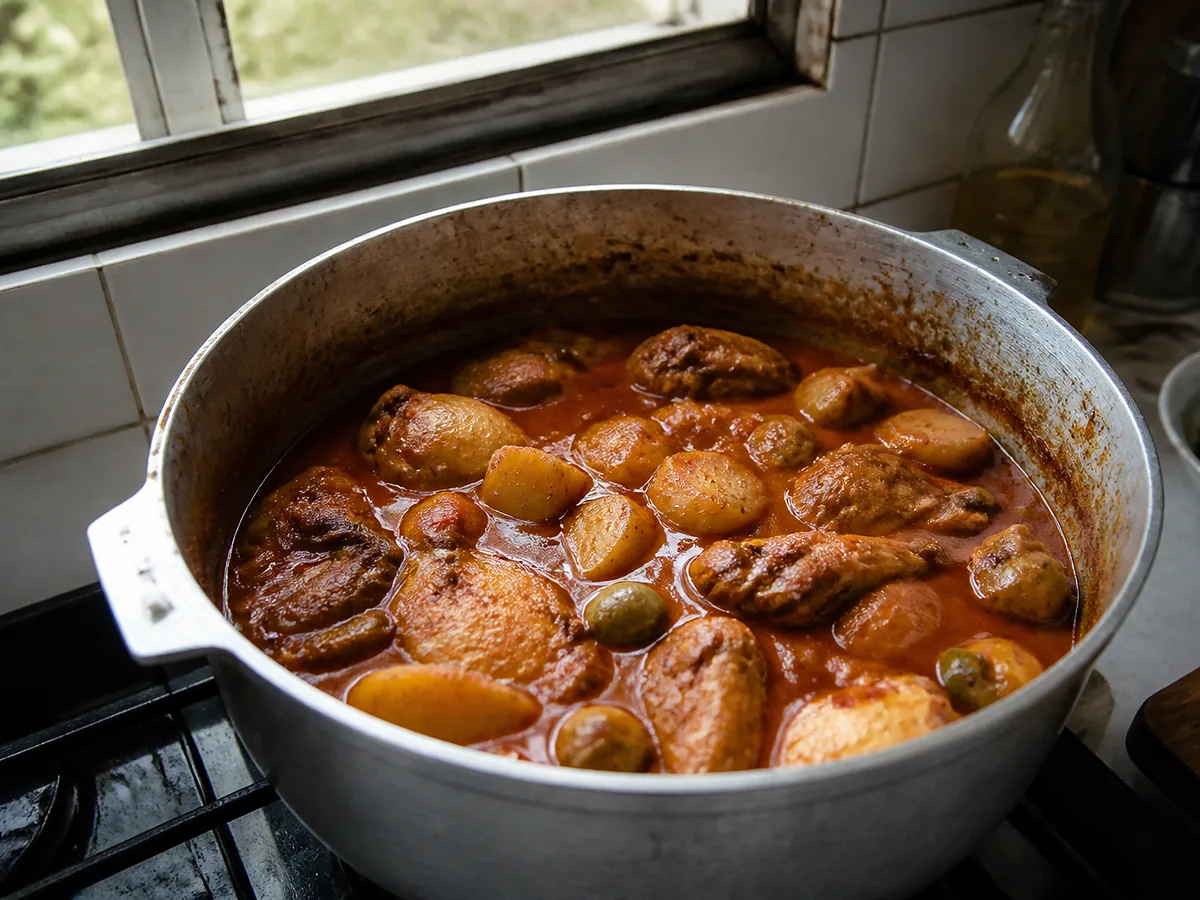
The spoon is the test I trust.
Pollo guisado is bone-in chicken braised in recaíto and tomato until the sauce clings in a rust-orange coat — olives in it, oregano in the steam, achiote in the colour. If the liquid runs off the chicken like soup, you cooked asopao weather, not this stew.
Asopao wants wet rice in the same pot. This pot wants white rice on the side, habichuelas next to it, and a sauce that stains the grain instead of flooding the plate.
I brown the pieces first. That is not restaurant theatre — the fond in the caldero is what keeps a tomato-recaíto braise from tasting like boiled chicken in ketchup. Skin-on, bone-in. I do not make this with boneless breasts.
Potatoes go in if the house wants them; I label them so you can leave them out without thinking I hid a rule.
Recaíto — the green base
- 25 g8–12 leavesRecao (culantro) leaves, thick stems trimmed
- 20 g⅓ packed cupCilantro, leaves and tender stems
- 80 g½ mediumYellow onion, rough-chopped
- 60 g½ pepperCubanelle or Italian frying pepper, seeded, rough-chopped
- 40 g6–8 peppersAjíes dulces, stemmedif you cannot find them, add 40 g more cubanelle and say so
- 18 g5–6 clovesGarlic, peeled
- 30 ml2 tbspWateronly if the blender needs a splash to turn
Chicken and the first seasoning
- 1.6 kg3½ lbBone-in, skin-on chicken — mixed thighs and drumsticks8 to 10 pieces, extra fat flaps trimmed, patted dry
- 10 g1¾ tspKosher salt, for the chicken
- 4 g1 large cloveGarlic, mashed to a pasteor 3 g garlic powder
- 2 g1 tspDried oregano, crumbled
- 2 g1 tspBlack pepper, freshly ground
- 5 ml1 tspWhite vinegar or bitter orangerubbed on the pieces
- 8 g1½ tspSazón with achioteor homemade — 3 g salt, 2 g ground coriander, 1 g cumin, 1 g garlic powder, 1 g ground achiote
The braise
- 45 ml3 tbspAchiote oilor neutral oil plus 3 g ground achiote bloomed in it
- 30 g2 tbspTomato paste
- 240 g1 cupTomato sauce, plainunsalted if you can get it. Not pasta sauce. Not ketchup
- 350–450 ml1½–1¾ cupsWater or light chicken stock, warmstart low — add, do not flood
- 80 g½ cupPimiento-stuffed manzanilla olives, drained
- 15 ml1 tbspOlive brineheld for the end, if the pot tastes flat
- 2 leaves2 leavesDried bay leaves
- 2 g1 tspDried oregano, for the sauce
- 1 g½ tspGround cuminoptional, only if the sazón was pale
- 3 g½ tspKosher salt, for the potthen taste after the olives
- 1 g½ tspBlack pepper
Potatoes — a labelled house choice
- 400 g14 ozWaxy potatoes, peeled, in 3 cm chunkssome island pots always carry potato, some never. Not a requirement of the name
Yield and timing
4 to 6 plates with rice and beans. About 40 minutes of active work, then a 40 to 55 minute braise — around 1 hour 40 minutes total, plus recaíto if you start from leaves. Better the next day. The recaíto above makes about 180–200 g. Leftovers freeze in spoonfuls. Jarred recaíto is a weekday stand-in; fry it the same way.
On the chicken
Bone-in pieces. The bone keeps the meat from going stringy in a 45-minute braise, and the skin gives you fat for the recaíto. Thighs and drums are what I buy on purpose. A whole bird cut up is the Sunday version — breasts cook faster, so nestle them on top and pull them at 74 °C / 165 °F, then finish the dark meat. Boneless skinless breast in this sauce tastes like banquet chicken. Pat the chicken dry: wet skin steams and will not brown. The first seasoning is salt, garlic, oregano, pepper, and a smear of vinegar — adobo as a paste on the meat, not only a shaker.
On recaíto
Recaíto is recao, cilantro, ají dulce, onion, cubanelle, garlic, blended wet, no tomato. Recao (culantro) is the island smell; cilantro alone is a named substitute, greener and less persistent. Ají dulce is aromatic, not hot — jalapeño is the wrong pepper. Fry recaíto until the raw leaf smell turns sweet, because water in the herbs has to leave before tomato goes in. Jarred recaíto is how many weekday kitchens actually cook. Fry it the same.
On tomato, sazón, and achiote
Tomato sauce for volume, paste for body. Fry the paste on the metal until it darkens a shade and the tinny smell goes. Seasoned pasta sauce is Italian-adjacent. Achiote is colour and a peppery, earthy bottom. Sazón with achiote is the packet in the drawer: salt, coriander, cumin, garlic, oregano, annatto. If you already salted the chicken hard, taste before you dump a second packet. Turmeric is not the colour I want here.
On olives and potatoes
Manzanilla with pimiento, added in the last 15 minutes so they warm and leak brine without going flabby. Potatoes are optional and they drink sauce. Cut them large and add them when the chicken has about 20 to 25 minutes left. If you skipped potato and want a thicker coat, reduce uncovered — potato starch is not the thickener of record; reduction is.
On what this is not
This is not asopao. Asopao is a wet rice stew, spooned from a bowl. Pollo guisado is a braise served beside dry white rice. This is not Cuban arroz con pollo; the rice does not cook in this pot. If I wanted broth I would have made sopa.
Equipment
- A 6 to 7 L caldero or wide Dutch oven with a lid — wide matters, because a tall stockpot steams the recaíto and will not reduce the sauce to a coat
- Tongs and a wooden spoon
- An instant-read thermometer
- A blender, or a pilón, for the recaíto
Do not use as the headline method: a slow cooker; a blender to "finish" the sauce; boneless chunks in an Instant Pot. A pressure cooker exists in island kitchens as a weekday shortcut, and the times are in the substitutions — but you still brown first, and you still reduce uncovered at the end.
Method
Recaíto, and season the chicken15–20 min
Blend the recao, cilantro, onion, cubanelle, ajíes dulces, and garlic to a coarse paste — not a juice. Water only if the blades stall. Raw recao smells pungent, almost metallic-green. That is correct; it will change in the fat.
Pat the chicken dry. Rub with the salt, mashed garlic, oregano, pepper, and vinegar. Let it sit 15 minutes at room temperature while the pot heats. Do not wet-brine it.
Pulse recao, cilantro, onion, cubanelle, ají dulce and garlic to a coarse paste; add water only if blades stall. Dry chicken, rub with salt, mashed garlic, oregano, pepper and vinegar, and leave 15 minutes at room temperature while heating the pot.
Brown the chicken12–16 min
Heat the caldero over medium-high and add the achiote oil. When it shimmers and smells of annatto rather than raw oil — about 160–170 °C / 320–340 °F at the metal — lay in the chicken skin-side down, in batches. Crowding drops the temperature and the skin goes grey.
Leave them 4 to 6 minutes. The skin should release when it has colour: deep gold, some mahogany spots, not black. Flip for 3 to 4 minutes.
You are not cooking the chicken through. You are building fond and rendering fat.
Lift to a tray and pour off all but about 45 ml of fat. The brown bits are the dish. If they are black, wipe the pot and start the fat again — burnt achiote is bitter forever.
Skipping this step is how you get cafeteria pollo guisado.
Heat achiote oil over medium-high, with pan at 160–170 °C / 320–340 °F. Brown chicken in batches, skin-down 4–6 minutes until it releases, then 3–4 minutes on the other side. Remove and retain 45 ml fat. Keep brown fond; if black, clean the pot and restart the fat.
Fry the recaíto6–8 min
Drop the heat to medium and add the recaíto. It will sputter. Stir, scraping the fond into the paste, 6 to 8 minutes.
Water leaves. The paste darkens a shade, looks oily at the edges, and smells sweet-green instead of raw. If it sticks, a spoon of water and a scrape. Medium is enough — garlic in the paste burns if you crank it.
Raw allium and chlorophyll taste grassy until the water cooks off, and the fat-soluble aromatics in recao and ají dulce bloom in oil, not in a flood of tomato.
Reduce to medium and add recaíto. Stir and scrape up fond for 6–8 minutes until darker, sweet-smelling and oily at the edges. If sticking, add a spoonful of water and scrape; do not scorch the garlic.
Paste, sauce, spices5–7 min
Push the recaíto aside and drop the tomato paste on the hot metal. Fry 1 to 2 minutes until it turns brick and smells caramelised, not tinny. Stir it in.
Add the tomato sauce, sazón, oregano, cumin if using, bay, salt, and pepper. Cook 3 to 4 minutes until the sauce bubbles thickly and little orange beads of oil show at the rim.
Those beads mean the water has left and the fat has emulsified with the tomato. A pale watery sauce now will only get thinner when the chicken and stock go in.
Push recaíto aside and fry tomato paste against the pan 1–2 minutes until brick-red and caramelised; stir together. Add tomato sauce, sazón, oregano, optional cumin, bay, salt and pepper. Cook 3–4 minutes until thick with orange oil beads.
Return the chicken and braise40–55 min
Nestle the chicken in, skin up, with any tray juices. Pour 350 ml of warm water or stock around the pieces, not over the skin. Liquid should come a little more than halfway up the meat. If you cover the chicken you are making soup.
Bring to a boil, then drop at once to a lazy simmer: small bubbles, 90–95 °C / 195–203 °F in the sauce. Lid ajar. A hard boil tightens the meat and can break the emulsion into grease and water.
At 20 minutes, turn the pieces. If the pot looks dry and the paste is catching, add 50 to 100 ml of hot water. If it looks like broth, lid off and let water leave.
*Potatoes, if using:* tuck the chunks in at minute 20 to 25. They need 20 to 25 minutes at a simmer — a knife should slide in with a little resistance.
Doneness: 80–85 °C / 176–185 °F in the thickest thigh for dark meat you want to pull from the bone. Food safety is 74 °C / 165 °F, but thighs have collagen that is nicer a little higher. Rubbery means the simmer was a boil, or you stopped at temperature without giving collagen time.
Return chicken skin-up with juices; add 350 ml warm water or stock around it, just above halfway up. Boil, then simmer lid ajar at 90–95 °C / 195–203 °F for 40–55 minutes. Turn at 20 minutes; add 50–100 ml hot water if catching or uncover if watery. Add optional potatoes at 20–25 minutes; cook 20–25 minutes until knife-tender. Thighs should reach 80–85 °C / 176–185 °F; if using breast, remove at 74 °C / 165 °F.
Olives, and reduce to a coat8–12 min
Stir in the olives. Lid off. Raise to a lively simmer.
You want the sauce to go from wet to a coat that leaves a trail when you drag the spoon — 8 to 12 minutes, sometimes 15 if you were heavy-handed with stock.
Taste for salt now; olives are salt. If the pot is round and sweet but tired, add the tablespoon of olive brine or a squeeze of bitter orange. Acid keeps tomato from reading as jam.
Pull the bay. Rest 10 minutes off the heat — as it cools from a boil the sauce clings.
Finished: rust-orange, flecked green from recaíto, oil in small beads, olives visible, chicken lacquered. A spoonful of sauce should sit on rice, not fill the well of the plate.
Add olives and simmer briskly uncovered 8–12 minutes, up to 15 if watery, until sauce leaves a spoon trail. Taste before salting; add 1 tablespoon olive brine or sour orange if flat. Remove bay and rest off heat 10 minutes; sauce should cling to chicken and rice.
Storing it
Keeping and reheating
Cool with the lid off until the steam stops, then refrigerate in shallow containers within 2 hours. Keeps 3 to 4 days at 4 °C / 40 °F or below. Reheat to a simmer, 74 °C / 165 °F in the centre of a piece, stirring so the sauce does not scorch. The sauce tightens in the fridge; a splash of water brings it back. Bone-in chicken in thick sauce hides cold pockets — reheat in a pot, not a microwave.
Freezing
Freezes 2 to 3 months. Potatoes get mealy after a freeze, so if you know you are freezing, leave them out. Thaw in the refrigerator.
Troubleshooting
- The sauce is thin, like soup.
Too much water, lid on, heat too low, or you never fried the paste. Uncover, lively simmer, 10 to 20 minutes. Do not add flour or cornstarch.
- It tastes like raw cilantro and onion.
The recaíto did not fry long enough. Cook uncovered another 8 to 10 minutes. Do not dump sugar on it.
- It tastes like the can.
The paste went in without frying. Fry a spoon of paste in a little oil on the side, stir it in, and simmer 10 minutes.
- The chicken is dry and stringy.
A boil instead of a simmer, boneless breast, or you reduced until the pot was frying the meat. For this batch: a ladle of hot water, lid on, 5 minutes off the boil.
- The chicken is rubbery and will not pull from the bone.
Undercooked collagen, or a hard boil. Return to a true simmer. Rubbery at 25 minutes is often time, not a bad bird.
- It is pale.
No achiote, no paste fry, timid browning. A pinch of achiote bloomed in oil will paint it. It will not invent fond.
- It is too salty.
Sazón plus salted sauce plus olives plus adobo. Add a peeled chopped tomato or a splash of water. Next time, salt after the olives.
- It tastes bitter.
Achiote or garlic burned. If the fond is black, do not scrape it in.
- Potatoes still hard, chicken done.
Scoop the chicken to a tray and simmer the potatoes in the sauce 8 to 10 minutes more.
- The potatoes dissolved.
Too small, or they went in at the start. Next time, 3 cm chunks at minute 20.
Substitutions
Traditional, in my practice
Bone-in chicken, browned in achiote oil; recaíto fried; tomato sauce and paste; sazón with achiote, bay, oregano, manzanilla olives; sauce reduced to a coat; white rice and habichuelas on the plate. Potatoes are a common island addition I label. Recao in the recaíto is the herb I want.
Acceptable home shifts
Jarred recaíto. A packet of sazón. Cilantro if recao is missing. Cubanelle if ají dulce is missing. Water instead of stock. A Maggi cube in a house that always uses one — I would rather salt and sazón, but I will not pretend the cube is foreign to the island.
Departures, named as such
Boneless breast as the only cut. Skipping the browning. Flour or cornstarch to fake a coat. Pasta sauce. Turmeric for colour. A slow cooker as the method. Blending the sauce smooth. Turning it into asopao by adding rice to this liquid.
Pressure cooker, labelled
Brown as written, recaíto and tomato as written, then high pressure 10 to 12 minutes for thighs and drums, natural release 8 to 10 minutes, then lid off and reduce to a coat for 8 to 15 minutes. A weekday departure, not the headline pot. The sauce still has to reduce — pressure does not concentrate.
Scaling
Braise time does not double.
For a bigger table
For 8 to 10, double the chicken and recaíto, use a wider pot or two calderos, and do not double the water automatically — cover to the same height, halfway up. Brown in batches.
What to serve it with
White rice — long-grain, steamed, each grain separate.
- White rice
- Habichuelas guisadas on the same plate
- Tostones, if the table wants something fried
That is the weekday plate I mean. I do not serve this over pasta.
Questions
Can I use a whole chicken?
Yes. Cut it up, and pull the breasts when they are done.
Do I have to use recao?
Without it you are closer to a generic cilantro-onion stew. Frozen recao exists in some markets. Cilantro is the named substitute, not the first choice.
Why not more liquid?
Because you want a coat, not asopao. You can always add a splash.
Can I make it in a pressure cooker?
Yes, as a labelled departure. Brown first. Reduce after.
Is sazón cheating?
It is the drawer. Homemade or packet, the point is coriander, cumin, garlic, oregano, achiote, salt.
How do I know the sauce is ready if I do not trust the clock?
Drag a spoon. It should leave a trail that fills slowly. The chicken should be lacquered, not swimming.
Next-day?
Yes. Cool fast, refrigerate, reheat to a simmer with a splash of water.