Asopao de Pollo
Soupy rice with bone-in chicken and sofrito — thicker than soup, wetter than arroz con pollo. Pull it off the heat before it looks right, because the rice keeps drinking.
- Prep
- 15 min
- Cook
- 1 hr 10 min
- Serves
- 6 in bowls, or 4 with leftovers
- Difficulty
- Medium
Researched · Kitchen testing pending
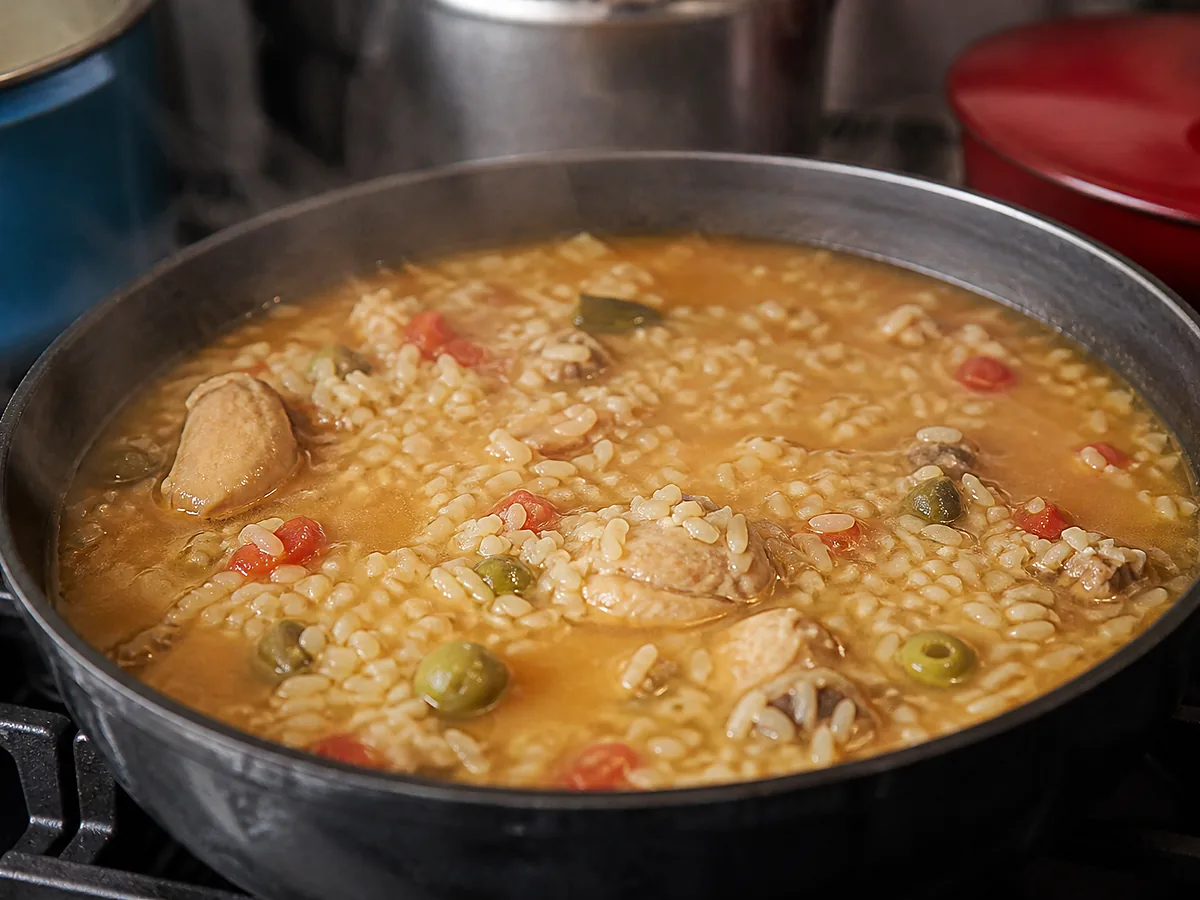
I make asopao de pollo when the house needs a bowl more than a plate.
The steam off this pot hangs lower and wetter than arroz con pollo; it smells like chicken skin meeting sofrito, not like rice toasting in fat, and a wooden spoon stands for a second in the finished pot before it falls.
I cook it on a Sunday with extra meat on the bone, on a Wednesday from whatever thighs are in the fridge, and when someone is sick, with more broth, more cilantro, and lime at the table. Same pot: a soupy rice thicker than soup and wetter than a plate of arroz.
This is not gumbo. No roux, no okra, no filé — the thickener is the rice itself as it blows open and sheds starch.
I do not put gandules in this asopao. Pigeon peas belong, in my kitchen, to arroz con gandules; they muddy the chicken broth and turn this toward a different Sunday. If your family adds them, that is a labelled departure.
Chicken and seasoning
- 1.6–1.8 kg3½–4 lbBone-in, skin-on chicken — thighs, drumsticks, and one breast split in twobones matter. Boneless asopao tastes like it skipped a step
- 12 g2 tspKosher salt
- 4 g1 tspAdobo without pepperor salt, garlic powder, and oregano if you are out
- 2 g½ tspBlack pepper
- 15 ml1 tbspOlive oil or achiote oil, for browning
The sofrito base
- 30 ml2 tbspAchiote oilor olive oil plus 3 g annatto seeds, warmed and strained
- 120 g½ cupSofritorecao, ají dulce, onion, cubanelle, garlic — the green wet paste
- 120 g1 cupYellow onion, small diceif your sofrito is light on onion
- 4 cloves4 clovesGarlic, mashed
- 200 ml¾ cupTomato sauce
- 15 g1 tbspTomato pasteoptional, when the sauce tastes thin
- 2 g1 tspDried oregano, crumbled
- 1 leaf1 leafBay leaf
- 4 g1 tspSazón with achiote
- 2 g½ tspGround cumin
Liquid and rice
- 2.3 L9½ cupsWateror 1.5 L water plus 800 ml unsalted chicken stock. The bones make the broth
- 300 g1½ cupsMedium-grain ricedo not rinse it hard — you want the surface starch. Long-grain stays too separate
- 80 g½ cupManzanilla olives, whole or halvedplus 15 ml of the brine
- 60 g⅓ cupPimientos, slicedor roasted red pepper in a pinch
- 15 g1 tbspCapers, drainedoptional — I add them when I have alcaparrado
- 20 g¾ cup packedCilantro — stems finely chopped, leaves roughly choppeddivided. Plus 2 recao leaves, chopped, folded in with the stems
- to tasteto tasteLime wedges, for the table
Yield and timing
Serves 6 in bowls, or 4 with leftovers that thicken overnight. About 1 hour 15 minutes, including a 20-minute simmer and a 10-minute covered rest. The rice keeps drinking after you kill the heat.
What I am not adding, labelled
No gandules, no okra, no andouille, no shrimp unless I am openly switching recipes. A smoked turkey wing or jamón de cocinar is a Sunday departure — I leave it off the weekday pot so chicken stays in front.
On the rice
Medium grain is the right starch for this: it blows and thickens. 300 g of rice to about 2.3 L of liquid at the start, knowing some steam leaves and the chicken contributes juice. That lands in asopao territory — not soup with a few grains, and not a wet arroz. Leftover cooked rice is a different, lesser pot; the grains will not shed the same starch. Add it raw. Stir, but do not beat. Beating breaks grains into mush. A scrape of the bottom every few minutes is enough. A dry hiss means add a splash and drop the flame.
On the broth
It should taste of chicken, recao, tomato, and annatto, in that order. Water plus bones plus a proper brown is enough. Do not drown it in bouillon cubes — they make it taste like a packet, and the olives then scream salt. If bouillon is all you have, use half a cube and hold the added salt until the end. Achiote is colour and a gentle peppery floor. Without it the pot looks brown-red and still tastes like asopao, just less like the island pot I know.
On consistency — the whole trick
Thicker than soup, wetter than arroz con pollo. In the bowl, the rice should mound slightly when you tilt it, then slump. You eat it with a spoon; a fork is a sign you went too far. Off the heat, ten minutes changes everything: grains that looked separate relax, and the liquid goes from shiny to creamy. If you wait until the pot looks like the asopao you want to eat, it will be arroz con pollo by the time you sit down. Day-two asopao without extra liquid is porridge.
Equipment
- A 6–7 L caldero or heavy Dutch oven with a lid
- Tongs, a wooden spoon, a ladle
- A thermometer for the chicken at the bone, until you know your stove
Method
Season and brown the chicken10 min
Pat the pieces dry and season all over with the salt, adobo, and pepper.
Heat the tablespoon of oil in the caldero over medium-high until it shimmers, about 1 minute. Skin-side down, in batches if you must, brown 4 to 5 minutes per side until the skin is deep gold and the fond on the bottom is brown, not black.
You are not cooking it through. You want 160–175 °C / 320–350 °F at the metal — hot enough that the skin releases and the fat renders, not so hot that the garlic later burns in a scorched crust.
Set the chicken on a plate. Leave 30–45 ml of rendered fat and spoon off the rest.
Dry chicken and season with salt, adobo and pepper. Heat 1 tablespoon oil over medium-high 1 minute, keeping the pan at 160–175 °C / 320–350 °F. Brown skin-down first, 4–5 minutes per side, in batches. Remove; retain 30–45 ml fat and discard excess.
Build the sofrito8 min
Drop the heat to medium. Achiote oil into that fat until the colour blooms, 30 seconds. Onion, if using, 3 minutes until translucent. Sofrito and mashed garlic, stirring, 3 to 4 minutes.
The raw recao smell should turn sweet and the paste should look a shade darker, with the oil separating in orange-green beads around the edge. If it sticks and smells bitter, splash in a tablespoon of water and scrape.
Tomato sauce, tomato paste, oregano, bay, sazón, cumin. Cook 2 to 3 minutes until the tomato loses its tinny edge and thickens to a jam that coats the spoon. That jam is why the finished asopao tastes round instead of watery-red.
Reduce to medium. Add achiote oil 30 seconds, optional onion 3 minutes, then sofrito and garlic 3–4 minutes until sweet and oily. If sticking, add 1 tablespoon water and scrape. Add tomato sauce, optional paste, oregano, bay, sazón and cumin; cook 2–3 minutes until jammy.
Liquid, chicken back, simmer22 min
Pour in the water — or water and stock — and scrape the fond. It should smell like chicken and annatto, not burnt sugar.
Bring to a lively simmer, 95 °C / 203 °F, not a furious boil. Rolling boils emulsify fat into the broth and shred the chicken too soon.
The browned pieces go back in, skin side up, with any juices from the plate. Lid ajar. Simmer 20 to 22 minutes, until a thigh at the bone reads about 71 °C / 160 °F — close, not done.
The broth should taste salted but not finished; the rice will mute it. Skim large rafts of foam, not every drop of orange fat.
Add 2.3 L water or the listed water-stock mixture; scrape the fond. Bring to a lively 95 °C / 203 °F simmer, never a rolling boil. Return chicken skin-up with juices; simmer lid ajar 20–22 minutes to about 71 °C / 160 °F near the thigh bone, not yet done. Skim large foam patches.
Rice in2 min
Sprinkle the rice around the pot, not in a clump, and stir once so every grain gets wet.
Olives, brine, pimientos, capers if using, and the chopped cilantro stems and recao. Cilantro leaves go at the end so they stay green.
Taste the broth now and add salt if it does not taste almost too seasoned. The rice is about to dilute it.
Sprinkle in raw medium-grain rice without heavy rinsing; stir once to wet all grains. Add olives, brine, pimientos, optional capers, cilantro stems and recao. Reserve cilantro leaves. Taste and salt until strongly seasoned before the rice absorbs broth.
Cook to soupy, not dry16–18 min
Keep a steady simmer, lid ajar, stirring every 3 to 4 minutes so the rice does not cake on the bottom.
After 12 minutes the grains are still firm in the centre and the liquid looks like a thick soup. After 16 to 18 minutes the rice is just past al dente, the broth has turned cloudy-gold and silky, and a ladle of it coats the back of a spoon but still pours.
That is when you pull the pot off the heat. The rice continues to swell off heat.
The chicken should now be 74 °C / 165 °F at the bone, juices clear, meat clinging but not falling into threads — unless you want it that way for a sick-day bowl. If a breast is dry, pull it, shred it, and return it at the rest.
Simmer lid ajar 16–18 minutes, scraping gently every 3–4 minutes; grains remain firm at 12. Stop when rice is just past al dente and silky broth coats a spoon but pours. Chicken must reach 74 °C / 165 °F near the bone. If breast is dry, remove, shred and return during the rest.
Rest, cilantro, adjust10 min
Lid on, heat off, 10 minutes. Then stir in the cilantro leaves.
The pot will have tightened. If it is thicker than a stew, loosen with 120–240 ml of hot water or stock and salt again. If it is still brothy like consomé with rice floating, either you made a sick-day pot on purpose or you under-riced it — simmer two minutes more.
You want a spoonful that is wet enough to require a bowl and thick enough that the rice and broth arrive together.
Lime at the table. Do not boil lime into the pot — it goes grey.
Rest covered off heat 10 minutes; add cilantro leaves. If thicker than stew, add 120–240 ml hot water or stock and adjust salt; if still thin, simmer 2 minutes more. Serve spoonable and creamy with lime wedges; do not boil lime into the pot.
Storing it
It keeps swelling
Cool in shallow containers. Refrigerated, 3 days. The rice will swell until the leftovers look solid. Reheat in a pot with 60–120 ml of water per bowl, stirring over medium-low until it loosens to the original nap, 8 to 10 minutes, and add fresh cilantro. A microwave works if you stir halfway and add water; it will not taste as round.
Freezing, and holding
Freeze up to 2 months, knowing the rice will be softer on the thaw. Thaw overnight in the fridge and reheat with more water than you think you need. Do not hold it warm all afternoon. Bring it back to a simmer, 85–90 °C / 185–195 °F, to serve.
Troubleshooting
- It turned into arroz con pollo.
Too little liquid, too much time on heat after the rice went tender, or you skipped the rest and then returned it to a boil. Loosen with hot stock, 120 ml at a time, and stop at nap.
- It is thin and the rice is blowing apart.
The heat was a boil, not a simmer — or you used long-grain and then cooked it until it split trying to get body. Body comes from starch and time, not from violence. Next pot: medium grain, a 95 °C simmer, pulled earlier.
- The chicken is dry.
Breast left in too long, or boneless pieces. Shred what you have, moisten it in the broth, and use thighs next time. A thermometer at the bone is not fussy; it is how you stop guessing.
- It tastes flat.
Under-salted broth before the rice went in, sofrito not cooked long enough, no olive brine, cilantro stems skipped. Fix a flat finished pot with brine, a spoon of sofrito fried in a side pan for 2 minutes and stirred in, and lime.
- It tastes salty.
Olives plus sazón plus adobo on the chicken plus salted stock. Add unsalted hot water, and more cilantro. Next time, season the chicken lighter and salt the broth at the end.
- There is a greasy slick.
You browned at too low a heat and the fat never flavoured the fond, or you boiled hard. Skim with a spoon. A few ice cubes in a ladle, touched to the surface, pick up fat — I do that for a sick-day bowl.
- I added gandules out of habit.
The pot is still edible. It is no longer this recipe. Say so.
Substitutions
Traditional, in my practice
Bone-in chicken, sofrito, tomato, medium-grain rice cooked past a pilaf into a spoonable stew, olives and pimiento, cilantro, achiote, no pigeon peas. Weeknight timing, Sunday quantity, sick-day looseness. Served in bowls, sometimes with tostones or avocado.
Departures I will make
A smoked turkey wing on Sunday. Extra recao. Pulling the chicken, shredding it, and returning it for a child who will not work around a bone. A handful of frozen peas at the end for colour in a mainland kitchen.
Departures I will not treat as the lead
Shrimp asopao — a real pot, but a labelled substitution. Gumbo logic. Risotto technique with ladle-by-ladle stock and wine. A baking-dish "asopao" that sets like a casserole.
Scaling
The rice-to-liquid ratio is the recipe. Scale both, and still pull the pot early.
Sick-day looseness
Add an extra 400–500 ml of water with the broth and keep the cilantro generous. It should drink like a soup with rice in it — still seasoned, still chicken. Toast on the side, and lime.
Starting in the morning
Cook the chicken and broth in the morning, cool it, and add the rice 25 minutes before you eat. If the rice sits in the pot from noon, you will serve porridge at supper.
What to serve it with
Bowls, not plates.
- Lime wedges
- Tostones
- Avocado
- Toast, on a sick day
Questions
Can I use white meat only?
You can. Pull it at 74 °C / 165 °F and let the rice finish in the broth without it, then return it. Thighs forgive more.
Do I have to brown the chicken?
I have skipped it on a sick day and the pot still works — it tastes flatter, more like boiled chicken and rice with sofrito. Browning is the Sunday in the weekday.
Medium-grain or short-grain?
Medium. Short-grain can go sticky. Long-grain never quite thickens unless you overcook it to mush.
Can I make it in a rice cooker?
Not this texture. You need access to stir, taste, and add liquid.
Pigeon peas or not?
Not, in this recipe — my call, labelled. If I want gandules I make arroz con gandules, which is a drier, different pot.
What about asopao de camarones?
Swap in 700 g of shrimp, same sofrito, quicker simmer, shrimp only for the last 4 to 5 minutes. A substitution, not this lead recipe.
Is this gumbo?
No. No roux, no okra as the thickener, no filé, no celery-bell-pepper-onion in the Louisiana sense. Sofrito is a different aromatic, and the rice is the body.