Alcapurrias
Yautía and green banana masa, orange from achiote, smeared around cold picadillo and fried naked in deep oil until the crust blisters. Kiosco food.
- Prep
- 1 hr 10 min
- Cook
- 45 min
- Serves
- 12 torpedoes
- Difficulty
- Hard
Researched · Kitchen testing pending
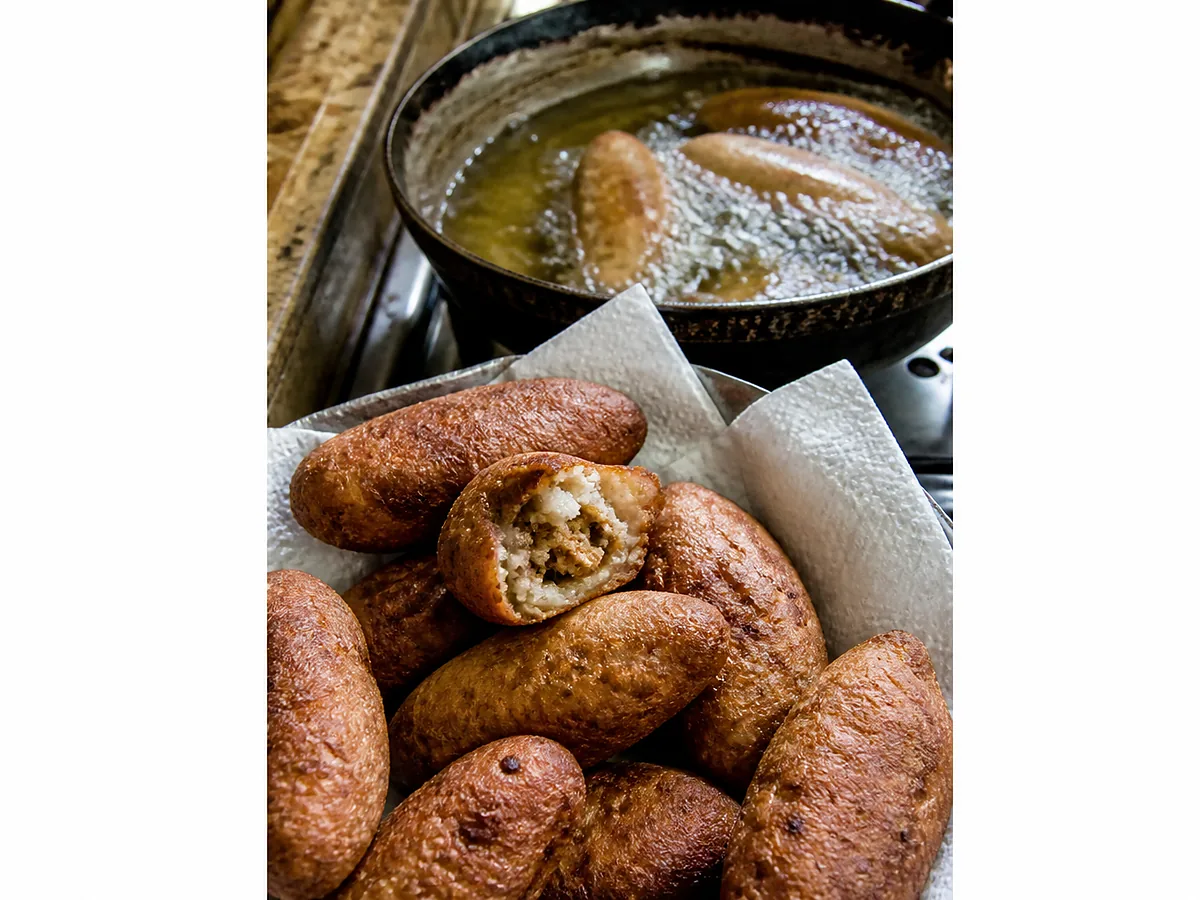
Alcapurrias belong to the caldero: green banana and yautía masa, pale orange from achiote, stuffed and fried until the crust thins and the filling steams recao into the air. Loíza and the kioscos east of San Juan still set the standard; the rest of the island copies the shape.
The kiosco cook worked a banana-leaf scrap like a little conveyor: smear, fill, roll, slide. Nothing was wrapped for the pot. Nothing was boiled. The sound I still carry is masa hitting fat hot enough to seize the surface in a few seconds.
This is a fritura. I grate yautía and green banana into a sticky masa, sometimes fold in a little green plantain for a drier edge, smear it around cooled filling, shape a torpedo, and fry until the crust blisters and the interior sets.
At home I stuff them with picadillo de carne. On the coast, and at the kioscos in Piñones and Loíza, crab — jueyes when you can get them — is the habit, and I treat that as its own labelled filling, not a garnish on beef.
I do not confuse them with pasteles. A pastel is wrapped in hoja and boiled. An alcapurria goes naked into oil.
Picadillo de carne — the home default
- 30 ml2 tbspAchiote oilor neutral oil plus 2 g ground achiote
- 450 g1 lbGround beef, 80/20some fat, so it stays moist without weeping
- 80 g½ cupYellow onion, finely chopped
- 4 cloves4 clovesGarlic, mashed to a paste with a pinch of salt
- 60 g¼ cupSofritorecao, ají dulce, cubanelle, garlic, onion — the wet green paste
- 120 ml½ cupTomato sauce
- 8–10 olives8–10 olivesManzanilla olives, slicedplus 15 ml of their brine
- 5 g1 tspKosher saltthen more to taste
- 3 g½ tspGround cumin
- 2 g½ tspDried oregano, crumbled
- 1 g¼ tspBlack pepper
- 1 leaf1 leafBay leaf
The masa
- 700 g1½ lbYautía, peeled weightmostly yautía lila for starch, with blanca if that is the market. Lila gives a faint lilac cast under the achiote
- 450 g1 lbGreen bananas (guineos verdes), peeled weightstarchy and tight, not sweet. Any yellow and I throw it back
- 150 g5 ozGreen plantain, peeled weightoptional — I add it when the yautía looks watery
- 45 ml3 tbspAchiote oil, warm, not smoking
- 8 g1½ tspKosher salt
- 2 g½ tspSazón with achioteoptional, when the achiote oil is pale
- 15–30 ml1–2 tbspCold wateronly if the masa will not smear
Crab filling — the coastal and kiosco habit, labelled
- 15 ml1 tbspAchiote oil
- 40 g¼ cupSofrito
- 2 cloves2 clovesGarlic, mashed
- 250 g9 ozPicked crab, well drainedjueyes if you can get them, otherwise lump crab with the liquid pressed out
- 4 olives4 olivesManzanilla olives, minced
- 10 ml2 tspTomato sauceor none — many kiosco pans stay green and orange from sofrito and achiote alone. Plus salt, pepper, a pinch of oregano
Frying and shaping
- 1.5–2 L6–8 cupsNeutral oil with a high smoke point
- 12 pieces12 piecesBanana-leaf scraps, wipedor a 30 cm square of oiled plastic wrap
- to tasteto tasteFine salt, for the hot crust
Yield and timing
12 torpedoes, about 10–12 cm long. Active work 55–70 minutes once the filling is cold; frying 12–16 minutes in two batches. About 2 hours all in, including cooling the picadillo.
On the masa — water management disguised as grating
Yautía and guineo verde are full of starch that gelatinises in the fryer and becomes the wall of the torpedo. If you add wheat flour or egg to "help," you are making a different fritter. Island practice is the two roots, oil, salt. Green banana without yautía fries grey and pasty. Yautía without banana can work in a pinch but tastes flatter and splits more readily. My ratio is about 60% yautía to 40% guineo by peeled weight. Plantain is a correction, not a third equal part. Taste a pea of raw masa for salt only — frying mutes it, so the salt should be present. If the masa looks glossy and loose after five minutes in the bowl, it is weeping: stir in extra grated yautía you held back, or spread it on a towel for two minutes and gather it up. Never rinse it. Rinsing washes away the starch you need.
On the oil
Depth matters. In a thin film the underside sets while the top is still masa, and the seam smears open when you turn it. You want the torpedo floating and bathed. Hold 175–180 °C / 350–355 °F, because starch needs that heat to gel before steam from the filling inflates a weak spot. The first thirty seconds are the seal. If one goes in and sits pale and quiet, pull it if you can, get the oil hotter, and start again — pale and quiet means it is already taking on oil.
On shaping, and on stuffing
The leaf is a tool, not a wrapper that stays on. Wipe it, warm it over the burner for a second so it flexes, and oil it. Plastic wrap works in a kitchen without leaves. The tapered ends are not decoration: filling that reaches the tip has no masa cap, and that is a fuse. Filling goes in cold, dry, and chopped small. Large cubes of potato belong in empanadillas. A wet olive dumps brine, so slice them. Twelve torpedoes from the masa weights above is the right density — fourteen means you stretched the walls.
Equipment
- A box grater with small holes, or a food processor you will not let run into a purée
- A 25–30 cm caldero or heavy pot that can hold at least 5 cm of oil
- A thermometer
- A spider, and a rack
- Water for your fingers — masa is glue
Method
Cook the picadillo, and get it dry25 min, plus 30 min to chill
Warm the achiote oil in a skillet over medium until it smells of annatto and pepper, not raw oil, about 1 minute. Onion until translucent with a little gold at the edges, 4 to 5 minutes. Garlic for 30 seconds, then sofrito until the raw recao smell sweetens, 2 to 3 minutes.
Beef in, in pieces. Break it up and let it take colour in spots rather than steaming grey, 6 to 8 minutes. Then tomato sauce, olives, brine, salt, cumin, oregano, pepper, bay.
Cook uncovered until a spoon dragged across the pan leaves a dry track and the liquid has reduced to a glaze, 8 to 12 minutes more. If it still puddles, keep going. Wet picadillo is the second most common reason an alcapurria bursts.
Spread it on a plate, pick out the bay, and refrigerate until cold to the touch, at least 30 minutes. Warm filling melts the masa from the inside.
*For the crab filling instead:* oil, sofrito, garlic, 2 minutes. Crab in with the olives, seasoned, 2 to 3 minutes only — just enough to perfume it. Cool it the same way. Label the batch: this is the coastal and kiosco filling, not a twist hidden inside a beef recipe.
Warm achiote oil over medium 1 minute. Cook onion 4–5 minutes, garlic 30 seconds, sofrito 2–3 minutes, then crumble and brown beef 6–8 minutes. Add tomato sauce, olives, brine, salt, cumin, oregano, pepper and bay; reduce uncovered 8–12 minutes until a spoon leaves a dry track. Remove bay; spread and refrigerate at least 30 minutes until cold. For crab instead, cook oil, sofrito and garlic 2 minutes; add drained crab, olives and seasoning for 2–3 minutes. Chill and identify the crab batch.
Peel and grate15 min
Yautía peels like a stubborn potato — take off all the brown skin and any grey under-layer. Green bananas leak sap that stains, so oil your knife and your hands.
Grate on the small holes into a bowl. If the kitchen is hot, nest the bowl over ice so the masa does not weep.
You want wet sawdust that clumps when you squeeze it — not a paste, and not shreds you can pick apart. With a processor, pulse. Ten extra seconds and you have baby food that will never hold a seam.
Peel yautía completely, removing brown skin and grey under-layer. Oil hands and knife before peeling green bananas. Grate finely; keep the bowl over ice in hot weather. If processing, pulse only to moist, clumping crumbs, never smooth paste. Do not rinse away the starch.
Season the masa10 min
Mix the grated yautía and green banana — and plantain, if using — with the warm achiote oil and salt. Work it with your hand for a full minute.
It should smear on a leaf in a thin oval without tearing, and it should not drip. Pick up a walnut of masa and squeeze: a few drops of liquid are fine, but a trickle means grating in more yautía or a little plantain, or squeezing a handful in a clean towel and returning the solids.
If it cracks when you smear it, add a teaspoon of cold water at a time.
Too wet, and the torpedo opens in the oil and dumps its filling. Too dry, and the fried masa eats like paste, with a gummy core that never quite cooks.
Mix grated yautía, green banana and optional plantain with warm achiote oil and salt; work by hand 1 minute. Masa must spread without tearing or dripping. If runny, add grated yautía or plantain, or squeeze a handful in a towel and return solids. If cracking, add cold water 1 teaspoon at a time.
Shape20 min for twelve
Rub a banana-leaf scrap or oiled plastic with a film of achiote oil. Spread 80–90 g of masa into an oval about 12 × 8 cm, thinner at the edges, maybe 5 mm at the centre.
A heaping tablespoon of cold filling, 25–30 g, down the middle — not to the ends.
Lift one long side of the leaf and roll so the masa meets itself, then pinch the seam and the two tips until you have a torpedo: fat in the middle, tapered, no holes. Peel the leaf back.
If masa stuck to the leaf, the smear was too thin or the leaf was dry. Set each one on an oiled plate.
Oil a flexible leaf scrap or plastic. Spread 80–90 g masa into a 12 × 8 cm oval, about 5 mm thick centrally and thinner at edges. Add 25–30 g cold filling centrally, away from tips. Roll with the leaf, pinch seam and tapered ends closed, remove leaf and place on an oiled plate.
Heat the oil, and fry12–16 min in two batches
Oil to a depth of at least 5 cm, heated to 175–180 °C / 350–355 °F. Below about 165 °C the masa drinks oil and the crust never sets before the interior boils and splits. Above 190 °C the outside browns in a minute and the centre stays raw and starchy.
Slide in four or five at a time — crowding drops the temperature and they glue to each other. They should sizzle hard on contact: a steady hiss, not a violent crack, and not a lazy bubble.
Turn after 2 to 3 minutes. Total fry 5 to 7 minutes, until the crust is deep gold with darker blisters and a tap sounds hollow-ish rather than sodden.
Drain on a rack, salt while they shine, and wait 3 to 4 minutes before biting — the filling is molten, and the masa finishes setting in that rest.
For the second batch, let the oil return to 175–180 °C, 2 to 4 minutes, and skim the crumbs so they do not burn.
Heat oil at least 5 cm deep to 175–180 °C / 350–355 °F; avoid below 165 °C or above 190 °C. Fry four or five at a time, leaving untouched initially; turn after 2–3 minutes, cook 5–7 minutes total until deeply golden, blistered and hollow-sounding. Drain on a rack, salt and wait 3–4 minutes before eating. Skim crumbs and allow 2–4 minutes to regain 175–180 °C between batches.
Storing it
Eat them from the fryer
Within 20 minutes when you can. Held under a lamp they soften. Leftover fried alcapurrias go in a single layer in the fridge, covered loosely, up to 2 days. Reheat in a 200 °C / 400 °F oven or in a skillet with a film of oil, 8 to 12 minutes, turning, until the crust re-crisps. The microwave makes them limp and turns the masa to glue.
Freezing, and the components
Freeze uncooked, shaped torpedoes on a tray, then bag them, up to 1 month. Fry from frozen at 170–175 °C / 340–350 °F for 8 to 10 minutes, so the outside does not race ahead. Picadillo keeps 3 days refrigerated. Grate the masa the day you fry.
Troubleshooting
- They burst in the oil.
Masa too wet, filling too wet or too hot, oil too cool, or a hole at the seam. Cook the next filling longer, thicken the masa, and patch holes with a dab of masa before frying. Let the first side set instead of turning every ten seconds.
- They are greasy and heavy.
Oil was under 165 °C / 330 °F, or you stacked them on paper so they steamed in their own fat. Rack, space, right heat.
- Dark crust, pasty inside.
Oil too hot, wall too thick, or masa too dry to gelatinise evenly. Drop to 175 °C and smear thinner. Pasty is dry masa — a spoon of water worked into the bowl fixes the next ones.
- The filling tastes dull.
Under-salted picadillo, no olive brine, or sofrito cooked too little. The masa is mild; the filling has to carry garlic, recao, and salt.
- I made them with yuca.
That is alcapurrias de yuca, a labelled variant with a denser, slightly gluey masa. It is not the same recipe.
Substitutions
Traditional, in my practice
Yautía and green banana masa, achiote oil, salt; beef picadillo with sofrito, tomato, olives; fried in a deep caldero; shaped on hoja; eaten as beach and kiosco food, and also made at home for parties. Crab is traditional on the coast and at the kioscos. I keep it labelled so nobody thinks I put jueyes in a weekday beef batch as a flourish.
Departures I will make
A little green plantain in the masa when the yautía is wet. A food processor for grating, pulsed. Plastic instead of leaf.
Departures I will not pretend are island default
Baking them. Air-frying as the primary method. Stuffing with cheese. Calling them pasteles. Leading with yuca. A pastel uses similar roots in a different ratio, is wrapped, tied, and boiled, and eats soft, not fried.
Scaling
Twelve torpedoes from the masa weights above is the right density. Fourteen means you stretched the walls.
Batches, not a bigger pot
Frying is the limit, not the masa. Four or five at a time in a 25–30 cm caldero, and let the oil come back to 175–180 °C between batches. Doubling the masa means doubling the frying time, not the pot.
What to serve it with
Beach food. It does not need a plate.
- A cold beer, or a maltita
- Pique at the table
- More alcapurrias
I pick one filling per batch — beef or crab — so the oil and the story stay clean.
Questions
Can I use only plantain?
You can, and you will have a sturdier, sweeter fritura that is not this recipe. Keep the guineo.
Do I have to use achiote?
Without it the masa fries beige-grey and tastes flatter. Annatto seeds warmed in oil and strained is the old way.
Beef or crab?
Beef is the home default here. Crab is the coastal and kiosco habit. One filling per batch.
Why a cylinder and not a ball?
Surface area, and a seam you can pinch. Balls hide wet spots and cook unevenly. The torpedo is the kiosco shape.
Can I boil them?
Then you are most of the way to a pastel, and you need a wrap. Do not boil naked masa; it sloughs.
What oil?
Something that can live at 180 °C / 355 °F without smoking. Olive oil smokes. Lard fries beautifully and tastes like an older kitchen — I use it when I have it.
How do I know the interior is cooked?
Rest them, then cut one from the first batch. The masa should be set, yellow-orange, not translucent-raw, and the filling should steam. If the wall is cream-coloured in the middle, give the rest a minute more and drop the oil five degrees so you do not burn the crust chasing the core.