Pasteles
Grated green banana, plantain, and yautía, coloured with achiote and folded around a reduced pork guiso in a banana leaf, tied, and boiled. Not a tamal.
- Prep
- 2 hr 30 min
- Cook
- 1 hr
- Serves
- 24 pasteles — 2 per person as a Navidad side
- Difficulty
- Hard
Researched · Kitchen testing pending
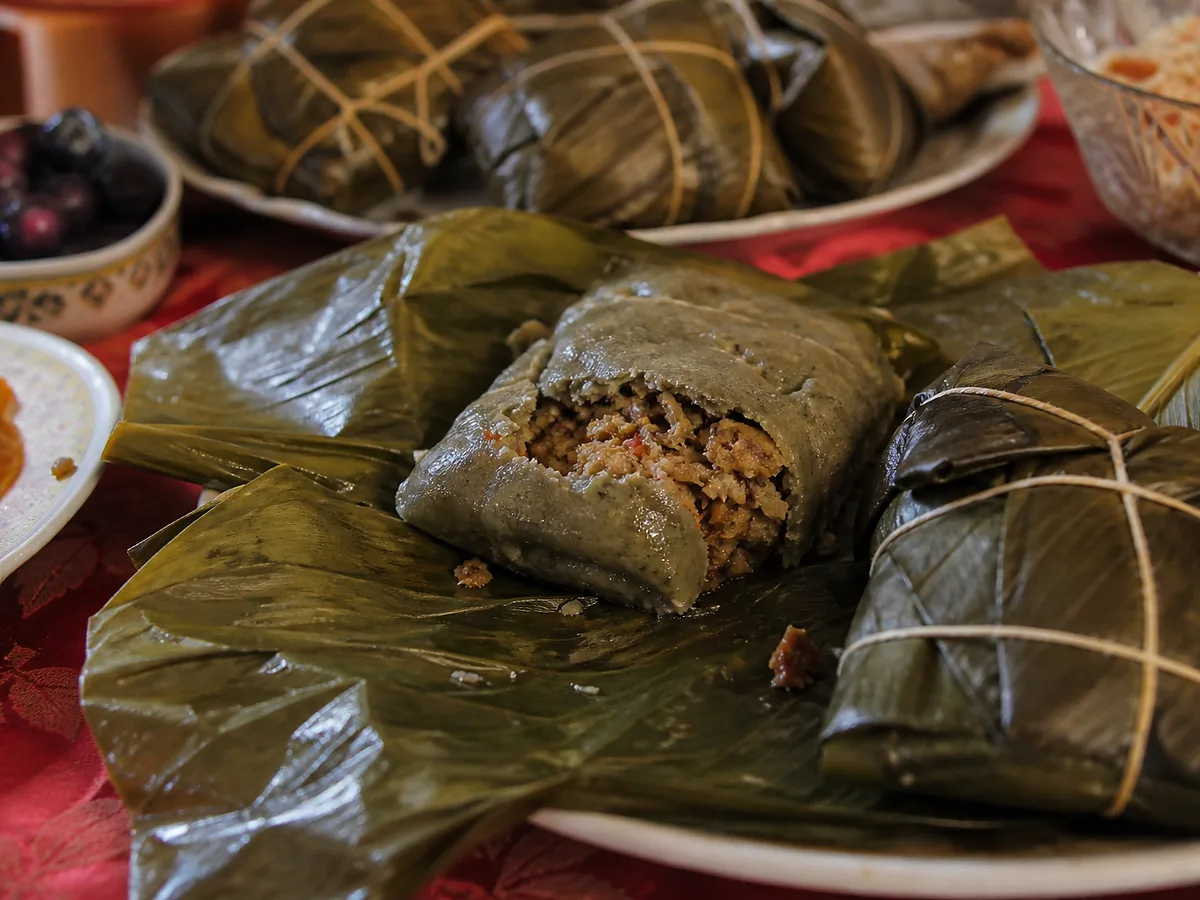
I make pasteles because the work is the dish: a wet board, green fruit on a grater, banana leaves warmed until they go pliable, and a stack of tied packets that freeze until Nochebuena.
The masa is grated green banana, green plantain, and yautía, sometimes calabaza, coloured with achiote, folded around a spoon of pork guiso that is seasoned and reduced — not wet enough to burst the wrap. You boil them. Labour and assembly are the point. A bag of premade masa is a labelled shortcut, not the afternoon I am writing.
This is not a Mexican tamal. Tamales are nixtamalised corn masa — dried maize cooked in alkaline water, washed, ground — spread on a dried corn husk, filled, and typically steamed. Corn masa tastes like nixtamal: mineral, sweet-corn, a little alkaline, and the husk is dry, papery, and not eaten. Pasteles are a tropical-root-and-green-fruit mash on a banana leaf, boiled in water, orange from achiote, with a pork guiso inside. The leaf is a wrap, not a corn vehicle.
Calling a pastel a “Puerto Rican tamale” is a translation habit that erases the grater, the banana, the yautía, and the pot of boiling water. Dominican pasteles en hoja sit in the same Caribbean family of grated-masa packets; they are a cousin, not a recipe I copy onto this page.
Masa that pours like batter leaks and bursts. Masa that bounces like rubber was overworked or too heavy on plantain. Soup filling soaks the masa from inside and splits the leaf. Guiso first, reduced until a spoon leaves a slow path. Grate until the masa holds a furrow. Then wrap.
The pork guiso
- 900 g2 lbPork shoulder, in 1 cm dicedice, not ground — ground pork weeps
- 30 ml2 tbspAchiote oilfrom the batch below
- 120 ml½ cupRecaítoculantro, cilantro, ají dulce, onion, garlic
- 15 g4 clovesGarlic, mincedif the recaíto is shy
- 80 g⅓ cupTomato sauce
- 80 g½ cupAlcaparrado, drained and roughly chopped
- 4 g2 tspDried oregano
- 2 g¾ tspGround cumin
- 1 leaf1 leafBay leaf
- 8 g1½ tspCoarse saltplus more to taste
- 2 g1 tspBlack pepper
- 120–180 ml½–¾ cupWater or unsalted stockto stew, then reduce away
- 80 g3 ozPotato, in 1 cm diceoptional
- 30 g3 tbspRaisinsan optional house split — I usually skip them
The masa
- 1.6 kg3.5 lbGreen bananas / guineos verdes, peeled weight8 to 10. Buy extra — the peels are thick
- 500 g1.1 lbGreen plantain, peeled weight2 large
- 500 g1.1 lbYautía (taro / malanga), peeled weightfirm, white-to-cream. Skip spongy or sour pieces
- 250 g9 ozCalabaza, peeled and seededoptional. Kabocha stands in; canned purée is a departure
- 120 ml½ cupAchiote oilplus more to brush the leaves
- 240–360 ml1–1½ cupsWhole milk or unsalted chicken stock, coldadd only until the masa holds a furrow
- 18 g1 tbspCoarse salt
Achiote oil — for masa, guiso, and leaves
- 240 ml1 cupNeutral oil, or lard
- 30 g3 tbspAnnatto seeds
The wrap
- 24–30 pieces24–30 piecesBanana leaves, cut about 30 × 25 cmthawed if frozen, wiped. Plus extras
- 24–3024–30Parchment rectanglesa liner, or the labelled modern wrap when leaf is scarce
- 1 roll1 rollHeavy-duty foillabelled modern wrap, especially for the freezer
- 24–30 × 50 cm24–30 × 20 inKitchen twine
Yield
24 as a Navidad side — two per person with pernil and arroz con gandules — or 12 if pasteles are the starch. Freeze the batch. Boil all 24 the day you grate only if the party is tonight. Home starting point for 24: 1.6 kg peeled green banana + 500 g plantain + 500 g yautía, 900 g pork, 120 ml achiote oil in the masa.
On the masa
Green banana is the spine: starchier, milder, and it sets when boiled. Green plantain adds body and a tannic note — too much and the masa goes heavy and gummy. Yautía gives silk. Calabaza is colour insurance and a little sweetness, and it also loosens the mash, so I keep it optional. Peel bananas under a trickle of water or with oiled hands; the sap stains and itches. Grate on the small holes of a box grater, or use a food mill. A food processor is a labelled departure: pulse, do not purée. Purée ruptures starch the grater leaves intact, and you get glue. Finished masa looks like wet sand that holds a furrow. It does not pour, and it does not pull in shiny elastic strings. Cold milk or stock binds and carries the achiote — add it gradually. Warm liquid starts the starch early and you get paste before the boil.
On the fruit and the root
Any yellow on the bananas is too ripe: sugar instead of starch, and slack brown masa. Plantains should be hard and deep green. Yautía should feel dense — grey or pink inside can be variety, but a sour smell or slime is rot. Yuca in the masa is a house add that tightens the set; I am not writing a yuca pastel. Potato in the masa tastes like potato.
On the guiso
Dice, do not grind. Shoulder has enough fat to stay moist through a freeze and a boil. Brown the dice in achiote oil, cook the recaíto until sweet, add tomato, olives, oregano, cumin, bay, then stew with a little water until the pork is tender and the liquid is a coating, not a broth. The pork will pass 74 °C / 165 °F easily; I am cooking for a dry sauce, not a roast reading. If a ladle of guiso stands in a mound, you can wrap. If it floods the spoon, reduce longer. Potato cubes drink juice and bulk the spoon. Raisins are a split; chickpeas appear in some pots.
On banana leaf, parchment, and foil
Banana leaf is the traditional wrap: green, tea-like perfume, and what the boil expects. Frozen leaves are how most diaspora kitchens buy them. Thaw, wipe, and pass over a medium flame or through hot water until the leaf goes from brittle to oily-flexible — glossy, no charred holes. A tear gets a patch, or parchment underneath. Parchment or foil instead of leaf is a labelled modern wrap: you lose the leaf aroma, you gain a packet that does not split in the freezer. I wrap leaf, then foil, for storage. Foil alone is the emergency wrap. Corn husks are the wrong plant.
On freezing
Frozen pasteles are the make-ahead. Wrap, tie, freeze on a tray until solid, then bag. Boil from frozen — thawing on the counter wets the masa. Ice on the outside of a tight wrap is normal. Ice inside a loose wrap is freezer burn; cook those first.
Equipment
- A wide skillet, for the guiso
- A box grater or food mill, and gloves
- A bowl set over ice, if the kitchen is hot
- Kitchen twine
- A 10 to 12 L stockpot, or two
- Tongs, and an instant-read thermometer
Do not use: corn husks; a steamer as the headline, because these are boiled; a blender for the masa; a mandoline, because you want grate, not slices; a pressure cooker unless you take the labelled departure.
Method
Achiote oil, then cool it10 min
240 ml oil, 30 g seeds, medium-low, 90–100 °C / 195–210 °F, 6 to 8 minutes, to brick-orange. Strain. Cool until warm, not hot.
About 30 ml for the guiso, 120 ml for the masa, and the rest for the leaves.
Hot oil in masa cooks starch at the edge of the bowl. Bitter black seeds ruin the batch.
Warm 240 ml oil with 30 g annatto seeds over medium-low at 90–100 °C / 195–210 °F for 6–8 minutes until brick-orange, never black. Strain and cool until warm. Reserve 30 ml for guiso, 120 ml for masa and the rest for leaves.
The guiso45–60 min, including the reduce
Medium-high skillet, 30 ml achiote oil. Brown the pork in two batches, 6 to 8 minutes each, pan around 160–175 °C / 320–350 °F. Do not crowd.
Recaíto for 6 to 8 minutes, until the grass smell turns sweet. Garlic for 1 minute. Tomato sauce for 2 minutes. Then oregano, cumin, bay, olives, salt, pepper, and 120 ml water. Optional potato.
Simmer with the lid ajar until the pork is tender and a spoon dragged through the sauce leaves a path that fills slowly, 25 to 35 minutes. Still brothy: lid off, high heat, 5 minutes.
The pork should yield, the cubes hold, and a spoonful should mound. Cool it until warm, not steaming, before you wrap — hot filling melts masa from inside.
Wet filling is the main reason a pastel bursts, and you cannot thicken it once it is inside the leaf.
Heat 30 ml achiote oil to a pan temperature of 160–175 °C / 320–350 °F. Brown pork in two uncrowded batches, 6–8 minutes each. Cook recaíto 6–8 minutes, garlic 1 minute, tomato sauce 2 minutes; add oregano, cumin, bay, olives, salt, pepper, 120 ml water and optional potato. Simmer lid ajar 25–35 minutes until pork is tender, above 74 °C / 165 °F, and sauce clings. If brothy, reduce uncovered on high 5 minutes. Cool until warm, not steaming.
Peel and grate40–60 min
Oil your hands. Peel the bananas, plantains, yautía, and optional calabaza. Grate on the small holes into a cold bowl. Work so the first banana does not sit weeping.
The masa should be pale and slightly sticky, smelling green and earthy, not fermented. A little brown foam is oxidation; a lot means the fruit sat too long, so beat the achiote in sooner.
This is the labour. Coarse shreds leave fibres. A purée is glue.
Oil hands and peel green bananas, plantains, yautía and optional calabaza. Grate finely into a cold bowl, working promptly to limit weeping. Keep a pale, slightly sticky granular texture; if using a processor, pulse without puréeing.
Season the masa5 min
Beat in the 120 ml of warm — not hot — achiote oil and the 18 g of salt.
Add cold milk or stock 60 ml at a time until a spoon leaves a furrow that does not flood. You may not use all 360 ml. Even orange-gold, no white streaks.
It should hold a peak like stiff mashed potato that still looks moist. A blob on a plate does not slump into a puddle in 10 seconds.
Too wet and the boil turns them to soup. Too dry and you bite a brick.
Beat in 120 ml warm achiote oil and 18 g salt. Add cold milk or stock in 60 ml increments, up to 360 ml only as needed. Stop when uniformly orange-gold masa holds a furrow and a moist peak without puddling after 10 seconds.
Soften the leaves15 min
Wipe them. Pass over a flame or through hot water until flexible. Brush the duller side with achiote oil. Stack leaf, then optional parchment.
Cut the twine. Guiso and masa within reach. A little water on your fingers keeps masa from sticking.
A brittle leaf splits when you fold.
Wipe leaves and pass over flame or through hot water until glossy and flexible, without charring; patch tears or use parchment. Oil the dull side and prepare optional parchment, twine, filling and masa. Moisten fingers lightly to prevent sticking.
Assemble45–75 min for 24
For each pastel: leaf oiled-side up, parchment if using. Spread 90 to 110 g of masa into a 12 × 8 cm rectangle, leaving a border. Spoon 30 to 40 g of guiso down the centre — a line, not a puddle.
Fold the long sides so masa meets masa. Fold the ends under. You want a tight rectangle, like a small wrapped book, not a burrito with air in it.
Tie: one wrap long, one short. For the freezer, foil around the leaf packet.
Masa must seal around the meat. Gaps let water in, overfilling bursts the fold, and rushing assembly is how you get open pasteles in the pot.
On each oiled leaf, with optional parchment, spread 90–110 g masa in a 12 × 8 cm rectangle with a border. Add 30–40 g guiso centrally. Fold long sides so masa seals around filling, tuck ends under and tie lengthwise and crosswise. Keep packets tight without gaps; add foil for freezing.
Freeze, or boil now45–90 min to boil
Freeze: tray until solid, 2 to 3 hours, then bag, up to 3 months. Do not thaw to boil.
Boil, fresh or frozen: a 10 to 12 L pot, salted water at a rolling boil. Do not jam the packets in. Return to a boil, then hold a lively simmer at 95–100 °C / 203–212 °F.
Fresh: 45 to 60 minutes. Frozen: 75 to 90 minutes.
Lift one — it should feel firm, not squashy. Open one: masa set, orange, no raw starch core, filling hot. The centre of a sacrificial pastel should be at least 74 °C / 165 °F, and I usually see 85–90 °C when the masa is truly set.
Underboiled masa is sticky and tastes raw-green. Overboiled packets split. Frozen starts at −18 °C and needs the extra time.
Freeze on a tray 2–3 hours until solid, bag and store up to 3 months; boil directly from −18 °C, without thawing. In a 10–12 L pot of boiling salted water, add packets without crowding, return to boil then maintain 95–100 °C / 203–212 °F. Cook fresh 45–60 minutes or frozen 75–90 minutes. Test one: firm orange masa without raw centre, hot filling and at least 74 °C / 165 °F centrally, commonly 85–90 °C when set.
Drain, rest, unwrap5 min
Onto a tray for 3 to 5 minutes, so you do not burn your hands. Cut the twine. Open the leaf.
A set loaf, glossy, smelling of banana leaf and pork. Serve in the leaf or on the plate. Pique at the table, not in the pot.
Drain on a tray and rest 3–5 minutes before handling to avoid burns. Cut twine and open leaves; serve the set, glossy pasteles in their leaves or on plates, with pique at the table.
Storing it
Before they are boiled
Wrap within 2 hours of cooking the pork. Do not leave raw grated banana on a warm counter all afternoon. Refrigerate uncooked wrapped pasteles overnight only, then boil or freeze. The frozen quality window I use is 3 months.
After boiling
Refrigerate within 2 hours, 3 days. Reheat by simmering 15 to 20 minutes, or steaming, until the centre is 74 °C / 165 °F. A microwave dries the edges — a damp towel helps. Do not re-freeze a boiled pastel. Sour, slimy, or a puffed package: throw it out.
Troubleshooting
- Masa watery, packets burst.
Too much milk, ripe bananas, or wet guiso. Next batch: less liquid, greener fruit, longer reduce.
- Masa gummy.
Processor purée, too much plantain, or an overworked mash. You cannot undo glue. Next time, grate.
- White masa.
No achiote, or the oil sat on top. Knead a warm spoon of oil in before wrapping if you catch it.
- The filling leaks.
Overfilled, or the ends were not folded under. Less guiso. Patch and re-tie if you see it before the boil.
- Waterlogged.
A torn leaf, no tie, or a furious boil. Simmer. Leaf plus foil for the freeze.
- Raw centre, set edges.
Underboiled, or packed too tight in the pot. Back in for 15 minutes.
- Dark brown masa.
The fruit oxidised for hours, or the bananas were ripe.
- My hands itch.
Banana sap. Oil, rinse, lemon. Gloves next time.
- The leaf splits on the fold.
Not softened.
- It tastes like a tamal.
Corn masa or corn husks. Wrong dish.
Substitutions
Traditional versus known departure
| Component | Traditional | Known departure |
|---|---|---|
| Masa | Grated green banana, green plantain, yautía; optional calabaza | Processor pulse, not purée. A little yuca. Frozen supermarket masa. Potato in the masa. Corn masa is a tamal |
| Colour | Achiote oil in the masa | Sazón with achiote. Turmeric is a named departure I do not use |
| Filling | Diced pork shoulder guiso with recaíto and alcaparrado, reduced | Chicken. Meatless chickpea and potato — say so. Ground pork is wetter. Raisins and chickpeas are house habits |
| Wrap | Banana leaf, tied | Leaf + parchment liner. Leaf + foil for the freezer. Parchment or foil instead of leaf is a labelled modern wrap. Corn husk is the wrong wrap |
| Cook | Boiled in salted water | Steamed is drier and slower to set. Pressure cooker is labelled below |
| Make-ahead | Wrapped and frozen, boiled from frozen | Boil the day you wrap. Refrigerate overnight only |
Pressure cooker, labelled departure
I boil. If you pressure-cook: a rack, 250 ml of water in a 6 L cooker, packets in a single loose layer, in batches. High pressure 20 minutes from fresh, 30 from frozen, natural release 10. Check one. Wetter, and easier to waterlog if a wrap failed. A time-saver, not the Nochebuena pot I described.
Scaling
Masa and filling scale together. Wrap time does not: 12 pasteles are an hour of assembly, and 48 need a second pair of hands.
| Pasteles | Peeled banana | Plantain | Yautía | Pork | Achiote oil in masa |
|---|---|---|---|---|---|
| 12 | 800 g | 250 g | 250 g | 450 g | 60 ml |
| 24 | 1.6 kg | 500 g | 500 g | 900 g | 120 ml |
| 48 | 3.2 kg | 1 kg | 1 kg | 1.8 kg | 240 ml |
Boil time does not scale
Boil time does not drop if you kept the same thickness. Do not make bricks and keep the 45-minute clock. Two pots if you are feeding the block.
What to serve it with
Arroz con gandules and pernil. That is the Navidad plate.
- Arroz con gandules
- Pernil
- Pique, or chilli-garlic vinegar, at the table
- Tostones, if you still want fried starch
- Avocado
I do not pour tomato sauce over a pastel as if it were a tamal with chile. Leftover boiled pastel, pan-seared in oil until the outside catches, is a known next-day breakfast with coffee.
Questions
Can I freeze them raw?
Yes — that is the point of a big batch. Boil from frozen. Do not thaw on the counter.
Food processor?
Pulse until it looks grated, not like baby food. A named departure. The grater is the texture I want.
No banana leaf?
Modern wrap: parchment, then foil. You lose the leaf smell. Still a pastel if the masa and guiso are right. Corn husk is a tamal habit.
Are these tamales?
No. Corn masa, corn husk, usually steamed. Pasteles are grated green banana, plantain, and yautía, in a banana leaf, boiled, orange from achiote, around a pork guiso.
Dominican pasteles en hoja?
A family resemblance. Different kitchens, different ratios. I am not pasting that recipe here.
My masa turned brown.
Oxidation. Work colder and faster, and get the achiote in sooner. A little brown is cosmetic; grey-sour is a dump.
How do I know they are done?
Open one. Masa set like a moist pudding-bread — not batter, not rubber. Filling hot. Centre at least 74 °C / 165 °F.
Vegetarian?
A thick guiso of chickpeas, potato, olives, and recaíto, reduced hard. Say it is meatless.
Steam instead of boil?
Longer, drier. I boil. Steaming is a departure, not a correction.
How many per person?
Two as a side on a loaded Christmas plate. Three if pasteles are the starch.