Arroz con Gandules
Pigeon peas and rice in one pot with recaíto, achiote oil, and pork, until the grains are stained orange and the bottom has a chance at pegao.
- Prep
- 25 min
- Cook
- 55 min
- Serves
- 8 as a Navidad side, 5–6 as a weeknight main
- Difficulty
- Medium
Researched · Kitchen testing pending
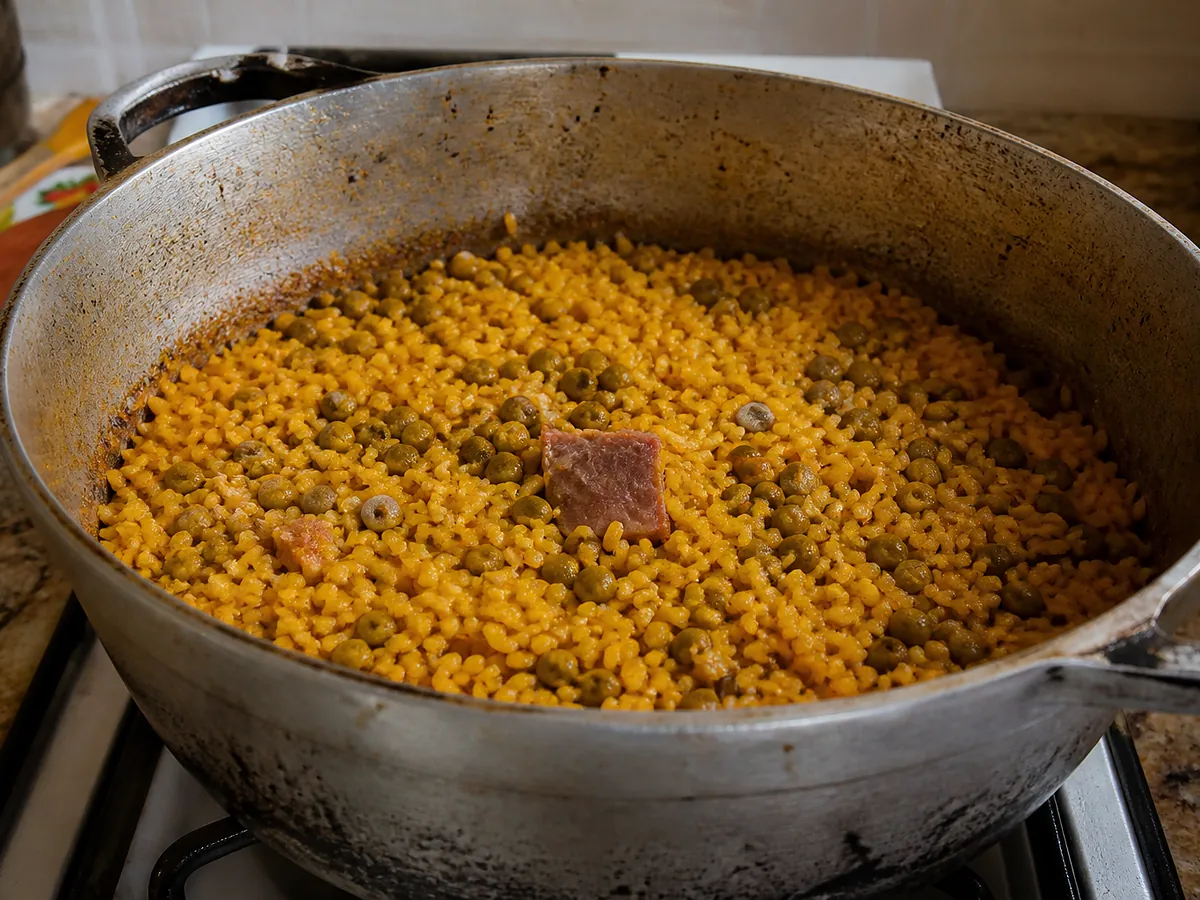
Pigeon peas and medium-grain rice share one pot with recaíto, achiote oil, and pork — smoked ham, tocino, or a length of salchichón — until the grains are stained orange and the bottom has a chance at pegao.
I put it on the Navidad table next to pernil. I also cook it in March when I want the same plate without waiting for December.
This is not Cuban moros y cristianos: those are black beans cooked with long-grain rice on a different island.
Colour comes from achiote fat. Turmeric is a labelled departure. Gandules from a can are a known island and diaspora reality, and I cook from them as the ordinary pot. Recaíto in the fat, alcaparrado in with the rice, lid on, rest. One pot.
Achiote oil
- 60 ml4 tbspNeutral oil, or lard
- 10 g1 tbspAnnatto seeds / semillas de achiote
The pork
- 120 g4 ozSmoked cooking ham / jamón de cocinar, in 1 cm dice
- 80 g3 ozTocino (salt pork) or salchichón, in 1 cm diceone or the other, or 40 g of each
Recaíto
- 180 ml¾ cupPrepared recaíto, homemade or jarredor grind: 40 g culantro, 20 g cilantro, 80 g yellow onion, 80 g ajíes dulces (or cubanelle), 18 g garlic
Gandules and rice
- 2 × 425 g2 × 15 ozCanned pigeon peas / gandules, undrainedkeep the liquid. Or 250 g dried gandules, soaked overnight and simmered tender, liquor kept
- 480 g2⅓ cupsMedium-grain or medium-long white ricerinsed until mostly clear, drained 10 minutes
- 80 g½ cupAlcaparrado — olives, capers, pimientos — drained
- 400–500 ml1⅔–2 cupsWater or unsalted stock, warmonly to hit the liquid line
- 4 g2 tspDried oregano
- 2 g¾ tspGround cumin
- 1 leaf1 leafBay leaf
- 4 g¾ tspCoarse saltonly after tasting the liquor
- 1 g½ tspBlack pepper
- 15 ml1 tbspTomato sauceoptional — for body, not the colour
Yield, and the liquid line
8 as a Navidad side next to pernil; 5 to 6 as a weeknight main. Home starting point: 480 g rice, two 425 g cans with their liquid, about 200 g pork, 180 ml recaíto, 60 ml achiote oil. Free liquid before the rice goes in: 850 to 950 ml, including the can liquor.
On the gandules
Pigeon peas — beige-green, and they hold their shape. Not black beans, not kidney beans, not garden peas. Canned gandules are how most homes actually cook this rice, in San Juan and in Orlando. That is the baseline, not a confession. Keep the can liquid: starch, salt, pea. Dump it and you get pale rice with peas sitting on top. Dried if you have them: soak overnight, simmer until just tender, keep the liquor. Earthier. Not required for legitimacy.
On the rice
Medium-grain or medium-long white. Canilla-style extra-long is what a lot of Puerto Rican cabinets hold, and it is more separate than Valencia. Rinse until the water is no longer milky — you wash off loose surface starch so the pot does not glue, and leave starch inside the grain to gelatinise in the orange liquor. Short-grain sets like a cake. Converted rice stays pale and hard on this clock. Jasmine perfumes a plate that should smell of recao and pork. I do not hunt a paella crust. I do want a chance at pegao: a thin toasted sheet you scrape after serving, not carbon.
On recaíto — green, not red
Culantro (recao), cilantro, ají dulce, onion, garlic. Culantro is the long serrated leaf that outlasts cilantro, and it is the backbone. Ají dulce is aromatic, not a heat bomb; cubanelle stands in. This is not Cuban onion-pepper-tomato sofrito. Tomato, if I use it, is a spoon of sauce for body, not the colour. Jarred recaíto is ordinary. Cook it in fat 6 to 8 minutes until the grass smell turns sweet — raw recaíto in rice tastes like cold herbs in starch.
On achiote oil
Annatto seeds in warm fat until brick-orange. Bixin is fat-soluble, so bloom it in oil, not in a cold cup of water. 90–100 °C / 195–210 °F: tiny bubbles around a seed, not a fry. Five to eight minutes, then strain. You want mahogany fat, earthy-sweet, faintly peppery. If the seeds go dark and the oil turns bitter, start over. That orange is the dish. Sazón with achiote is a pantry shortcut. Turmeric is not achiote — curcumin reads as curry.
On the pork, and the alcaparrado
Jamón de cocinar is the Navidad default: salty, pink, already cooked, diced so it dots the rice. Tocino renders the fat recaíto wants. Salchichón is the firm paprika-ish sausage, a known house pork. I use ham plus one of the fattier two. Spanish chorizo drags the plate toward Spain. Bacon stands in for tocino. No pork: more achiote oil, and say so. Alcaparrado is olives, capers, and pimiento, often in one jar. Manzanilla, not kalamata. It is the salt-sour against sweet recaíto and smoked ham. Drain it; do not rinse it until it tastes like nothing. Some houses skip it. I do not, on Navidad.
Equipment
- A heavy pot, 5 to 6 L, with a tight lid — thin stainless scorches the bottom while the top is still wet
- A wooden spoon
- A strainer, for the rice and the achiote seeds
- A measuring jug
Do not use: a colander on canned gandules; a rice cooker as the headline; a pressure cooker for the finished rice unless you take the labelled departure. Dried gandules in a pressure cooker is a fuel-saving departure, and it is in the substitutions.
Method
Achiote oil8–10 min
60 ml oil, 10 g seeds, medium-low, 90–100 °C / 195–210 °F. Tiny bubbles, not a thrash. At 5 to 8 minutes the oil is deep orange-red. Strain.
You want stained fat that smells earthy-sweet, not like burnt popcorn. Bitter means the seeds fried — do not use it.
Recaíto is green. Without this oil the pot goes khaki.
Warm 60 ml oil with 10 g annatto seeds over medium-low at 90–100 °C / 195–210 °F. After 5–8 minutes, strain the deep orange-red oil. Keep bubbling gentle; discard and restart if bitter or burnt.
Rinse the rice, open the peas10 min, overlapping
Rinse the rice until the water runs mostly clear and drain it 10 minutes.
Open both cans and do not drain them. Dried gandules should already be tender in their liquor. Taste the liquid: salty, pea-sweet.
Wet rice dumps unmeasured water into a ratio you are about to set.
Rinse rice until mostly clear and drain 10 minutes. Open both cans of gandules without draining. If using dried gandules, have them soaked overnight and simmered tender, with cooking liquor reserved.
Render the pork6–8 min
Heavy pot over medium, achiote oil in. Tocino or salchichón first — render 4 to 5 minutes until the fat runs. Ham for 2 to 3 minutes. Pan around 160–170 °C / 320–340 °F: a sizzle, not a scorch.
It should smell of smoked ham, with orange fat and an orange-brown fond, not black.
The rice eats this fat.
Heat achiote oil in a heavy pot over medium, around 160–170 °C / 320–340 °F. Render tocino or salchichón 4–5 minutes, then cook ham 2–3 minutes. Aim for orange-brown fond, never black.
Cook the recaíto6–8 min
Recaíto into the pork fat. Cook until the water boils off and the paste looks oily and darker green. Oregano and cumin for 30 seconds. Optional tomato sauce for 1 minute.
The raw leaf smell should be gone, replaced by cooked onion, recao, and garlic in pork fat. Bitter garlic means the heat was too high.
Raw recaíto tastes grassy. Burnt recaíto tastes like a blender jar.
Cook recaíto in pork fat 6–8 minutes until darker, oily and sweet-smelling, with raw herbal aroma gone. Add oregano and cumin for 30 seconds; cook optional tomato sauce 1 minute. Avoid scorching garlic.
Gandules, liquor, alcaparrado3 min
Both cans, liquid and peas. Scrape the fond. Alcaparrado, bay, pepper. Taste — salt only if it is dull. Bring to a lively simmer.
Now measure. For 480 g of rice you want 850 to 950 ml of free liquid around the peas. The peas are not liquid. Add warm water or stock only to hit that line.
Too little liquor, chalky top. Too much, porridge. Salt now.
Add both cans of peas with liquor and scrape the fond. Add alcaparrado, bay and pepper; simmer and taste before salting. For 480 g rice, measure 850–950 ml free liquid excluding peas; add warm water or stock only as needed.
Rice in — then do not stir1 min
Stir the drained rice once through the peas and pork. Level the surface. The liquid should sit at the grain line, orange.
Do not stir again. Further stirring knocks starch off the grains and glues the pot.
Stir drained rice through peas and pork once, then level the surface. The orange liquid should reach the grain line. Do not stir again.
Covered simmer18–22 min
Lid on. A gentle simmer you can hear — a soft tick, not a rattle, the pot around 95 °C / 203 °F. Steam screaming from the lid means a carbon bottom and a wet top.
At 18 minutes, tilt the lid. Liquid gone from the surface; steamy pits are fine. Standing liquor: lid on for 3 more minutes. A toast smell means pegao may be forming; a burn smell means pull it.
A grain bitten in half should be tender with no white pin-dot. Peas whole, pork in dots, moist but not sloshing.
Cover and simmer gently around 95 °C / 203 °F for 18–22 minutes. Check at 18: if liquid remains, cover 3 minutes more. Grains should be tender without a white centre, peas intact and rice moist. Remove from heat immediately if it smells burnt.
Rest10 min, lid on, off the heat
Do not lift the lid. Residual steam at 90–95 °C finishes the core.
Then fluff once from the edges in: orange grains, peas, ham, olives, achiote gloss. Scrape the pegao after serving the fluffy rice, not into it.
Serving at minute 20 gives you a wet top and a tight bottom.
Rest covered off heat 10 minutes without lifting the lid; residual steam at 90–95 °C finishes the grains. Fluff once from edges inward. Serve fluffy rice first, then scrape the toasted pegao separately.
Storing it
Cooked rice does not sit warm
Cooked rice is a Bacillus cereus problem if it sits warm. Cool lid-off and refrigerate within 2 hours in a shallow container. 4 days. Reheat until steaming, 74 °C / 165 °F in the centre, with a splash of water in a covered pan. Freeze up to 2 months. Do not leave a full olla on a warm stove all afternoon. Sour or ropy leftovers: throw them out.
Troubleshooting
- Pale, khaki rice.
No achiote oil, or you used turmeric. This batch will not stain now.
- Peas sitting on top of white rice.
You drained the cans.
- Glue.
You stirred after the rice went in, or used short-grain, or skipped the rinse.
- Chalky, dry top.
Not enough liquor, or heat too high. 60 ml hot water, lid on, 5 minutes low, then rest.
- Soupy.
Too much liquid, or you counted the peas as liquid. Lid off, 3 minutes, watching the bottom.
- Burnt bottom, raw top.
Thin pot or high heat. Scoop out the unburnt rice and finish it on low with a splash of water.
- Bland.
You replaced the can liquid with water and did not salt. Taste before the rice goes in.
- Bitter.
Burnt garlic, cumin, or blackened achiote seeds.
- It tastes like curry.
Turmeric. That is a departure, and I do not use it here.
- Too salty.
Ham plus olives plus canned peas. Fold in a cup of plain cooked white rice off the heat.
- No pegao.
Not a failure. Forcing it with high heat burns the pot.
Substitutions
Traditional versus known departure
| Component | Traditional | Known departure |
|---|---|---|
| Peas | Gandules — canned with liquid is ordinary island and diaspora practice; dried, soaked, simmered, liquor kept, if you have them | Black beans (moros, different island). Garden peas. Chickpeas |
| Rice | Medium-grain or medium-long white, rinsed | Extra-long Canilla-style. Valencia is clingier. Short-grain glues. Converted is pale and hard |
| Colour | Achiote oil from seeds in fat | Sazón packet with achiote. Bijol. Turmeric is a named departure. Saffron is Spanish money |
| Base | Recaíto — culantro, cilantro, ají dulce, onion, garlic, in fat | Jarred recaíto is ordinary. Cubanelle for ají dulce. A spoon of tomato sauce. Cuban sofrito is a different base |
| Pork | Smoked ham, tocino, and/or salchichón | Bacon for tocino. No pork, more oil — say so. Spanish chorizo drags it toward Spain |
| Brine | Alcaparrado | Olives only. None. Kalamata is the wrong brine. Raisins are a house split |
| Cookware | Heavy olla, stovetop, lid | Pressure cooker for dried gandules only. Finished rice under pressure is labelled below |
Pressure cooker, labelled departure
I do not cook Navidad arroz con gandules this way. Dried gandules only: after the soak, 10 to 12 minutes high pressure, natural release 10 minutes; peas and liquor back into the olla, and continue from pork and recaíto on the stove. If you cook the rice under pressure: sauté pork and recaíto, bloom the achiote, add gandules and rice, liquid around 700–750 ml, high pressure 5 to 7 minutes, natural release 10. Wetter, easier to mush, weaker pegao. A shortcut, not the pot I described.
Scaling
Rice, gandules, and free liquid scale together. Recaíto and pork can be slightly generous on a small pot so they do not scorch.
| People (side) | Rice | Gandules | Free liquor | Pot |
|---|---|---|---|---|
| 4 | 320 g (1½ cups) | 1 can, plus 80 ml water if shy | 560–640 ml | 3–4 L |
| 8 | 480 g (2⅓ cups) | 2 cans | 850–950 ml | 5–6 L |
| 12–14 | 720 g (3½ cups) | 3 cans | 1.25–1.4 L | 7–8 L |
Do not crowd it
A doubled batch in a small pot boils over, then scorches. Two pots beat a heap. Extra water "for safety" is porridge. The simmer stays 18 to 22 minutes — check a grain, not only the clock.
What to serve it with
Pernil on Navidad. That is the pairing, and the roast pork juices on the rice are allowed.
- Pernil
- Pasteles, if someone made them
- Tostones, or maduros
- Avocado, onion, oil, salt
White rice on the side is redundant; this is the rice. On leftovers, a fried egg is a known next-day plate.
Questions
Canned gandules, or dried?
Canned is how I cook this, and how a lot of the island cooks it. Keep the liquid. Dried if you have them and the time.
Is this moros?
No. Different bean, different island, different sofrito.
Do I rinse the rice?
Yes. Do not rinse the gandules.
Turmeric if I have no achiote?
A named departure — the plate will taste like turmeric. Buy seeds, or sazón with achiote.
No pork?
More achiote oil, recaíto, alcaparrado. Say it is meatless.
Jarred recaíto?
Ordinary. Cook it in the fat until it stops smelling raw.
Can I make it ahead?
Same day is better. Reheat covered with a splash of water. Pegao will not survive the fridge as crust.
Sazón packet?
A pantry shortcut. Cut the salt you add. I prefer oil from seeds.
Is pegao required?
A bonus. The identity is orange rice, gandules, recaíto, pork, one pot.