Moros y Cristianos
Black beans and long-grain rice cooked in one pot, in the bean liquor, until the grains are stained and still separate. Not beans parked next to rice.
- Prep
- 30 min
- Cook
- 2 hr
- Serves
- 6 as a side, 4 as a main
- Difficulty
- Medium
Kitchen-tested
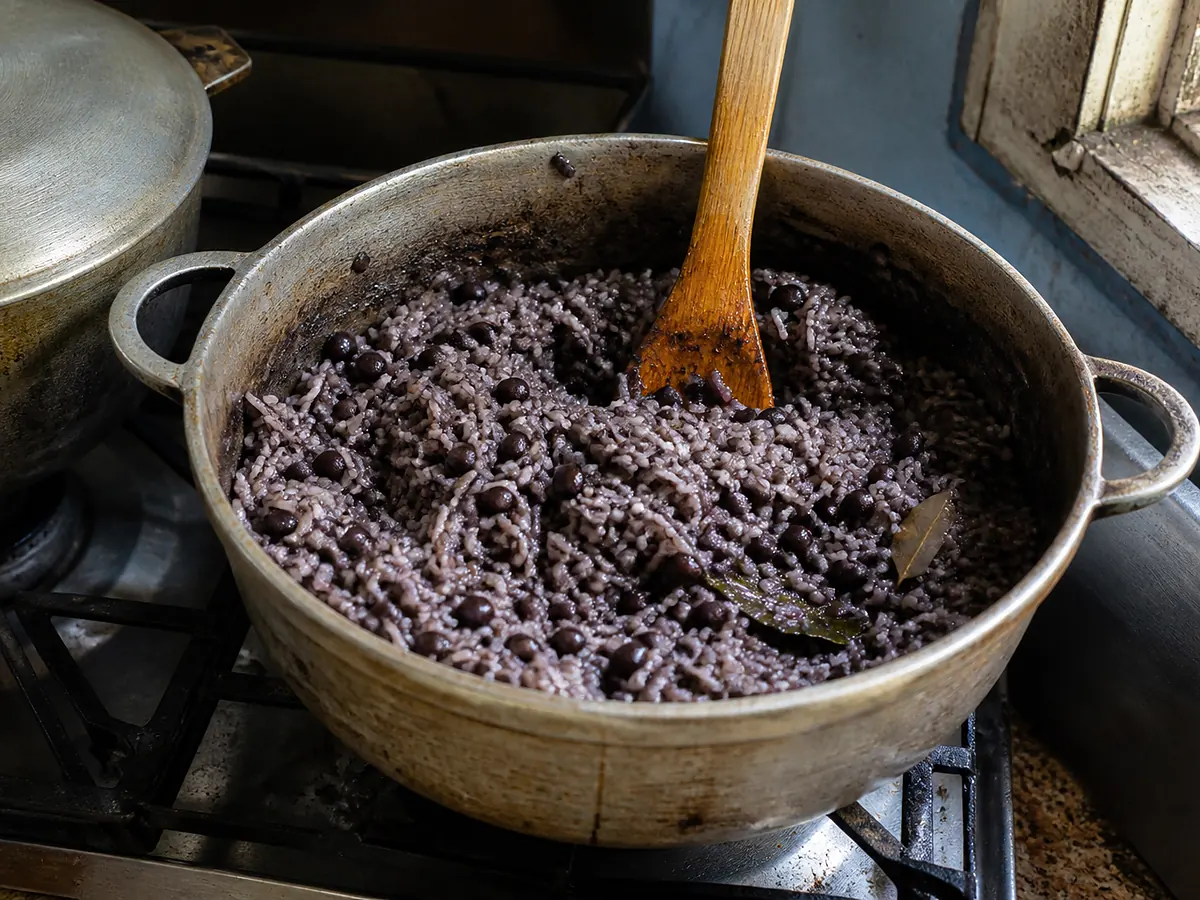
I cook black beans and long-grain rice in one pot, in the bean liquor, until the grains are stained and still separate. That plate is moros y cristianos.
A bowl of black beans parked next to a mound of white rice is arroz blanco y frijoles negros — different dish, different method, not this page.
The Spanish nickname pairs the dark beans and the white rice with the Reconquista. I am not giving a history class; I am telling you not to throw out the pot liquor. Sofrito, cumin, oregano, bay. Sometimes bacon or salt pork so the fat is in the rice. Dump the liquor and start the rice in tap water and you get pale grains with beans sitting on top like a garnish you forgot to mix.
Beans, soaked overnight
- 250 g1¼ cupsDried black beans, picked over
- to coverto coverWater, 8 cm / 3 in above the beans
- 1 leaf1 leafBay leaf, for the bean pot
- 6 g1 tspCoarse salt, for the beansadded once they are tender, not at the start
Sofrito and fat
- 80 g3 ozSmoked bacon, salt pork (tocino), or a fatty leftover pork endcut in 1 cm strips
- 15 ml1 tbspNeutral oilonly if the pork runs dry
- 200 g7 ozYellow onion, small dice1 large
- 150 g5 ozGreen bell pepper, small dice1 medium
- 18 g5 clovesGarlic, minced
- 60 g2 ozRipe tomato, seeded and small-dicedoptional — I often skip it so the liquor stays dark
The rice pot
- 360 g1¾ cupsLong-grain white ricerinsed until the water runs mostly clear, drained
- all of itall of itThe cooked beans, with all their liquor
- 100–250 ml⅓–1 cupExtra water or unsalted stockonly as needed to hit the liquid line. Taste first
- 4 g1½ tspGround cumin
- 2 g1 tspDried oregano
- 1 leaf1 leafBay leaf
- 15 ml1 tbspDry white wine, or white vinegaroptional
- 2 g⅓ tspCoarse saltonly after you taste the liquor
- 1 g½ tspBlack pepper
- 2 g½ tspSugaroptional, if the beans taste dusty
Yield
6 as a side. 4 as a main with a fried egg or leftover roast pork.
On the beans
Dried black beans. The skins should hold; the interiors go creamy. I soak overnight because hydration is even and skins blow less than on a hard boil from dry. A quick soak — cover, boil 2 minutes, sit 1 hour, drain — is a known departure for when you forgot. Canned beans are a weekday departure: keep the can liquid, stretch with water, and accept a weaker stain. No baking soda in the soak; it speeds the skins and flattens the taste.
On the liquor — the whole point
If you cooked beans from dry, the pot liquid is the dish. Anthocyanin from the black skins stains the rice; starch, salt, and bay are in there too. I never drain cooked beans in a colander. I never start the rice in tap water "to be neat." Taste the liquor before the rice goes in: if it is already as salty as a broth you would eat with a spoon, add no more salt. If it tastes like plain bean water, it will make plain rice.
On the rice
Long-grain white — extra-long supermarket rice is what most Cuban-American kitchens use. I rinse it for surface starch so the grains stay distinct. That is not permission to rinse the beans. Jasmine smells like a different plate. Basmati stays too separate. Short-grain drinks the liquor and sets like a cake. Converted or parboiled rice stays pale and hard on this clock; I do not use it here.
On the sofrito and the pork
Onion, green pepper, garlic, in fat, until the onion is translucent and sweet — not browned to jam. Tomato is optional in moros; acid shifts the bean pigment toward brown. I bloom the cumin in the fat for 30 seconds so it smells warm, not dusty. Pork is not required, but bacon or tocino is the ordinary fat. Lard is traditional. Olive oil is a diaspora habit. I render the pork first and cook the sofrito in that fat.
On congrí oriental
In Oriente — Santiago and the east — the sister pot is often red beans with rice, called congrí. Same one-pot logic, different bean, a redder liquor. Swap dried red beans (frijoles colorados) at the same 250 g, keep the sofrito and the long-grain rice, and expect a brick-red plate. Naming fights are regional; the method is still beans cooked *with* the rice, not next to it.
Equipment
- A heavy pot, 4 to 5 L, with a lid that fits — an enamelled Dutch oven or a thick aluminium olla
- A wooden spoon
- A fine-mesh strainer for rinsing the rice — not for dumping the beans
Do not use: a colander to "clean" cooked beans; a rice cooker as the headline method; a thin wide pan that boils off the liquor before the rice is done; a blender. Island kitchens do use a pressure cooker for the beans to save fuel — that is a labelled departure below, not how I cook the rice.
Method
Soak8–12 hours
Cover the beans with cold water, 8 cm above. Room temperature unless the kitchen is over 25 °C / 77 °F, in which case refrigerate. Drain in the morning.
The smell should be clean and earthy. Sour and foamy: dump it and start over.
Bone-dry skins in a rolling boil split, and then you have soup before the rice exists.
Cover black beans with cold water by 8 cm and soak overnight; refrigerate if the kitchen exceeds 25 °C / 77 °F. Drain in the morning. Discard a sour, foamy batch.
Cook the beans in their future liquor60–90 min
Put the drained beans in the heavy pot and cover with fresh water by 4 cm — about 1.2 to 1.5 L. Add boiling water if the line drops. One bay leaf. Boil, then simmer at 90–95 °C / 195–203 °F: small bubbles, not a thrash. Lid ajar.
Doneness: a bean mashed against the pot yields, with no chalky core and skins mostly intact. Mush means you went long; hard means the rice will not finish them. When they are just tender, add the 6 g of salt and simmer 5 more minutes — salt earlier and the skins stay tough on some hard-water stoves; salt now and the liquor is seasoned for the rice.
The liquor has to exist, and the beans have to be almost done. The rice only gives you about 20 minutes of further heat.
*Island departure, beans only:* stovetop pressure cooker, 12 to 15 minutes at high pressure after the soak, natural release 10 minutes. Instant Pot, 8 to 12 minutes, natural release. Then the beans and liquor go back into the olla and you continue from the sofrito. You are saving fuel — you are not making the rice in there.
Cover drained beans with fresh water by 4 cm, about 1.2–1.5 L; add bay. Boil, then simmer at 90–95 °C / 195–203 °F with lid ajar, adding boiling water as needed. When creamy inside with intact skins, add 6 g salt and simmer 5 minutes. Keep all liquor. Alternatively pressure-cook soaked beans 12–15 minutes with 10-minute natural release, or Instant Pot 8–12 minutes with natural release; return beans and liquor to the pot.
Render the pork, cook the sofrito12–15 min
In a skillet, or pushed to the side of a wide olla, render the bacon or tocino over medium heat until the fat runs and the edges brown, 6 to 8 minutes. Pan surface around 160–170 °C / 320–340 °F: the onion should sizzle quietly, not scorch.
Add the onion and green pepper. Cook 6 to 8 minutes until the onion is translucent and sweet, edges just turning gold. Garlic for 1 minute. Optional tomato for 2 minutes. Cumin and oregano for 30 seconds in the fat.
It should smell of pepper and cumin — not raw onion, not burnt garlic — and the fat should be orange-tinted from the pork.
Raw sofrito stirred in with the rice tastes grassy. Burnt garlic tastes bitter in a dark pot.
Render pork over medium 6–8 minutes until fat runs and edges brown, pan about 160–170 °C / 320–340 °F. Add oil only if dry. Soften onion and pepper 6–8 minutes; add garlic 1 minute, optional tomato 2 minutes, then cumin and oregano 30 seconds without burning.
Marry sofrito, beans, liquor, rice3 min
Scrape the sofrito and pork into the bean pot — or the beans into the sofrito pot, if that vessel is bigger. Stir once. Taste the liquor. Add the optional wine or vinegar, the extra bay, 2 g salt only if it is dull, and the optional sugar if it tastes dusty-earthy.
Now measure the liquid. For 360 g of rice you want about 650–750 ml of free liquor visible above and around the beans. The beans themselves do not count as liquid. Add water or unsalted stock only to hit that line. Bring it to a lively simmer.
Stir in the drained rice once, distributing it, and level the surface. Do not stir again.
Rice hydrates from the liquor it sits in. Too little liquid, chalky top. Too much, porridge. Stirring now knocks starch off the grains and glues the pot.
Combine sofrito, pork and beans; taste. Add optional wine or vinegar, extra bay, 2 g salt only if needed and optional sugar if dusty. Measure 650–750 ml free bean liquor for 360 g rice, excluding beans; top up only as needed. Bring to lively simmer, add rinsed, drained rice, stir once and level. Do not stir again.
Covered simmer18–20 min
Lid on. Heat down to a gentle simmer you can hear — a soft tick, not a rattle, the pot around 95 °C / 203 °F. Leave it. If steam is screaming out of the lid, the heat is too high and the bottom will toast while the top is wet.
At 18 minutes, tilt the lid. The liquid should be gone from the surface; a few steamy pits are fine. The rice is dark and swollen, not floating. If there is standing liquor, lid back on for 3 minutes. If the bottom smells like toast, pull it — a thin socarrat is edible, carbon is not.
A grain bitten in half should be tender with no white pin-dot of raw starch. Beans still whole. Moist, not sloshing.
Cover and gently simmer around 95 °C / 203 °F for 18–20 minutes. Check at 18: liquid should be absorbed and grains tender without white centres. If liquid remains, cover 3 minutes more; remove from heat if the bottom smells toasted. Keep beans whole and rice moist, not soupy.
Rest10 min, lid on, off the heat
Kill the flame. Do not lift the lid for 10 minutes. Residual steam at roughly 90–95 °C finishes the core.
Then fluff once with a fork, from the edges in: stained grains, beans distributed, gloss from the pork fat.
The rest is part of the cook. Serving at minute 20 gives you a wet top and a tight bottom.
Turn off heat and leave covered for 10 minutes, allowing residual steam around 90–95 °C to finish the centres. Fluff once with a fork from the edges inward, distributing beans without crushing them.
Storing it
Keeping and reheating
Cool lid-off until the steam dies, then refrigerate within 2 hours in a shallow container. Eat within 4 days. Reheat until steaming, 74 °C / 165 °F in the centre; a splash of water in the pan keeps it from drying into a brick. Freeze meal blocks up to 2 months — the beans soften a little more on the thaw. Do not leave a full olla on a warm stove all afternoon. Mouldy dried beans, or leftovers that smell sour or look ropy: throw it out.
Troubleshooting
- Pale rice, beans sitting on top.
You drained the liquor, or used canned beans plus too much tap water. This batch will not stain now. Next time keep every drop of bean pot liquid.
- Glue.
You stirred after the rice went in, or used short-grain, or skipped the rice rinse. Fluff gently. Do not beat it.
- Chalky cores, dry top.
Not enough liquor, or the heat was too high. Sprinkle 60 ml of hot water over the surface, lid on, 5 minutes low, then rest.
- Mushy beans, intact hard rice.
The beans were already collapsing, or you used converted rice. You cannot reverse mushy beans.
- Burnt bottom, raw top.
Thin pot or high heat. Scoop the unburnt rice into another pan with a splash of water and finish on low. Do not scrape carbon into the serving.
- Bland.
The liquor was unsalted. Oil and a pinch of salt at the table is the salvage. Salt the beans when they go tender, then taste.
- Bitter.
Burnt garlic or scorched cumin. More rice and a fried egg. Nothing else fixes it.
- It tastes like black beans with white rice dumped in.
You added cooked white rice at the end. That is not this dish.
Substitutions
Traditional versus known departure
| Component | Traditional | Known departure |
|---|---|---|
| Beans | Dried black beans, soaked, cooked with their liquor | Canned black beans plus can liquid — weaker colour. Red beans at the same weight is congrí oriental, not a second recipe |
| Rice | Long-grain white, rinsed | Extra-long grain. Jasmine (perfume). Basmati (too dry-separate). Short-grain (glue). Converted rice (pale, hard) |
| Fat | Bacon, tocino, lard | Neutral oil. Olive oil is diaspora. Meatless: oil only, and say so |
| Sofrito | Onion, green pepper, garlic | A little tomato, optional. Red pepper is sweeter. No chipotle. Cilantro at the table is a house habit, not the base |
| Liquid | Bean pot liquor | Unsalted stock or tap water to stretch. Do not replace the liquor |
| Cookware | Heavy olla, stovetop | Pressure cooker for beans only. Rice cooker as a finish is last-ditch, and the sofrito still happens in a pan |
| Seasoning | Cumin, oregano, bay | A dash of vino seco or vinegar. Bijol or annatto is a different yellow rice |
Scaling
Rice and dried beans scale together. You still measure free liquid against the rice.
| People (side) | Dried beans | Rice | Free liquor target | Pot |
|---|---|---|---|---|
| 3–4 | 170 g (1 cup) | 240 g (1¼ cups) | 450–500 ml (2 cups) | 3 L |
| 6 | 250 g (1¼ cups) | 360 g (1¾ cups) | 650–750 ml (2¾–3¼ cups) | 4–5 L |
| 10–12 | 400 g (2 cups) | 540 g (2⅔ cups) | 1.0–1.1 L (4¼–4¾ cups) | 6–7 L |
Do not crowd the pot
A doubled batch in a small pot boils over, then scorches. Two pots beat a heap. Extra water "for safety" is porridge.
What to serve it with
This is the starch and the bean in one pot.
- Roast pork, fried chicken, or a fried egg
- Ripe fried plantains
- Tomato, onion, oil, vinegar
- Picadillo, if people are hungry — it makes a heavy table
Not a bed for chili. No cheese folded in.
Questions
Can I cook the rice and beans separately and mix them?
You can. You will have arroz blanco y frijoles negros. That is a normal Cuban plate. It is not moros y cristianos.
Do I rinse the beans after cooking?
No. That liquid is the colour and the salt.
Do I rinse the rice?
Yes — surface starch on long-grain rice. Different rinse, different ingredient.
Canned beans?
A weekday departure. Keep the can liquid and stretch with water to the liquor line. Two 425 g cans stand in for 250 g dried.
No pork?
Oil and a careful sofrito. Still moros.
Why is mine grey instead of black?
Diluted liquor, too much tomato, or old beans. Grey-brown is still the dish. Jet-black is a magazine photo.
Pressure cooker for the whole thing?
Beans, yes, as a fuel-saving departure. Rice in a sealed cooker is a different texture and I do not use it as the headline. If the rice already went in: short cycle, natural release, stickier grains.
Leftover moros for breakfast?
Fried in oil until the edges catch, with a fried egg on top. A known next-day plate.